
Updated October 2026 · 10 min read
In California, who is liable for sexual harassment depends mostly on who did the harassing: your employer is automatically responsible when a supervisor harasses you, it is responsible for harassment by coworkers, customers and other non-employees if it knew or should have known and failed to take immediate and appropriate corrective action, and a harasser who works for the same employer can be held personally liable either way.
That distinction matters from day one. If the harasser is a supervisor, your employer cannot escape responsibility by saying “nobody told us.” If the harasser is a coworker or a customer, what you reported and how the company responded can decide the case.
This guide explains employer liability for sexual harassment in California under the Fair Employment and Housing Act (FEHA): who counts as a supervisor, the rules for coworkers and outsiders, personal liability, the duty to prevent harassment, common defenses, and deadlines.
- When a supervisor harasses you, California holds the employer liable without proof it knew (Gov. Code 12940(j)(1)).
- For coworkers, customers and vendors, the employer is liable if it knew or should have known and failed to take immediate and appropriate corrective action.
- Job titles do not decide who is a supervisor; actual authority to direct, discipline or recommend action does (Gov. Code 12926(t)).
- A harasser who is an employee is personally liable, whether or not the employer knew (Gov. Code 12940(j)(3)).
- You generally have 3 years to file with the CRD, then 1 year after the right-to-sue notice to file a lawsuit.
Who can be held liable for sexual harassment in California?
FEHA makes it unlawful for an employer “or any other person” to harass an employee, an applicant, an unpaid intern or volunteer, or a person providing services under a contract because of sex, gender, gender identity, gender expression or sexual orientation, among other protected traits (Gov. Code 12940(j)(1)). Harassment because of sex includes sexual harassment, gender harassment, and harassment based on pregnancy, childbirth or related medical conditions, and it does not have to be motivated by sexual desire (Gov. Code 12940(j)(4)(C)).
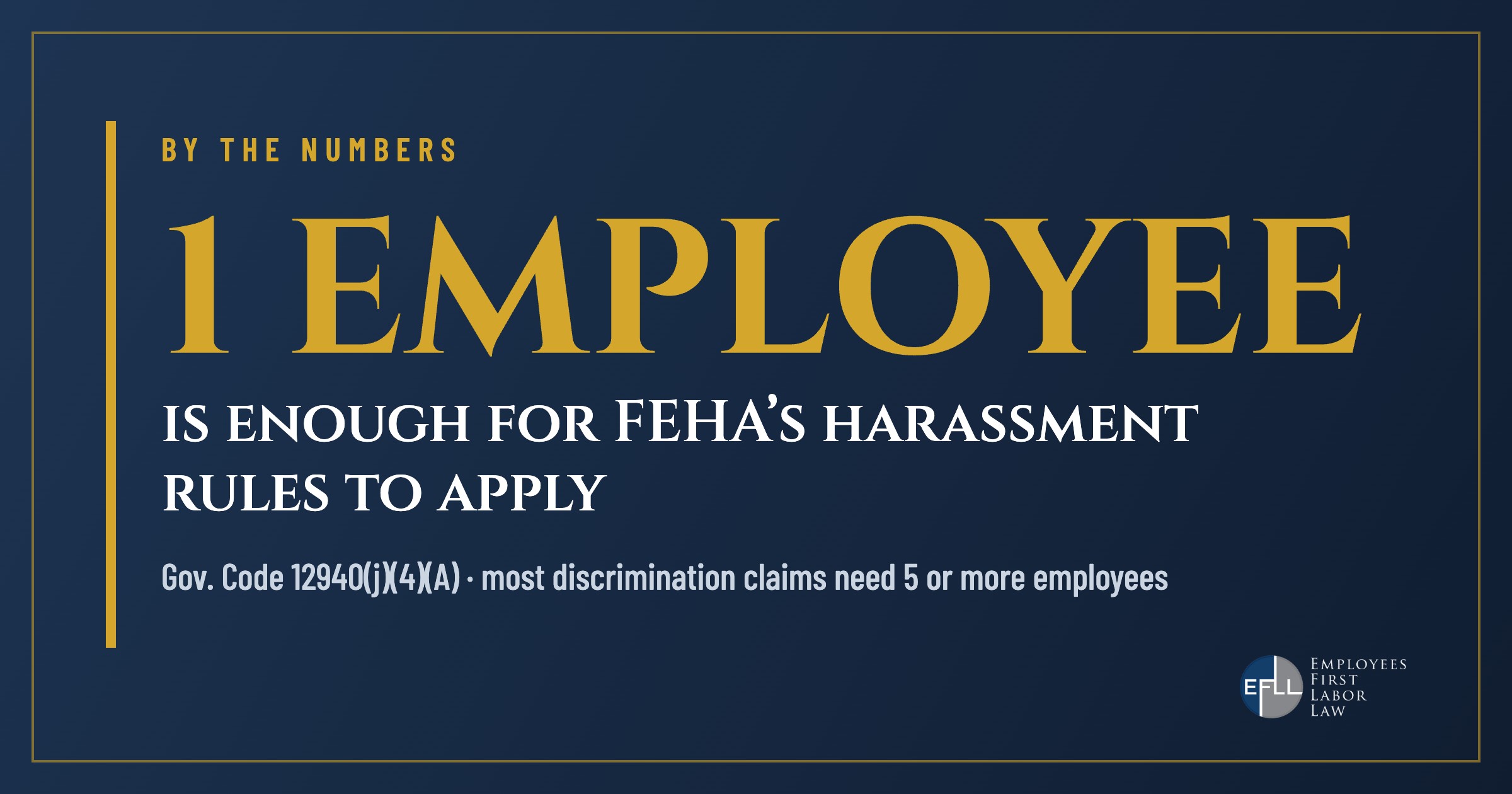
The harassment rules reach almost every workplace. For most FEHA discrimination claims, an “employer” must regularly employ five or more people (Gov. Code 12926(d)). For harassment, an employer is anyone who regularly employs one or more persons or regularly receives the services of one or more contractors (Gov. Code 12940(j)(4)(A)). There are limited exceptions, such as certain religious nonprofits (Gov. Code 12940(j)(4)(B)).
Responsibility at a glance:
| Who harassed you | When the employer is liable | Is the harasser personally liable? | Key law |
|---|---|---|---|
| A supervisor or agent of the employer | Automatically, without proof the company knew | Yes | Gov. Code 12940(j)(1), (j)(3); 2 CCR 11019(b)(3) |
| A coworker (non-supervisor) | If the employer, its agents or supervisors knew or should have known and failed to take immediate and appropriate corrective action | Yes | Gov. Code 12940(j)(1), (j)(3); 2 CCR 11019(b)(4), (b)(6) |
| A customer, client, patient, vendor or other non-employee | Same knew-or-should-have-known test; the employer’s control over the person is considered | FEHA’s personal-liability rule covers employees; other claims may apply | Gov. Code 12940(j)(1) |
| Anyone, when the company had no real prevention plan | A separate claim for failing to prevent harassment can be added if the harassment claim succeeds | Not applicable | Gov. Code 12940(k); 2 CCR 11023(a)(2) |
Harassment by a supervisor: the employer is strictly liable
When the harasser is a supervisor, California holds the employer responsible automatically. Lawyers call this strict liability. The reason is in the structure of the statute: FEHA requires proof that the employer “knows or should have known” and failed to act only when the harasser is “an employee, other than an agent or supervisor” (Gov. Code 12940(j)(1)). The Civil Rights Council’s regulations say the same thing plainly: harassment by an employer, “its agents or supervisors is unlawful,” while the knowledge requirement applies to other employees (Cal. Code Regs., tit. 2, § 11019(b)(3)–(4)).
So you do not have to prove you complained to HR or that management ignored a report before the employer can be liable for a supervisor’s harassment. You also do not have to show that you lost a promotion, pay or your job; FEHA states that loss of tangible job benefits is not necessary to establish harassment (Gov. Code 12940(j)(1)).
Supervisor harassment can create a hostile work environment, or it can tie a job benefit to sexual conduct, such as hinting that a raise depends on a date. The second form is covered in our guide to quid pro quo sexual harassment.
Who counts as a supervisor under California law?
Because supervisor harassment triggers strict liability, employers often argue the harasser was “just a lead.” Titles do not decide the question. FEHA defines a supervisor as anyone with authority, in the interest of the employer, to hire, transfer, suspend, lay off, recall, promote, discharge, assign, reward or discipline other employees, or the responsibility to direct them or adjust their grievances, or to effectively recommend any of those actions, if that authority requires independent judgment and is not merely routine or clerical (Gov. Code 12926(t)).
A few points follow from that definition:
- A person does not need the power to fire you. The responsibility to direct your work, or the ability to effectively recommend discipline, can be enough.
- Titles like “team lead,” “shift lead,” “crew chief” or “assistant manager” can describe a supervisor if the person actually uses independent judgment over other workers.
Write down what the person could actually do: assign shifts, approve time off, write you up, or weigh in on hiring and firing. Save schedules and messages that show their role.
Whether the harasser was a supervisor, a coworker or a customer changes the rules. Tell us what happened in a free, confidential consultation.
Harassment by a coworker: the “knew or should have known” standard
When the harasser is a coworker without supervisory authority, the employer is liable if the employer, its agents or supervisors knew or should have known of the conduct and failed to take immediate and appropriate corrective action (Gov. Code 12940(j)(1)).
Knowledge can be proved by direct or circumstantial evidence (2 CCR 11019(b)(4)), for example a written complaint to HR or harassment that happened openly in front of managers. Under the regulation, if the employer did not know but should have known, knowledge is imputed to the employer unless it can show it took reasonable steps to prevent harassment, such as raising the subject, expressing strong disapproval, developing sanctions, and telling employees how to raise harassment concerns (2 CCR 11019(b)(4)).
The regulations also say a harassed employee should inform the employer, but that failing to give notice is not an affirmative defense (2 CCR 11019(b)(5)). Even so, a clear report is usually the strongest way to prove the company knew. Our step-by-step guide on how to report sexual harassment at work walks through how to do it.
A response that only tells you to “work it out,” moves you instead of the harasser, or lets the conduct continue may not meet that standard.
💡 Example: Elena (a hypothetical worker) works the night shift at a distribution center. Her coworker repeatedly makes sexual comments and sends her explicit messages. She reports it in writing to HR. HR interviews no one and tells her to avoid him, and the messages continue for weeks. Because the harasser is a coworker, Elena must show the company knew or should have known and failed to act quickly and appropriately. Her written report and the continued messages are strong evidence of both. Had the harasser been her shift lead, who assigns her work and writes her up, the company could be strictly liable even without a report.
Harassment by customers, clients and other non-employees
Your employer can also be responsible for harassment by people who do not work for it, such as customers, clients, patients, guests or vendors. FEHA applies the same test: the employer is liable if it, or its agents or supervisors, knew or should have known of the conduct and failed to take immediate and appropriate corrective action (Gov. Code 12940(j)(1)). In these cases, the law considers the extent of the employer’s control over the non-employee and any other legal responsibility the employer has for that person’s conduct.
“The customer is always right” is not a defense. An employer that keeps sending a server back to a table where a guest grabbed her after she reported it may be liable. Our guide to sexual harassment by customers, clients and vendors covers these situations in more detail.
When the harasser is personally liable
FEHA does not only hold companies responsible. An employee who harasses a coworker is personally liable for that harassment, regardless of whether the employer knew or should have known of the conduct or failed to take corrective action (Gov. Code 12940(j)(3); 2 CCR 11019(b)(6)). That applies to supervisors and coworkers alike.
Many harassment lawsuits name both the employer and the individual harasser. Personal liability matters most when the employer argues it acted quickly enough in a coworker case. Whether to name an individual is a strategic decision to make with a lawyer.
FEHA’s personal-liability provision speaks to employees, so a customer or vendor who harasses you may be reached through other legal claims, depending on the facts.
The employer’s separate duty to prevent harassment
California goes further than requiring employers to respond after the fact. FEHA requires every covered entity to “take all reasonable steps to prevent harassment from occurring” (Gov. Code 12940(j)(1)), and it is a separate unlawful practice to fail to take all reasonable steps necessary to prevent discrimination and harassment (Gov. Code 12940(k)).
Under the Civil Rights Council’s regulations, employers must have a written prevention policy that, among other things, covers harassment by coworkers and third parties as well as supervisors, offers a way to complain that does not require going to your immediate supervisor, promises a fair, timely and thorough investigation, and prohibits retaliation (2 CCR 11023(b)). Employers with five or more employees must also provide sexual harassment training, at least two hours for supervisors and one hour for other employees (Gov. Code 12950.1(a)). See our guide to California sexual harassment training requirements.
Two limits are worth knowing. First, a private worker cannot sue only for failure to prevent; you must also plead and prevail on the underlying harassment, discrimination or retaliation claim (2 CCR 11023(a)(2)). Second, completing training does not, by itself, insulate an employer from liability (Gov. Code 12950.1(c)).
Common employer defenses, and why they often fail
- “We didn’t know.” Irrelevant to the employer’s liability when the harasser is a supervisor. In coworker and customer cases, the question is also whether the company should have known.
- “She never used the complaint process.” For coworker harassment, failure to report is not an affirmative defense under 2 CCR 11019(b)(5), although reporting remains the best evidence of notice.
- “It only happened once.” California law says a single incident of harassing conduct can be enough to create a triable issue of a hostile work environment if it unreasonably interfered with your work or created an intimidating, hostile or offensive environment (Gov. Code 12923(b)).
- “That’s just how this industry is.” The Legislature has declared that the legal standard for sexual harassment should not vary by type of workplace (Gov. Code 12923(d)).
- “He was just a lead.” Supervisor status turns on actual authority under Gov. Code 12926(t), not on a title.
Retaliation is a separate violation. It is unlawful to discharge or otherwise discriminate against someone because they opposed harassment or filed a complaint (Gov. Code 12940(h)). If you were punished after reporting, see our guide to retaliation claims in California.
Deadlines and what to do next
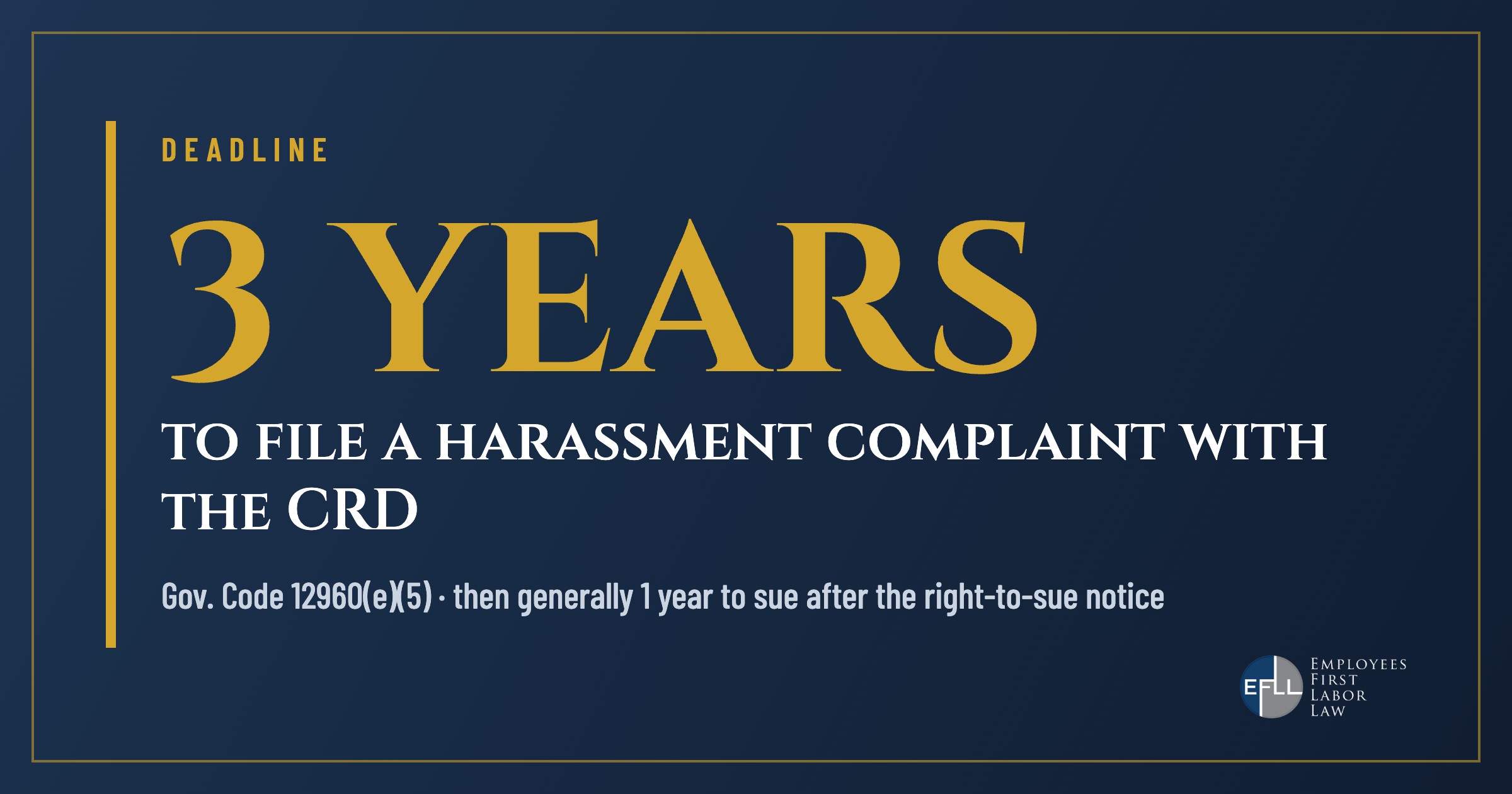
A FEHA harassment claim starts with a complaint to the California Civil Rights Department (CRD). You generally have three years from the date of the unlawful practice to file with the CRD (Gov. Code 12960(e)(5)). After the CRD issues a right-to-sue notice, you generally have one year from the date of that notice to file a lawsuit (Gov. Code 12965(c)(1)(D)). A court may award the prevailing party reasonable attorney’s fees and costs, including expert witness fees, but a prevailing employer can recover them only if the case was frivolous, unreasonable or groundless (Gov. Code 12965(c)(6)). Other deadlines can apply, so get advice early.
- Write it down. Keep a dated log of each incident and who saw it.
- Save the evidence. Keep texts, emails, chat messages and voicemails, and store copies somewhere your employer does not control.
- Identify the harasser’s role. Note what authority they had over you. It may decide whether the employer is strictly liable.
- Report in writing. Follow the company policy if there is one, and keep a copy. If the harasser is your supervisor, the policy should give you another person to go to.
- Watch for retaliation. Track any schedule cuts, write-ups or changes in treatment after you report.
- Talk to an employment lawyer before the deadlines run. A lawyer can evaluate who is liable and how to file with the CRD. Our sexual harassment attorneys offer a free consultation.
Frequently asked questions
Is my employer liable for sexual harassment by my supervisor if I never reported it?
Generally, yes. Under Gov. Code 12940(j)(1), the “knew or should have known” requirement applies only to harassment by non-supervisory employees, so liability for supervisor harassment does not depend on a report. Reporting is still wise because it creates evidence.
Can I sue the person who harassed me personally?
Yes, if the harasser is an employee of the covered employer. FEHA makes an employee who harasses another worker personally liable, whether or not the employer knew about it (Gov. Code 12940(j)(3)). Many cases name both the company and the individual.
Is my employer responsible if a customer sexually harassed me?
It can be. The employer is liable for non-employee harassment if it knew or should have known and failed to take immediate and appropriate corrective action, taking into account how much control it had over the customer (Gov. Code 12940(j)(1)).
What if my employer investigated but the harassment kept happening?
An investigation alone is not enough. In coworker and customer cases, the question is whether the employer took immediate and appropriate corrective action. Harassment that continues after a report is important evidence, so keep documenting and report each repeat incident in writing.
How long do I have to file a sexual harassment claim?
Generally three years from the harassment to file a CRD complaint (Gov. Code 12960(e)(5)), then one year from the right-to-sue notice to file in court (Gov. Code 12965(c)(1)(D)). Special situations can change the timeline, so check your dates with a lawyer.
Related guides
 Workers only. Never employers.
At Employees First Labor Law, we represent California workers only, never employers. Our team has recovered more than $200 million for our clients, and we prepare every case as if it is going to trial. We have offices in Pasadena, Irvine, Long Beach, Pomona, Riverside, Bakersfield and Fresno, and we serve workers throughout California. Meet our team.





We represent California workers harassed by supervisors, coworkers and customers. We can help you identify everyone who is responsible, file with the CRD on time, and pursue your claim.
- ✅ Free, confidential consultation
- ✅ We represent workers only, never employers
- ✅ Se habla español: Empleados Primero
This article provides general information about California law and is not legal advice for any specific situation. Reading it does not create an attorney-client relationship. Past results do not guarantee a similar outcome.