
Updated October 2026 · 10 min read
In a California sexual harassment case, you can generally recover your lost wages and benefits, money for emotional distress, out-of-pocket costs, and, when the conduct was especially bad, punitive damages, plus your attorney’s fees and costs. These remedies come from the Fair Employment and Housing Act (FEHA), and California law does not put a fixed dollar cap on them the way federal law caps emotional distress and punitive damages.
That still doesn’t tell you what your case is worth. Two people harassed by the same manager can have claims of very different value, depending on what they lost, how it affected them, what the employer did and what can be proved. Anyone who quotes you an “average settlement” without those facts is guessing.
This guide explains each type of sexual harassment damages California law allows, who can be made to pay, what pushes a case’s value up or down, the deadlines that protect your claim, and the steps you can take now. For a broader look at remedies in all kinds of employment cases, see our guide to employment law damages in California.
- Under FEHA you can generally recover back pay, front pay, emotional distress damages and out-of-pocket costs, and in serious cases punitive damages.
- Punitive damages require clear and convincing evidence of malice, oppression or fraud (Civ. Code § 3294) and are not available against public entities (Gov. Code § 818).
- If you win, the employer can be ordered to pay your attorney’s fees and costs; a winning employer generally can’t recover its fees from you unless the case was frivolous, unreasonable or groundless (Gov. Code § 12965(c)(6)).
- The harasser can be personally liable (Gov. Code § 12940(j)(3)), and the employer can be liable for supervisors and, when it failed to act, for coworkers and customers.
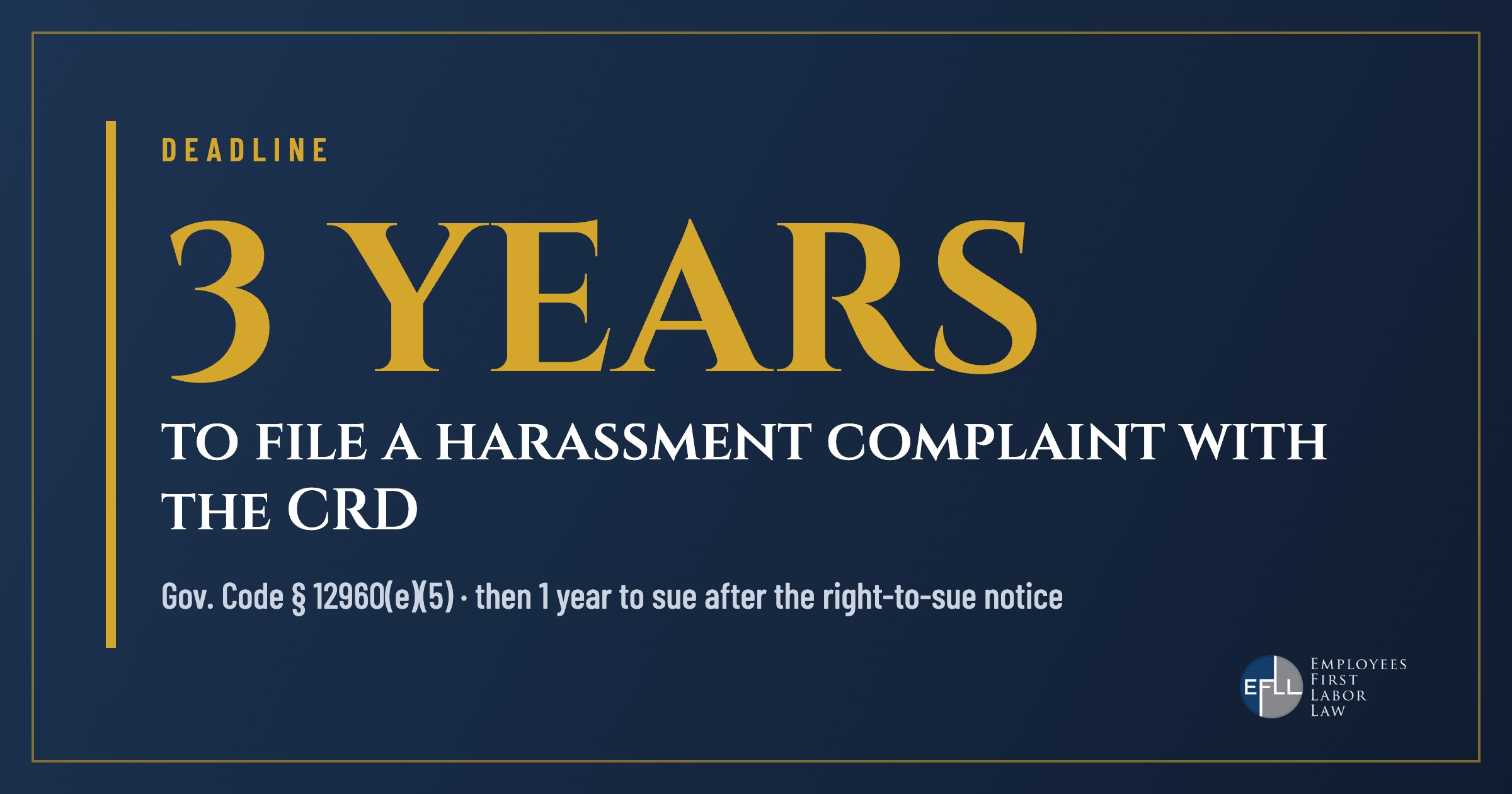
- Deadlines: generally 3 years to file with the CRD, then 1 year from the right-to-sue notice to file a lawsuit.
What damages can you recover in a California sexual harassment case?
FEHA makes it unlawful for an employer, or “any other person,” to harass an employee, applicant, unpaid intern, volunteer or contractor because of sex, gender, gender identity, gender expression or sexual orientation (Gov. Code § 12940(j)(1)).
The California Civil Rights Department (CRD) lists the remedies state law provides for employment discrimination, including back pay, front pay, hiring or reinstatement, promotion, out-of-pocket expenses, policy changes, training, damages for emotional distress, punitive damages, and attorney’s fees and costs.
| Type of damages | What it covers | Key law |
|---|---|---|
| Back pay | Wages and benefits you lost from the harassment up to trial | FEHA; CRD remedies list |
| Front pay | Future lost earnings when returning to the job isn’t realistic | FEHA; CRD remedies list |
| Emotional distress | Anxiety, humiliation, sleeplessness, fear, loss of enjoyment of life | Civ. Code § 3333; CRD remedies list |
| Out-of-pocket costs | Therapy, medical bills, job-search costs and similar expenses | Civ. Code § 3333; CRD remedies list |
| Punitive damages | Punishment for malice, oppression or fraud, proved by clear and convincing evidence | Civ. Code § 3294 |
| Attorney’s fees and costs | Your lawyer’s reasonable fees, costs and expert witness fees if you win | Gov. Code § 12965(c)(6) |
Lost wages: back pay and front pay
Economic damages are the part of a case you can usually put on a spreadsheet. For harassment claims, they often come from one of three situations:
- You were fired or demoted after rejecting advances or reporting harassment. Punishing someone for reporting is also retaliation under Gov. Code § 12940(h).
- You quit because the harassment made work intolerable. If a reasonable person in your position would have felt forced to resign, the law may treat it like a firing. Our guide to constructive discharge explains how that works.
- You lost hours, shifts, a promotion or a raise because of the harassment, or took unpaid time off to cope with it.
Back pay covers what you would have earned from the time of the loss until trial or settlement, including benefits such as health insurance, retirement contributions and bonuses you would likely have received. Front pay covers future lost earnings when going back to that job isn’t realistic, for example because the harasser still runs the department.
Expect the employer to argue that your lost wages should be reduced by what you earned, or could reasonably have earned, at another job. Keeping a record of every application, interview and offer helps answer that argument.
💡 Example: Maria (hypothetical) earned $5,000 a month as an office coordinator. After she reported her supervisor’s repeated sexual comments, she was let go. She was out of work for 6 months, then found a job paying $4,200 a month. Twelve months later, her case resolves. Her wage loss through that date is 6 × $5,000 = $30,000 while unemployed, plus 12 × $800 = $9,600 in reduced pay at the new job, for a total of $39,600 in back pay, before benefits, emotional distress or any other damages. This is an illustration of the math only, not a prediction of any case’s value.
Emotional distress damages
For many people, the heaviest harm from sexual harassment isn’t financial. It’s the dread before every shift, the lost sleep and the strain on your relationships. California law measures tort damages as the amount that will compensate for “all the detriment proximately caused” by the wrongful conduct (Civ. Code § 3333), and the CRD lists emotional distress damages among FEHA remedies.
There is no formula for emotional distress. A jury decides what is fair based on the evidence, which can include:
- Your own description of how the harassment affected you, day to day.
- Testimony from a spouse, family members, friends or coworkers who saw the change in you.
- Records from a therapist, counselor or doctor, if you sought treatment.
- Messages, journal entries or notes written at the time.
- How long the harassment lasted and how severe it was, including any physical contact or threats.
Treatment records aren’t the only way to show emotional harm, but they often make it easier for a jury to understand. Getting help is about your health first. It can also document what you’ve been through.
Every case is different. Tell us what happened in a free, confidential consultation and we will explain the damages that may apply to you.
Punitive damages: when the conduct was especially bad
Punitive damages are not meant to compensate you. They punish a defendant and send a message. Under Civil Code § 3294(a), you can recover them only by proving, by clear and convincing evidence, that the defendant was guilty of oppression, fraud or malice. That is a higher bar than the “more likely than not” standard that applies to the rest of the case.
- Malice means conduct intended to cause injury, or despicable conduct carried on with a willful and conscious disregard of the rights or safety of others (Civ. Code § 3294(c)(1)).
- Oppression means despicable conduct that subjects a person to cruel and unjust hardship in conscious disregard of that person’s rights (Civ. Code § 3294(c)(2)).
Getting punitive damages against a company takes more. The employer must have had advance knowledge that the employee was unfit and kept them on with conscious disregard of others’ rights, or authorized or ratified the conduct, or been personally guilty of oppression, fraud or malice. For a corporation, that knowledge, ratification or conduct must come from an officer, director or managing agent (Civ. Code § 3294(b)). In practice, this is why it matters whether leadership knew about the harassment and protected the harasser.
Punitive damages are not available against public entities such as cities, counties or state agencies (Gov. Code § 818).
Attorney’s fees and costs
FEHA lets the court award the prevailing party “reasonable attorney’s fees and costs, including expert witness fees” (Gov. Code § 12965(c)(6)). If you win, the employer can be ordered to pay your lawyer’s fees on top of your damages. This fee-shifting rule exists so that workers can bring civil rights cases even when they can’t pay a lawyer by the hour.
The rule is not symmetrical. A prevailing defendant can’t be awarded fees and costs unless the court finds the case was frivolous, unreasonable or groundless when brought, or the worker kept litigating after it clearly became so. That protection applies even if you rejected a settlement offer under Code of Civil Procedure § 998 (Gov. Code § 12965(c)(6)).
Many cases settle before trial, and how fees are handled then is part of the negotiation. Ask any lawyer you meet to explain their fee agreement in writing.
Who can be held responsible for paying
Who pays depends on who harassed you and what the employer knew. (We cover this in depth in our guide to employer liability for sexual harassment.)
- Harassment by a supervisor: The employer is generally responsible. The knew-or-should-have-known requirement in Gov. Code § 12940(j)(1) applies to harassment by employees “other than an agent or supervisor.”
- Harassment by a coworker: The employer is liable if it, or its agents or supervisors, knew or should have known and failed to take immediate and appropriate corrective action (Gov. Code § 12940(j)(1)).
- Harassment by customers, clients or other non-employees: The employer may be responsible under the same knew-or-should-have-known standard. The court also considers how much control the employer had over the non-employees (Gov. Code § 12940(j)(1)).
- The harasser personally: An employee who harasses is personally liable, whether or not the employer knew (Gov. Code § 12940(j)(3)).
Employers must also take all reasonable steps to prevent harassment (Gov. Code § 12940(j)(1), (k)). For harassment claims, FEHA covers an employer that regularly employs even one person (Gov. Code § 12940(j)(4)(A)).
Is there a cap on sexual harassment damages in California?
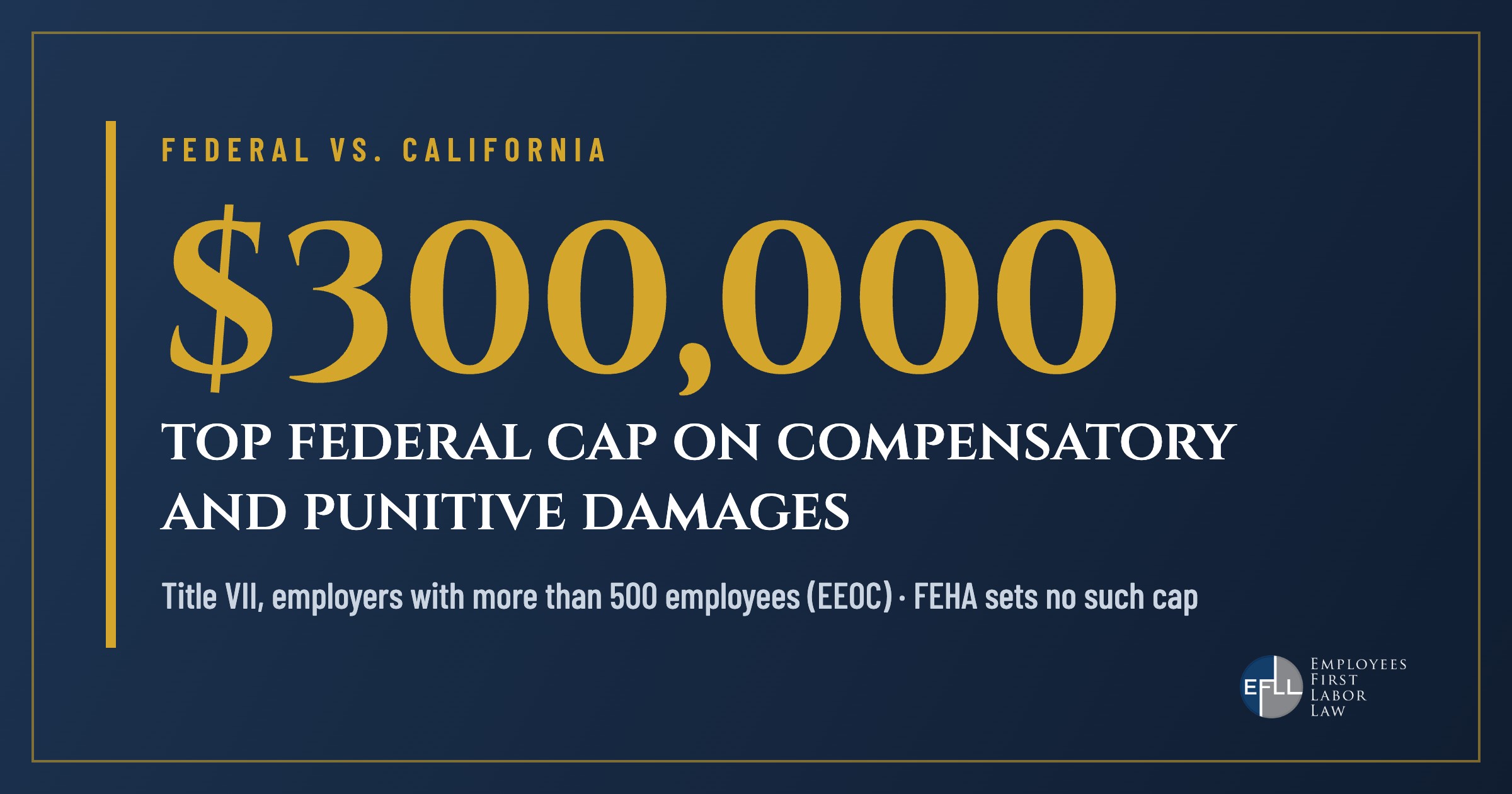
Federal law caps some of them. Under Title VII, the combined compensatory and punitive damages a person can recover (back pay is not included in the cap) are limited by employer size, according to the U.S. Equal Employment Opportunity Commission (EEOC):
- 15–100 employees: $50,000
- 101–200 employees: $100,000
- 201–500 employees: $200,000
- More than 500 employees: $300,000
FEHA’s remedy provisions don’t contain caps like these, which is one reason many California workers file harassment claims under state law with the CRD. That doesn’t make every case large. It means a judge or jury sets the amount from the evidence, not a statutory ceiling.
Some limits still apply. Punitive damages require proof that meets Civil Code § 3294, public employers can’t be ordered to pay them (Gov. Code § 818), and after a jury trial a judge who finds damages excessive can order a new trial unless the winning side accepts a reduced amount (Code Civ. Proc. § 662.5(a)(2)).
What makes a sexual harassment case worth more (or less)
Every case turns on its own facts, but these factors tend to drive value:
- Severity and duration. Physical contact, threats, or conduct that went on for months usually weighs more than a single remark. California law does say a single incident can be enough to create a triable hostile-work-environment claim if it unreasonably interfered with your work or created an intimidating, hostile or offensive environment (Gov. Code § 12923(b)).
- Who did it. Harassment by a supervisor or executive carries different liability rules, and a more direct route to the employer, than harassment by a coworker.
- The employer’s response. An employer that ignored complaints or punished the person who reported looks very different to a jury from one that investigated promptly and fixed the problem.
- Economic loss. A firing, demotion or forced resignation adds back pay and possibly front pay.
- Evidence. Texts, emails, witnesses, HR complaints and notes made at the time make the facts harder to deny.
- Impact on your life. Treatment and testimony from people close to you help show the real harm.
Settlement terms matter too. California restricts settlement clauses that prevent disclosure of factual information about sexual harassment claims filed in court or with an agency (Code Civ. Proc. § 1001). Read our guide to sexual harassment NDAs and settlements before you sign anything.
Deadlines and steps to protect your claim
Damages mean nothing if a deadline passes. You generally must file a complaint with the CRD within three years of the harassment (Gov. Code § 12960(e)(5)). After the CRD issues a right-to-sue notice, you have one year from the date of that notice to file a lawsuit (Gov. Code § 12965(c)(1)(D)). Exceptions and tolling rules can change these dates. Our guide to the sexual harassment statute of limitations walks through them.
- Write it down now. Note dates, places, what was said or done, and who saw it.
- Save the evidence. Screenshot texts and messages with the dates visible, and keep copies of emails, schedules and pay records. Don’t delete anything.
- Report it in writing if it’s safe to do so, using your employer’s complaint procedure, and keep a copy.
- Track your losses. Keep pay stubs, therapy and medical bills, and every job application if you’ve lost your job.
- Take care of your health. See a doctor or counselor if you’re struggling. Your well-being comes first.
- Talk to a lawyer before you sign a severance agreement, release or settlement, and before your deadlines get close.
Frequently asked questions
How much is the average sexual harassment settlement in California?
There is no reliable “average” that can tell you what your case is worth. Results depend on the severity of the conduct, your economic losses, the emotional harm, the employer’s response and the strength of the evidence. A lawyer who reviews your facts can give you a much more useful assessment than any average figure.
Can I recover sexual harassment damages in California if I wasn’t fired?
Yes. If the harassment created a hostile work environment, you may recover emotional distress damages and other losses even if you still work there. Lost wages come in if you were fired, demoted, lost hours or were forced to quit.
Can I sue the harasser personally?
Yes. Under Gov. Code § 12940(j)(3), an employee who commits harassment is personally liable for it, regardless of whether the employer knew. In many cases, both the employer and the individual are named.
Do I have to pay the employer’s lawyers if I lose?
Generally, no. Under Gov. Code § 12965(c)(6), a winning employer can be awarded fees and costs only if the court finds the case was frivolous, unreasonable or groundless when brought, or that the worker kept litigating after it clearly became so.
Can I get punitive damages against a government employer?
No. Government Code § 818 bars punitive damages against public entities. You may still recover lost wages, emotional distress damages and attorney’s fees from a public employer, and the individual harasser can still be held personally liable.
Are sexual harassment settlements taxable?
Some parts may be, depending on how the payment is allocated. Talk with a tax professional before you finalize a settlement.
Related guides
 Workers only. Never employers.
At Employees First Labor Law, we represent California workers only, never employers. Our team has recovered more than $200 million for our clients, and we prepare every case as if it is going to trial. We have offices in Pasadena, Irvine, Long Beach, Pomona, Riverside, Bakersfield and Fresno, and we serve workers throughout California. Meet our team.







If you were sexually harassed at work in California, we can help you document your losses, meet your deadlines and pursue the full damages the law allows, including lost wages, emotional distress and attorney’s fees. Consultations are free and confidential.
- ✅ Free, confidential consultation
- ✅ We represent workers only, never employers
- ✅ Se habla español: Empleados Primero
This article provides general information about California law and is not legal advice for any specific situation. Reading it does not create an attorney-client relationship. Past results do not guarantee a similar outcome.