
Updated October 2026 · 10 min read
Quid pro quo sexual harassment happens when someone with power over your job conditions a hire, promotion, raise, better shifts or keeping your job on your going along with sexual advances or other conduct based on sex. “Quid pro quo” is Latin for “this for that.” In California, it is a form of sexual harassment that the Fair Employment and Housing Act (FEHA) makes unlawful under Government Code section 12940(j), and when the harasser is your supervisor, your employer is responsible for it even if nobody in HR knew.
The stakes are real. A supervisor who says “be nice to me and the promotion is yours” is putting your income and career on the line, and the pressure often continues after you say no: cut hours, a sudden bad review or a termination. You generally have three years from the last act to file a complaint with the California Civil Rights Department (CRD), so acting early protects your options.
This guide explains what quid pro quo sexual harassment in California looks like, who is protected, why employers are strictly liable for supervisors, what evidence helps, what you can recover, the deadlines, and the steps to take now.
- Quid pro quo (“this for that”) harassment is the explicit or implicit conditioning of a job, promotion or other work benefit on submission to sexual advances or other conduct based on sex (2 CCR § 11034(f)(1)).
- When the harasser is a supervisor or agent, California regulations make the employer strictly liable, even if it did not know (2 CCR § 11034(f)(2)(C)).
- The harasser can be personally liable, and you do not have to lose a tangible job benefit to have a claim (Gov. Code § 12940(j)(1), (j)(3)).
- Retaliation for rejecting advances or reporting harassment is also unlawful (Gov. Code § 12940(h)).
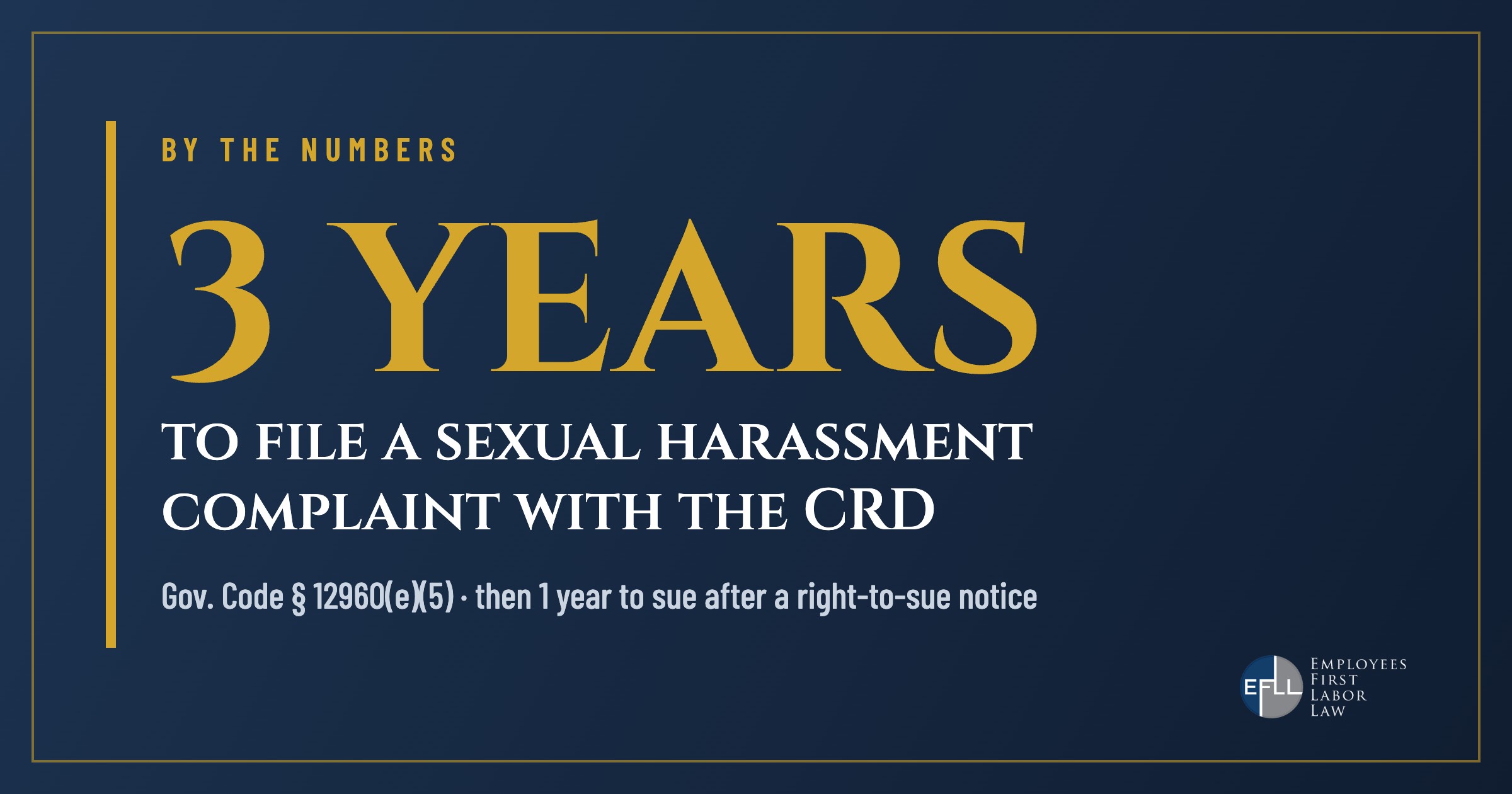
- You generally have 3 years to file with the CRD, then 1 year after a right-to-sue notice to file in court (Gov. Code §§ 12960(e)(5), 12965(c)(1)(D)).
What is quid pro quo sexual harassment in California?
California’s civil rights regulations define it directly. Quid pro quo sexual harassment is “characterized by explicit or implicit conditioning of a job or promotion on an applicant or employee’s submission to sexual advances or other conduct based on sex” (Cal. Code Regs., tit. 2, § 11034(f)(1)). The regulations also list “sexual favors” as a form of harassment, meaning unwanted sexual advances “which condition an employment benefit upon an exchange of sexual favors” (§ 11019(b)(2)(D)).
A few points in that definition matter a lot:
- The condition can be implicit. Your boss does not have to say “sleep with me or you’re fired.” Hints, “favors,” and remarks that tie your schedule or review to how “friendly” you are can count.
- It covers job benefits of every kind: hiring, promotions, raises, assignments, shifts, overtime, references and keeping your job.
- It is not about attraction. FEHA says sexually harassing conduct “need not be motivated by sexual desire” (Gov. Code § 12940(j)(4)(C)). It can happen between people of any gender, including the same gender.
- You do not have to lose something first. The statute states that loss of tangible job benefits is not necessary to establish harassment (§ 12940(j)(1)).
Quid pro quo is one of the two recognized types of sexual harassment. The other is a hostile work environment, where unwelcome sex-based comments or conduct are severe or pervasive enough to change your working conditions. The two often overlap: a supervisor who makes demands usually also makes the workplace hostile.
Common examples of quid pro quo harassment
Every situation is different, but these patterns come up again and again:
- A manager suggests a promotion or raise will go to you if you go on a date, come to their hotel room or “spend time” together outside work.
- A supervisor hints that your hours, shifts or sales territory depend on accepting their advances.
- A hiring manager tells an applicant the job is theirs if they agree to a personal relationship.
- A boss implies that a pending write-up or a layoff decision will “go away” in exchange for sexual favors.
- After you say no, the same person suddenly cuts your schedule, gives you a poor review, moves you to worse assignments or recommends your termination.
- A supervisor who controls overtime or tips reminds you, after a rejected advance, that they “decide who gets taken care of.”
The California Civil Rights Department’s sexual harassment fact sheet lists “offering employment benefits in exchange for sexual favors” among the behaviors that may be sexual harassment, and states that actual or threatened retaliation for rejecting advances is also unlawful.
💡 Example: Maria is a server at a restaurant. Her assistant manager, who writes the schedule, tells her she can have the weekend dinner shifts if she goes out with him. She says no. The next schedule moves her to three weekday lunch shifts instead. If she was averaging $120 more in tips on each weekend dinner shift, she is losing about 3 × $120 = $360 a week, or $3,600 over ten weeks. Because the assistant manager has authority to assign shifts, the restaurant can be held responsible for his conduct, and the schedule change after her refusal also supports a retaliation claim. (Hypothetical, for illustration only.)
Who is protected, and who can be the harasser
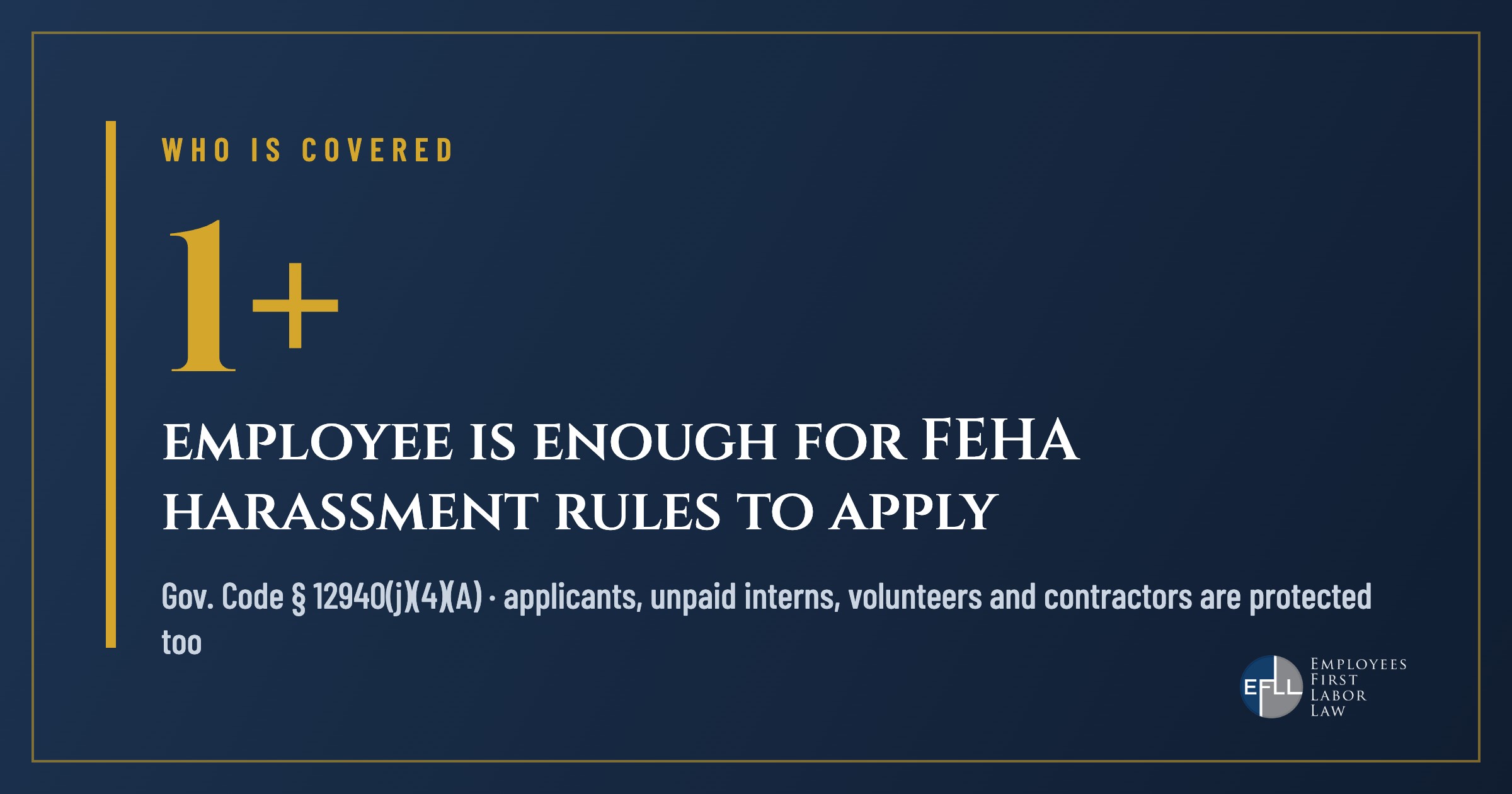
FEHA’s harassment rules are broad. They protect employees, job applicants, unpaid interns and volunteers, and people providing services under a contract (Gov. Code § 12940(j)(1)). And unlike most of FEHA, which applies to employers with five or more employees, the harassment provisions apply to any employer that regularly employs one or more people or regularly receives services from one or more contractors (§ 12940(j)(4)(A)). There is a limited exception for religious nonprofit associations and corporations (§ 12940(j)(4)(B)).
Quid pro quo harassment is usually committed by someone with power to grant or withhold job benefits. Under Government Code section 12926(t), a “supervisor” is anyone with authority, in the interest of the employer, to hire, transfer, suspend, lay off, recall, promote, discharge, assign, reward or discipline other employees, or to direct them or adjust their grievances, or to effectively recommend any of those actions, when that authority requires independent judgment. That means a shift lead who writes the schedule or a team lead whose recommendation decides promotions can qualify, even without a “manager” title.
Outside traditional employment, California Civil Code section 51.9 separately allows a lawsuit for sexual harassment in certain business, service or professional relationships, such as with a director or producer, a teacher, a landlord or property manager, or someone who holds themselves out as able to help you establish a business or professional relationship.
If a supervisor offered something in exchange for sexual conduct, or punished you for saying no, talk to our team in a free, confidential consultation.
Employer liability: why a supervisor’s demand makes the company responsible
This is where quid pro quo claims differ from many other workplace complaints. FEHA makes harassment by a coworker unlawful only if the employer knew or should have known and failed to take immediate and appropriate corrective action, and it limits that rule to harassers “other than an agent or supervisor” (Gov. Code § 12940(j)(1)). California’s regulations spell out the result: an employer “is strictly liable for the harassing conduct of its agents or supervisors, regardless of whether the employer … knew or should have known of the harassment” (Cal. Code Regs., tit. 2, § 11034(f)(2)(C)). Our guide on who is liable for sexual harassment explains the different standards in more detail.
| Who harassed you | Is the employer liable? | Is the harasser personally liable? | Source |
|---|---|---|---|
| Supervisor or agent | Yes, strictly liable | Yes | Gov. Code § 12940(j)(1), (j)(3); 2 CCR § 11034(f)(2)(C) |
| Coworker (non-supervisor) | If it knew or should have known and failed to take immediate and appropriate corrective action | Yes | Gov. Code § 12940(j)(1), (j)(3) |
| Customer, client or other non-employee | If it knew or should have known and failed to take immediate and appropriate corrective action | Not under § 12940(j)(3), which covers employees | Gov. Code § 12940(j)(1) |
| Any harasser, when the employer did not take reasonable steps to prevent harassment | Can also be liable for failure to prevent | N/A | Gov. Code § 12940(k) |
The individual supervisor can also be sued personally. FEHA says an employee who harasses is “personally liable” for that harassment, whether or not the employer knew about it (Gov. Code § 12940(j)(3)).
Evidence that helps prove quid pro quo harassment
Quid pro quo demands are often made in private, so the case is usually built from a combination of records and timing. Useful evidence includes:
- Messages. Texts, direct messages, emails and voicemails in which the person hints at or makes the offer or threat. Take screenshots that show the date, time and sender, and keep the originals.
- A written timeline. Write down what was said, when, where and who was nearby, as soon as you can after each incident. Notes made close in time carry weight.
- Your job record before and after. Schedules, pay stubs, tip reports, performance reviews and commendations. A strong record that suddenly changes after you said no is powerful evidence.
- Witnesses. Coworkers who saw the behavior, heard comments, or were told about it at the time.
- Complaints you made. Copies of any report to HR or management, and their response.
Be careful about recording. California Penal Code section 632 generally makes it a crime to record a confidential conversation without the consent of all parties. Talk to a lawyer before recording anyone, and do not take confidential company documents you are not authorized to have.
Retaliation for saying no or reporting
Many quid pro quo cases become retaliation cases too. FEHA makes it unlawful to discharge, expel or otherwise discriminate against any person because they opposed practices FEHA forbids or filed a complaint, testified or assisted in a proceeding (Gov. Code § 12940(h)). The CRD’s fact sheet states plainly that actual or threatened retaliation for rejecting advances or complaining about harassment is unlawful.
Watch for changes that follow your refusal or your complaint: reduced hours, demotion, worse assignments, being shut out of meetings, sudden discipline, or termination. Each one should go on your timeline with the date. If you were pushed out or fired, read our guide to retaliation claims in California.
What you can recover in a quid pro quo case
The CRD’s sexual harassment fact sheet lists civil remedies that include damages for emotional distress from each employer or person who violated the law, hiring or reinstatement, back pay or promotion, and changes in the employer’s policies or practices. Lost wages from cut hours, a lost promotion or a termination are often a central part of the claim, along with the emotional harm harassment causes. In some cases punitive damages may also be available.
In a FEHA lawsuit, the court may award the prevailing party reasonable attorney’s fees and costs, including expert witness fees. A prevailing employer generally cannot recover its fees unless the court finds the case was frivolous, unreasonable or groundless when brought, or the worker kept litigating after it clearly became so (Gov. Code § 12965(c)(6)). Every case is different; our guide to sexual harassment damages explains what affects the value of a claim.
Deadlines to file a quid pro quo sexual harassment claim
Before you can sue under FEHA, you must file with the CRD. Under Government Code section 12960(e)(5), a complaint alleging a FEHA employment violation must be filed within three years from the date the unlawful practice occurred, with limited extensions in section 12960(e)(6). The CRD’s complaint page explains that in employment cases you can skip its investigation, but you must obtain an immediate right-to-sue notice before filing your own lawsuit.
Once the CRD issues a right-to-sue notice, you generally have one year from the date of that notice to file a civil lawsuit (Gov. Code § 12965(c)(1)(D)). Some rules can pause or change these periods, so confirm your dates with a lawyer. For a full breakdown, see our guide to the sexual harassment statute of limitations.
What to do if you are facing quid pro quo harassment
- Write it down today. Record the date, place, exact words, and anyone nearby. Keep updating your notes.
- Save every message. Screenshot texts, chats and emails with dates visible, and back them up somewhere the company does not control.
- Report it in writing if you can. Follow your employer’s harassment policy and send your complaint by email so there is a dated record. Our step-by-step guide on how to report sexual harassment at work walks through this.
- Keep copies of your job records. Save schedules, pay stubs and reviews you already have access to, so you can show what changed.
- Track any retaliation. Note every change to your hours, duties, pay or treatment after you said no or reported.
- Do not sign anything in a hurry. If you are offered a severance or settlement agreement, have a lawyer review it before you sign.
- Talk to an employment lawyer early. A lawyer can assess whether the harasser counts as a supervisor, protect your deadlines and handle the CRD filing.
Frequently asked questions
Is it still quid pro quo sexual harassment in California if I gave in?
It can be. The regulatory definition focuses on conditioning a job or promotion on your “submission” to sexual advances or other conduct based on sex (2 CCR § 11034(f)(1)). Going along with a demand because you feared for your job does not make it legal. A lawyer can review the specific facts with you confidentially.
Does it count if my boss only hinted and never followed through?
Possibly yes. The definition covers “explicit or implicit” conditioning, and FEHA states that loss of tangible job benefits is not necessary to establish harassment (Gov. Code § 12940(j)(1)). A threat or offer can be unlawful even if your boss never acted on it.
Can I sue my supervisor personally?
Yes. Under Government Code section 12940(j)(3), an employee who commits harassment is personally liable for it, regardless of whether the employer knew. Claims are often brought against both the employer and the individual.
My company is very small. Am I still protected?
Yes. For harassment claims, FEHA defines “employer” as one that regularly employs one or more persons or regularly receives services from one or more contractors (Gov. Code § 12940(j)(4)(A)), with a limited exception for religious nonprofit organizations.
How long do I have to file?
Generally three years from the last unlawful act to file with the CRD (Gov. Code § 12960(e)(5)), then one year from the date of the right-to-sue notice to file in court (§ 12965(c)(1)(D)). Do not wait until the deadline is close; evidence and witnesses are easier to secure early.
Related guides
 Workers only. Never employers.
At Employees First Labor Law, we represent California workers only, never employers. Our team has recovered more than $200 million for our clients, and we prepare every case as if it is going to trial. We have offices in Pasadena, Irvine, Long Beach, Pomona, Riverside, Bakersfield and Fresno, and we serve workers throughout California. Meet our team.





We represent California workers facing quid pro quo harassment and retaliation, including claims against employers and the individual harassers. We can review your timeline, protect your CRD deadline and explain what you may be able to recover.
- ✅ Free, confidential consultation
- ✅ We represent workers only, never employers
- ✅ Se habla español: Empleados Primero
This article provides general information about California law and is not legal advice for any specific situation. Reading it does not create an attorney-client relationship. Past results do not guarantee a similar outcome.