
Updated October 2026 · 10 min read
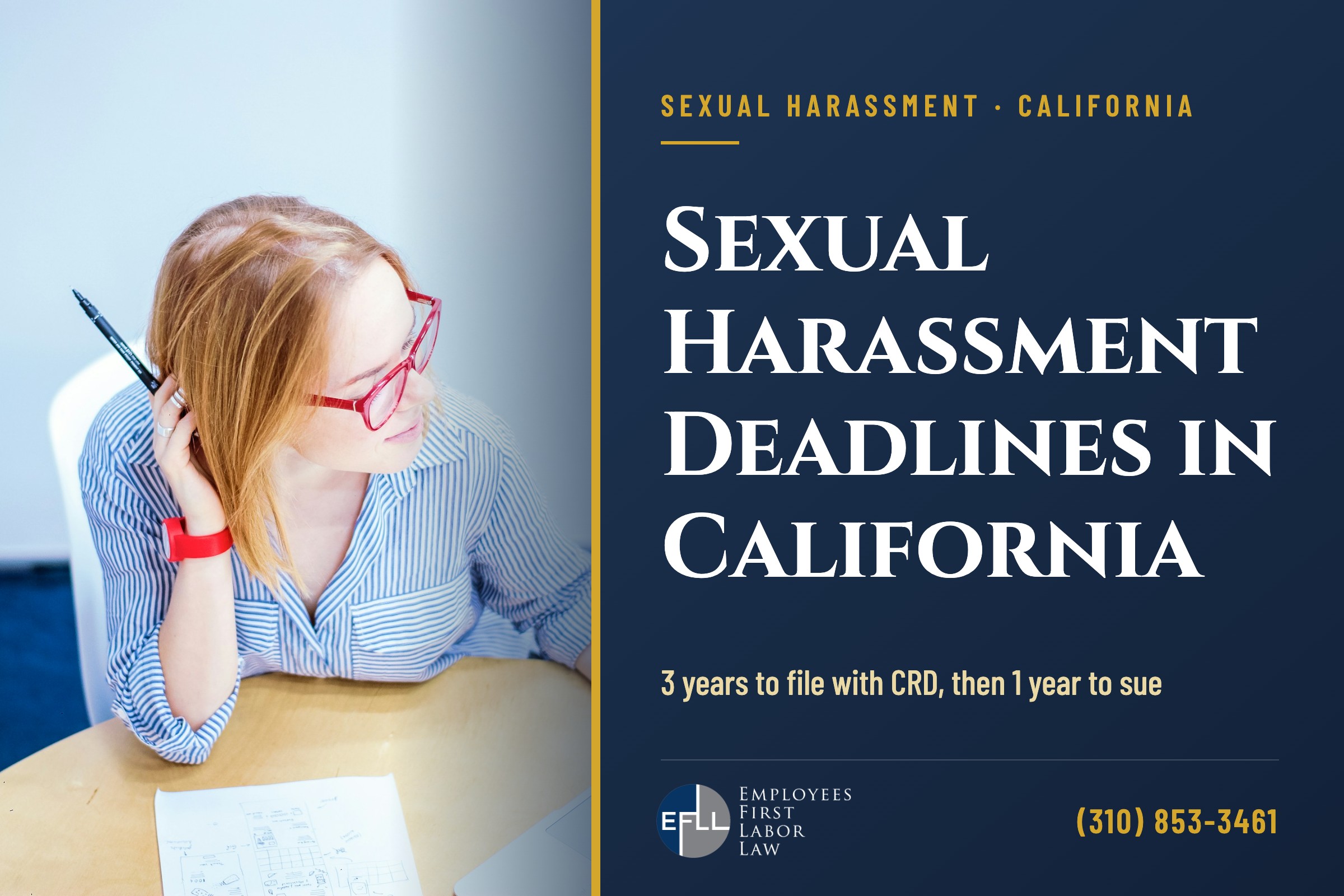
In California, you generally have three years from the last act of sexual harassment to file a complaint with the Civil Rights Department (CRD), and then one year from the date CRD issues your right-to-sue notice to file a lawsuit in court. Those two deadlines come from the Fair Employment and Housing Act (FEHA), Government Code sections 12960 and 12965, and they apply to most sexual harassment claims against an employer, a supervisor or a coworker.
Missing either deadline can end a strong case. A worker who waits three years and one day after the last incident, or lets thirteen months pass after a right-to-sue notice, can lose the right to recover lost wages and emotional distress damages, no matter how clear the evidence is.
This guide explains the sexual harassment statute of limitations in California: when the clock starts, what can extend it, the special rules for sexual assault, and how to protect your deadline.
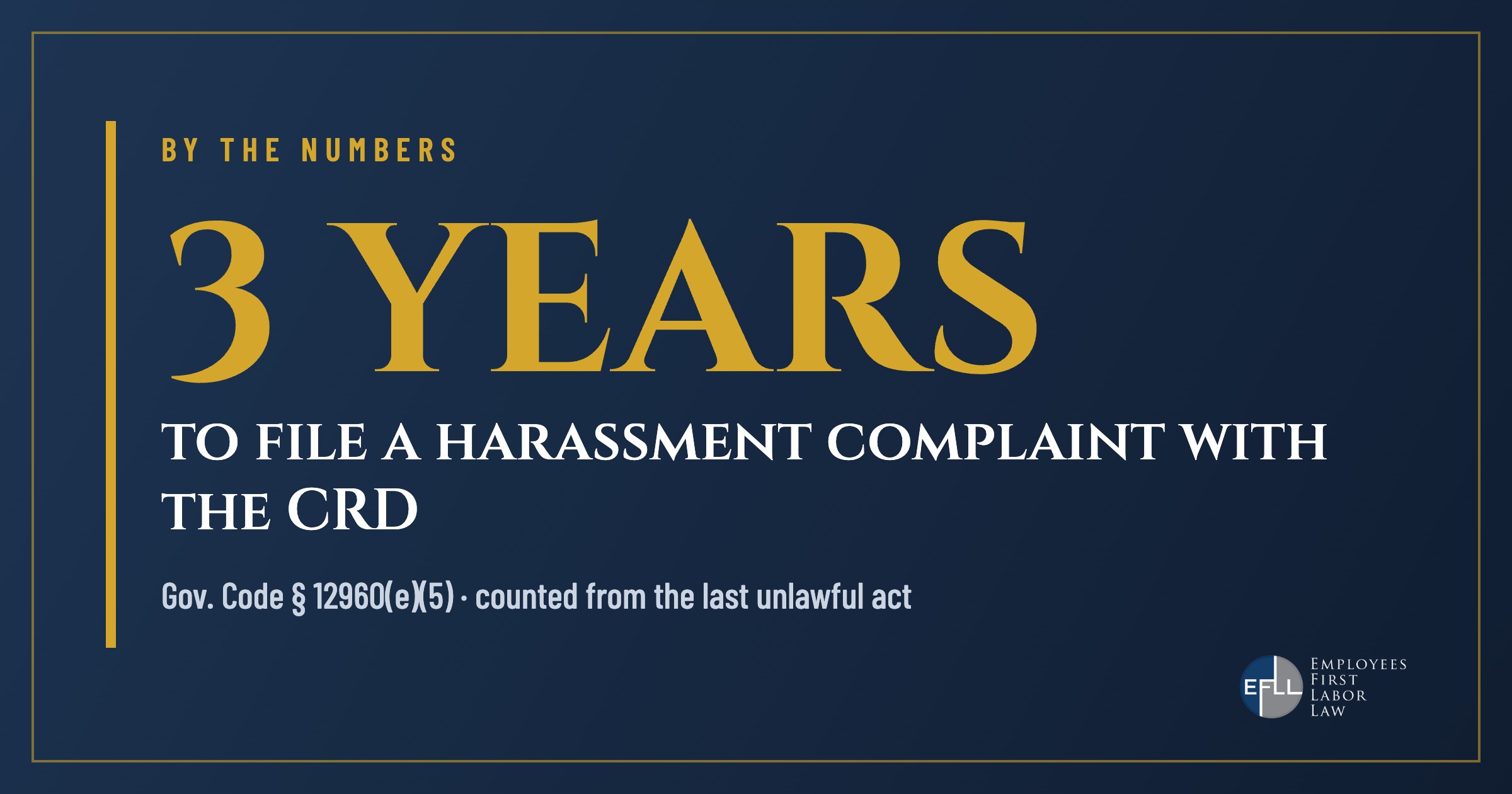
- You generally have 3 years from the last act of harassment to file an intake form with the Civil Rights Department (Gov. Code § 12960(e)(5)).
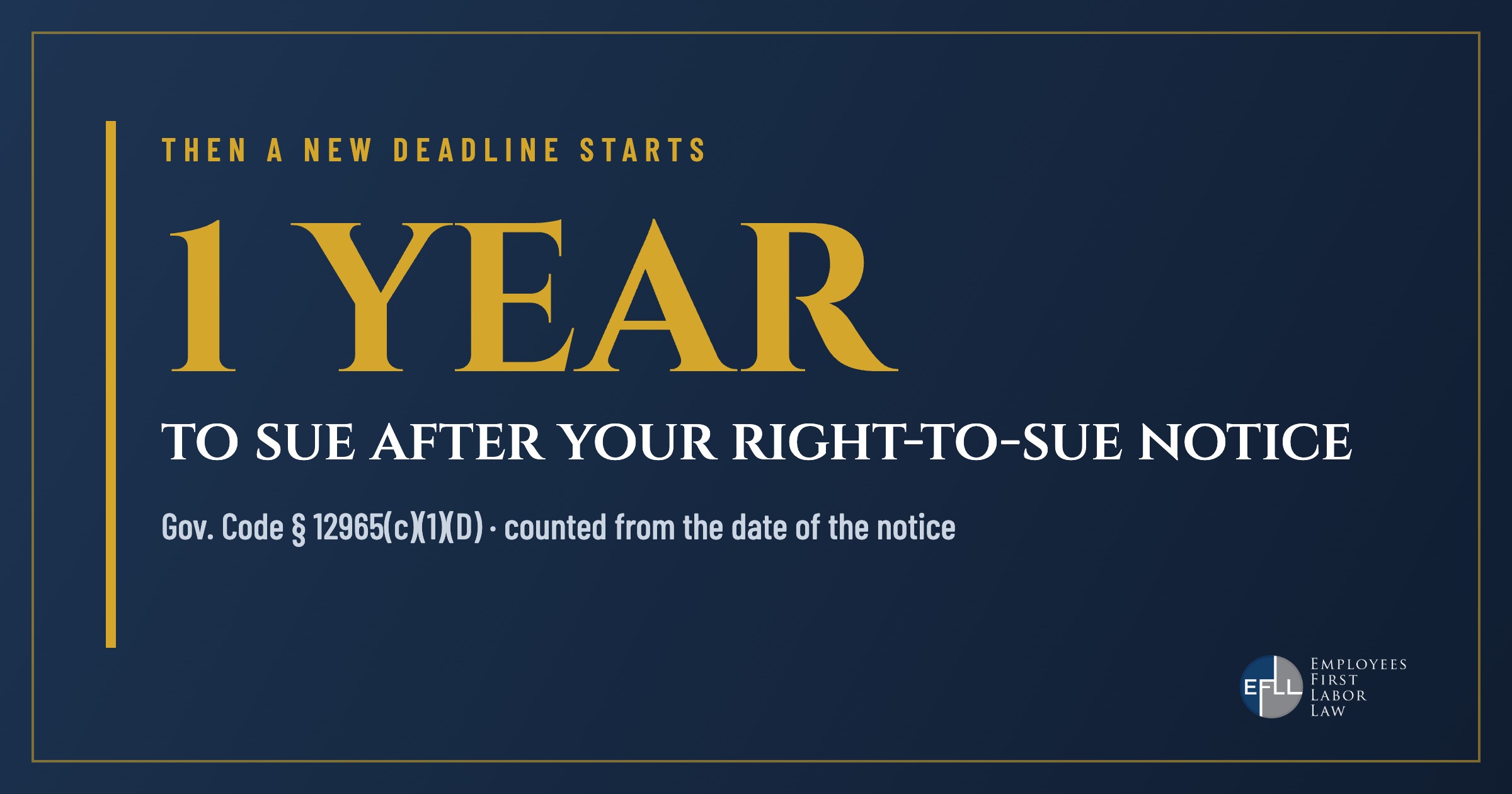
- After CRD issues a right-to-sue notice, you have 1 year from the date of the notice to file your lawsuit (Gov. Code § 12965(c)(1)(D)).
- The date you submit your CRD intake form is the filing date that counts (Gov. Code § 12960(b)).
- Don’t count on an HR report to pause the clock; the statutes allow only narrow extensions, such as late discovery of the facts or harassment of a minor.
- Sexual assault claims have longer deadlines, and a revival window for some older adult claims runs through December 31, 2027 (Code Civ. Proc. § 340.16).
The basic rule: 3 years to file with CRD, then 1 year to sue
Under FEHA, sexual harassment is an unlawful employment practice (Gov. Code § 12940(j)). Before you can sue under FEHA, you have to file with the Civil Rights Department, the state agency formerly known as the DFEH. Government Code section 12960(e)(5) says a complaint alleging a FEHA employment violation, or a violation of Civil Code section 51.9, cannot be filed after three years from the date the unlawful practice occurred.
The statute also spells out that “filing a complaint” means filing an intake form with CRD, and the date of the formal, verified complaint relates back to the date of that intake form (Gov. Code § 12960(b)). In practice, that means the date you submit your intake form is the date that counts for the three-year deadline. CRD’s own website says the same thing in plain words: in employment cases, you must submit an intake form within three years of the date you were last harmed.
Once CRD issues a right-to-sue notice, a second clock starts. The notice tells you that you may bring a civil action against the people and companies named in your CRD complaint within one year from the date of that notice (Gov. Code § 12965(c)(1)(D)). Many people miss it because they assume the three-year period still applies. It doesn’t.
The same three-year rule covers related FEHA claims, such as retaliation for complaining and failure to prevent harassment. Each separate act, like a firing, can have its own start date.
Investigation or immediate right-to-sue: your two paths
Path 1: let CRD investigate. CRD reviews your intake, and if it accepts the case, it prepares a formal complaint, serves the employer and investigates. If CRD has not filed its own lawsuit within 150 days, or decides earlier that it won’t, it must tell you in writing that it will issue a right-to-sue notice on request. If you never ask for one, CRD issues the notice when its investigation is complete, and no later than one year after the complaint was filed (Gov. Code § 12965(c)(1)(A)). Your one-year deadline to sue then runs from the date of that notice.
Path 2: request an immediate right-to-sue. CRD explains that you don’t have to use its investigation process. In employment cases, you can instead obtain an immediate right-to-sue notice and file your own lawsuit. Workers with a private attorney often take this route. The trade-off: your one-year deadline to sue starts right away.
Either way, name everyone who should be responsible. FEHA makes the individual harasser personally liable for harassment they commit (Gov. Code § 12940(j)(3)), and the right-to-sue notice covers the persons and entities named in your CRD complaint. Leaving someone out can create problems later. Our guide on filing a CRD complaint and getting a right-to-sue notice walks through the forms.
When the clock starts: the “last act” of harassment
The three-year period runs from the date the unlawful practice occurred; CRD describes it as the date you were “last harmed.” Harassment, though, is usually a pattern spread over months.
When harassment is ongoing, the most recent incident usually matters most. The federal EEOC, for example, says a harassment charge must be filed within its deadline measured from the last incident, and it will then look at all the incidents, including earlier ones. California courts can also consider a pattern of harassment as a whole in some situations, but whether older incidents count depends on the facts, so don’t rely on that without advice.
Two practical points:
- Leaving your job does not restart the clock. If the harassment stopped when you quit, the last incident is usually your start date, not your last day of work.
- If you were fired or demoted after reporting harassment, that retaliation is its own act with its own date.
Deadlines depend on dates that are easy to miscount. Our attorneys can review your timeline in a free, confidential consultation.
What can pause or extend the deadline
FEHA deadlines are strict, but the statutes include a few specific extensions. Don’t count on one without a lawyer reviewing your dates.
- Late discovery of the facts: if you first learned the facts of the unlawful practice during the 90 days after the three-year deadline expired, you get up to 90 more days (Gov. Code § 12960(e)(6)(A)).
- Harassment of a minor: the filing period can be extended for up to one year from the date the person turns 18 (Gov. Code § 12960(e)(6)(D)).
- CRD processes: CRD’s own deadlines for issuing your right-to-sue notice are paused during its dispute resolution process, for a period set in a written agreement between CRD and the employer, while a petition to compel is pending, and during a timely appeal of a complaint closure (Gov. Code § 12965(c)(1)(F)). Because your one-year clock runs from the notice date, this can affect when it starts.
- Dual filing with the EEOC: if you file with both CRD and the EEOC and the investigation is deferred between the agencies, your one-year deadline to sue can be extended until the federal right-to-sue period expires, if that is later (Gov. Code § 12965(e) and (f)).
Notice what is not on the list. Reporting to HR or going through an internal investigation generally does not stop the clock. The EEOC says so for federal charges; assume the same for your state deadline.
California sexual harassment deadlines at a glance
This table summarizes the main time limits. Dates are counted from the event listed, and the exact last day can depend on weekends, holidays and the facts of your case.
| Situation | Deadline | Source |
|---|---|---|
| File a FEHA harassment complaint (intake form) with CRD | 3 years from the unlawful practice | Gov. Code § 12960(b), (e)(5) |
| File a FEHA lawsuit after a CRD right-to-sue notice | 1 year from the date of the notice | Gov. Code § 12965(c)(1)(D) |
| CRD must issue a right-to-sue notice if you don’t request one | When its investigation ends, no later than 1 year after the complaint | Gov. Code § 12965(c)(1)(A) |
| Harassment in a business, service or professional relationship (CRD complaint) | 3 years from the unlawful practice | Gov. Code § 12960(e)(5); Civ. Code § 51.9 |
| Facts first discovered just after the deadline | Up to 90 extra days | Gov. Code § 12960(e)(6)(A) |
| Civil lawsuit for sexual assault of an adult | Later of 10 years from the last act or 3 years from discovery of the injury | Code Civ. Proc. § 340.16(a) |
| Federal Title VII charge with the EEOC | 180 days, extended to 300 days where a state agency enforces a similar law | EEOC guidance |
| Title VII lawsuit after an EEOC Notice of Right to Sue | 90 days from receiving the notice | EEOC guidance |
💡 Example: Maria, a hypothetical restaurant manager, was harassed by her regional supervisor for months. The last incident happened on March 10, 2025. Her deadline to submit a CRD intake form is March 10, 2028. She talks to a lawyer, files with CRD and requests an immediate right-to-sue notice, which CRD issues on June 2, 2026. Her deadline to file her lawsuit is now June 2, 2027, not 2028. Once the notice issued, the one-year clock controlled.
Harassment outside a job: Civil Code 51.9
Not all sexual harassment happens between an employer and an employee. Civil Code section 51.9 covers harassment within a business, service or professional relationship, such as with a doctor, therapist, attorney, landlord, teacher, lender, elected official, or a director or producer. The conduct must be unwelcome and pervasive or severe, and must cause economic loss, personal injury or emotional distress, or violate a legal right.
A CRD complaint under section 51.9 has the same three-year filing deadline as an employment harassment complaint (Gov. Code § 12960(e)(5)). Filing a CRD complaint also tolls the time to file a civil lawsuit under the statutes covered by section 12960, which include section 51.9, until CRD files its own case or until one year after CRD gives written notice that it closed its investigation, or, since January 1, 2026, that the complaint stayed closed after a timely appeal (Gov. Code § 12960(f)).
Section 51.9 itself does not state a filing deadline for going straight to court. If you were harassed by someone you did business with, talk to a lawyer quickly about which deadline applies to you.
Sexual assault at work has longer deadlines
When harassment includes sexual assault, a separate statute can give you more time to sue. For a civil action for damages from sexual assault that happened on or after the plaintiff’s 18th birthday, Code of Civil Procedure section 340.16(a) allows the later of 10 years from the last act or attempted act, or 3 years from the date the plaintiff discovers, or reasonably should have discovered, that an injury or illness resulted from it. A criminal prosecution or conviction is not required.
California has also opened a revival window. Under section 340.16(e), adult sexual assault claims that would otherwise have been barred before January 1, 2026, can be filed between January 1, 2026 and December 31, 2027. Revived claims against an entity require allegations that the entity engaged in or attempted a cover-up of a previous instance or allegations of sexual assault by the alleged perpetrator, the revival extends to related claims such as sexual harassment and wrongful termination arising out of the assault, and the window does not apply to claims against public entities or to claims already litigated to finality or settled in writing before January 1, 2026.
How the federal EEOC deadlines compare
Sexual harassment also violates federal law (Title VII), which has its own, shorter deadlines. The EEOC says you generally must file a charge within 180 calendar days, extended to 300 calendar days when a state or local agency enforces a law prohibiting the same discrimination. Once you receive a federal Notice of Right to Sue, you have just 90 days to file your lawsuit.
For most California workers, FEHA is the more forgiving path: three years instead of 300 days, and one year to sue instead of 90 days. FEHA’s harassment rules also reach very small workplaces: for harassment, an “employer” includes anyone regularly employing one or more persons (Gov. Code § 12940(j)(4)(A)). See our guide to CRD vs. EEOC: where to file for the trade-offs.
If you work for a public agency, other rules may also apply. Certain claims against public entities require a written government claim within six months or one year, depending on the type of claim (Gov. Code § 911.2).
What to do now to protect your deadline
- Find your last-incident date. Write down every date you can remember.
- Save your evidence. Keep copies of texts, emails, messages and any complaint you made outside your work accounts.
- Report it if it’s still happening. Reporting helps put your employer on notice. Our step-by-step reporting guide explains how.
- Talk to an employment lawyer before deadlines get close.
- Submit your CRD intake form on time. The intake form date is the filing date for the three-year deadline.
- Name every responsible party, including the individual harasser.
- Calendar the one-year deadline the day your right-to-sue notice issues.
Harassment cases are often the tip of the iceberg, with retaliation or wrongful termination close behind. Our sexual harassment attorneys look at the whole picture, including when your employer is legally responsible.
Frequently asked questions
What is the sexual harassment statute of limitations in California?
For most workplace harassment claims under FEHA, you have three years from the last unlawful act to file an intake form with the Civil Rights Department (Gov. Code § 12960(e)(5)). After CRD issues a right-to-sue notice, you have one year from the date of that notice to file your lawsuit (Gov. Code § 12965(c)(1)(D)).
Does reporting harassment to HR stop the clock?
Generally, no. An internal complaint or investigation doesn’t pause the CRD deadline, and the EEOC says internal grievances don’t extend federal deadlines either. Report the harassment, but keep track of your filing dates separately.
I quit because of the harassment. When does my deadline start?
The three-year period runs from the unlawful practice, which is usually the last act of harassment, not necessarily your last day of work. If you were forced out or fired after complaining, those may be separate claims with their own dates.
The harassment happened more than three years ago. Is it too late?
Possibly, but not always. A narrow 90-day extension applies if you first learned the facts just after the deadline, minors get extra time, and sexual assault claims have longer deadlines and a revival window through December 31, 2027 (Code Civ. Proc. § 340.16). Get a free case review before you assume your claim is gone.
Do I have to file with both CRD and the EEOC?
No. To bring a FEHA lawsuit, you need a CRD right-to-sue notice. To bring a federal Title VII lawsuit, you need an EEOC notice, which comes with a 90-day deadline to sue.
Related guides
 Workers only. Never employers.
At Employees First Labor Law, we represent California workers only, never employers. Our team has recovered more than $200 million for our clients, and we prepare every case as if it is going to trial. We have offices in Pasadena, Irvine, Long Beach, Pomona, Riverside, Bakersfield and Fresno, and we serve workers throughout California. Meet our team.







If you were sexually harassed at work in California, we can check every deadline that applies, file with the CRD and pursue lost wages, emotional distress damages and attorney’s fees. Call before your time runs out.
- ✅ Free, confidential consultation
- ✅ We represent workers only, never employers
- ✅ Se habla español: Empleados Primero
This article provides general information about California law and is not legal advice for any specific situation. Reading it does not create an attorney-client relationship. Past results do not guarantee a similar outcome.