
Updated October 2026 · 10 min read
Yes. Same-sex sexual harassment is illegal in California, and so is harassment because of a worker’s sexual orientation, gender identity or gender expression. The Fair Employment and Housing Act (FEHA) protects every worker, whatever the sex or orientation of the person doing the harassing, and California law says plainly that sexually harassing conduct does not have to be motivated by sexual desire.
That matters because many people who are harassed by someone of the same sex, or who are targeted for being gay, lesbian, bisexual, transgender or nonbinary, are told some version of “that’s not sexual harassment” or “it’s just how the guys joke around here.” Under California law, both of those answers are often wrong. A manager who mocks an employee as “not man enough,” a coworker who keeps calling a transgender colleague by their old name on purpose, or a crew that “initiates” new hires with sexualized hazing can all create a legal claim.
This guide explains the rule for same sex sexual harassment in California, who is protected, what the Civil Rights Department (CRD) regulations say about names, pronouns, restrooms and dress codes, when conduct crosses the legal line, who is responsible, and what to do if it is happening to you.
- Same-sex sexual harassment is illegal in California. Harassing conduct does not have to be motivated by sexual desire (Gov. Code 12940(j)(4)(C)).
- FEHA protects workers from harassment because of sexual orientation, gender identity and gender expression, including when the harasser only perceives you to be LGBTQ+.
- CRD regulations say an employer that ignores your stated name or pronouns may be liable, and you may use the restroom that matches your gender identity.
- Employers are strictly liable for harassment by supervisors; for coworkers and customers, they are liable if they knew or should have known and failed to act.
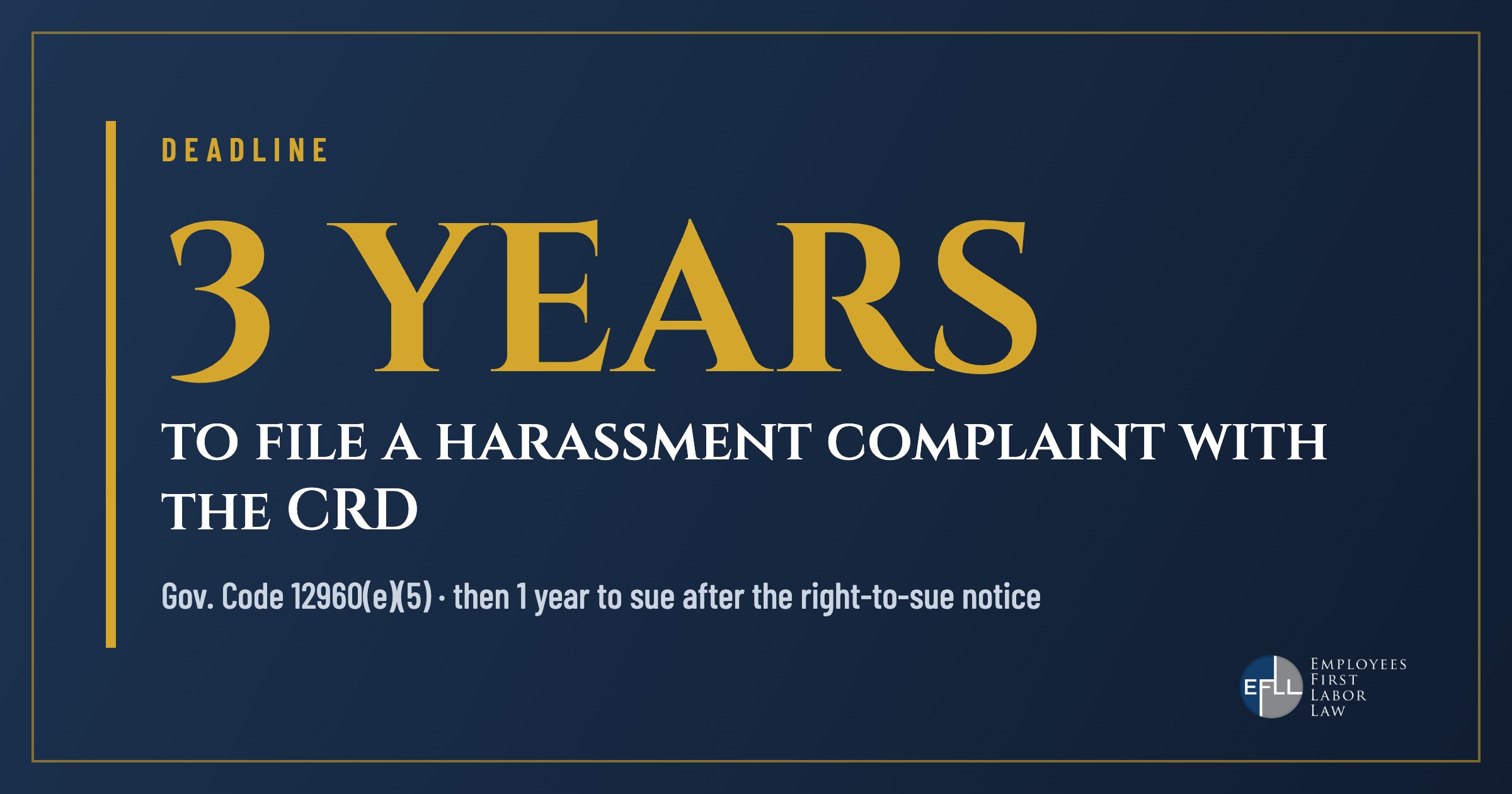
- You generally have three years to file with the CRD, then one year after a right-to-sue notice to file in court.
Same-sex sexual harassment in California: the basic rule
FEHA makes it unlawful for an employer, or “any other person,” to harass an employee, applicant, unpaid intern, volunteer or person providing services under a contract because of sex, gender, gender identity, gender expression or sexual orientation, among other protected characteristics (Government Code section 12940(j)(1)).
Three points in the statute and the CRD regulations answer most same-sex questions:
- Desire is not required. Harassment “because of sex” includes sexual harassment and gender harassment, and “sexually harassing conduct need not be motivated by sexual desire” (Gov. Code 12940(j)(4)(C)). The CRD regulations repeat that an employer may be liable “even when the harassing conduct was not motivated by sexual desire” (Cal. Code Regs., tit. 2, § 11034(f)).
- The harasser’s identity does not matter. An employer may be liable for sexual harassment “regardless of the sex, gender, gender identity, gender expression, or sexual orientation of the perpetrator” (tit. 2, § 11034(f)(2)(B)). A man can sexually harass a man; a woman can sexually harass a woman.
- You do not have to lose pay or a promotion. “Loss of tangible job benefits shall not be necessary in order to establish harassment” (Gov. Code 12940(j)(1)).
Who is protected: sexual orientation, gender identity and gender expression
California defines these protected characteristics broadly, and it protects everyone, not only LGBTQ+ workers.
- Sexual orientation means heterosexuality, homosexuality and bisexuality (Gov. Code 12926(s)).
- Sex includes a person’s gender, and “gender” includes gender identity and gender expression (Gov. Code 12926(r)(2)).
- Gender identity is each person’s internal understanding of their gender, which may be male, female, a combination, neither, a gender different from the sex assigned at birth, or transgender (tit. 2, § 11030(b)).
- Gender expression is a person’s gender-related appearance or behavior, whether or not it is stereotypically associated with the sex assigned at birth (Gov. Code 12926(r)(2); tit. 2, § 11030(a)).
Protection also covers perception and association. FEHA’s protected categories include a perception that a person has a characteristic, and a perception that the person is associated with someone who has it (Gov. Code 12926(o)). So a straight employee who is harassed because coworkers assume he is gay is protected, and so is an employee targeted because of a same-sex spouse. You do not have to be “out” at work, and you never have to prove your orientation or identity to be protected.
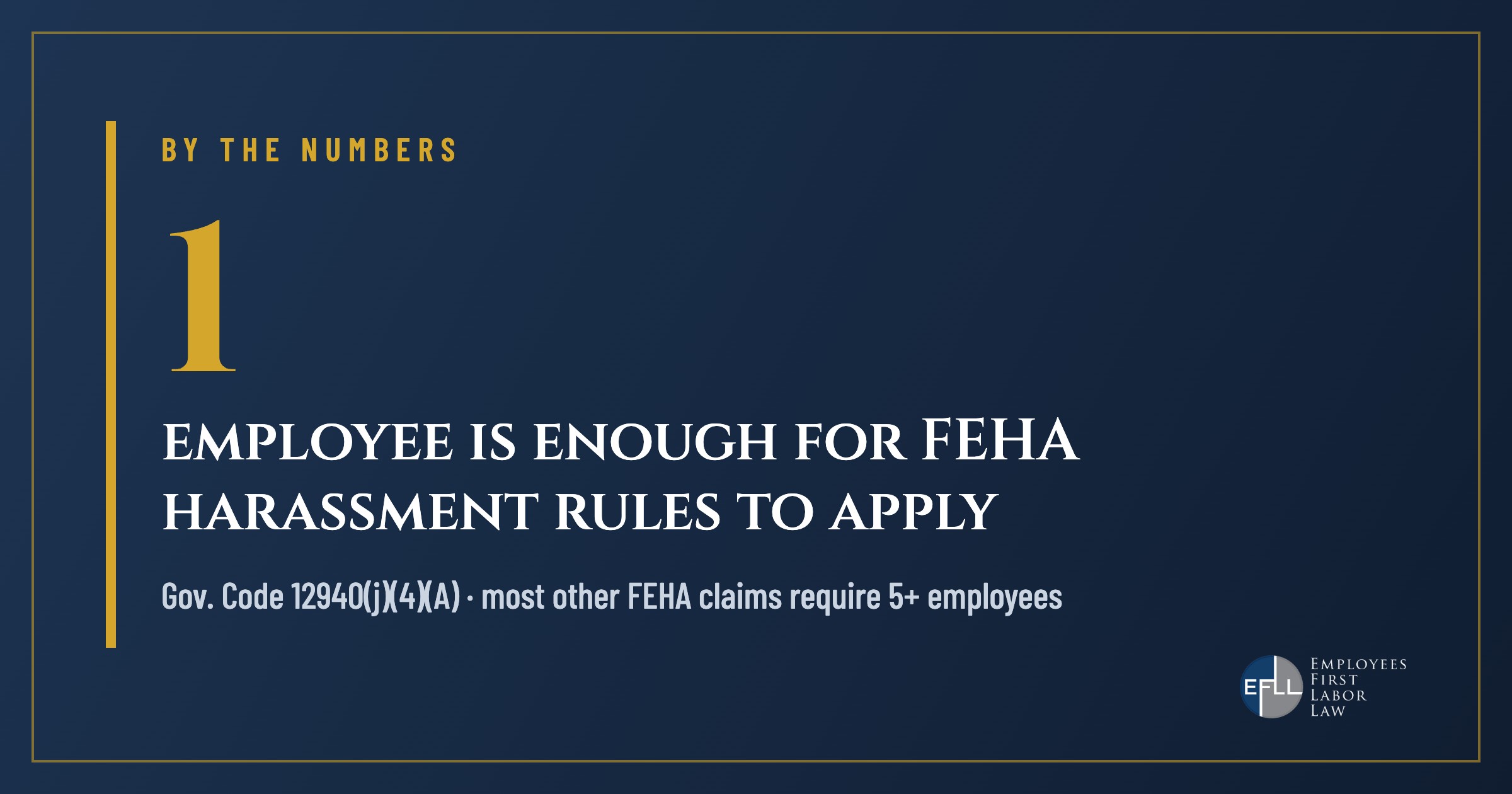
The definition of “employee” for harassment purposes includes unpaid interns, volunteers and qualifying contractors (tit. 2, § 11019(b)(1)), and the harassment rules apply to employers with even one employee (Gov. Code 12940(j)(4)(A)).
What same-sex and LGBTQ+ harassment can look like
The CRD regulations describe harassment as verbal (epithets, derogatory comments or slurs), physical (assault, blocking movement, physical interference), visual (derogatory posters, cartoons or drawings), and unwanted sexual advances, including demands for sexual favors (tit. 2, § 11019(b)(2)). In same-sex and LGBTQ+ cases, that often includes:
- Slurs, “jokes” or nicknames about a worker’s sexual orientation or gender identity.
- Comments that a worker is not “masculine” or “feminine” enough, or ridicule of how someone dresses, talks or wears their hair.
- Sexualized hazing, grabbing, or “horseplay” aimed at a worker’s body, including by people of the same sex.
- Questions about a worker’s sex life, body, medical history or transition that the worker did not invite.
- Threats to “out” a worker, or spreading rumors about their orientation or identity.
- Deliberately and repeatedly using the wrong name or pronouns after being asked to stop.
- Unwanted sexual advances from a supervisor or coworker of the same sex, or job benefits tied to going along with them.
When a supervisor conditions a raise, schedule or promotion on sexual conduct, that is quid pro quo harassment, and the same rules apply no matter the genders involved.
You do not have to prove the harasser wanted a relationship. Talk to our team in a free, confidential consultation.
Names, pronouns, restrooms and dress codes: what the CRD regulations say
California’s regulations spell out how employers must treat transgender and nonbinary workers. The table below summarizes the key rules.
| Situation | California rule | Source |
|---|---|---|
| You ask to be called by a different name or pronoun | An employer that fails to abide by your stated name, gender or pronoun (including gender-neutral pronouns) may be liable under FEHA | Tit. 2, § 11034(h)(3) |
| Payroll or legal paperwork | Your legal name or gender from a government ID may be used only where needed to meet a legally mandated obligation; otherwise the employer must use your gender identity and preferred name | Tit. 2, § 11034(h)(4) |
| Restrooms and locker rooms | You may use facilities that match your gender identity or expression; you cannot be required to show medical proof or ID to use them; single-occupancy restrooms need gender-neutral signs | Tit. 2, § 11034(e)(2)(A)–(D) |
| Dress codes and grooming | Employers may set reasonable standards, but must let you dress consistently with your gender identity or expression | Gov. Code 12949; tit. 2, § 11034(g) |
| Questions about your sex or gender | Employers generally may not demand documentation or proof of your sex, gender, gender identity or expression as a condition of employment | Tit. 2, § 11034(i)(1) |
| Transitioning on the job | Discrimination against someone who is transitioning, has transitioned, or is perceived to be transitioning is unlawful | Tit. 2, § 11034(i)(4) |
An honest mistake that is quickly corrected is different from a supervisor or coworker who keeps misgendering or “deadnaming” someone on purpose, or an employer that refuses to update a name badge, email address or schedule. Repeated, intentional conduct is the kind of evidence that can support a harassment claim, and an employer’s refusal to follow these regulations can also support a discrimination claim under FEHA’s anti-discrimination rules (Gov. Code 12940(a)).
When does it become illegal? Severe or pervasive conduct
For a hostile work environment claim, the harassment must be severe or pervasive enough to alter the conditions of employment, and it must be offensive both to you and to a reasonable person in your position (tit. 2, § 11034(f)(2)(A)). California has made that standard more worker-friendly in several ways (Gov. Code 12923):
- You do not have to prove your productivity dropped. It is enough that a reasonable person would find the harassment made the job more difficult to do (12923(a)).
- A single incident can be enough to create a triable issue if it unreasonably interfered with your work or created an intimidating, hostile or offensive environment (12923(b)).
- Discriminatory remarks count as evidence even if they were not made by the decision-maker or at the moment of a job decision (12923(c)).
- The standard does not change by type of workplace. A history of crude talk in an industry is not a defense, except where sexual content is actually part of the job duties (12923(d)).
That last point matters in construction yards, warehouses, kitchens, locker rooms and other settings where harassment is sometimes waved off as “culture.” For more on how courts look at the whole picture, see our guide to a hostile work environment in California.
💡 Example: Marcus works on a delivery crew. After a coworker sees a photo of Marcus and his husband, two crew members start calling him slurs, leave a crude drawing on his locker, and grab him from behind while making sexual comments, saying it is “just a joke.” Marcus reports it in writing to his supervisor, who laughs and does nothing. Even though the harassers are men and claim no sexual interest, this is harassment because of sex and sexual orientation, and the employer’s failure to act after Marcus reported it can make the employer liable. (Hypothetical, for illustration only.)
Who is responsible: supervisors, coworkers and customers
Who pays depends on who did the harassing:
- Supervisors. The employer is strictly liable for harassment by its supervisors and agents, whether or not it knew (tit. 2, § 11034(f)(2)(C)).
- Coworkers. The employer is liable if it, or its supervisors, knew or should have known and failed to take immediate and appropriate corrective action (Gov. Code 12940(j)(1)).
- Customers, clients and other non-employees. The same “knew or should have known” standard applies, and the employer’s control over those people is considered (Gov. Code 12940(j)(1)).
- The harasser personally. An employee who harasses a coworker is personally liable, regardless of what the employer knew (Gov. Code 12940(j)(3)).
Employers also have an independent duty to take all reasonable steps to prevent harassment and discrimination (Gov. Code 12940(k)). Employers with five or more employees must provide harassment-prevention training that includes harassment based on gender identity, gender expression and sexual orientation, with practical examples (Gov. Code 12950.1(a)(3)), and covered employers must post the CRD’s transgender rights poster (Gov. Code 12950(a)(2)). Missing training or posters does not by itself create a lawsuit, but it can be evidence that an employer did not take prevention seriously. For a full breakdown, read who is liable for sexual harassment in California.
What to do if you are being harassed
You do not need to have every detail sorted out before you get help. These steps protect both you and your claim:
- Write it down. Keep a private log with dates, times, what was said or done, who did it, and who saw it. Write entries soon after each incident.
- Save the evidence. Keep texts, chat messages, emails, photos of drawings or graffiti, and any written complaints. Store copies somewhere your employer does not control, without taking confidential company or customer data you are not entitled to.
- Report it in writing. Follow your employer’s complaint policy and send a short email to HR or a manager. Say clearly that you are reporting harassment based on sex, sexual orientation, gender identity or gender expression. Our step-by-step reporting guide walks through what to include.
- Share only what you want to share. You generally do not have to disclose details of your medical history, transition or private life to make a complaint. Describe the conduct and how it affected you.
- Watch for retaliation. Note any schedule cuts, write-ups, demotions or exclusion after you complain.
- Talk to a lawyer before deadlines approach. You generally must file with the CRD within three years of the harassment (Gov. Code 12960(e)(5)), and after the CRD issues a right-to-sue notice you generally have one year to file in court (Gov. Code 12965(c)(1)(D)). See our full guide to sexual harassment deadlines in California.
Retaliation and related claims
Harassment rarely happens alone. It is illegal for an employer to fire, demote or otherwise punish you because you opposed harassment or discrimination, filed a complaint, or helped with an investigation (Gov. Code 12940(h)). If a complaint led to a firing, a sudden “performance” problem or a schedule change, you may have a retaliation claim in addition to the harassment claim.
Other claims that often appear alongside same-sex or LGBTQ+ harassment include discrimination in pay, promotions or assignments based on sex, gender identity or sexual orientation (Gov. Code 12940(a)); failure to prevent harassment (Gov. Code 12940(k)); and wrongful termination. In a FEHA lawsuit, a court may also award reasonable attorney’s fees and costs to a prevailing employee (Gov. Code 12965(c)(6)). Our guide to sexual harassment damages in California explains what compensation may be available.
Frequently asked questions
Is it still sexual harassment if the harasser is the same sex as me?
Yes. Under California law, sexual harassment can be committed by anyone, regardless of the sex, gender identity or sexual orientation of the person doing it (Cal. Code Regs., tit. 2, § 11034(f)(2)(B)), and the conduct does not have to be motivated by sexual desire (Gov. Code 12940(j)(4)(C)).
Do I have to be LGBTQ+, or out at work, to be protected?
No. FEHA protects people who are perceived to have a protected characteristic and people perceived to be associated with someone who has one (Gov. Code 12926(o)). Straight workers harassed with anti-gay slurs, and workers targeted because of a family member, are protected too.
Is repeated misgendering or deadnaming illegal in California?
It can be. CRD regulations say an employer that fails to abide by an employee’s stated name, gender or pronoun may be liable under FEHA (tit. 2, § 11034(h)(3)). Deliberate, repeated misgendering after a request to stop can support a harassment or discrimination claim, especially when management knows and does nothing.
Can my employer make me use the restroom that matches my birth certificate?
No. California employers must let employees use facilities that correspond to their gender identity or gender expression and may not require medical proof or an identity document to use them (tit. 2, § 11034(e)(2)(A), (D)).
What if my employer says it is a small business?
FEHA’s harassment rules apply to employers that regularly employ even one person (Gov. Code 12940(j)(4)(A)). Other FEHA rules, such as most discrimination claims, generally apply to employers with five or more employees (Gov. Code 12926(d)).
Related guides
 Workers only. Never employers.
At Employees First Labor Law, we represent California workers only, never employers. Our team has recovered more than $200 million for our clients, and we prepare every case as if it is going to trial. We have offices in Pasadena, Irvine, Long Beach, Pomona, Riverside, Bakersfield and Fresno, and we serve workers throughout California. Meet our team.




We represent California workers harassed because of sex, sexual orientation, gender identity or gender expression, including same-sex harassment by supervisors, coworkers and customers. We can help you report safely, protect yourself from retaliation and pursue compensation under FEHA.
- ✅ Free, confidential consultation
- ✅ We represent workers only, never employers
- ✅ Se habla español: Empleados Primero
This article provides general information about California law and is not legal advice for any specific situation. Reading it does not create an attorney-client relationship. Past results do not guarantee a similar outcome.