
Updated October 2026 · 10 min read
In California, a settlement agreement cannot stop you from disclosing the facts of a sexual harassment claim you filed in court or with a government agency, and an employer generally cannot use a severance or employment agreement to silence you about unlawful conduct at work. What a settlement can still keep private is narrower than many people think: usually the dollar amount, and your own identity if you ask for that protection.
Confidentiality language is often buried in the last pages of a settlement or severance agreement. Some of it is legal. Some of it is void under California law even if you sign it. Knowing the difference protects both your voice and your settlement.
This guide covers the main California laws on sexual harassment NDAs, what can still be kept confidential, the rules for severance agreements, and what to check before you sign.
- A settlement cannot restrict the facts of a sexual harassment, discrimination or retaliation claim filed in court or with an agency such as the CRD (Code Civ. Proc. 1001).
- The settlement amount can be kept confidential, and your identity can be shielded if you ask.
- Severance agreements cannot bar you from disclosing unlawful acts at work, and non-disparagement clauses need a required carve-out sentence (Gov. Code 12964.5).
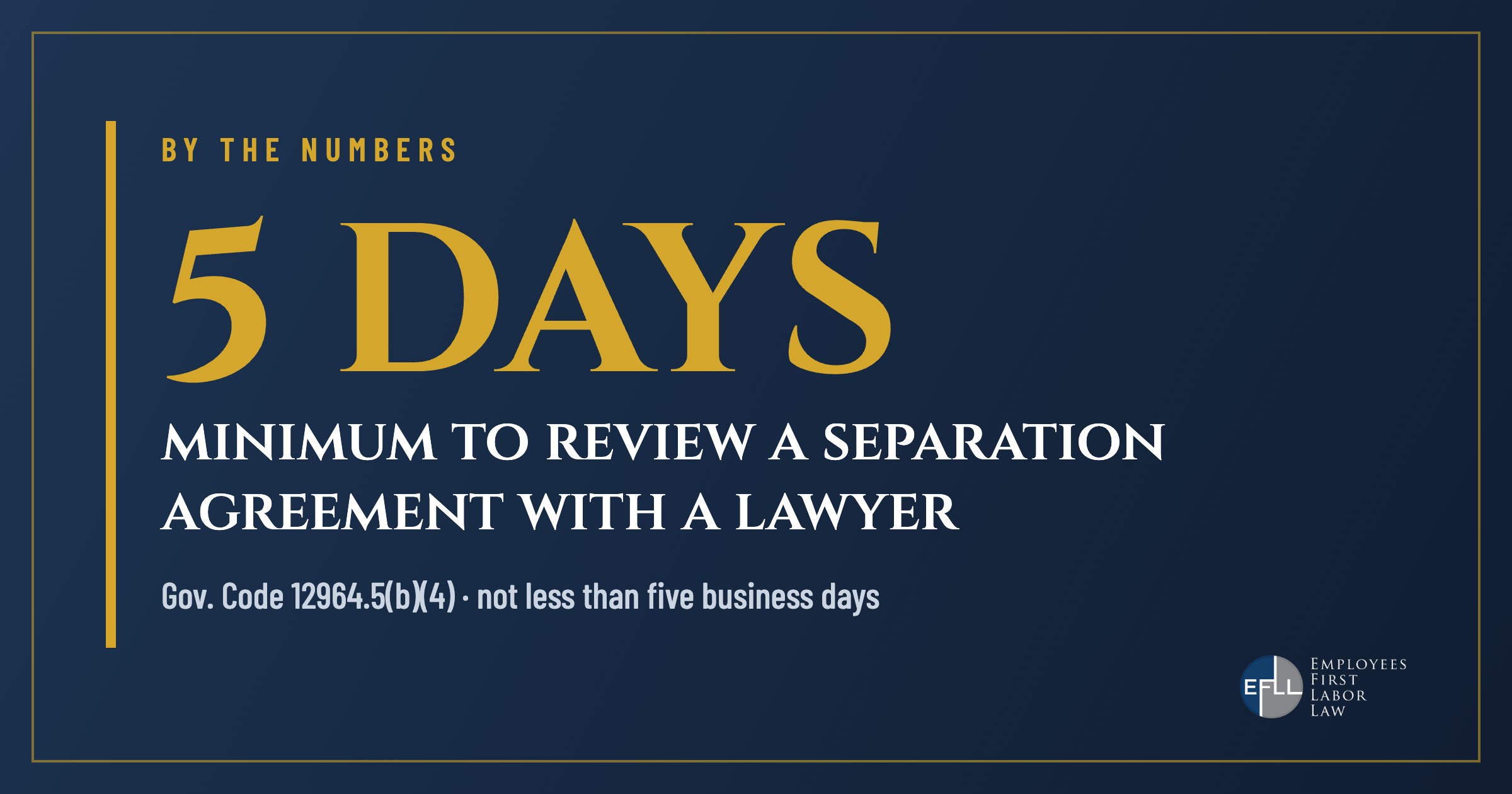
- You get at least five business days to consult a lawyer about a separation agreement.
- No contract or settlement entered into on or after January 1, 2019, can waive your right to testify about sexual harassment when subpoenaed or asked by an agency (Civ. Code 1670.11).
Sexual harassment NDAs in California: the basic rule
The core rule is in Code of Civil Procedure section 1001. It says that a provision in a settlement agreement that “prevents or restricts the disclosure of factual information” related to certain claims is prohibited. The protected claims include:
- An act of sexual harassment, as defined in Civil Code section 51.9.
- An act of workplace harassment or discrimination, a failure to prevent harassment or discrimination, or retaliation against someone for reporting or opposing it, as described in Government Code section 12940, subdivisions (a), (h), (i), (j) and (k), the core of California’s Fair Employment and Housing Act (FEHA).
Under section 1001(d), a provision that restricts disclosure of the factual information about these claims, in an agreement entered into on or after January 1, 2019, is void as a matter of law and against public policy. And under section 1001(b), a judge cannot get around the rule by entering a court order, “by stipulation or otherwise,” that restricts disclosure in a way that conflicts with it.
In plain terms: if you sued or filed an administrative complaint over harassment at work, your settlement can pay you and end the case, but it generally cannot require you to stay silent about what happened.
When the ban applies: filed claims and “factual information”
Two details in section 1001 decide whether it covers your situation.
First, a claim has to be filed. The statute applies to factual information related to “a claim filed in a civil action or a complaint filed in an administrative action.” A lawsuit in superior court is a civil action. A complaint with the California Civil Rights Department (CRD) is an example of an administrative complaint. If you settle before anything is filed, section 1001 may not protect you, although the other laws below may. Raise this timing question with a lawyer before you settle; it is closely tied to your filing deadlines.
Second, the protection is about facts: what was said or done, by whom, and how the employer responded. Certain other terms can still be kept private, as explained next.
The ban covers more than sexual harassment. Section 1001(a)(3) reaches workplace harassment and discrimination under FEHA, failure to prevent it, and retaliation for reporting or opposing it. Senate Bill 331 of the 2021–22 session broadened that category, and under section 1001(g) those changes apply only to agreements entered into on or after January 1, 2022.
What a settlement can still keep confidential
California law does not ban every confidentiality term. These are the main things a settlement can lawfully keep private:
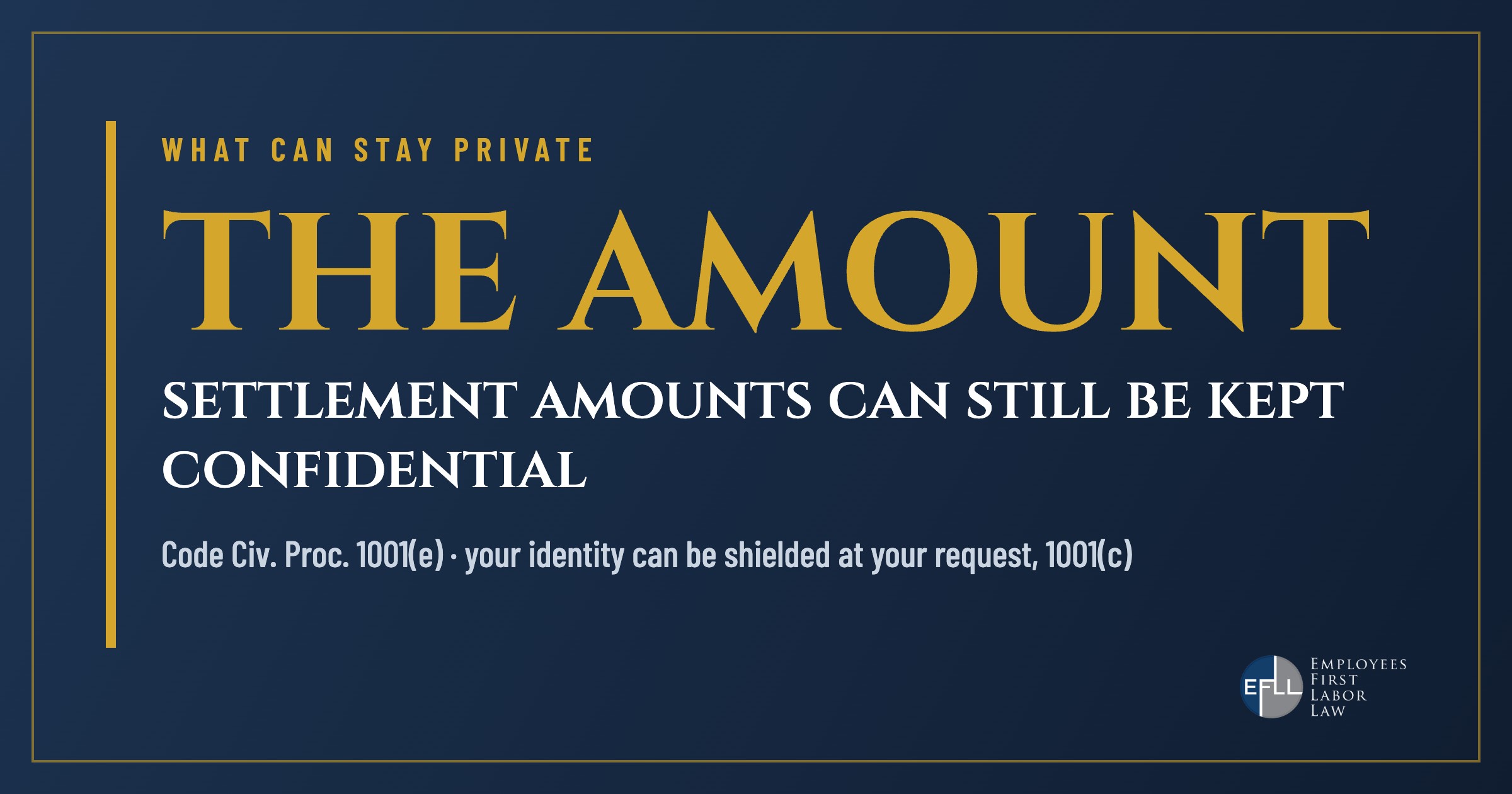
- The settlement amount. Section 1001(e) says the law does not prohibit a provision that precludes disclosure of “the amount paid in settlement of a claim.” Many agreements include exactly this kind of clause.
- Your identity, if you want it protected. Under section 1001(c), at the claimant’s request, the agreement can include a provision that shields your identity and all facts that could lead to discovering your identity, including in pleadings filed in court. This option belongs to you, not the employer. It does not apply if a government agency or public official is a party to the settlement.
- Genuine trade secrets and business information. In the employment-agreement context, Government Code section 12964.5(f) allows an employer to protect trade secrets, proprietary information or confidential information that does not involve unlawful acts in the workplace.
- A release of your claims. A settlement can still require you to give up the claims you are settling in exchange for payment. Section 12964.5(b)(3) expressly allows a general release or waiver of all claims in a separation agreement, as long as it is otherwise lawful and valid.
Also watch for a “no-rehire” clause. Code of Civil Procedure section 1002.5 generally bars an employment settlement from preventing a worker who filed a claim in good faith from future employment with the employer or its affiliates. A narrow exception applies if the employer documented a good-faith finding, before the claim was filed, that the worker engaged in sexual harassment, sexual assault or criminal conduct.
Before you sign, have a California employment lawyer read it. Our consultations are free and confidential.
Severance and separation agreements: Government Code 12964.5
Many workers first see confidentiality terms in a severance package. Government Code section 12964.5 covers that situation, and our guide to severance agreement review goes deeper on the rest of the package. Under section 12964.5(b):
- An employer or former employer cannot include in any agreement related to your separation a provision that prohibits disclosure of information about unlawful acts in the workplace. That term includes information about harassment, discrimination or any other conduct you have reasonable cause to believe is unlawful.
- Any non-disparagement or other clause that restricts your ability to disclose information about workplace conditions must include, in substantial form, this sentence: “Nothing in this agreement prevents you from discussing or disclosing information about unlawful acts in the workplace, such as harassment or discrimination or any other conduct that you have reason to believe is unlawful.”
- The employer must tell you that you have the right to consult an attorney about the agreement and give you a reasonable period of not less than five business days to do so. You can sign sooner only if that choice is knowing and voluntary, not induced by fraud, threats to withdraw the offer, or better terms for signing early.
A provision that violates these rules is against public policy and unenforceable. Section 12964.5(e) still allows an agreement to keep the amount of the severance confidential.
Section 12964.5(a) applies the same idea while you are still employed: an employer cannot, in exchange for a raise or bonus or as a condition of employment, require you to release FEHA claims or sign a non-disparagement agreement that denies your right to disclose unlawful acts at work.
There is an important exception. Under section 12964.5(d), the statute does not apply to a negotiated settlement agreement resolving a FEHA claim you filed in court, with an administrative agency, in an alternative dispute resolution forum, or through your employer’s internal complaint process. “Negotiated” means the agreement is voluntary, deliberate and informed, gives you something of value, and you either had notice and an opportunity to hire a lawyer or were represented by one. Even then, if your claim was filed in court or with an agency, Code Civ. Proc. 1001 still limits what that settlement can keep secret.
Rights no agreement can take away
Several other laws limit what a contract can make you give up, whatever the agreement calls itself.
Your right to testify. Civil Code section 1670.11 voids any provision in a contract or settlement entered into on or after January 1, 2019, that waives your right to testify in an administrative, legislative or judicial proceeding about alleged sexual harassment or criminal conduct by the other party or its agents or employees, when you are required or requested to attend by court order, subpoena, or written request from an administrative agency or the Legislature.
Your right to talk about working conditions. Under Labor Code section 232.5, an employer cannot require you, as a condition of employment, to keep quiet about its working conditions, cannot make you sign a waiver of that right, and cannot discipline or fire you for such disclosures. Trade secrets and privileged information are not covered.
Federal protection for pre-dispute NDAs. The federal Speak Out Act, signed December 7, 2022, makes nondisclosure and nondisparagement clauses agreed to before a dispute arises judicially unenforceable in sexual assault and sexual harassment disputes where the conduct is alleged to violate federal, tribal or state law. It applies to claims filed on or after that date. So an NDA in your hiring paperwork generally cannot be enforced to keep you quiet about sexual harassment.
See also our guide on whether you can be sued for defamation for reporting harassment.
Which settlement clauses are allowed? A quick reference
| Clause in the agreement | Generally allowed in California? | Law |
|---|---|---|
| You can’t disclose the facts of a filed sexual harassment, discrimination or retaliation claim | No, void | Code Civ. Proc. 1001(a), (d) |
| You must keep the settlement amount confidential | Yes | Code Civ. Proc. 1001(e) |
| Your name and identifying facts are kept confidential, at your request | Yes (not if a government agency or public official is a party) | Code Civ. Proc. 1001(c) |
| Separation agreement bars disclosure of information about unlawful acts at work | No, unenforceable | Gov. Code 12964.5(b) |
| Non-disparagement clause without the required “unlawful acts” carve-out | No, in agreements covered by the statute | Gov. Code 12964.5(a), (b) |
| You waive your right to testify about sexual harassment when subpoenaed or requested by an agency | No, void | Civ. Code 1670.11 |
| You can never work for the employer or its affiliates again | Generally no, with a narrow exception | Code Civ. Proc. 1002.5 |
| General release of the claims being settled | Yes, if otherwise lawful | Gov. Code 12964.5(b)(3) |
What to check before you sign a harassment settlement
A settlement is usually final, so fix the language before you sign:
- Find every confidentiality term. Look for confidentiality, non-disclosure, non-disparagement and “no publicity” sections; they are often spread across several paragraphs.
- Check what is confidential. Keeping the amount private is lawful. A clause covering “the facts,” “the allegations” or “the dispute” may go further than the law allows.
- Look for the carve-out sentence. In a severance or employment agreement, a non-disparagement clause should contain the “Nothing in this agreement prevents you from discussing or disclosing information about unlawful acts in the workplace” language required by Gov. Code 12964.5.
- Decide whether you want identity protection. If so, ask for a provision under Code Civ. Proc. 1001(c).
- Check for testimony restrictions. Strike language that would stop you from testifying under subpoena.
- Watch for no-rehire clauses and penalties. Note any ban on future employment and any “liquidated damages” or clawback for breaking confidentiality.
- Use your review time. For separation agreements, you get at least five business days to consult a lawyer.
- Understand what you are releasing. Know exactly which claims you are giving up. Our guide to sexual harassment damages explains what a claim may be worth.
💡 Example: Dana (hypothetical) filed a sexual harassment complaint with the CRD and then sued her former employer. At mediation, the employer’s draft settlement says she “shall not disclose the existence of the dispute, the allegations, or the settlement.” Her lawyer points out that Code Civ. Proc. 1001 bars restricting the facts of her filed claim, so the clause is narrowed to the settlement amount. At Dana’s request, a provision keeping her name confidential is added under section 1001(c). The final agreement pays her, keeps the amount private, and leaves her free to describe what happened.
What if you already signed an NDA?
Signing does not make an unlawful clause valid. Under section 1001(d), a provision that restricts disclosure of the facts of a covered claim is void as a matter of law if the agreement was entered into on or after January 1, 2019. For the changes Senate Bill 331 made to the workplace harassment, discrimination and retaliation category, the date is January 1, 2022. Under Gov. Code 12964.5, a non-compliant provision in a separation or employment agreement is unenforceable.
Whether the rest of the agreement still binds you depends on its terms, and older agreements may be governed by the law in effect when they were signed. Before speaking publicly about a settled case, have a lawyer tell you which terms still bind you. If your employer threatens you for speaking about harassment, that may itself be unlawful retaliation.
Frequently asked questions
Can my employer make me sign an NDA to settle a sexual harassment claim in California?
Not one that hides the facts of a claim filed in court or with an administrative agency like the CRD; Code Civ. Proc. 1001 makes those provisions void. The employer can ask you to keep the amount confidential.
Can the settlement amount be confidential?
Yes. Both Code Civ. Proc. 1001(e) and Gov. Code 12964.5(e) allow an agreement to keep the amount paid confidential.
Does a non-disparagement clause in my severance agreement mean I can’t talk about harassment?
No. Under Gov. Code 12964.5, a separation agreement cannot bar disclosure of unlawful acts in the workplace, and a non-disparagement clause must include language preserving your right to discuss harassment and discrimination.
Can a settlement stop me from testifying if I’m subpoenaed?
No. Civil Code 1670.11 voids waivers of your right to testify about alleged sexual harassment when you are subpoenaed, ordered by a court, or asked in writing by an administrative agency or the Legislature to appear (for agreements entered into on or after January 1, 2019).
Do I need a lawyer to review a sexual harassment settlement?
You are not required to have one, but confidentiality, release and no-rehire terms can affect you for years. Employees First Labor Law offers a free consultation, and you can learn more about how we handle these cases on our sexual harassment practice page.
Related guides
 Workers only. Never employers.
At Employees First Labor Law, we represent California workers only, never employers. Our team has recovered more than $200 million for our clients, and we prepare every case as if it is going to trial. We have offices in Pasadena, Irvine, Long Beach, Pomona, Riverside, Bakersfield and Fresno, and we serve workers throughout California. Meet our team.




If you reported sexual harassment and are being asked to sign a settlement, severance or non-disparagement agreement, we can review it, explain what California law allows, and push back on terms that go too far. Call or message us for a free, confidential consultation.
- ✅ Free, confidential consultation
- ✅ We represent workers only, never employers
- ✅ Se habla español: Empleados Primero
This article provides general information about California law and is not legal advice for any specific situation. Reading it does not create an attorney-client relationship. Past results do not guarantee a similar outcome.