
Updated October 2026 · 10 min read
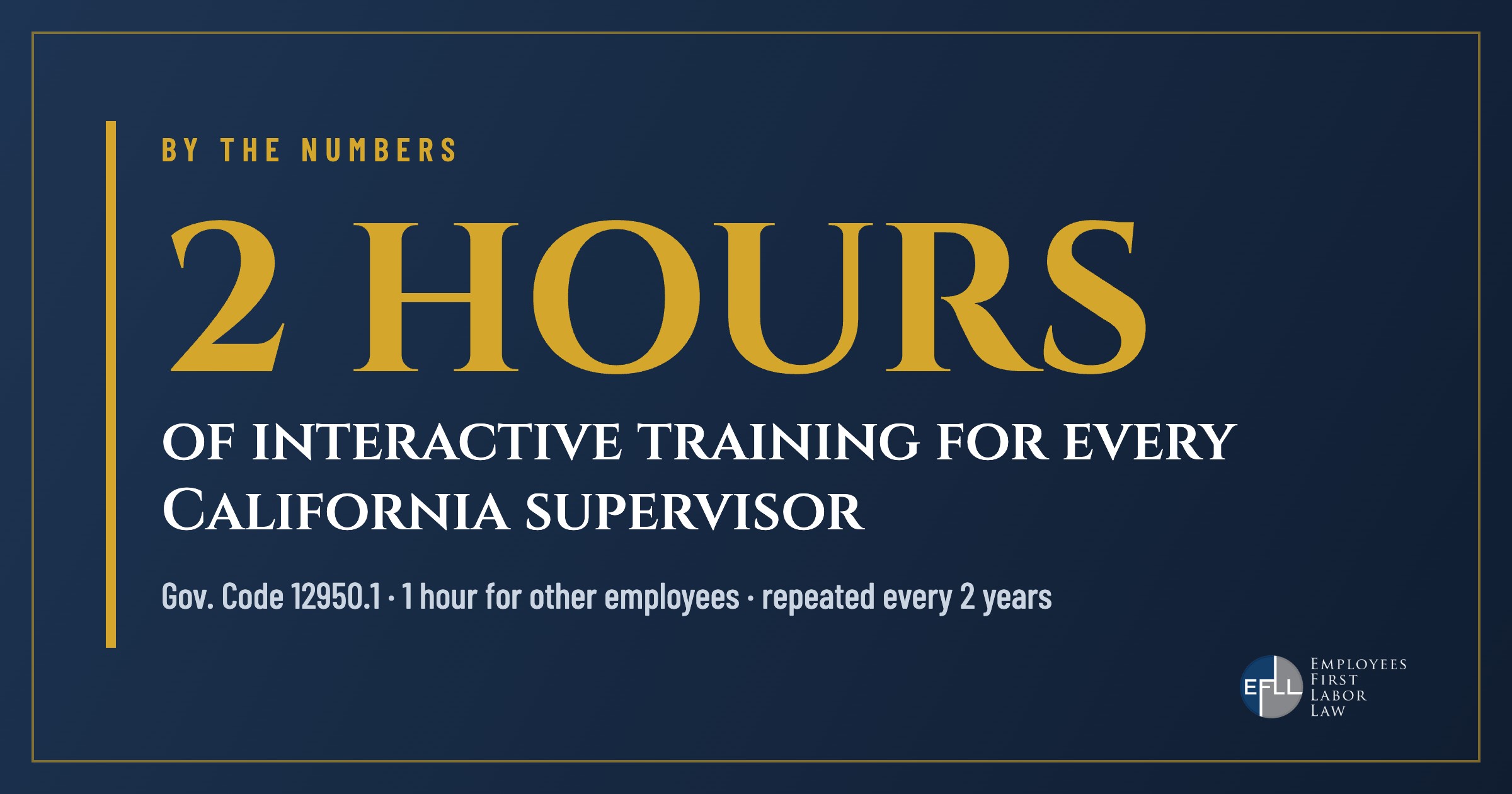
Under California’s sexual harassment training requirements, an employer with five or more employees must give every supervisor at least two hours, and every other employee at least one hour, of interactive sexual harassment prevention training, and repeat it once every two years. New hires and newly promoted supervisors must be trained within six months, and short-term seasonal and temporary workers even sooner. The core rule is Government Code section 12950.1, with detailed regulations from the California Civil Rights Department (CRD).
This matters to workers for a simple reason: training is one of the first places an employer tells you what harassment is, how to report it, and that retaliation is illegal. If your employer never trained anyone, never handed out a policy, or never told you how to complain without going through the person harassing you, that gap can become important evidence if harassment happens.
Below: who must train, how many hours and how often, what training must cover, the free CRD course, the required posters and policy, and what you can do if your employer skipped it.
- Employers with five or more employees (contractors count toward the five) must provide sexual harassment prevention training to employees in California every two years.
- Supervisors need at least two hours and other employees at least one hour, within six months of hire or promotion.
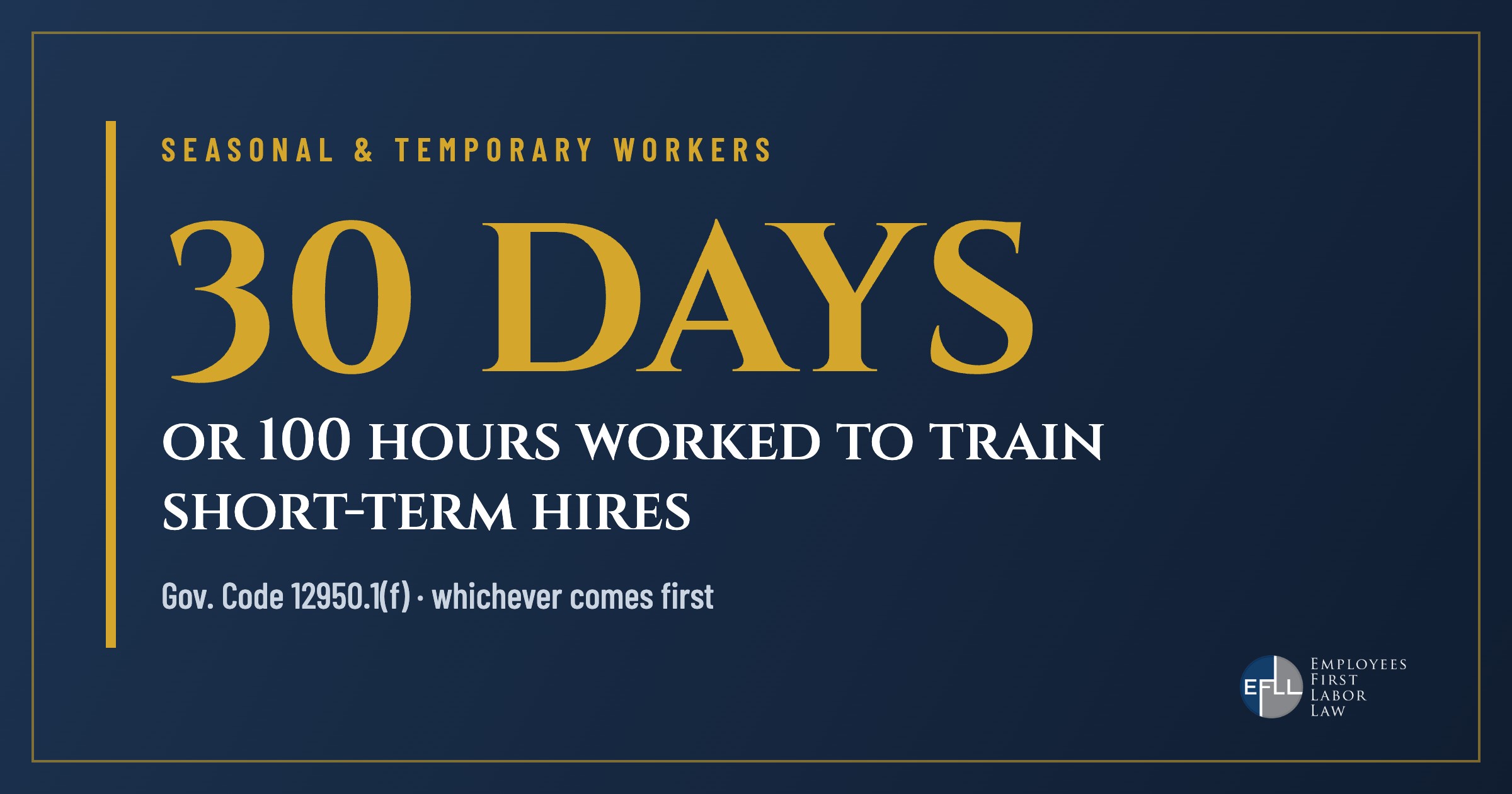
- Seasonal and temporary workers hired for under six months must be trained within 30 calendar days or 100 hours worked, whichever comes first.
- Employers must also post CRD notices, distribute a harassment information sheet and give you a written anti-harassment policy.
- Missing training alone rarely creates a lawsuit, but it can be strong evidence that your employer failed to prevent harassment (Gov. Code 12940(k)).
Who has to provide sexual harassment training in California?
The training mandate applies to any employer that regularly employs five or more people, or regularly receives services from five or more people working under a contract (Gov. Code § 12950.1(h)(1)). The state, cities and other public entities are covered too, regardless of size.
The CRD regulations add some important details about counting (Cal. Code Regs., tit. 2, § 11024(a)):
- Full-time, part-time and temporary workers all count as employees.
- For reaching the five-person threshold, unpaid interns, unpaid volunteers and independent contractors also count.
- The five do not have to work at the same location, and they do not all have to work or live in California.
Once an employer is covered, it must train its employees in California. Supervisors are people with authority to hire, fire, discipline, promote, assign or direct other employees, or to effectively recommend those actions, using independent judgment (Gov. Code § 12926(t)). Job titles do not control. A “lead” or “shift manager” who directs other workers may need the two-hour supervisor course.
Small employers are not off the hook for harassment itself. The training mandate starts at five employees, but California’s ban on harassment applies to employers with one or more employees (Gov. Code § 12940(j)(4)(A)).
California sexual harassment training requirements: hours and deadlines
The basic schedule is set by Government Code section 12950.1(a) and (f) and section 11024(b) of the CRD regulations. The training can be done alone or in a group, and it can be split into shorter segments as long as the total hours are met. Classroom and webinar segments must be at least half an hour each.
| Who | How much | Deadline | Source |
|---|---|---|---|
| Nonsupervisory employees | At least 1 hour | Within 6 months of hire, then every 2 years | Gov. Code § 12950.1(a)(1) |
| Supervisors | At least 2 hours | Within 6 months of becoming a supervisor, then every 2 years | Gov. Code § 12950.1(a)(1) |
| Seasonal, temporary or other workers hired for less than 6 months | 1 hour (2 for supervisors) | Within 30 calendar days of hire or 100 hours worked, whichever comes first | Gov. Code § 12950.1(f) |
| Workers placed by a temp agency | Same as above | The temp agency trains, not the client business | Gov. Code § 12950.1(f) |
| Minors ages 14 to 17 | Same as other employees | Within 6 months of hire (or of turning 14), then every 2 years | 2 CCR § 11024(b)(8) |
| Employees at a new business | Same as other employees | Within 6 months of the business being established, then every 2 years | 2 CCR § 11024(b)(3) |
A seasonal or temporary worker who is hired to work both fewer than 30 calendar days and fewer than 100 hours does not have to be trained (2 CCR § 11024(b)(9)). Employers may track the two-year cycle employee by employee or by a company-wide “training year,” and they must keep training records, including sign-in sheets, certificates and the training materials, for at least two years (2 CCR § 11024(b)(1)–(2)).
💡 Example: Maria (a hypothetical worker) is hired on Monday, March 2, for a four-month seasonal job and works 8 hours a day, Monday through Friday. Thirty calendar days after her hire date is April 1. But after 12 shifts she has worked 96 hours, and she passes 100 hours during her 13th shift on Wednesday, March 18. Because the law uses whichever deadline comes first, Maria’s employer must train her by March 18, two weeks earlier than the 30-day mark.
What the training must cover
California does not allow a five-minute video and a checkbox. The law requires “classroom or other effective interactive training,” presented by trainers with real knowledge of harassment prevention (Gov. Code § 12950.1(a)(1)). It must include:
- The federal and state laws prohibiting sexual harassment, and the remedies available to victims.
- Practical examples of harassment, discrimination and retaliation.
- Harassment based on gender identity, gender expression and sexual orientation, with practical examples (Gov. Code § 12950.1(a)(3)). Our guide to same-sex and LGBTQ sexual harassment covers these protections.
- Prevention of abusive conduct: malicious conduct a reasonable person would find hostile and offensive and unrelated to the employer’s legitimate business interests, such as repeated insults or sabotaging someone’s work (Gov. Code § 12950.1(a)(2), (h)(2)).
The CRD regulations add more required topics (2 CCR § 11024(c)(2)), including the types of conduct that count as harassment, supervisors’ duty to report harassment they learn about, the limited confidentiality of the complaint process, resources for victims, the employer’s obligation to investigate complaints, and what to do if a supervisor is personally accused.
The training also has to be interactive, with questions that check understanding and hypothetical scenarios to discuss (2 CCR § 11024(a)(2)(F)). An e-learning course must let you reach a trainer, who must answer within two business days.
Missing training and policies can strengthen a harassment claim. Talk to our attorneys in a free, confidential consultation.
The CRD’s free online training course
Employers do not have to buy a training program. The CRD offers two free online courses on its website: a one-hour course for nonsupervisory employees and a two-hour course for supervisors (Gov. Code § 12950.1(j)–(k)). An employer can simply direct employees to take the CRD course, and the law treats that as meeting the training requirement (Gov. Code § 12950.1(i)).
A few practical points from the statute and the CRD’s training page:
- The courses are available in English, Spanish, Chinese, Korean, Vietnamese and Tagalog, with closed captioning.
- At the end, you can save or print a certificate of completion. The CRD cannot email a replacement, so keep a copy for yourself as well as giving one to your employer.
- Questions about the course content go to your employer’s human resources department, not to the CRD.
Your own copy also helps if you change jobs, because compliant training from a prior employer within the last two years can count (Gov. Code § 12950.1(m)).
Posters, the CRD information sheet and a written policy
Training is only one part of the package. Under Government Code section 12950, every employer must also:
- Post the CRD’s workplace discrimination poster, which includes information about sexual harassment, in a prominent and accessible place.
- Post the CRD’s poster on transgender rights.
- Give each employee the CRD’s sexual harassment information sheet, or equivalent information covering what harassment is, examples, the employer’s internal complaint process, the CRD complaint process, protection against retaliation, and a link to the CRD’s online training. It must reach every employee, for example by including it with a paycheck.
The CRD regulations also require a written harassment, discrimination and retaliation prevention policy (2 CCR § 11023(b)). Among other things, the policy must list the protected categories, state that coworkers and third parties are prohibited from harassing as well as supervisors, offer a way to complain that does not require going to your immediate supervisor, promise a fair, timely and thorough investigation, and make clear that you will not be retaliated against for complaining. If at least 10 percent of the workforce at a facility speaks a language other than English, the policy must be translated into that language (2 CCR § 11023(e)).
What happens if your employer skips the training
Here is the honest answer: missing training alone usually does not give an individual employee a lawsuit. The statute says a claim that training “did not reach” a particular person does not, in and of itself, make the employer liable in a sexual harassment case (Gov. Code § 12950.1(c)). The CRD can seek an order requiring the employer to comply (§ 12950.1(d)).
The bigger issue is the employer’s broader duty. California law makes it unlawful for an employer to fail to take all reasonable steps necessary to prevent discrimination and harassment (Gov. Code § 12940(k)). The CRD regulations explain that this is not a stand-alone claim: to recover on it, you must also prove the underlying harassment, discrimination or retaliation (2 CCR § 11023(a)(2)).
So when harassment did happen, missing training, posters or a usable complaint policy can matter a great deal. It can support a failure-to-prevent claim, explain why you did not know where to report, and undercut an employer’s claim that it took harassment seriously. The statute calls the training a minimum threshold, not a substitute for taking all reasonable steps to prevent and correct harassment (Gov. Code § 12950.1(e)).
Training does not excuse harassment
The reverse is also true. An employer’s compliance with the training law “does not insulate” it from liability for sexual harassment (Gov. Code §§ 12950(f), 12950.1(c)). A completed course on file is not a defense to what actually happened to you.
Under the Fair Employment and Housing Act (FEHA):
- Harassment by coworkers is unlawful if the employer, or its agents or supervisors, knew or should have known about it and failed to take immediate and appropriate corrective action (Gov. Code § 12940(j)(1)).
- Harassment by customers, clients and other nonemployees follows a similar knew-or-should-have-known standard, taking into account how much control the employer has over those people (§ 12940(j)(1)).
- Harassment by supervisors is generally treated more strictly, and the employer can be responsible even if it did not know. See our guide to employer liability for sexual harassment.
- The individual harasser is personally liable for harassment they commit, regardless of what the employer knew (§ 12940(j)(3)).
FEHA protects employees, job applicants, unpaid interns, volunteers and certain contractors. Sexually harassing conduct does not have to be motivated by sexual desire (§ 12940(j)(4)(C)), and a single incident can be enough to create a triable issue of a hostile work environment if it unreasonably interfered with your work or created an intimidating, hostile or offensive environment (Gov. Code § 12923(b)).
What to do if you were harassed and never got training or a policy
If harassment is happening and your employer’s training or policy is missing, outdated or useless, these steps protect your rights:
- Write down what happened. Dates, times, places, exact words, and the names of anyone who saw or heard it. Do it as soon as you can, and keep the notes somewhere personal.
- Save what you have. Keep copies of any training certificate, the handbook or policy you received (or a note that you never got one), and texts, emails or messages related to the harassment.
- Report it in writing. Use any channel the employer offers. A compliant policy must give you a way to complain that does not require going to your immediate supervisor, such as human resources, another designated manager or a hotline (2 CCR § 11023(b)(5)). Our step-by-step guide on how to report sexual harassment at work walks through this.
- Watch for retaliation. It is illegal to fire, demote, cut hours or otherwise punish you for opposing harassment or filing a complaint (Gov. Code § 12940(h)). Learn more about retaliation claims in California.
- Know the deadlines. A FEHA claim generally must be filed with the CRD within three years of the unlawful practice (Gov. Code § 12960(e)(5)). After the CRD issues a right-to-sue notice, you generally have one year to file in court (Gov. Code § 12965(c)(1)(D)). Exceptions and tolling rules can change the math; see our sexual harassment statute of limitations guide.
- Get advice early. A sexual harassment attorney can review whether the facts support harassment, failure-to-prevent and retaliation claims, and what the employer’s training records may show.
Frequently asked questions
What are the California sexual harassment training requirements for small businesses?
The training mandate applies once an employer regularly has five or more employees or contractors, counted together, even if they work in different places or some work outside California (2 CCR § 11024(a)). An employer with fewer than five is not required to train, but it is still prohibited from allowing harassment, because FEHA’s harassment ban covers employers with one or more employees.
Does the training have to be in person?
No. Classroom training, live webinars and individualized e-learning can all qualify if they are interactive and meet the content rules, and the CRD’s free online course counts. Audio, video or computer materials used on their own, without classroom, webinar or e-learning training, do not meet the requirement (2 CCR § 11024(a)(2)(E)).
I took the training at my last job. Do I have to take it again?
Not necessarily. If you completed compliant training within the past two years with a current, prior, joint or alternate employer, your new employer must give you its anti-harassment policy to read and acknowledge within six months, and then track your next training from your last one. The new employer has the burden of showing the earlier training was compliant (Gov. Code § 12950.1(m)).
Can I sue my employer just because it never trained us?
Generally, no. Missing training alone does not create liability, and the failure-to-prevent claim under Gov. Code § 12940(k) requires an underlying harassment, discrimination or retaliation claim. But if you were harassed, the absence of training or a complaint policy can be strong evidence that your employer failed to take reasonable steps to prevent it.
Related guides
 Workers only. Never employers.
At Employees First Labor Law, we represent California workers only, never employers. Our team has recovered more than $200 million for our clients, and we prepare every case as if it is going to trial. We have offices in Pasadena, Irvine, Long Beach, Pomona, Riverside, Bakersfield and Fresno, and we serve workers throughout California. Meet our team.






If you were harassed at work in California, we can review what happened, what your employer did (or failed to do) to prevent it, and the deadlines that apply to you. We represent employees only and offer free, confidential consultations.
- ✅ Free, confidential consultation
- ✅ We represent workers only, never employers
- ✅ Se habla español: Empleados Primero
This article provides general information about California law and is not legal advice for any specific situation. Reading it does not create an attorney-client relationship. Past results do not guarantee a similar outcome.