
Updated October 2026 · 10 min read
To dispute a QME or AME report in California workers’ comp, you challenge the report itself: send a written objection, ask the doctor for a supplemental report, depose the doctor, move to strike or replace the evaluator when the rules were broken, and, if needed, ask a workers’ compensation judge to give the report little or no weight. Which tool fits depends on what went wrong and on whether you have a lawyer.
This matters because the medical-legal report often decides the case. A QME who leaves out a body part, misreads your MRI or applies the wrong apportionment can cut a permanent disability rating by many points, and every point changes how many weeks of benefits you receive.
Below are the options step by step, the deadlines, the rules on late reports and improper contact with the doctor, the 2025 change to replacement panels, and new QME rules for 2026 and 2027.
- You dispute a QME report by challenging the report itself: written objections, supplemental report requests, a deposition of the doctor, and argument to the WCAB judge.
- A QME or AME generally must serve the report within 30 days of the exam. To get a new evaluator for a late report, you must object in writing before the report is served.
- Prohibited ex parte contact with the evaluator lets the aggrieved party end the evaluation and seek a new one (Labor Code §4062.3).
- Since Vazquez v. Renteria (2025), only the WCAB decides whether a replacement QME panel is valid.
- Unrepresented workers have 30 days to request a factual correction of the report and 30 days to seek reconsideration of a DEU rating.
Why the QME or AME report matters so much
When you or the insurer disagree with your treating doctor about causation, work restrictions, permanent impairment or future medical care, the dispute goes to a medical-legal evaluator. In most cases that is a Qualified Medical Evaluator (QME) or, if you have an attorney, possibly an Agreed Medical Evaluator (AME).
The report usually answers the questions that drive your claim’s value:
- Whether the injury or illness is work-related
- Whether you have reached maximum medical improvement (MMI)
- Your whole person impairment, which becomes your permanent disability rating
- Apportionment to prior injuries or other causes
- Work restrictions and future medical care
The Workers’ Compensation Appeals Board (WCAB) relies on written reports: under WCAB Rule 10682 (8 CCR §10682), live medical testimony at trial is allowed only for good cause. If a wrong report goes unchallenged, it can become the basis of your award.
QME vs. AME: who wrote your report?
The way you dispute a report depends partly on who wrote it. For a fuller comparison, see our guide to QME vs. AME in California workers’ comp.
- Panel QME. The DWC Medical Unit issues a panel of three state-certified doctors. Insurers do not handpick panel QMEs. If you have no lawyer, you choose one doctor from the panel and schedule the exam within 10 days (Labor Code §4062.1(c)); see our post on the panel QME process for unrepresented workers. If you have a lawyer, each side strikes one name within 10 days and the remaining doctor is the QME (Labor Code §4062.2(c)); see the panel process for represented workers.
- AME. Only available if you are represented. Your attorney and the defense agree on one doctor (Labor Code §4062.2(f)). An unrepresented worker cannot use an AME (Labor Code §4062.1(a)).
Because both sides chose the AME, its opinion is much harder to escape. You can still depose an AME, request a supplemental report and challenge an opinion that is not well reasoned, but you generally cannot replace an AME just because you dislike the result.
Watch: injured at work in California
Our attorneys explain what your employer must do after a work injury, and what to do in the first 24 hours to protect your claim.
Red flags: signs a report may be wrong or one-sided
A QME is supposed to be neutral, and most disputes involve errors and gaps rather than provable bias. Look for:
- A medical history that is wrong or leaves out the mechanism of injury
- Records you know exist (MRI, surgery, nerve studies) that the report never mentions
- A body part or condition you claimed that the doctor did not evaluate
- Apportionment percentages with no explanation of how the doctor reached them
- Conclusions that do not match the doctor’s own exam findings
- No discussion of how your impairments affect your activities of daily living
WCAB Rule 10682 lists what a report should contain, including the records reviewed, causation, apportionment and “the reasons for the opinion,” and Labor Code §4062.3(d) requires the evaluator to identify everything received, reviewed and relied on. A report that skips these steps is open to attack.
Our workers’ comp attorneys review QME and AME reports and can tell you which options fit your case. The consultation is free.
How to dispute a QME report: your options at a glance
| Problem with the report | Main tool | Rule |
|---|---|---|
| Missing records, unanswered questions, unclear reasoning | Objection letter and request for a supplemental report | 8 CCR §38(i): answer due within 60 days |
| Factual errors (unrepresented worker) | Request for factual correction | Labor Code §4061(d); 8 CCR §37: within 30 days of receiving the report |
| Opinions you need to test under oath | Deposition and cross-examination of the doctor | Transcript becomes part of the medical record |
| Report served late with no approved extension | Object before the report is served, then request a new evaluation | Labor Code §4062.5; 8 CCR §§31.5(a)(12), 38 |
| Improper one-sided contact with the evaluator | Terminate the evaluation and seek a new one, plus costs | Labor Code §4062.3(g)–(h) |
| Report is not substantial evidence | Ask the WCAB judge to give it no weight or develop the record | Declaration of Readiness, MSC, trial |
| Disputed summary rating (unrepresented) | Request reconsideration of the DEU rating | Labor Code §4061(g): within 30 days of receiving the rating |
Step 1: Objection letter and supplemental report request
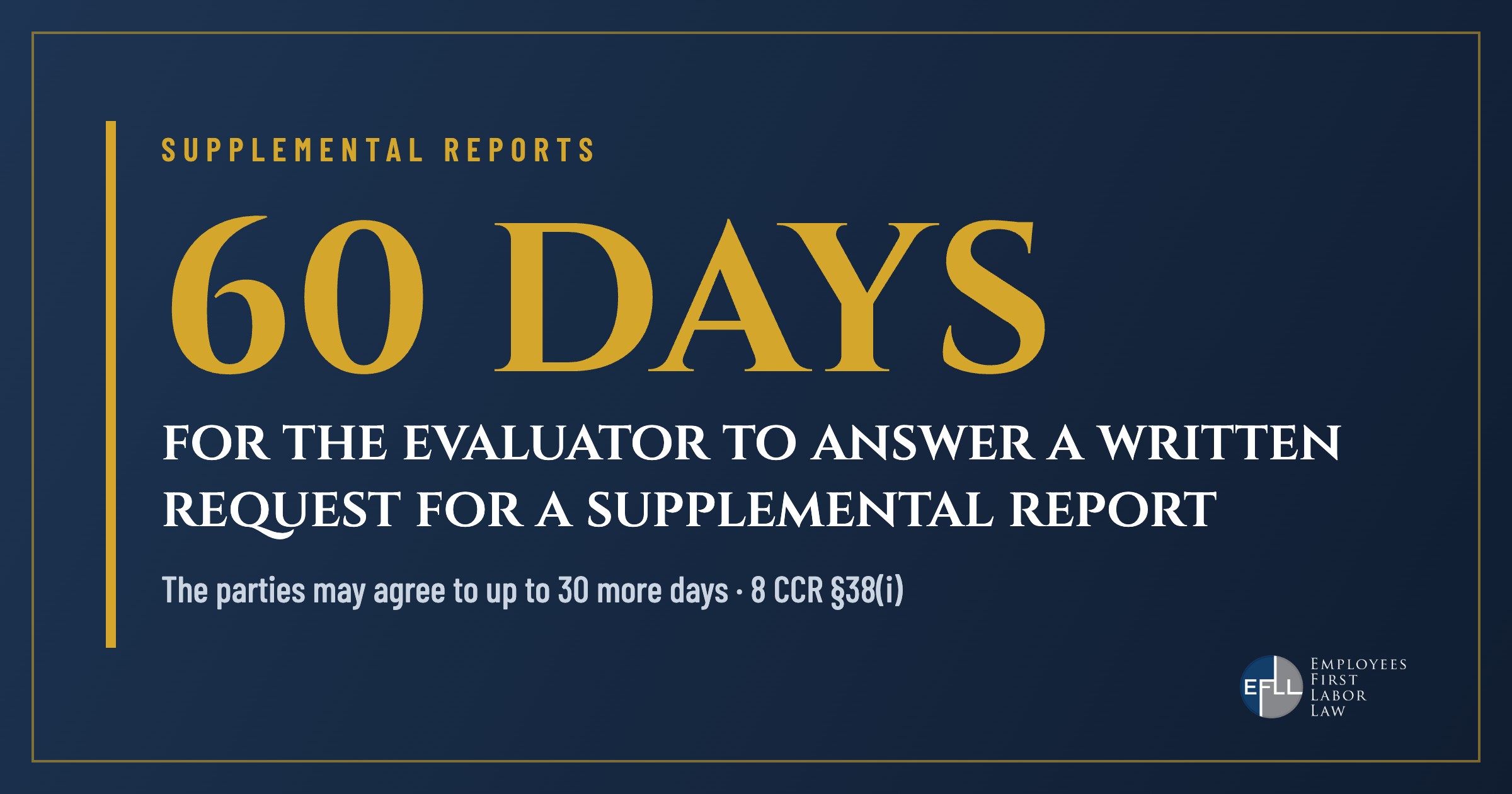
The first and most common move is a written letter to the evaluator that points out what the report missed and asks specific questions. The doctor then issues a supplemental report. Under 8 CCR §38(i), the evaluator has no more than 60 days from a written request to respond, and the parties can agree to up to 30 more days.
Good requests are specific: review this record, address this body part, explain this apportionment figure. New records sent with the request must first be served on the other side (Labor Code §4062.3), and all communication with a panel QME must be in writing and copied to the opposing party.
If you do not have a lawyer, you can also request one correction of factual errors within 30 days of receiving the report (Labor Code §4061(d); 8 CCR §37). This covers facts, such as a wrong date or history, not disagreement with the doctor’s opinion.
💡 Example: Luis claimed injuries to his shoulder and neck. The panel QME rated the shoulder but never mentioned the neck, even though his treating doctor’s records describe it. His attorney sends a supplemental request enclosing the properly served neck records and asks the QME to address the cervical spine. If the QME finds ratable impairment in the neck, it can be included in his rating.
Step 2: Depose the QME and cross-examine the doctor
If a supplemental report does not fix the problem, your attorney can take the evaluator’s deposition. The doctor answers questions under oath in front of a court reporter, and the transcript becomes part of the medical evidence the judge reviews.
Since live medical testimony at trial is rare, the deposition is where cross-examination happens. It can:
- Show the doctor did not review key records or misunderstood your job duties
- Get the doctor to explain, or abandon, an apportionment figure with no stated basis
- Test whether the rating follows the AMA Guides and the rating schedule
Striking or replacing the evaluator: late reports, ex parte contact and replacement panels
Late reports
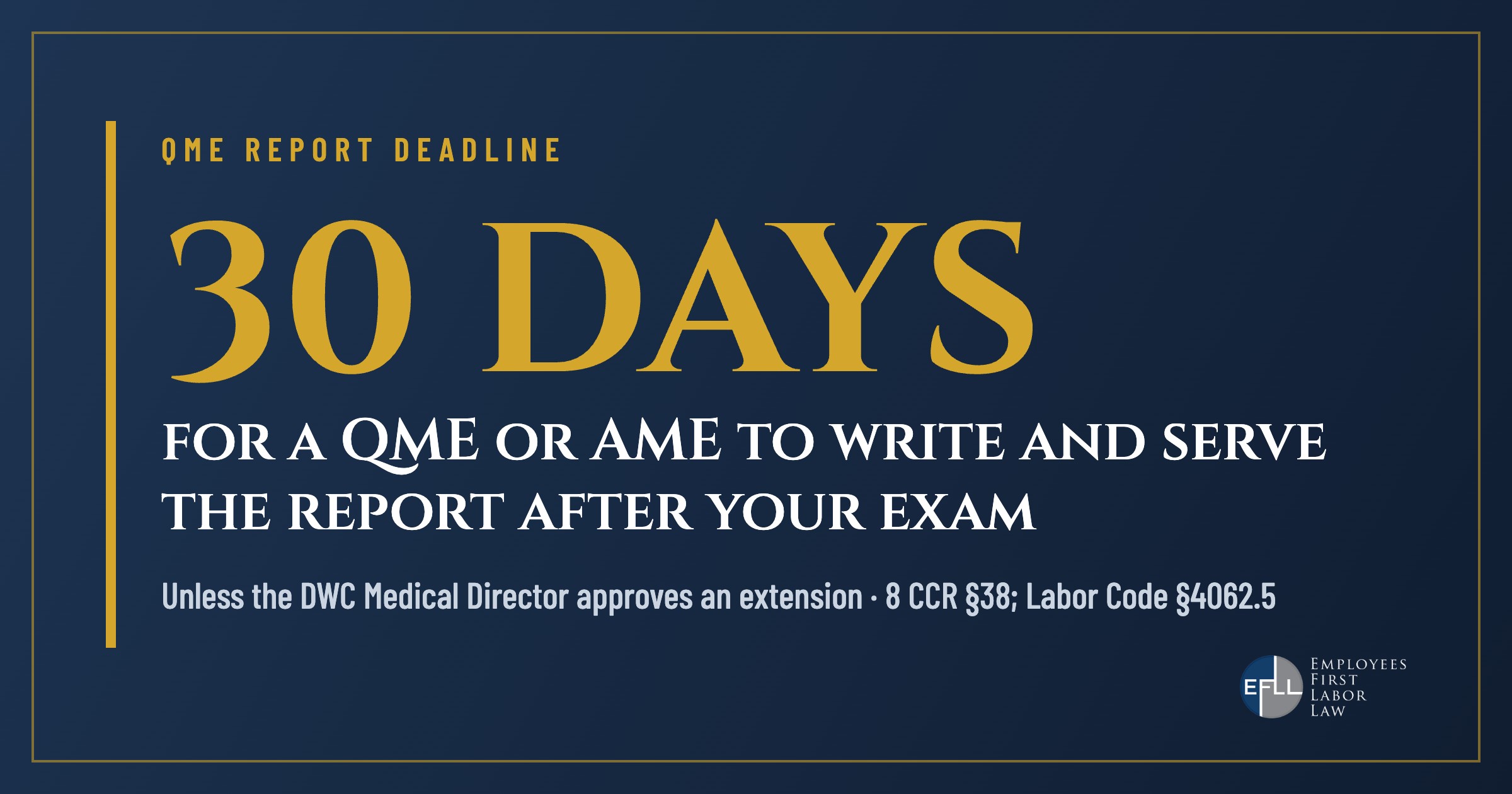
A QME or AME must prepare and serve the report within 30 days of the exam unless the DWC Medical Director approves an extension (8 CCR §38(a)–(c)). If a panel QME misses the deadline, either party may obtain a new evaluation (Labor Code §4062.5). The regulations add an important condition: the party asking for a replacement must have objected to the report as late, in writing, before the evaluator served it (8 CCR §31.5(a)(12)). Once a late report arrives without that objection, the remedy is usually gone.
Ex parte (one-sided) communication
Communications with a panel QME must be in writing and served on the other side, and ex parte communication with a QME or AME is prohibited (Labor Code §4062.3(e)–(g)). If the other side violates this rule, the aggrieved party may elect to terminate the evaluation and seek a new one from another QME, or proceed with the original evaluation. The party that made the improper contact can be charged with contempt and must pay the resulting costs, including attorney’s fees for related discovery (Labor Code §4062.3(h)). In Suon v. California Dairies (2018, en banc), the WCAB held that a party choosing to terminate must do so within a reasonable time after discovering the contact.
Replacement panels after Vazquez
8 CCR §31.5 lists the grounds for a replacement QME or panel, such as a doctor in the wrong specialty, a conflict of interest, or a QME who cannot schedule the exam within 90 days of the appointment request (120 days if the party scheduling the exam waived the 90-day limit). In Vazquez v. Renteria (2025-EB-01, May 19, 2025), the WCAB held en banc that only the Appeals Board has jurisdiction to decide whether a replacement panel is valid. In a represented case, replacement because a QME is unavailable within the regulatory timeframes is not automatic. The judge may order it for good cause after weighing factors such as the length of the delay, the prejudice to each side and efforts to fix the scheduling problem. The Board applied the decision prospectively.
Unrepresented workers have one more protection. If the evaluator shows bias against you because of race, sex, national origin, religion or sexual orientation, or asks you to undergo an unnecessary medical procedure, you may have good cause to end the exam and receive a new panel (Labor Code §4062.1(d)).
Ask the WCAB judge to reject or limit the report
If the dispute cannot be resolved informally, your attorney can file a Declaration of Readiness to Proceed and take the issue to a Mandatory Settlement Conference and, if needed, trial before a workers’ compensation judge. Our guide to workers’ comp hearings, the MSC and trial explains those stages.
A judge can rely only on medical evidence that is substantial: based on an accurate history, an adequate exam and stated reasoning. If a report falls short, the judge can give it little or no weight, rely on other reports in the record such as your primary treating physician’s, or order further development of the record. In Vigil v. County of Kern (2024-EB-03), for example, the WCAB returned a case for further development because the QME failed to discuss how the worker’s impairments affected his activities of daily living.
If you don’t have a lawyer: DEU ratings and reconsideration
When an unrepresented worker sees a panel QME, the report goes to the DWC’s Disability Evaluation Unit (DEU). The DEU calculates a permanent disability rating within 20 days of receiving the report (Labor Code §4061(e)). Our guide to how permanent disability ratings work explains what the number means in dollars.
Within 30 days of receiving the rating, you or the employer may ask the Administrative Director to reconsider it, in writing, stating the reasons and serving the other side (Labor Code §4061(g)).
Timing matters if you plan to hire a lawyer: a worker evaluated while unrepresented who later hires an attorney is not entitled to an additional evaluation for that reason (Labor Code §4062.1(e)).
New QME rules for 2026 and 2027
- Anti-bias training for QMEs (8 CCR §55.1). QMEs applying for reappointment on or after April 1, 2026 must complete 16 hours of continuing education, including at least 2 hours of anti-bias training and 3 hours on medical-legal report writing (DWC Newsline 2026-11).
- A standard QME report template is coming, but is not here yet. AB 1293 (Ch. 298, Stats. 2025) added Labor Code §4062.4, which directs the DWC to develop a template QME report form and a request form for communicating with a panel QME, with regulations due by January 1, 2027. The statute also says using the template does not by itself prove a report is complete, accurate or compliant.
What to do when you receive a bad QME report
- Note the date you received the report. Several deadlines run from receipt.
- Read it against your records: history, every body part claimed, records list, apportionment.
- List specific errors. “The doctor did not review my MRI” is useful; “the doctor was unfair” is not.
- Check timing problems. If a report is late and has not been served yet, a written objection must go out before it arrives.
- Request a supplemental report (or a factual correction if unrepresented), with properly served records.
- Consider a deposition if the doctor’s reasoning needs to be tested under oath.
- Talk to a workers’ comp attorney before signing any settlement based on the disputed report.
Frequently asked questions
Can I get a new QME if I disagree with the report?
Not just because you disagree. A new evaluator generally requires a specific ground, such as a late report you objected to before it was served, prohibited ex parte communication, a conflict of interest, or another reason listed in 8 CCR §31.5. Under Vazquez, the WCAB decides whether a replacement panel is valid. Disagreement alone is handled through supplemental reports, deposition and argument to the judge.
How long does a QME have to write the report?
Thirty days from the exam, unless the DWC Medical Director grants an extension: 15 days for good cause, or up to 30 days when the doctor is waiting on test results or a consultant’s report (8 CCR §38). Supplemental reports are due within 60 days of a written request.
How do I dispute a QME report if I don’t have a lawyer?
Within 30 days of receiving the report, you can request a factual correction. Within 30 days of receiving the DEU rating, you can request reconsideration. A DWC Information and Assistance officer can explain the forms. Many workers also choose to consult an attorney at this stage.
Can I dispute an AME report?
Yes, through supplemental reports, deposition and argument to the judge that the opinion is not substantial evidence. Because both sides agreed to the AME, replacing one is much harder than replacing a panel QME.
Related guides
 Workers only. Never employers.
At Employees First Labor Law, we represent California workers only, never employers. Our team has recovered more than $200 million for our clients, and we prepare every case as if it is going to trial. We have offices in Pasadena, Irvine, Long Beach, Pomona, Riverside, Bakersfield and Fresno, and we serve workers throughout California. Meet our team.







If a QME or AME report undervalues your injury, ignores your records or was served late, we can review it, request supplemental reports, depose the evaluator and present your case to the WCAB. We represent injured workers only, never employers or insurers.
- ✅ Free, confidential consultation
- ✅ We represent workers only, never employers
- ✅ Se habla español: Empleados Primero
This article provides general information about California law and is not legal advice for any specific situation. Reading it does not create an attorney-client relationship. Past results do not guarantee a similar outcome.