
Updated October 2026 · 10 min read
Yes. In California, PTSD caused by your job can be covered by workers’ compensation as a psychiatric injury, but only if you meet the stricter rules in Labor Code section 3208.3. Those rules cover how the condition is diagnosed, how much of it your work caused, and how long you worked for the employer.
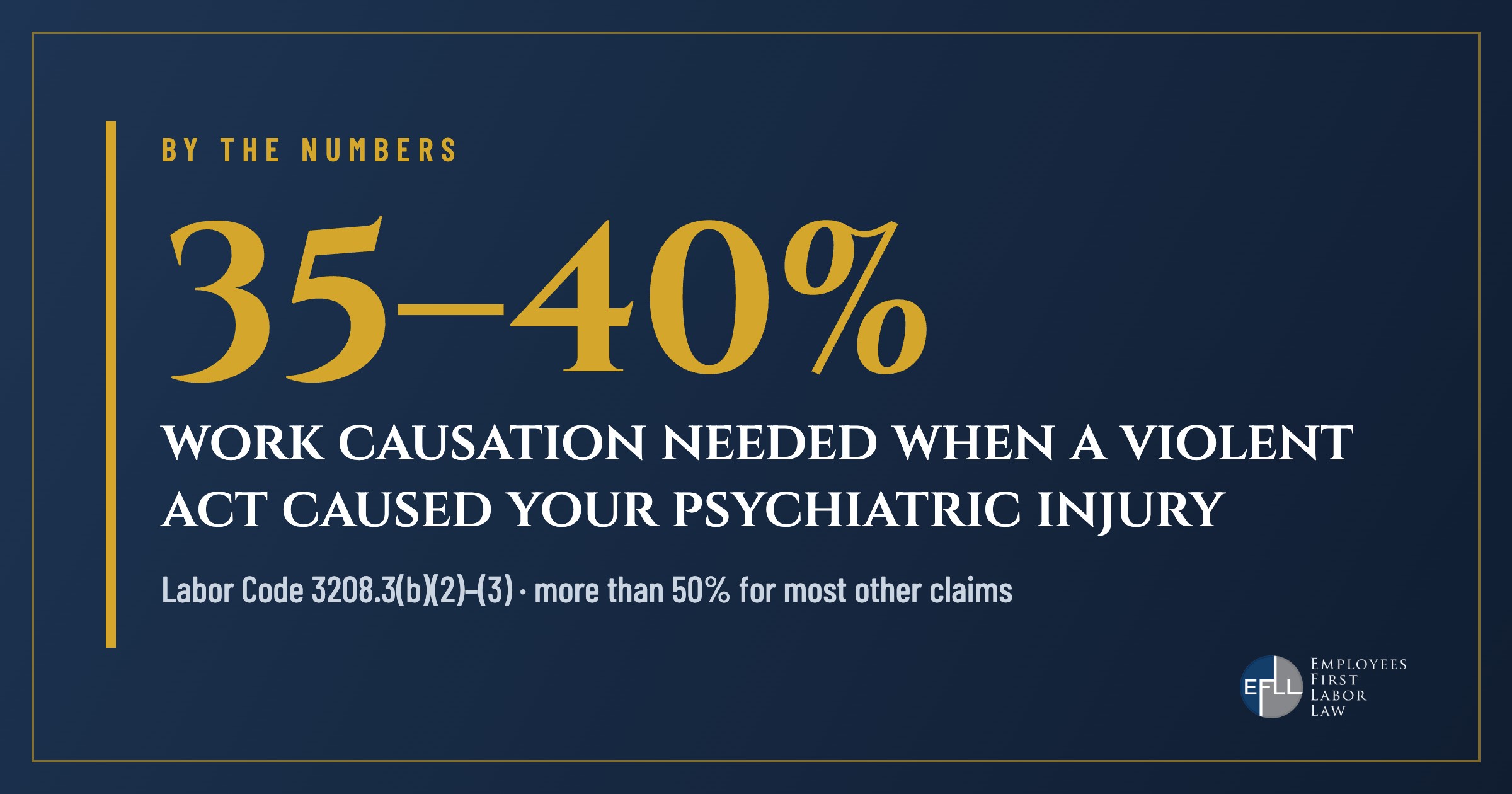
The details matter. A worker who was assaulted on the job only has to show that work was at least 35 to 40 percent of the cause. Most other workers have to show it was more than half. Most workers also have to have been on the job at least six months. If you miss the 30-day window to report the injury in writing, the insurer has one more argument against you.
This guide covers what PTSD is, the California rules for a psychiatric claim, how acute stress disorder differs from PTSD, the special presumption for firefighters and peace officers, the benefits you can receive, the deadlines, and what to do after a traumatic event at work.
- PTSD can be covered as a psychiatric injury under Labor Code 3208.3 if work was the predominant cause (more than half), or at least 35 to 40 percent of the cause if you were the victim of, or directly exposed to, a significant violent act.
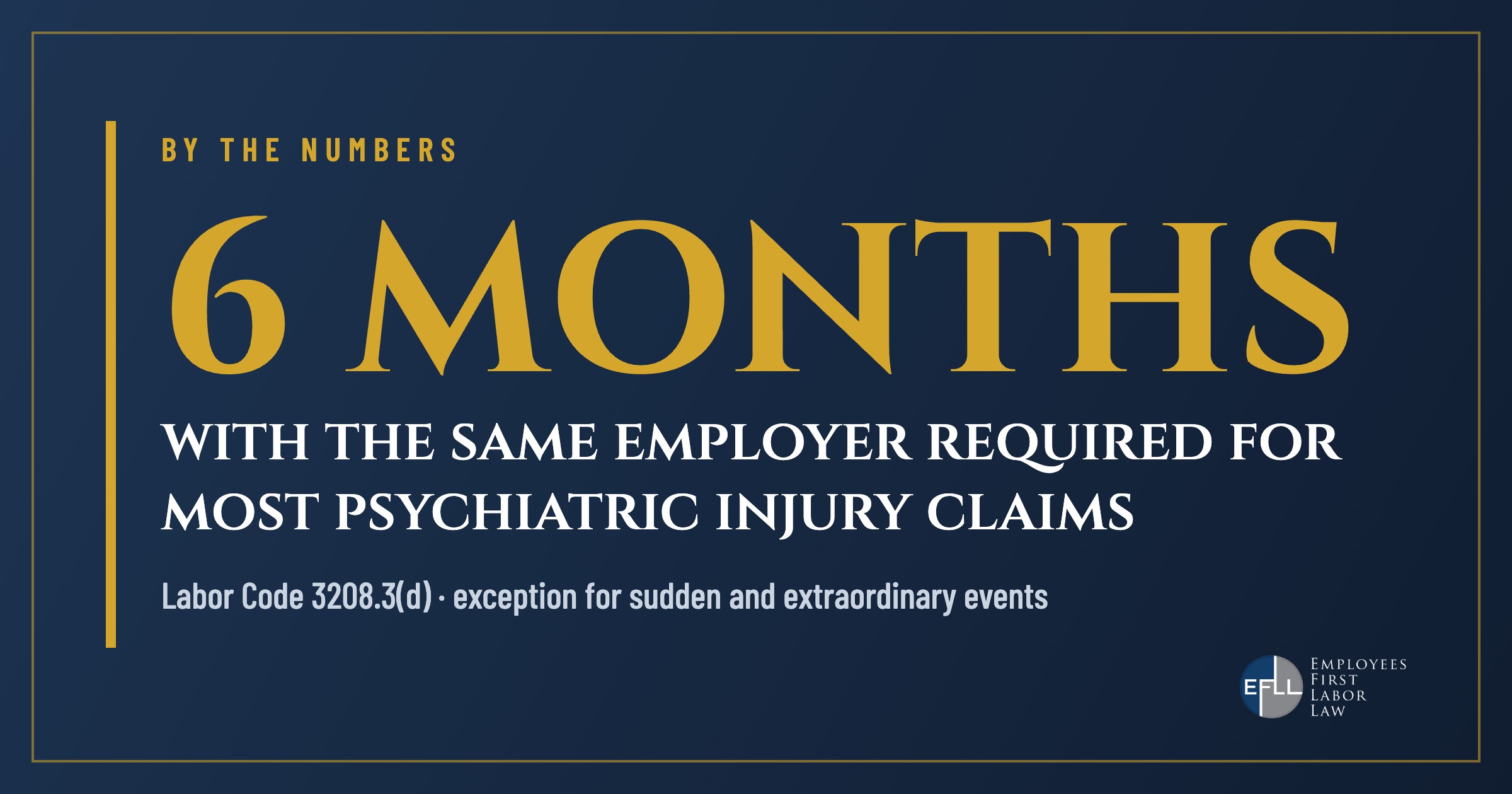
- You generally need six months with the employer, unless a sudden and extraordinary employment condition caused the injury.
- Acute stress disorder lasts 3 days to 1 month after the trauma; PTSD lasts more than a month, and both follow the same workers’ comp rules.
- Certain firefighters and peace officers get a rebuttable presumption that their PTSD is work-related (Labor Code 3212.15).
- Report the injury in writing within 30 days and ask for a DWC-1 claim form; once you file it, your employer must authorize up to $10,000 in treatment while it decides the claim.
What PTSD Is and What Can Cause It at Work
PTSD (post-traumatic stress disorder) is a mental health condition that can develop after you experience or witness a traumatic event, one that involves actual or threatened death, serious injury, or sexual violence. Some workers, such as first responders, develop it after repeated exposure to the details of traumatic events. Common workplace triggers include:
- Workplace violence or physical assault
- Serious or fatal accidents
- Repeated exposure to trauma (for example, first responders, nurses, and security personnel)
- Sexual assault
- Being threatened with a weapon or with serious violence
- Sudden, catastrophic incidents like explosions or machinery failures
Symptoms can include flashbacks or nightmares, panic attacks or heightened anxiety, emotional numbness, irritability, trouble sleeping, and avoiding people, places, or situations connected to the trauma. Only a licensed clinician can diagnose PTSD.
Ongoing harassment, bullying, or discrimination can also cause serious psychiatric injuries, such as depression or an anxiety disorder, even when they don’t meet the clinical definition of PTSD. Those injuries fall under the same workers’ comp rules. Our guide to workers’ comp for psychological injuries in California covers them.
The California Rules for a PTSD Claim
Under Labor Code section 3208.3, a psychiatric injury like PTSD is generally covered when all four of these are true:
- A clinician diagnoses a mental disorder using recognized psychiatric criteria (the DSM), and it causes disability or a need for medical treatment.
- Your work was the predominant cause, meaning more than half of all causes combined. If you were the victim of a violent act or were directly exposed to a significant violent act, work only has to be a substantial cause, which means at least 35 to 40 percent.
- You worked for that employer for at least six months (the months don’t have to be in a row), unless the injury was caused by a sudden and extraordinary employment condition.
- The injury was not substantially caused by a lawful, nondiscriminatory, good-faith personnel action, such as a legitimate disciplinary or termination decision. The employer has the burden of proving this defense.
Courts read the “sudden and extraordinary” exception narrowly. It covers events that are uncommon, unusual, and unexpected, not routine ones. Even a serious but ordinary accident, like a slip and fall, may not qualify. Different rules also apply if you file your claim after receiving a notice of termination or layoff, so talk to a lawyer before you file in that situation.
💡 Example: Ana has worked at a warehouse for two years when a coworker attacks her on the loading dock. Her psychologist diagnoses PTSD and finds that the assault caused 40 percent of her condition and stress outside work caused the rest. Work is not more than half of the cause. But Ana was the victim of a violent act, so work only has to be at least 35 to 40 percent of the cause, and 40 percent meets that standard. She has also worked there more than six months. (Hypothetical, for illustration only.)
Watch: injured at work in California
Our attorneys explain what your employer must do after a work injury, and what to do in the first 24 hours to protect your claim.
Acute Stress Disorder vs. PTSD
Not every trauma reaction is PTSD. After a traumatic event at work, many people have strong stress reactions, and most recover over time. When the reaction is severe in the first weeks after the event, a clinician may diagnose acute stress disorder (ASD). The main difference between ASD and PTSD is timing.
| Category | Acute Stress Disorder (ASD) | Post-Traumatic Stress Disorder (PTSD) |
|---|---|---|
| Timing | Symptoms last at least 3 days and less than 1 month after the trauma | Symptoms last more than 1 month. They usually start within 3 months, but sometimes later. |
| Type of event | Actual or threatened death, serious injury, or sexual violence, whether you experienced it, witnessed it, or were exposed to its details again and again on the job (as first responders often are) | The same kinds of events as ASD |
| Symptoms | At least 9 of 14 listed symptoms involving intrusive memories, negative mood, dissociation, avoidance, and arousal | Symptoms in four groups: intrusion, avoidance, negative changes in thinking and mood, and changes in arousal and reactivity |
| Usual treatment | Self-care and psychotherapy, mainly trauma-focused cognitive behavioral therapy | Psychotherapy, medication, or both |
| In a workers’ comp claim | Same Labor Code 3208.3 rules as any psychiatric injury. If symptoms fully resolve, the claim may center on treatment and any time off work. | Same 3208.3 rules. Longer-lasting symptoms may also support a permanent disability rating. |
How each is diagnosed
Both diagnoses come from the American Psychiatric Association’s Diagnostic and Statistical Manual of Mental Disorders (DSM-5-TR), and only a licensed clinician can make them. California workers’ comp also requires that a psychiatric injury be diagnosed using recognized psychiatric criteria like these. This guide is general information, not medical advice. If you’re struggling after a traumatic event at work, see a licensed mental health professional. If you’re in crisis, call or text 988 to reach the 988 Suicide & Crisis Lifeline at any hour.
When acute stress turns into PTSD
If your symptoms last longer than a month, your doctor may evaluate you for PTSD. According to the American Psychiatric Association, about half of people with acute stress disorder go on to have PTSD. Research also shows that most people who develop PTSD did not first meet the criteria for acute stress disorder. Feeling “okay” in the first few weeks does not rule out PTSD later. Keep telling your treating doctor about every symptom, including symptoms that last or get worse, so your records show how your condition has changed.
PTSD claims face stricter rules than physical injuries and are often denied or minimized. Talk to our workers’ comp team in a free, confidential consultation.
The PTSD Presumption for Firefighters and Peace Officers
Certain firefighters and peace officers get a presumption under Labor Code section 3212.15 that PTSD which develops or shows up during their service is work-related. The law covers:
- Active firefighters in listed fire departments, including, for injuries on or after January 1, 2026, departments that protect commercial airports
- Specified peace officers primarily engaged in active law enforcement
- A few related public-safety roles
The presumption does not cover every first responder. Public safety dispatchers, for example, are not covered. The presumption is also rebuttable: the employer can still try to disprove it with other evidence. The section has its own six-month service requirement, with an exception for sudden and extraordinary employment conditions. The law is currently set to expire on January 1, 2029, unless the Legislature extends it.
Benefits You Can Receive for PTSD
If your PTSD claim is accepted, you may receive the following benefits.
Medical treatment
This can include psychotherapy or counseling, psychiatric medication, and inpatient or outpatient treatment. Learn more about your medical treatment rights in California workers’ comp.
Temporary disability
If your condition keeps you from working while you recover, temporary disability generally pays two-thirds of your gross (pre-tax) lost wages, within a state minimum and maximum. For injuries in 2026, the weekly temporary total disability rate ranges from $264.61 to $1,764.11. For injuries on or after January 1, 2008, temporary disability is generally limited to 104 weeks within five years from the date of injury.
Permanent disability
Permanent disability is paid if PTSD leaves you with a lasting disability that affects your ability to earn a living. If your PTSD developed as a result of a physical work injury that happened on or after January 1, 2013, California law generally does not allow the psychiatric condition to increase your permanent disability rating. There are two exceptions: you were the victim of, or directly exposed to, a significant violent act, or the physical injury was catastrophic (for example, loss of a limb, paralysis, a severe burn, or a severe head injury). Either way, you can still get treatment for the psychiatric condition.
Supplemental job displacement benefit
For injuries on or after January 1, 2013, you can receive a $6,000 retraining voucher if you have a permanent partial disability and your employer does not offer you regular, modified, or alternative work.
Why Insurers Deny or Minimize PTSD Claims
PTSD and other psychiatric claims are often denied or minimized. Insurance companies commonly argue that:
- The trauma was unrelated to your job, or stress outside work caused your symptoms
- Your symptoms are exaggerated
- A personnel action, like discipline or a termination, caused your stress
- You worked there less than six months and the event wasn’t “sudden and extraordinary”
- You aren’t credible because you have no physical injury
These defenses can often be overcome with strong evidence. That means a careful psychiatric evaluation, witness statements, and workplace records such as incident reports, security footage, and police reports. Treatment records that show your symptoms began after the event help as well. If your claim has already been turned down, see our guide on what to do after a denied workers’ comp claim.
Deadlines for a PTSD Workers’ Comp Claim
Psychiatric injuries often surface weeks after the event. These deadlines still apply, so don’t wait to see whether the symptoms pass.
| Step | Deadline | Law |
|---|---|---|
| Tell your employer about the injury in writing | Within 30 days | Labor Code 5400 |
| Employer gives or mails you a claim form (DWC-1) | Within one working day after it learns of the injury | Labor Code 5401 |
| Employer authorizes medical treatment (up to $10,000 while the claim is decided) | Within one working day after you file the claim form | Labor Code 5402(c) |
| Employer accepts or denies the claim | 90 days after the claim form is filed, or 75 days for presumption injuries such as section 3212.15 PTSD. If it doesn’t deny in time, the injury is presumed compensable. | Labor Code 5402(b) |
| File with the Workers’ Compensation Appeals Board | Generally within one year of the injury, the last disability payment, or the last medical treatment provided | Labor Code 5405 |
What to Do After a Traumatic Event at Work
- Get safe and get care. See a doctor or licensed mental health professional, and tell them the symptoms began after a work event.
- Report the injury in writing within 30 days. Do this even if you hope the symptoms will pass.
- Ask for a claim form (DWC-1), fill it out, and return it to your employer. Keep a copy.
- Keep your treating doctor informed about every symptom, including symptoms that last or get worse.
- Write down your symptoms and triggers, along with the names of witnesses and any incident or police report numbers.
- Don’t discuss your claim on social media.
- Talk to a workers’ comp attorney before you give a recorded statement or sign a settlement.
PTSD From Harassment, Retaliation, or Violence: Other Claims
A workers’ comp claim is often the tip of the iceberg. Many PTSD claims arise from workplace misconduct, such as sexual harassment or assault, racial harassment, retaliation after reporting safety violations, or a hostile work environment. In those cases, you may have both a workers’ compensation claim and a civil lawsuit under California’s Fair Employment and Housing Act (FEHA) or other employee protections. We handle both tracks to pursue full compensation for you.
If you were attacked at work or saw a violent act happen, read our guide on what to do if you witness or experience a violent act at work. Violent acts get special treatment in California psychiatric claims, including the lower 35 to 40 percent causation threshold described above.
Frequently asked questions
Is PTSD covered by workers’ comp in California?
It can be. PTSD is a psychiatric injury under Labor Code section 3208.3. Your claim must meet that section’s rules on diagnosis, causation, length of employment, and personnel actions, which are explained above.
Can I file a workers’ comp claim for acute stress disorder?
Yes, if it meets the same section 3208.3 rules. Acute stress disorder is a recognized psychiatric diagnosis. If it causes disability or a need for treatment, it can support a claim even if it resolves within a month.
Do firefighters and police officers have to prove their PTSD is work-related?
Not if they are covered by Labor Code section 3212.15. Covered firefighters and peace officers get a presumption that their PTSD is work-related, but the employer can rebut it with other evidence. For these presumption injuries, the employer generally has 75 days, instead of 90, to deny the claim before it is presumed compensable.
What if the insurance company doesn’t decide my claim?
If your employer doesn’t deny the claim within 90 days after you file the claim form, the injury is presumed compensable. While the claim is being decided, your employer must authorize up to $10,000 in medical treatment.
Should I accept a PTSD settlement offer?
Talk to a workers’ comp attorney before you sign anything. A California workers’ comp settlement does not take effect until a workers’ compensation judge approves it. Before you agree, make sure you understand what you’re giving up, especially whether the settlement closes out future psychiatric treatment.
Related guides
 Workers only. Never employers.
At Employees First Labor Law, we represent California workers only, never employers. Our team has recovered more than $200 million for our clients, and we prepare every case as if it is going to trial. We have offices in Pasadena, Irvine, Long Beach, Pomona, Riverside, Bakersfield and Fresno, and we serve workers throughout California. Meet our team.







If a violent act, a serious accident or repeated trauma at work has left you with PTSD or acute stress, we can help you build your claim and pursue medical treatment, wage-loss and permanent disability benefits. We also look for related claims, such as harassment or retaliation, that workers’ comp alone does not cover.
- ✅ Free, confidential consultation
- ✅ We represent workers only, never employers
- ✅ Se habla español: Empleados Primero
This article provides general information about California law and is not legal advice for any specific situation. Reading it does not create an attorney-client relationship. Past results do not guarantee a similar outcome.