

Updated October 2026 · 9 min read
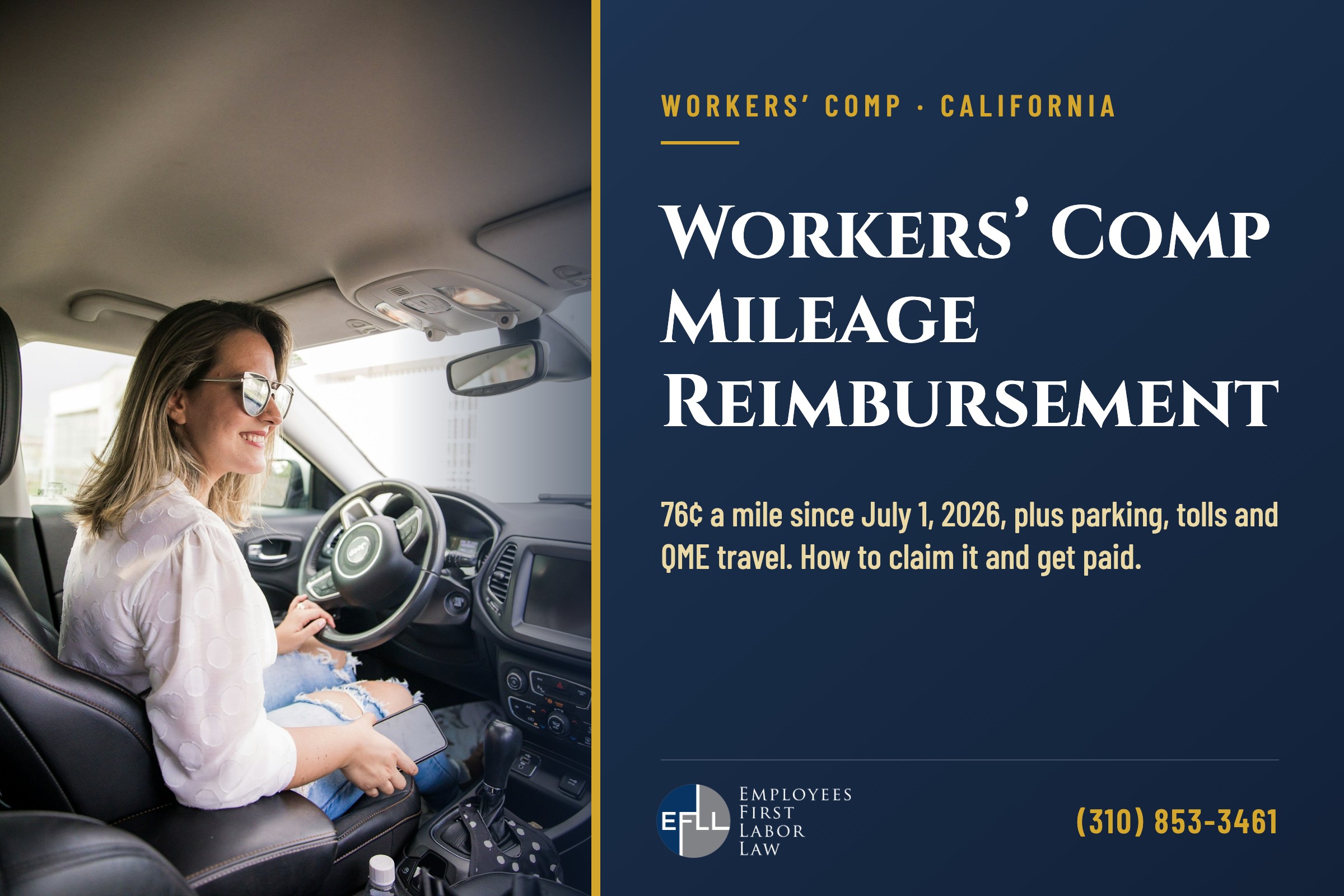
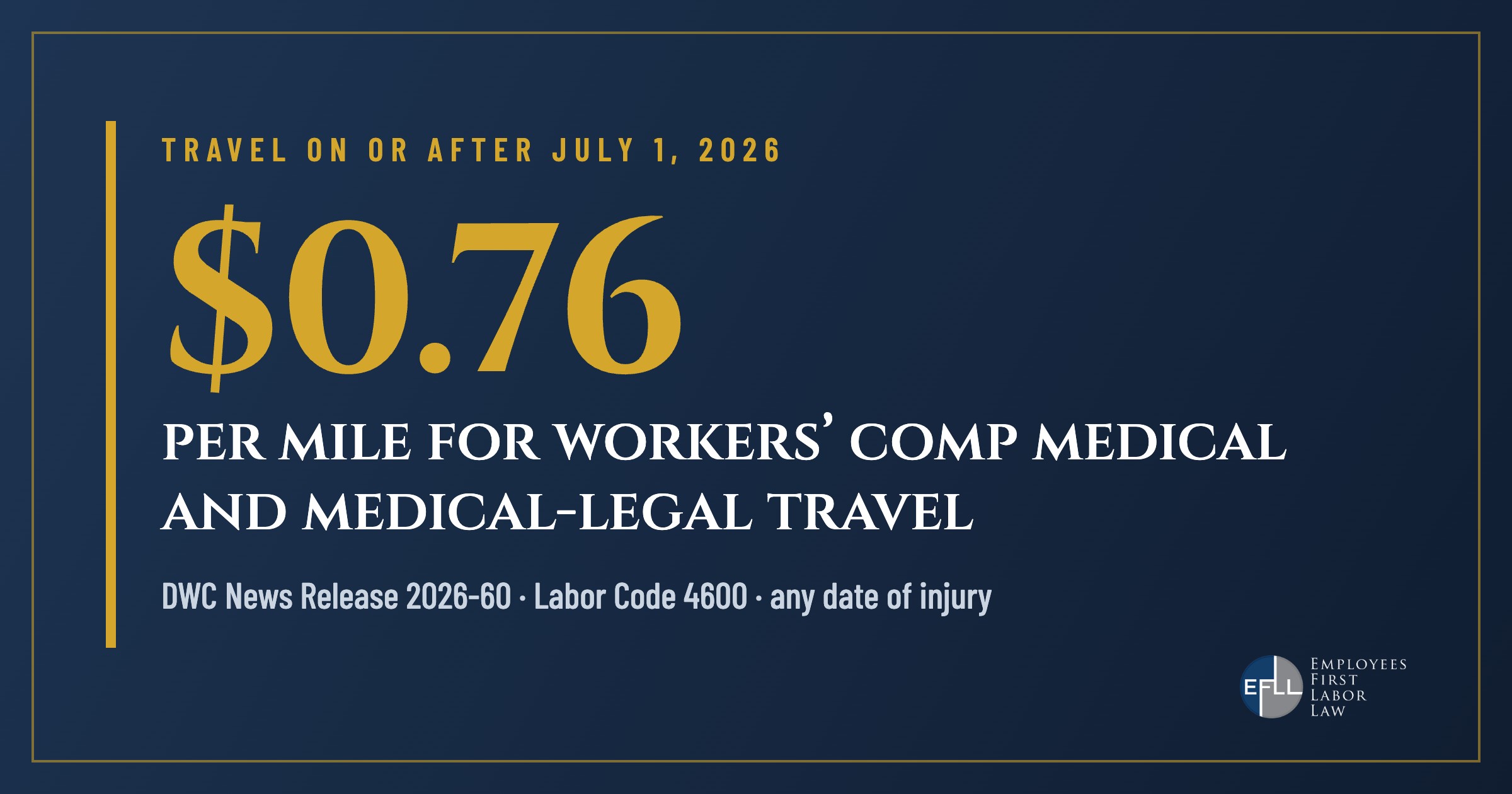
Yes. If you have a California workers’ comp claim, the insurance company must reimburse your mileage to and from medical treatment and medical-legal exams for your work injury, at 76 cents a mile for travel on or after July 1, 2026. Parking, bridge tolls and public transportation count too.
The money adds up faster than most people expect. A 20-mile round trip to your doctor is worth $15.20 at today’s rate. Two physical therapy visits a week for three months can easily run into the hundreds of dollars. Yet many injured workers never ask, because nobody tells them the benefit exists.
This guide explains the legal basis for workers’ comp mileage reimbursement in California, which trips are covered, the rate for every travel date since 2023, the extra benefits you get for QME, AME and employer-requested exams, how to document and submit your mileage, and what to do if the insurer doesn’t pay.
- 76 cents a mile for workers’ comp medical and medical-legal travel on or after July 1, 2026, and 72.5 cents for January–June 2026, regardless of your date of injury.
- Covered trips include your doctors, therapy, diagnostic tests, the pharmacy and QME or AME exams, plus parking, bridge tolls and public transportation.
- For exams requested by the employer, insurer or appeals board, Labor Code 4600(e) adds meals, lodging and one day of temporary disability per day of lost wages, with mileage due when you are notified of the exam.
- Send the DWC Medical Mileage Expense Form with receipts to the insurance company and keep a copy.
- Not paid within 60 days? Contact a DWC information and assistance officer. Unreasonable delay can bring a penalty of up to 25% (capped at $10,000) under Labor Code 5814.
Who qualifies for workers’ comp mileage reimbursement in California?
You qualify if you have a workers’ comp claim and you travel for medical care or a medical-legal evaluation related to that claim. Your job title, your wage and the date of your injury don’t matter. Full-time, part-time and seasonal workers are all covered.
The right comes from Labor Code 4600, the section that requires your employer to provide the medical treatment “reasonably required to cure or relieve” your injury. The rate is not left to the insurance company. Labor Code 4600, Government Code 19820 and the California Department of Human Resources (CalHR) regulations set the rate and tie it to the IRS business mileage rate. When the IRS changes its rate, the Division of Workers’ Compensation (DWC) announces the new workers’ comp rate and updates its mileage form.
Two rules shape every claim:
- The rate depends on the date you traveled, not the date you were injured. The DWC says the current rate “must be paid for travel on or after July 1, 2026, regardless of the date of injury.”
- The trip has to be for your claim. Driving to an authorized doctor, therapist, pharmacy or medical-legal exam counts. Your normal commute to work does not.
Mileage for workers’ comp medical travel is different from the mileage your employer owes you for driving your own car on the job. That is a wage-and-hour issue under a different law, covered in our guide to mileage reimbursement for driving at work.
What trips and travel costs are covered?
The DWC’s mileage form covers travel to “doctor, hospital, therapist, etc.” and expressly includes “reasonable travel to the pharmacy, parking, bridge tolls, public transportation and other travel-related costs.” In practice, that means trips to:
- Your primary treating physician (PTP) and any specialists you are referred to
- Physical therapy, chiropractic and acupuncture visits
- X-rays, MRIs, lab work and other diagnostic testing
- Surgery, hospital stays and follow-up visits
- The pharmacy, to fill prescriptions for your work injury
- QME and AME evaluations, and any exam the employer, insurer or judge asks you to attend
On top of mileage, you can claim parking fees, bridge tolls and public transportation such as bus or train fare. Keep every receipt. If you can’t drive because of your injury, ask the adjuster in writing, before the appointment, how your transportation will be handled.
One thing that is not a trip: Independent Medical Review (IMR). IMR is a paper review of a treatment denial. The reviewer does not examine you, so there is no appointment to drive to.
The insurer may refuse mileage for a visit it says was not authorized. Whether a doctor is authorized usually depends on your employer’s medical provider network (MPN) and your right to change doctors, explained in Can I choose my own doctor for workers’ comp?
Watch: injured at work in California
Our attorneys explain what your employer must do after a work injury, and what to do in the first 24 hours to protect your claim.
Workers’ comp mileage rate 2026 and rate history
Use the rate in effect on the day of each trip. If you drove to therapy in May 2026 and again in August 2026, the May trip is paid at 72.5 cents and the August trip at 76 cents.
| Date of travel | Rate per mile | Source |
|---|---|---|
| July 1, 2026 and later | 76 cents ($0.76) | DWC News Release 2026-60 |
| January 1 – June 30, 2026 | 72.5 cents ($0.725) | DWC News Release 2026-02 |
| January 1 – December 31, 2025 | 70 cents ($0.70) | DWC 2025 mileage form |
| January 1 – December 31, 2024 | 67 cents ($0.67) | DWC 2024 mileage form |
| January 1 – December 31, 2023 | 65.5 cents ($0.655) | DWC 2023 mileage form |
The DWC announced the 76-cent rate in News Release 2026-60 on July 23, 2026, after the IRS raised its rate mid-year. The January rate is in News Release 2026-02.
💡 Example: Maria injures her shoulder at work. Her physical therapy clinic is 18 miles from home, so each visit is a 36-mile round trip. At 76 cents a mile, each visit is worth $27.36. After 12 visits in August and September 2026, she is owed $328.32 in mileage, plus whatever she paid for parking.
Mileage is only one piece of your claim. To estimate your temporary and permanent disability benefits, try our workers’ comp calculator.
Unpaid mileage is often a sign that other benefits are being mishandled too. Our workers’ comp attorneys can review your claim in a free consultation.
QME, AME and employer-requested exams: meals, lodging and lost wages
Medical-legal exams get extra protection. Under Labor Code 4600(e)(1), when you go to an exam at the request of your employer, the insurer, the DWC administrative director, the Workers’ Compensation Appeals Board or a workers’ comp judge, you are entitled to:
- All reasonable expenses of transportation, including mileage from your home to the exam and back, plus bridge tolls
- Reasonable meals and lodging connected to reporting for the exam
- One day of temporary disability for each day of wages you lose to attend the exam
Labor Code 4600(e)(2) adds an important timing rule: the mileage and tolls for these exams “shall be paid to the employee at the time the employee is given notification of the time and place of the examination.” In other words, for an exam the other side requests, you should be paid up front, not weeks later. If the insurer schedules an exam and no travel payment comes with the notice, ask for it in writing before the appointment.
If you don’t speak or understand English well, Labor Code 4600(f) also entitles you to a qualified interpreter at these exams, provided by the employer.
QME and AME evaluations often come with long drives, because the doctor on your panel may not be close to home. To learn how those doctors are chosen and why it matters, read QME vs. AME in California workers’ comp.
💡 Example: David is sent to a QME 85 miles from home. The 170-mile round trip at 76 cents is $129.20 in mileage, plus tolls. He misses a full day of work for the exam, so he is also owed one day of temporary disability for that day.
How to document and submit your mileage
Insurers pay mileage that is easy to verify. A clean log and a complete form are the fastest way to get paid in full.
- Keep a running log. For every trip, write down the date, the address you left from, the name and address of the doctor, clinic, pharmacy or exam, and the round-trip miles. A map app’s driving distance is a reasonable way to measure miles.
- Save every receipt. Parking, bridge tolls, bus and train fare all need receipts. Take a photo of each one the same day.
- Use the official form. Fill out the DWC Medical Mileage Expense Form. It has columns for the date, where you traveled from, where you traveled to, round-trip mileage, parking and tolls.
- Send the original to the insurance company. The form says to send the original to the insurance company and keep a copy. Include your name, claim number and date of injury, and attach your receipts.
- Don’t send it to the court. The form specifically says not to send it to the local Workers’ Compensation Appeals Board or to the information and assistance officer.
- Submit regularly. Sending a form every month or after each batch of appointments keeps the amounts small, easy to check and harder to lose.
- Track what you’re paid. Compare each payment to your log. Insurers sometimes pay the wrong rate, skip a trip or leave out parking.
If you have a lawyer, send your attorney a copy of everything you send the insurer. It makes it much easier to follow up on unpaid amounts.
What if the insurance company doesn’t pay your mileage?
Unpaid mileage is usually one of the easier problems in a claim to fix. The usual reasons are a missing form or receipt, an address the adjuster can’t verify, a claim that the visit wasn’t authorized, or simple delay.
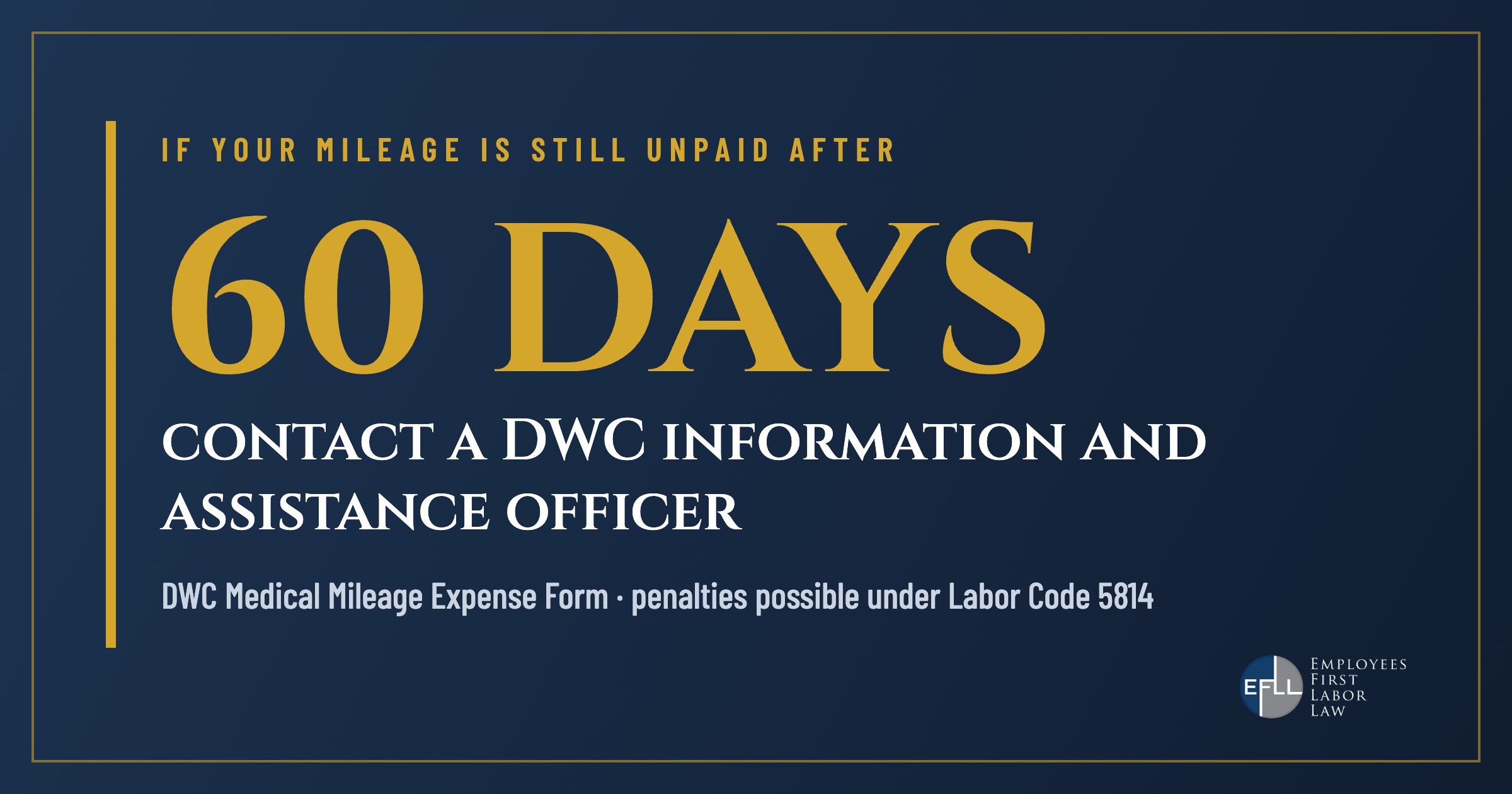
Wait 60 days, then get help. The DWC form tells injured workers: “If your travel costs are not paid within 60 days, contact the information and assistance officer.” Information and assistance (I&A) officers work at DWC district offices and help workers with claim problems at no cost.
Penalties for unreasonable delay. Mileage is a workers’ comp benefit, and the Labor Code defines “compensation” to include every benefit or payment the workers’ comp law provides (Labor Code 3207). When payment of compensation is unreasonably delayed or refused, Labor Code 5814 lets the appeals board increase the delayed amount by up to 25 percent or $10,000, whichever is less. The judge decides whether the delay was unreasonable and how much to award.
Let a lawyer handle it. If you have an attorney, they can demand payment from the adjuster and, if needed, ask the workers’ comp judge to order payment and penalties. If you don’t have one, unpaid mileage is often a sign that other benefits are being mishandled too.
A flat denial of your claim is a bigger problem than unpaid mileage. If the insurer denied the whole claim, start with our guide to a denied workers’ compensation claim.
Unpaid mileage is often the tip of the iceberg
When an insurer won’t pay a $15 trip, it is worth asking what else is being missed. Look at the rest of your claim:
- Temporary disability. Are your temporary disability checks arriving on time and at the right rate?
- Treatment. Is the insurer approving the care your doctor requests, or are you stuck in denials and delays?
- Your doctor. Are you treating with a doctor you trust, or one the insurer chose?
- Your job. Has your employer pressured you to skip appointments or punished you for missing work to attend them? Discrimination for filing a claim is prohibited by Labor Code 132a.
A workers’ comp attorney reviews the whole file, not just the mileage, and makes sure every benefit you are owed is paid.
Frequently asked questions
What is the workers’ comp mileage rate in California for 2026?
For travel from January 1 through June 30, 2026, the rate is 72.5 cents a mile. For travel on or after July 1, 2026, it is 76 cents a mile. The rate applies regardless of your date of injury.
Do I get mileage for a QME appointment?
Yes. Medical-legal exams such as QME and AME evaluations are covered. For an exam requested by the employer, insurer, administrative director, appeals board or a judge, Labor Code 4600(e) also covers reasonable meals and lodging and one day of temporary disability for each day of wages lost, and the mileage and tolls are due when you are notified of the exam.
Is mileage to the pharmacy covered?
Yes. The DWC’s Medical Mileage Expense Form specifically lists “reasonable travel to the pharmacy” for prescriptions related to your work injury.
Can I claim parking, tolls and bus fare?
Yes. The DWC form includes parking, bridge tolls, public transportation and other travel-related costs. Attach receipts to your form.
How long does the insurance company have to pay my mileage?
The DWC form says that if your travel costs are not paid within 60 days, you should contact an information and assistance officer. For exams requested by the employer or insurer, Labor Code 4600(e)(2) requires the mileage and tolls to be paid when you are notified of the exam. Unreasonable delay can lead to a penalty under Labor Code 5814.
Related guides
 Workers only. Never employers.
At Employees First Labor Law, we represent California workers only, never employers. Our team has recovered more than $200 million for our clients, and we prepare every case as if it is going to trial. We have offices in Pasadena, Irvine, Long Beach, Pomona, Riverside, Bakersfield and Fresno, and we serve workers throughout California. Meet our team.







If your mileage, temporary disability checks or medical treatment are being delayed or denied, we can review your workers’ comp claim for free. We represent injured workers across California and push insurers to pay every benefit the law requires.
- ✅ Free, confidential consultation
- ✅ We represent workers only, never employers
- ✅ Se habla español: Empleados Primero
This article provides general information about California law and is not legal advice for any specific situation. Reading it does not create an attorney-client relationship. Past results do not guarantee a similar outcome.