

In this guide8 sections
- What Is a Dedicated Rehabilitation Facility?
- When Is Inpatient Rehab Appropriate?
- What Is Outpatient Rehab — and When Is It Used?
- How Does Rehabilitation Impact the Value of a Workers’ Comp Case?
- Common Tactics Insurance Companies Use to Deny Rehab
- Real EFLL Case Example
- How EFLL Helps Injured Workers Access and Leverage Rehab
- Don’t Let the Insurance Company Deny You the Rehab You Need
When a work-related injury causes serious, long-term impairments, recovery often requires more than just a few doctor’s visits or physical therapy sessions. In some cases, the best path to healing includes treatment in a dedicated rehabilitation facility — either as an inpatient or outpatient.
At Employees First Labor Law, we help injured workers access the full scope of rehabilitative services they’re entitled to under California workers’ compensation law — and we understand how that level of care can substantially increase the value of your case.
What Is a Dedicated Rehabilitation Facility?
A rehabilitation facility is a specialized center that provides coordinated medical, therapeutic, and support services to help individuals regain function and independence after a serious injury or illness.
These facilities may offer:
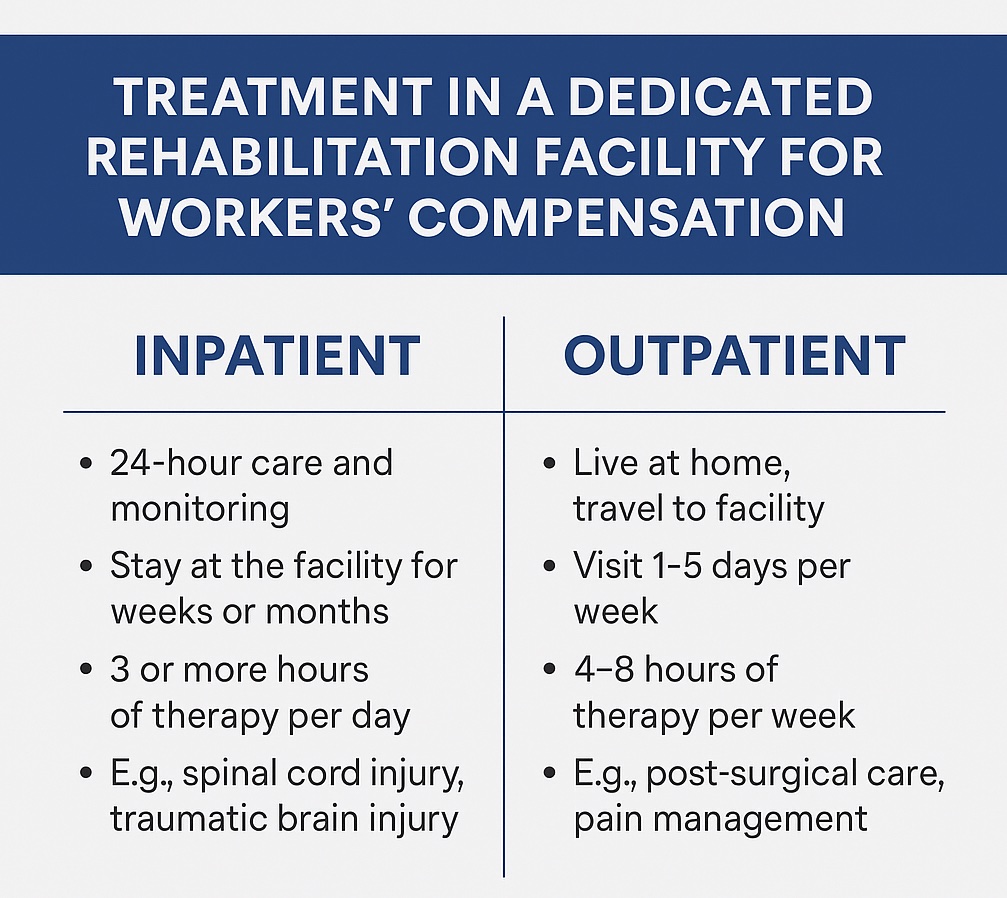
- Inpatient rehabilitation (you stay overnight and receive 24-hour care)
- Outpatient rehabilitation (you travel to the facility for therapy but live at home)
Common services include:
- Physical therapy
- Occupational therapy
- Speech therapy
- Pain management
- Mental health support
- Case management and vocational rehabilitation
When Is Inpatient Rehab Appropriate?
Inpatient rehabilitation is typically recommended for workers with:
- Spinal cord injuries
- Traumatic brain injuries (TBI)
- Multiple fractures or complex orthopedic injuries
- Post-surgical complications or infections
- Neurological conditions like stroke or nerve damage
- Severe psychiatric breakdowns tied to work trauma
In these settings, patients may receive 3+ hours of therapy per day, alongside 24-hour nursing, social services, and medical supervision. A team of doctors, therapists, and nurses monitors your progress and adjusts your care plan in real time.
Why it matters: Inpatient care shows the injury is severe and disruptive to daily life — factors that drive up both your Temporary Disability and Permanent Disability ratings.
What Is Outpatient Rehab — and When Is It Used?
Outpatient rehabilitation may be appropriate when:
- You’re medically stable and don’t require 24/7 care
- You have transportation and support at home
- Your condition improves with scheduled therapies but not hospitalization
This includes:
- Post-operative therapy (e.g., ACL or rotator cuff repair)
- Back, neck, or shoulder pain recovery
- Mild to moderate neurological or orthopedic injuries
- Chronic pain management programs
Even though outpatient programs are less intensive than inpatient rehab, they’re still critical to recovery — and insurance companies often try to cut them short or deny extended sessions. That’s when EFLL steps in.
How Does Rehabilitation Impact the Value of a Workers’ Comp Case?
1. Rehabilitation = Higher Claim Value
Rehabilitation is extensive and demonstrates lasting harm — and that’s a good thing for your case, so long as it’s medically necessary. Extensive therapy and long-term care:
- Document the seriousness of the injury
- Justify longer periods of Temporary Total Disability (TTD) payments
- Support higher Permanent Disability (PD) ratings
- Help unlock access to Supplemental Job Displacement Benefits (SJDB) and vocational retraining
Important: Never let the insurance company push you into a low-ball settlement before you’ve completed rehab. Your long-term outcome — and settlement value — may not be clear yet.
2. Proving Future Medical Needs
When a worker undergoes inpatient or extended outpatient rehab, doctors often identify future care needs, such as:
- Ongoing therapy sessions
- Pain injections or medication management
- Assistive devices (braces, walkers, wheelchairs)
- In-home nursing or home health care
- Modifications to home or vehicle
These needs increase the future medical award value or may justify a higher Compromise & Release (C&R) lump sum settlement.
3. Permanent Work Restrictions and Lost Earning Capacity
Rehab often ends with a report that includes Functional Capacity Evaluations (FCEs) and Work Status Reports. These determine:
- Whether you can return to your old job
- If you require accommodations or a modified role
- If you need to be retrained for a new occupation
This has major value implications for vocational experts, disability ratings, and structured settlement discussions.
Common Tactics Insurance Companies Use to Deny Rehab
We frequently see insurers:
- Deny inpatient rehab requests, citing cost or “lack of medical necessity”
- Approve only minimal outpatient sessions (e.g., 6 instead of 24)
- Cut off therapy too soon by pressuring doctors to issue MMI (Maximum Medical Improvement) prematurely
- Refuse to pay for transportation to/from rehab
- Suggest the worker “isn’t trying hard enough” to improve
These tactics are not only unfair — they violate your right to reasonable and necessary medical care under Labor Code § 4600. When this happens, we request expedited hearings and compel authorization.
Real EFLL Case Example
Case: TBI Victim Denied Inpatient Rehab
Our client, a delivery driver, suffered a traumatic brain injury after a warehouse accident. Though the neurologist ordered inpatient neuro-rehabilitation, the carrier denied the request, calling it “excessive.”
Our Response:
- We subpoenaed multiple specialist reports showing cognitive decline
- Filed for an expedited hearing
- Demonstrated how failure to approve would lead to permanent deficits
✅ Result: Judge ordered approval of a 30-day inpatient program
✅ Case settled for over $450,000, factoring in extensive rehab and future care needs
How EFLL Helps Injured Workers Access and Leverage Rehab
We work directly with treating physicians and rehab facilities to:
- Prepare solid Requests for Authorization (RFAs)
- Challenge UR/IMR denials of inpatient and outpatient care
- Show how rehab justifies higher TTD periods and PD ratings
- Present evidence of permanent restrictions and retraining needs
- Negotiate higher settlements based on the full picture of your injury

Don’t Let the Insurance Company Deny You the Rehab You Need
Rehabilitation is not a luxury — it’s a right under California law. Whether you need a short outpatient program or an extended inpatient stay, you deserve every opportunity to recover fully and regain control of your life.
Call Employees First Labor Law today for a free consultation.
✅ We’ll review your case
✅ Fight denials or delays in treatment
✅ Maximize your claim value — including medical care, disability pay, and settlement
📩 Schedule a consultation
📞 Call us now to speak with a workers’ comp attorney
🔗 Related Posts:
- Crushed by Machinery at Work: Can You Sue Outside of Workers’ Comp?
- Workers’ Comp for Spinal Injuries
- Traumatic Brain Injuries and Third-Party Liability
- Home Health for Workers Compensation Cases
- Workers’ Comp for Stress and Anxiety
- Pain Management in Workers Compensation
- What is the Medical Treatment Utilization Schedule (MTUS)