


Updated October 2026 · 10 min read
In California, an employer with five or more employees cannot fire you because of a physical or mental disability, because it believes you have one, or because you asked for a reasonable accommodation. If you were let go soon after you disclosed a condition, asked for modified duties, or took medical leave, you may have a claim under the Fair Employment and Housing Act (FEHA), Government Code section 12940.
The first few weeks after a firing matter. Documents get harder to find, a severance agreement may arrive with a short signing window, and memories fade. You generally have three years to file a complaint with the California Civil Rights Department (CRD), but the strongest cases are the ones where the worker starts protecting the evidence right away.
This guide is for workers who have already been fired. It explains how to tell whether the firing was disability discrimination, the separate claims that often come with it, what to do this week, the deadlines, and what you can recover. If you are still employed and need help asking for changes at work, see our guide on how to request a reasonable accommodation instead.
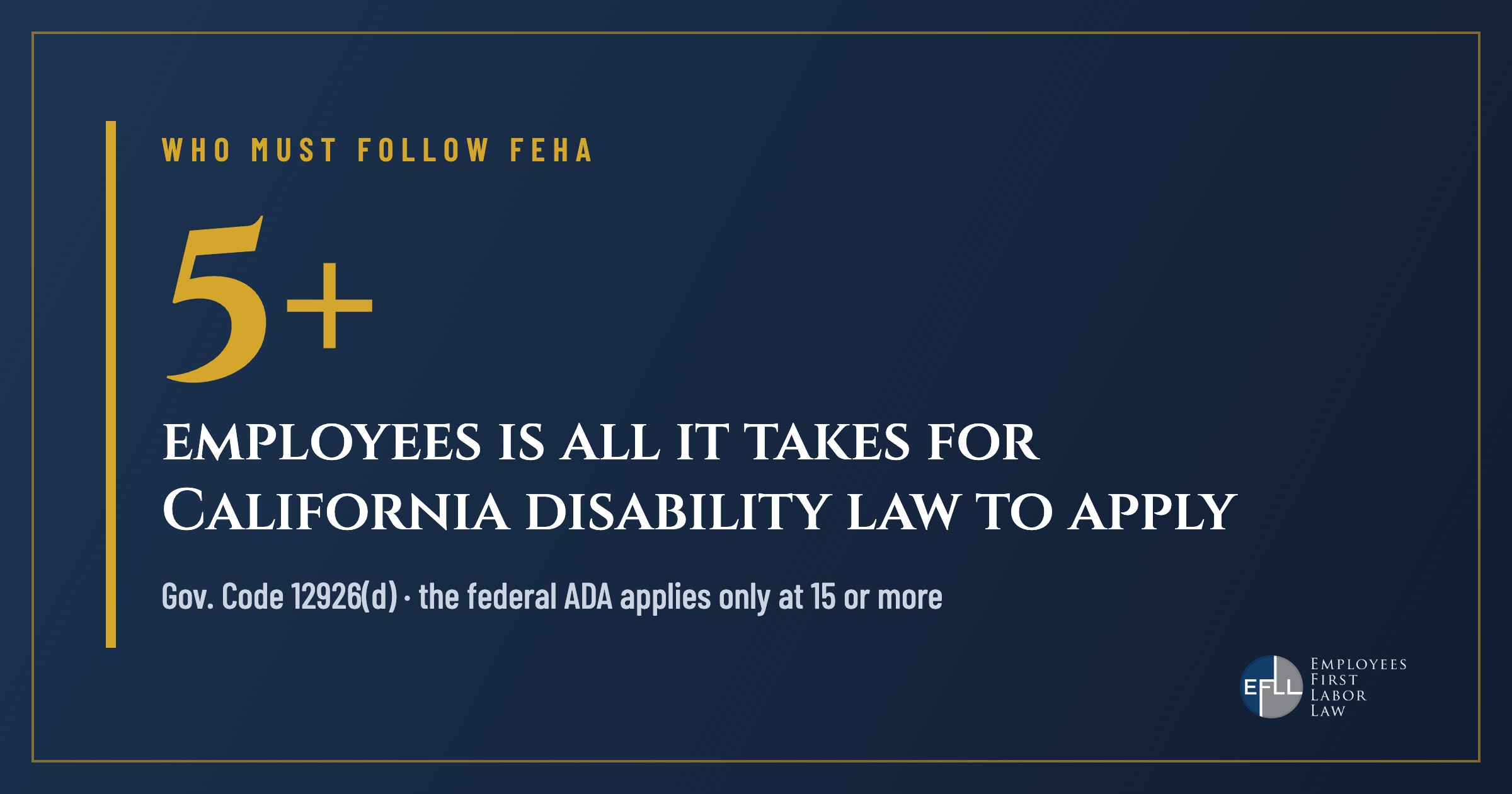
- FEHA bars employers with 5 or more employees from firing you because of a physical or mental disability, a perceived disability, or a request for accommodation.
- California’s definition is broader than the ADA: a condition only has to limit a major life activity, not substantially limit it.
- Failure to accommodate and failure to engage in the interactive process are separate violations from the firing itself.
- After a firing, request your personnel file and payroll records, check your final paycheck, and don’t sign a severance release before it is reviewed.
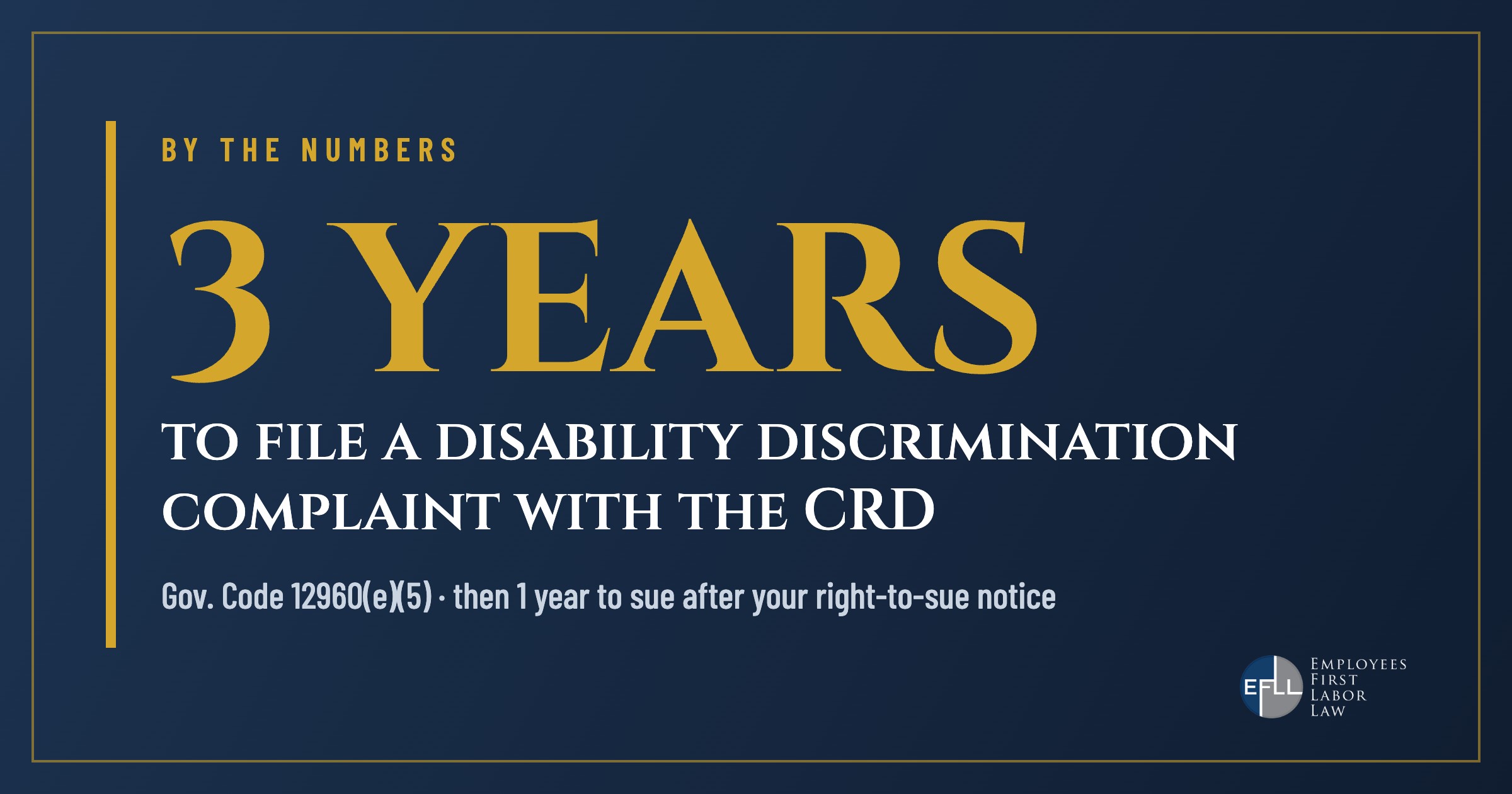
- You generally have 3 years to file with the CRD, then 1 year after your right-to-sue notice to file a lawsuit.
Is it illegal to be fired because of a disability in California?
Yes. FEHA makes it unlawful for an employer to discharge a person because of a physical disability, mental disability or medical condition (Gov. Code 12940(a)). The law covers any employer that regularly employs five or more people (Gov. Code 12926(d)), which reaches far more workplaces than the federal Americans with Disabilities Act (ADA), which applies at 15 employees.
FEHA does not guarantee a job no matter what. An employer may lawfully end employment if, because of the disability, you cannot perform the essential duties of the job even with reasonable accommodation, or cannot do them without endangering yourself or others even with accommodation (Gov. Code 12940(a)(1)). But the employer has to actually explore accommodations first. “We assumed you couldn’t do it” is not a defense.
In a lawsuit, you generally need to show that your disability (or your request for accommodation) was a substantial motivating reason for the firing. It does not have to be the only reason. California’s Supreme Court adopted that standard in Harris v. City of Santa Monica (2013).
Who counts as disabled under FEHA (the short version)
California’s definition is intentionally broad. A physical disability is a condition that affects a body system and limits a major life activity (Gov. Code 12926(m)). A mental disability is a mental or psychological disorder or condition that limits a major life activity (Gov. Code 12926(j)). “Limits” means the condition makes the activity difficult, judged without counting medication or other mitigating measures, and “major life activities” are read broadly to include physical, mental and social activities and working.
The Legislature has said this is deliberately broader than the ADA, which requires a substantial limitation (Gov. Code 12926.1(c)). The same section lists chronic or episodic conditions such as diabetes, epilepsy, clinical depression, bipolar disorder, multiple sclerosis and heart disease as examples.
FEHA also protects you if your employer regarded or treated you as having a disability, even if you don’t have one, and it separately protects a “medical condition,” such as a history of cancer or genetic characteristics (Gov. Code 12926(i)). For a deeper walk-through of covered conditions, read what qualifies as a disability under FEHA.
Failure to accommodate, the interactive process and other FEHA claims
A disability-related termination is rarely just one violation. California treats several employer failures as separate claims, and each can add to your case:
| Claim | What it means | Law |
|---|---|---|
| Disability discrimination | You were fired because of an actual or perceived disability or medical condition | Gov. Code 12940(a) |
| Failure to accommodate | The employer didn’t make a reasonable accommodation for a disability it knew about | Gov. Code 12940(m)(1) |
| Failure to engage in the interactive process | The employer didn’t have a timely, good-faith discussion about accommodations after you asked | Gov. Code 12940(n) |
| Retaliation for requesting accommodation | You were punished for asking, whether or not the request was granted | Gov. Code 12940(m)(2), 12940(h) |
| Failure to prevent discrimination | The employer didn’t take reasonable steps to stop discrimination from happening | Gov. Code 12940(k) |
The duty to accommodate doesn’t always wait for a formal request. Under the CRD’s regulations, an employer has an affirmative duty to make reasonable accommodation once it knows of the disability (Cal. Code Regs., tit. 2, § 11068(a)). If your manager saw you struggling after surgery and simply wrote you up, that matters. Our page on failure to accommodate explains how these claims are built.
Timing, shifting explanations and ignored requests are often the strongest evidence. Tell us what happened in a free, confidential consultation.
Medical leave can be a reasonable accommodation
Many disability firings happen right around medical leave: the day leave ends, the week you return, or when you ask for more time. California’s regulations say that holding a job open for an employee on leave, or extending a leave provided by CFRA, the FMLA or a company policy, may be a reasonable accommodation, as long as the leave is likely to let you return to work and does not create an undue hardship for the employer (Cal. Code Regs., tit. 2, § 11068(c)).
That means a rigid “you’ve used your 12 weeks, so you’re done” approach can violate FEHA if the employer never considered a short extension or another accommodation. Separately, if you were on job-protected leave under the California Family Rights Act (Gov. Code 12945.2), being fired for taking that leave can be its own violation. See our guide to FMLA and CFRA leave rights.
💡 Example: Maria, a warehouse worker, hurts her back and her doctor restricts her to light lifting for six weeks. She asks for light duty. Her supervisor never responds, and two weeks later she is fired for “attendance,” counting her doctor visits as absences. Depending on the facts, Maria may have claims for disability discrimination, failure to accommodate, failure to engage in the interactive process, and retaliation for requesting an accommodation.
Signs your firing was really about your disability
Employers rarely say “we’re firing you because of your condition.” They give another reason. In a discrimination case, the question is whether that reason is true or a pretext, a cover story for the real motive. These patterns often point to pretext:
- Timing. The firing came soon after you disclosed a diagnosis, requested an accommodation, gave a doctor’s note, or returned from leave.
- Shifting explanations. The reason in your termination meeting differs from the one in your letter, or from what the company later tells the CRD or EDD.
- A sudden paper trail. Years of good reviews, then write-ups that start only after your medical issue surfaced.
- Comments about your health. “Liability,” “can’t keep up,” “come back when you’re 100%,” or questions about how long your condition will last.
- Unequal treatment. Co-workers without disabilities did the same thing and were not disciplined.
- An ignored request. You asked for an accommodation and heard nothing, or got a quick “no” with no discussion.
- A “restructuring” that only hit you. Your position was “eliminated,” and then someone else started doing the same work.
One sign alone may not prove a case, but together they can be powerful. Write down every example while it’s fresh.
What to do after being fired for a disability
These steps protect your rights and your evidence. Most can be done in the first week.
- Write a timeline. List the dates you told your employer about your condition, asked for accommodation, took leave, and were disciplined or fired, plus who said what.
- Keep what’s yours. Save your termination letter, texts and personal emails with managers, doctor’s notes you submitted, and accommodation requests. Don’t take confidential company files or log in to company systems after you’re let go.
- Request your personnel file and payroll records. Your employer must let you see your personnel file within 30 calendar days of a written request (Labor Code 1198.5) and provide payroll records within 21 calendar days (Labor Code 226(b)–(c)). Each statute carries a $750 penalty for noncompliance. Our guide to requesting your personnel file includes what to ask for.
- Check your final paycheck. When you are fired, all earned wages are due immediately (Labor Code 201). A willful delay can trigger waiting-time penalties of up to 30 days of wages (Labor Code 203).
- Apply for unemployment. Being fired does not automatically disqualify you. EDD looks at whether you are unemployed through no fault of your own and able and available to work. If your condition keeps you from working right now, ask about State Disability Insurance instead. See unemployment after being fired.
- Don’t sign a severance release yet. Most severance agreements ask you to give up your FEHA claims. An employer offering a separation agreement must tell you that you have the right to consult an attorney and give you at least five business days to do so (Gov. Code 12964.5(b)(4)). Have it reviewed first; see our severance agreement review guide.
- Talk to an employment lawyer before you file. How the CRD complaint is written, and whether to request an immediate right-to-sue notice, affects the rest of your case.
Deadlines: CRD complaint and right to sue
Before you can sue under FEHA, you must file a complaint with the California Civil Rights Department and receive a right-to-sue notice. You can file online, and you can ask for an immediate right-to-sue notice if you plan to go to court with a lawyer. Our step-by-step guide covers how to file a CRD complaint and get a right-to-sue.
| Step | Deadline | Source |
|---|---|---|
| File a CRD complaint | Within 3 years of the unlawful act (usually the firing) | Gov. Code 12960(e)(5) |
| File a lawsuit | Within 1 year of the CRD right-to-sue notice | Gov. Code 12965(c) |
| Personnel file | Employer must produce within 30 calendar days of your written request | Labor Code 1198.5 |
| Payroll records | Employer must produce within 21 calendar days of your request | Labor Code 226(c) |
| Final wages | Due immediately upon firing | Labor Code 201 |
| Severance review | At least 5 business days to consult an attorney | Gov. Code 12964.5(b)(4) |
If you also want to preserve a federal ADA claim, the EEOC deadline is much shorter, generally 300 days in California. A complaint filed with one agency is usually cross-filed with the other, but get advice early. See CRD vs. EEOC: where to file.
What you can recover in a disability discrimination case
FEHA allows a court to award the relief needed to make you whole. Depending on your case, that can include:
- Back pay: wages and benefits you lost from the firing to the date of trial or settlement.
- Front pay: future lost earnings if you can’t reasonably return to comparable work right away.
- Emotional distress damages: for the anxiety, humiliation and stress the firing caused.
- Attorney’s fees and costs: a court may award reasonable attorney’s fees and costs, including expert witness fees, to a prevailing employee (Gov. Code 12965(c)).
- Punitive damages, in some cases: where an officer, director or managing agent of the employer acted with, or approved, malice, oppression or fraud (Civil Code 3294).
Every case is different, and no lawyer can honestly promise a number at the start. What drives value is the strength of the evidence, your lost income, and how the firing affected your life. Learn more about employment law damages in California.
Other claims that often come with a disability firing
A disability termination is often the tip of the iceberg. Look for related claims too:
- Workers’ compensation. If your condition came from a work injury, you may still be able to pursue benefits after being fired. See workers’ comp after a job termination.
- Retaliation for complaining. If you reported discrimination to HR before the firing, that is protected activity under Gov. Code 12940(h). See fired after complaining to HR.
- Leave violations. Interference with CFRA leave or denial of reinstatement after leave.
- Wage claims. Unpaid final wages, overtime, or missed meal and rest breaks.
Frequently asked questions
Can I be fired for a disability in California if I’m an at-will employee?
At-will employment lets an employer fire you for many reasons, but not an illegal one. Firing someone because of a disability, a perceived disability or a request for accommodation is unlawful under FEHA for employers with five or more employees.
Can my employer fire me while I’m on medical leave?
Being on leave does not make you immune from a legitimate layoff or other lawful decision. But firing you because you took protected leave, or refusing to consider a reasonable extension of leave as an accommodation, can violate CFRA and FEHA.
Do I have to tell my employer my exact diagnosis?
Generally, no. You need to give enough information for your employer to know you have a condition that needs accommodation. If the disability or need isn’t obvious, the employer may ask for reasonable medical documentation confirming both, but once it has that, it generally may not ask about the underlying medical cause (Cal. Code Regs., tit. 2, § 11069).
Are anxiety and depression disabilities under FEHA?
They can be. A mental or psychological condition is a disability under FEHA if it limits a major life activity, including working. California law specifically names clinical depression and bipolar disorder as examples (Gov. Code 12926.1(c)).
How long do I have to take action if I was fired because of a disability in California?
You generally have three years from the firing to file a complaint with the CRD, and then one year from the right-to-sue notice to file a lawsuit. Waiting can make evidence harder to gather, so it’s wise to talk to a lawyer early.
Related guides
 Workers only. Never employers.
At Employees First Labor Law, we represent California workers only, never employers. Our team has recovered more than $200 million for our clients, and we prepare every case as if it is going to trial. We have offices in Pasadena, Irvine, Long Beach, Pomona, Riverside, Bakersfield and Fresno, and we serve workers throughout California. Meet our team.







If you were fired after disclosing a disability, asking for an accommodation or returning from medical leave, we can review your evidence, explain your deadlines and pursue lost wages, emotional distress damages and attorney’s fees under FEHA.
- ✅ Free, confidential consultation
- ✅ We represent workers only, never employers
- ✅ Se habla español: Empleados Primero
This article provides general information about California law and is not legal advice for any specific situation. Reading it does not create an attorney-client relationship. Past results do not guarantee a similar outcome.