

Updated October 2026 · 10 min read
Yes, you can still get workers’ comp after being fired in California if you were hurt on the job, but a claim filed after you get a termination or layoff notice faces an extra legal hurdle, and how you handle the first few weeks matters. Losing your job does not cancel a work injury. Medical care, temporary disability checks and permanent disability benefits can continue after your last day, and a firing that was caused by your injury can create separate claims of its own.
A denied post-termination claim can leave you paying for treatment with no paycheck, while a worker earning $900 a week who is too hurt to work could be owed about $600 a week in temporary disability.
This guide covers filing after being fired or quitting, what happens to an existing claim, temporary disability (TD) versus unemployment, and what to do if the firing was retaliation.
- A work injury does not disappear when the job does. You can generally file, and keep collecting benefits, after being fired, laid off or quitting.
- If you file after a notice of termination or layoff for an earlier injury, Labor Code 3600(a)(10) requires you to prove one of four exceptions, and not every cumulative trauma claim qualifies.
- Temporary disability is generally still payable after termination while the injury keeps you from working ($264.61 to $1,764.11 a week for 2026 injuries).
- You cannot collect unemployment and TD in full for the same days, because unemployment requires that you be able and available to work.
- Fired for filing a claim? Labor Code 132a raises compensation by one-half (up to $10,000), plus up to $250 in costs, reinstatement and lost wages. File within one year. FEHA claims may add more.
Can you file workers’ comp after being fired in California?
Generally, yes. What matters is whether the injury happened at work, not whether you still work there when you file. A back injury from last month’s shift is still a work injury after you are fired.
The complication is Labor Code section 3600(a)(10). It applies when the claim is filed after a notice of termination or layoff, including a voluntary layoff, and the injury happened before that notice. In that situation, no compensation is paid unless you prove, by a preponderance of the evidence (more likely than not), that at least one of four conditions applies. Employers and insurers call this the “post-termination defense.”
If you reported the injury before you were let go, or a doctor documented it, you are usually in a strong position.
For a step-by-step walkthrough of filing the claim form after you have left a job, see our companion guide, Can I File Workers’ Comp After Being Fired or Quitting in California? This page focuses on what happens to your benefits and your rights once the job ends.
The post-termination rule and its four exceptions
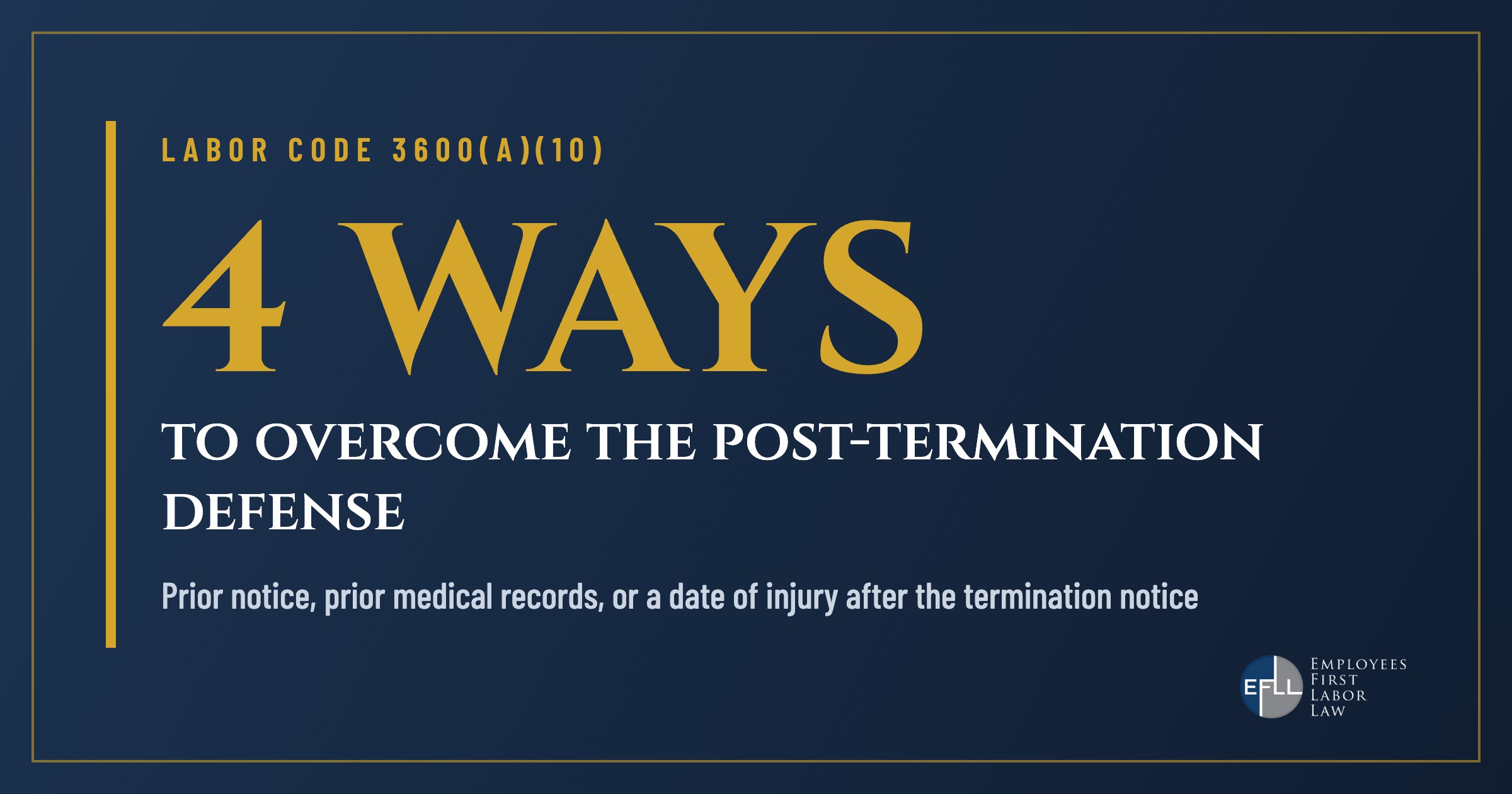
Under Labor Code section 3600(a)(10), a claim filed after a notice of termination or layoff for an injury that happened before the notice can go forward only if you show one or more of the following:
- Your employer had notice of the injury before the notice of termination or layoff. Notice is measured under the Labor Code’s claim-notice rules, and knowledge by a supervisor or other person in authority can count (Labor Code 5400 and 5402(a)).
- Your medical records, existing before the notice of termination or layoff, contain evidence of the injury. A doctor or urgent care note from before the notice can be enough, even if you never told your boss.
- For a specific injury, the date of injury falls after the notice of termination or layoff but before the termination or layoff actually takes effect. The “date of injury” here is the date of the incident under Labor Code 5411. For example, you are hurt while working out the final weeks of a layoff notice.
- For a cumulative trauma or occupational disease, the date of injury falls after the notice of termination or layoff. Under Labor Code 5412, that date is when you first suffered disability and knew, or reasonably should have known, it was caused by your work.
The fourth exception is narrower than many websites suggest. Not every cumulative trauma claim qualifies. It works only if the legal date of injury for the cumulative trauma lands after the notice. If you already had work-related disability and knew it was job-related before the notice, the fourth exception will not help, and you would need one of the other three.
Two more rules in the statute protect workers. A notice of termination or layoff that is not followed by the actual termination or layoff within 60 days does not trigger the rule. And issuing frequent termination notices to an employee is treated as a bad-faith personnel action that makes the rule inapplicable. Psychiatric injury claims follow a separate, stricter post-termination rule in Labor Code 3208.3(e).
Watch: injured at work in California
Our attorneys explain what your employer must do after a work injury, and what to do in the first 24 hours to protect your claim.
Can I file workers’ comp after I quit?
Usually, yes, as long as the injury is work-related and you file within the deadlines. Quitting does not waive your right to benefits for an injury you already suffered.
The statute’s wording covers a “notice of termination or layoff, including voluntary layoff.” Insurers often raise the post-termination defense against workers who resigned too, and whether a resignation triggers the rule can be argued either way. If you are thinking about quitting and you have a work injury, report it in writing and see a doctor before you give notice. That puts you inside the first two exceptions.
If you already quit, gather proof that your employer knew or a doctor recorded the injury before your notice: texts to a supervisor, incident reports or clinic notes.
We can check whether your claim fits one of the four exceptions and whether the firing itself was illegal. Free, confidential case review.
What happens to your workers’ comp if you get fired?
A claim filed before you were let go does not end because the job ended. The employer’s insurer remains responsible for benefits.
| Benefit | After you are fired or laid off | Law |
|---|---|---|
| Medical treatment | Continues for the work injury as long as it is reasonably required | Labor Code 4600 |
| Temporary disability (TD) | Generally still payable while the injury keeps you from working, subject to the 104-week cap | Labor Code 4650, 4653, 4656 |
| Permanent disability (PD) | Paid based on your permanent disability rating, whether or not you still work there | Labor Code 4658 |
| Job displacement voucher | Up to $6,000 for permanent partial disability if no qualifying regular, modified or alternative work is offered (injuries in 2013 or later) | Labor Code 4658.7 |
| Retaliation remedies | Increased compensation, reinstatement and lost wages if you were fired because of the claim | Labor Code 132a |
Keep going to your appointments, keep your mailing address current with the claims administrator, and respond to every letter.
Can you collect temporary disability after being terminated?
In most cases, yes. TD replaces part of your wages while your injury keeps you from working, and being fired does not change the fact that you are hurt. If your doctor says you cannot work, or your restrictions keep you from earning your usual wages, TD is generally still owed after termination.
TD for total disability is two-thirds of your average weekly earnings (Labor Code 4653). For injuries in 2026, the weekly rate is at least $264.61 and no more than $1,764.11. The first payment is due within 14 days after the employer learns of the injury and disability, unless the claim is denied first (Labor Code 4650), and for injuries on or after January 1, 2008, TD for one injury generally cannot exceed 104 compensable weeks within five years of the date of injury (Labor Code 4656). See our guide to temporary disability benefits for the details.
💡 Example: Maria’s average weekly earnings were $900 when she hurt her shoulder lifting stock. Two weeks later she was fired. Her doctor took her off work, so her TD rate is two-thirds of $900, or $600 a week, which falls between the 2026 minimum and maximum. Her firing does not reduce that amount.
The fight usually comes when a worker was back on modified duty within restrictions and is then fired for reasons the employer says have nothing to do with the injury. Insurers sometimes argue that the lost wages come from the firing, not the injury. Whether TD is owed then depends on your medical restrictions, whether you could actually find work within them, and the real reason for the firing, so get advice before accepting a cutoff.
Fired because you got hurt: Labor Code 132a
Under Labor Code 132a, an employer may not fire, threaten to fire or otherwise discriminate against you because you filed or said you intended to file a workers’ comp claim, or because you received a rating, award or settlement. It also protects workers who testify, or say they intend to testify, in a co-worker’s case before the appeals board.
If you prove a 132a violation, the law provides:
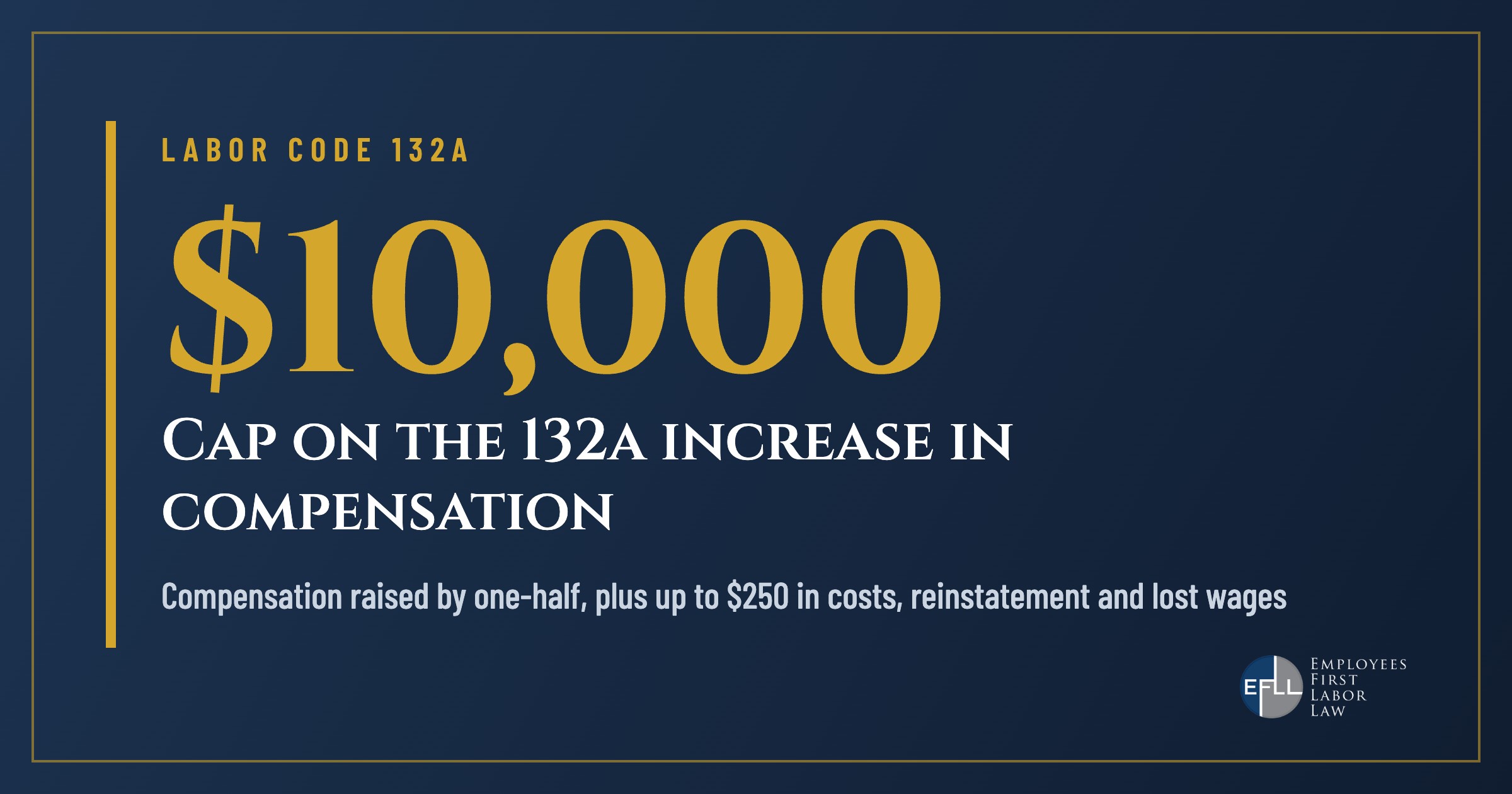
- ✅ Your compensation is increased by one-half, up to a maximum of $10,000
- ✅ Costs and expenses up to $250
- ✅ Reinstatement to your job
- ✅ Reimbursement for lost wages and work benefits caused by the employer’s conduct
Section 132a does not contain an attorney’s-fee provision. A 132a claim is filed as a petition with the Workers’ Compensation Appeals Board, and it must be filed within one year of the discriminatory act or the date you were terminated. Read more in our guide to workers’ comp retaliation claims under Labor Code 132a and whether you can be fired while on workers’ comp.
FEHA and wrongful termination claims after a work injury
Workers’ comp is usually your only remedy for the injury itself, but a firing connected to the injury can support a civil lawsuit on top of the comp case.
Under California’s Fair Employment and Housing Act (Government Code 12940), an employer with five or more employees generally may not fire you because of a physical or mental disability, may not fail to reasonably accommodate a known disability, and must engage in a timely, good-faith interactive process, for example about modified duty or a leave of absence. A work injury that limits a major life activity can qualify as a disability under FEHA. Unlike 132a, a successful FEHA claim can also include emotional distress damages and attorney’s fees, in addition to lost wages.
Wrongful termination in violation of public policy and other retaliation claims may also apply. If you were let go soon after reporting a problem, see fired after complaining to HR, and learn how our wrongful termination and disability discrimination attorneys handle these cases.
A FEHA claim starts with a complaint to the California Civil Rights Department, generally within three years of the unlawful act (Government Code 12960). After you receive a right-to-sue notice, you generally have one year to file in court.
Unemployment vs. temporary disability
Unemployment insurance and temporary disability are built for different situations, and you generally cannot collect both in full for the same days.
To receive unemployment benefits for a week, you must be able to work and available for work (Unemployment Insurance Code 1253(c)). TD, on the other hand, is paid because your injury keeps you from working. Under Unemployment Insurance Code 1255.5, you are not eligible for unemployment for the same days you receive, or are awarded, temporary total disability payments. If those TD payments are less than your unemployment benefit would be, you may be able to receive the difference.
If your comp claim is disputed and you are able to work within your restrictions, unemployment may help bridge the gap. If TD is later paid for weeks you also received unemployment, expect the overlap to be adjusted. Be truthful on every certification about your ability to work. For more, see California unemployment after being fired and workers’ comp and state disability (SDI).
What to do after being fired with a work injury
- Report the injury in writing now if you have not already. Send it to your former supervisor or HR by email or text and keep a copy.
- Ask for and file a claim form (DWC-1). Your employer must provide one within one working day of learning of an injury that needs more than first aid or causes lost time. See our DWC-1 form guide.
- Get medical care and tell the doctor it is work-related. Request any earlier records that mention the injury.
- Save your termination paperwork. The date of the notice and the effective date both matter under the four exceptions.
- Do not sign a severance agreement or release until someone has checked whether it affects your comp case or civil claims.
- Talk to an attorney before the deadlines below run.
| Deadline | Time limit | Law |
|---|---|---|
| Notify your employer of the injury | Within 30 days of the injury | Labor Code 5400 |
| Medical care while the claim is decided | Authorized within one working day after you file the claim form, up to $10,000 | Labor Code 5402(c) |
| Employer accepts or denies | If not denied within 90 days of the claim form, the injury is presumed compensable | Labor Code 5402(b) |
| Start a case to collect benefits | Generally 1 year from the date of injury, the last TD payment, or the last medical treatment provided | Labor Code 5405 |
| 132a retaliation petition | 1 year from the discriminatory act or termination | Labor Code 132a |
| FEHA complaint with the Civil Rights Department | Generally 3 years from the unlawful act | Government Code 12960 |
Frequently asked questions
Can you file workers’ comp after being fired in California?
Yes, if the injury happened at work. If you file after a termination or layoff notice for an earlier injury, you must show one of the four exceptions in Labor Code 3600(a)(10).
Can I file workers’ comp after I quit?
Generally, yes. Quitting does not erase a work injury, but evidence that your employer knew about it, or that a doctor documented it before you gave notice, is your strongest protection.
Can you collect workers’ comp after being terminated?
Yes. Benefits on a valid claim continue after the job ends, and TD is generally still owed while your injury keeps you from working, subject to the 104-week limit.
What happens to my workers’ comp if I get fired?
Your claim stays open and the insurer stays responsible for benefits. If you were fired because you filed or planned to file the claim, you may also have a 132a claim and a FEHA or wrongful termination claim in civil court.
Can I get unemployment and workers’ comp at the same time?
Not in full for the same days. You are not eligible for unemployment for days covered by temporary total disability payments, though you may receive the difference if TD is lower.
Related guides
 Workers only. Never employers.
At Employees First Labor Law, we represent California workers only, never employers. Our team has recovered more than $200 million for our clients, and we prepare every case as if it is going to trial. We have offices in Pasadena, Irvine, Long Beach, Pomona, Riverside, Bakersfield and Fresno, and we serve workers throughout California. Meet our team.







If you were hurt at work and then fired, laid off or pushed out, we can help you protect your workers’ comp benefits and review 132a, FEHA and wrongful termination claims against your former employer.
- ✅ Free, confidential consultation
- ✅ We represent workers only, never employers
- ✅ Se habla español: Empleados Primero
This article provides general information about California law and is not legal advice for any specific situation. Reading it does not create an attorney-client relationship. Past results do not guarantee a similar outcome.