

Updated October 2026 · 10 min read
In California workers’ comp, temporary disability (TD) replaces two-thirds of your lost wages while you heal and can’t do your job, and permanent disability (PD) pays you for the lasting impairment left after your doctor says you have reached maximum medical improvement. TD comes first. PD, if you have a permanent impairment, comes after.
The difference in dollars is large. For a 2026 injury, TD can pay up to $1,764.11 a week. PD for any injury on or after January 1, 2014 pays between $160 and $290 a week, no matter how much you earned. Knowing when one benefit ends and the other begins helps you spot underpayments and gaps in your checks.
This guide compares TD vs PD in California workers’ comp side by side: what each pays in 2026, when payments must start, how long each lasts, and what happens at the handoff. For the full permanent disability payment chart, see how much permanent disability pays. For how the rating itself is calculated, see how permanent disability ratings work.
- TD replaces lost wages while you recover; PD pays for a lasting impairment after you reach maximum medical improvement (MMI).
- For 2026 injuries, TD is two-thirds of your average weekly earnings, from $264.61 to $1,764.11 a week.
- For injuries since January 1, 2014, PD pays $160 to $290 a week for a number of weeks set by your rating.
- TD is capped at 104 weeks within five years of the injury, or 240 weeks for nine listed conditions (Labor Code 4656).
- PD must start within 14 days after your last TD payment, and late payments are increased by 10% (Labor Code 4650).
TD vs PD at a glance
Here is how the two benefits compare for a California work injury. The PD figures apply to injuries on or after January 1, 2014. The TD figures apply to injuries in 2026.
| Feature | Temporary disability (TD) | Permanent disability (PD) |
|---|---|---|
| What it pays for | Lost wages while you recover | Lasting impairment after you stop improving |
| Who qualifies | A doctor says you can’t do your usual job, or your employer can’t accommodate your restrictions | A doctor finds a permanent impairment once you reach MMI (permanent and stationary) |
| Weekly amount | Two-thirds of your average weekly earnings (Labor Code 4653) | Two-thirds of your average weekly earnings, within fixed limits (Labor Code 4658) |
| 2026 range | $264.61 to $1,764.11 a week | $160 to $290 a week |
| First payment due | Within 14 days after the employer knows of the injury and disability (Labor Code 4650(a)) | Within 14 days after your last TD payment (Labor Code 4650(b)) |
| How often | Every two weeks | Every two weeks, or as part of a settlement |
| How long | Up to 104 weeks within 5 years of the injury; 240 weeks for nine listed conditions (Labor Code 4656) | A set number of weeks based on your rating (Labor Code 4658(e)); for life at 100% |
| When it ends | You return to work, reach MMI, or use up the weeks | When all weeks owed for your rating are paid |
| Can you work? | Not at your usual job (or only part-time for temporary partial disability) | Yes. You can work and still receive PD |
What is temporary disability (TD)?
Temporary disability is the wage-replacement benefit you receive while you are recovering from a work injury or illness.
There are two kinds:
- Temporary total disability (TTD): your doctor says you can’t work at all, or your employer can’t offer work within your restrictions.
- Temporary partial disability: you can work, but only reduced hours or a lower-paying job while you heal. (Some insurers abbreviate this as TPD. It is different from permanent total disability, which is a 100% permanent rating.)
TD has a three-day waiting period. Under Labor Code 4652, TD is not paid for the first three days after you leave work because of the injury, unless the disability lasts more than 14 days or you are admitted to the hospital as an inpatient. In either case, TD is paid back to the first day of disability.
If your employer offers modified or light-duty work that fits your doctor’s restrictions, temporary total disability generally stops. If that job pays less than you earned before, you may receive temporary partial disability for part of the difference. Our temporary disability benefits page explains who qualifies in more detail.
Watch: injured at work in California
Our attorneys explain what your employer must do after a work injury, and what to do in the first 24 hours to protect your claim.
How much TD pays in 2026
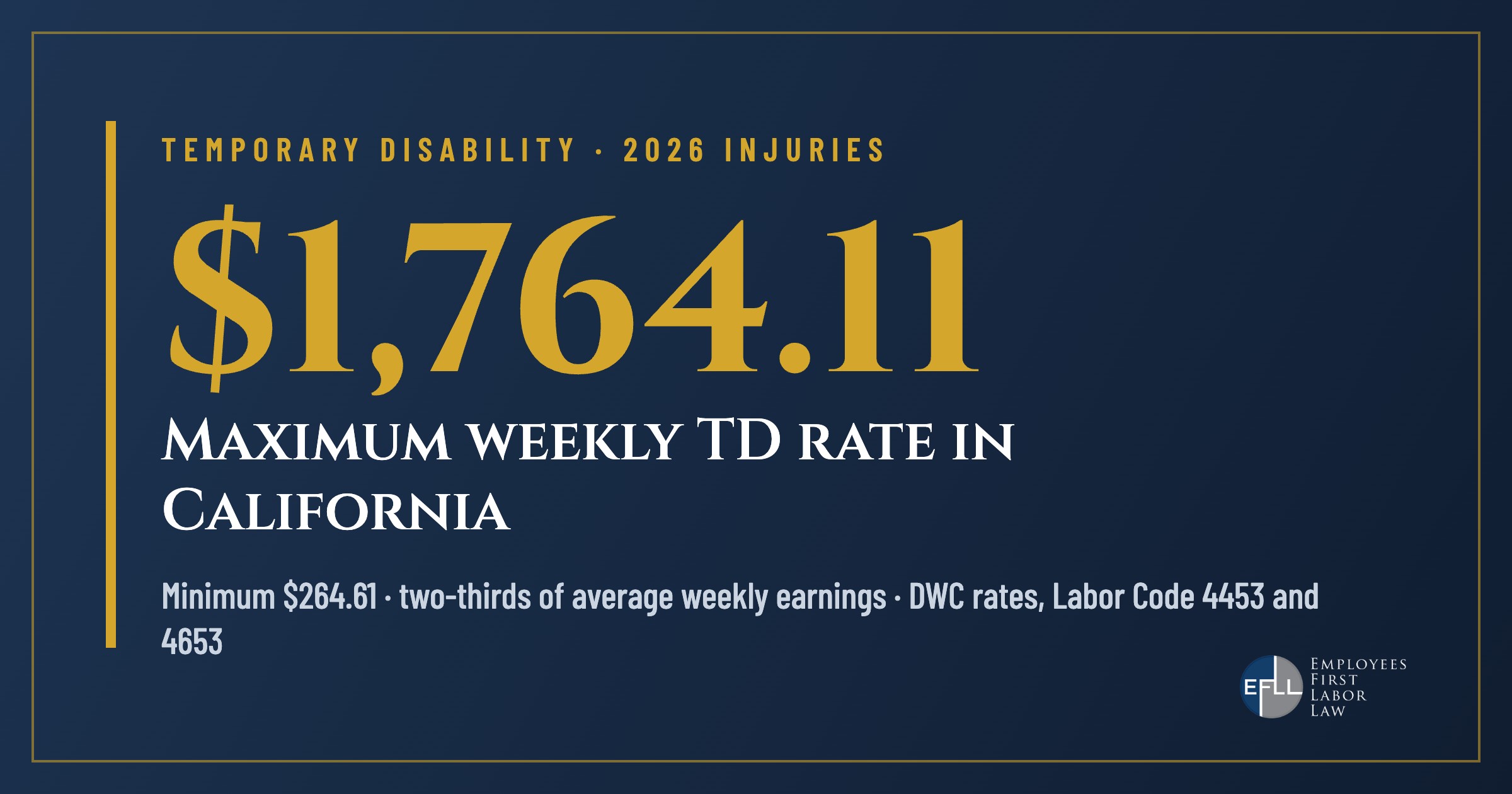
Temporary total disability is two-thirds of your average weekly earnings (Labor Code 4653), subject to a minimum and maximum set each year by the Division of Workers’ Compensation (DWC).
- Injuries in 2026: minimum $264.61, maximum $1,764.11 a week.
- Injuries in 2025: minimum $252.03, maximum $1,680.29 a week.
According to the DWC’s calculation, you reach the 2026 maximum if your average weekly earnings are about $2,646 or more. If you earn less than about $397 a week, you receive the minimum. Your average weekly earnings can include overtime and earnings from other jobs, so check how the insurer calculated your rate.
One rule surprises many workers: under Labor Code 4661.5, TD paid two years or more after the date of injury is calculated using the minimum and maximum in effect on the date of payment. If you are still on TD years later and were at the cap, your rate should go up.
Temporary partial disability works differently. It is two-thirds of your weekly wage loss, meaning the difference between what you earned before and what you can earn while recovering (Labor Code 4654 and 4657).
💡 Example: Maria earns $1,200 a week as a warehouse lead and hurts her shoulder in 2026. While she is off work, her TD is two-thirds of $1,200, or $800 a week. Later, her employer offers part-time light duty paying $600 a week. Her wage loss is $600, so her temporary partial disability is two-thirds of $600, or $400 a week, on top of her $600 paycheck.
Want to run your own numbers? Try our California workers’ comp benefits calculator.
If your temporary disability checks stopped, your permanent disability has not started, or your rate looks wrong, we can review your payment history in a free consultation.
When TD payments start and how often you get paid
Labor Code 4650 sets firm deadlines for TD:
- First payment: no later than 14 days after your employer knows about the injury and your disability, unless the claim is denied first.
- After that: every two weeks, on the day set with the first payment.
- Late payments: if a payment is late, the late amount is increased by 10% and must be paid to you without you having to ask.
There are limited exceptions to the 10% increase. For example, it does not apply when the insurer can’t yet decide whether TD is owed and notifies you within the 14 days explaining why, what information it needs and when it expects to decide. Read more in our guide to Labor Code 4650 and the timing of TD payments.
How long TD lasts and when it ends
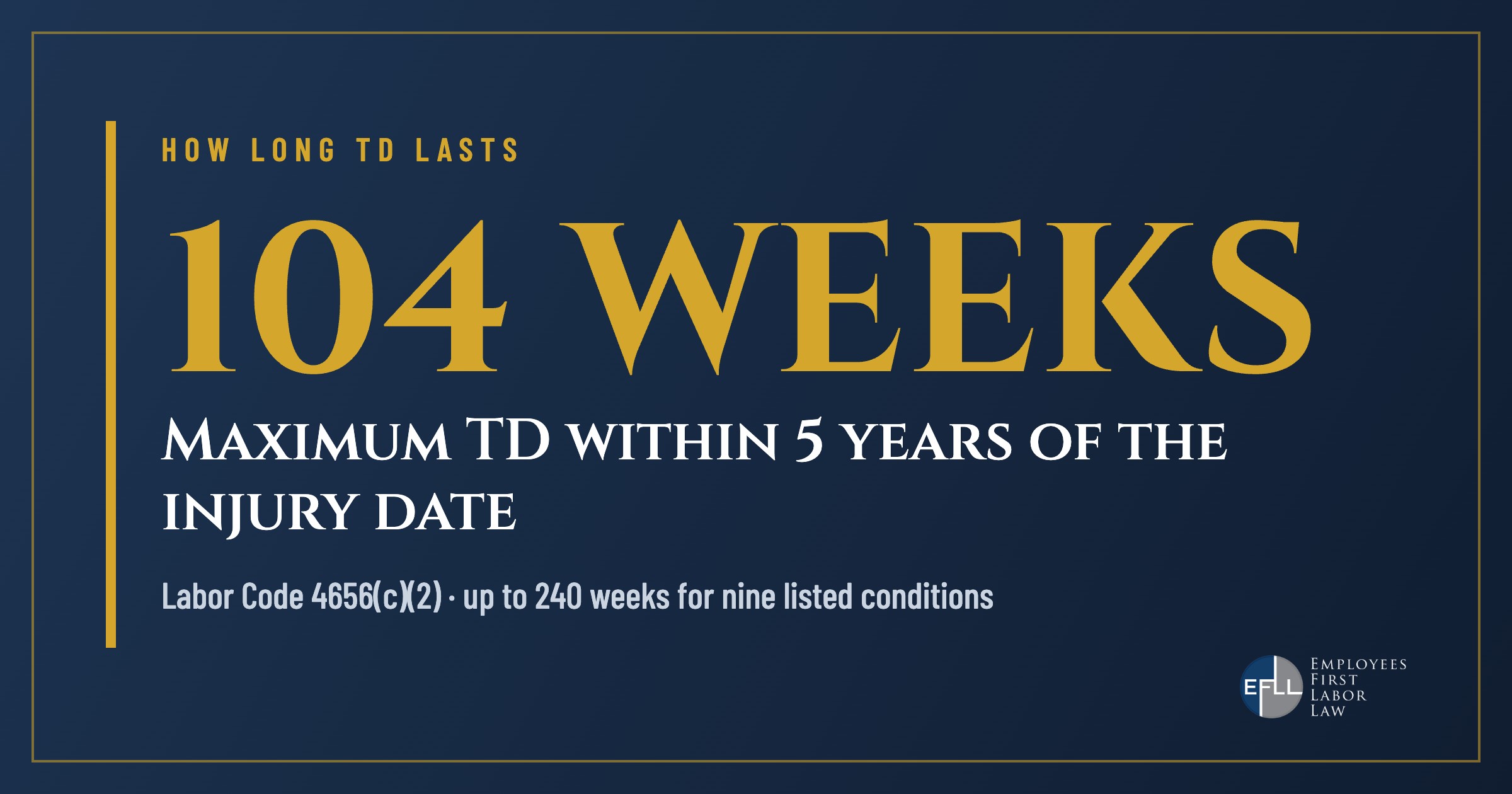
For injuries on or after January 1, 2008, TD for a single injury can’t exceed 104 compensable weeks within five years of the date of injury (Labor Code 4656(c)(2)). The weeks don’t have to be in a row, but the five-year window keeps running.
Labor Code 4656(c)(3) allows up to 240 compensable weeks within five years for these nine injuries or conditions:
- Acute and chronic hepatitis B
- Acute and chronic hepatitis C
- Amputations
- Severe burns
- Human immunodeficiency virus (HIV)
- High-velocity eye injuries
- Chemical burns to the eyes
- Pulmonary fibrosis
- Chronic lung disease
A separate rule, Labor Code 4656(d), also allows up to 240 weeks for certain cancers covered by Labor Code 3212.1 for injuries on or after January 1, 2023.
TD usually ends at the first of these events:
- You go back to your regular job, or to modified work that pays your full wages.
- Your doctor finds you have reached maximum medical improvement (MMI), also called permanent and stationary (P&S).
- You use up the 104 weeks (or 240 weeks) of TD.
Being fired or laid off does not, by itself, end your right to TD if you are still medically disabled. See workers’ comp after a job termination.
What is permanent disability (PD)?
Permanent disability pays you for an impairment that remains after you have healed as much as you are going to. It is not wage replacement, so you can receive PD even if you are back at work full time.
PD is based on a permanent disability rating from 0% to 100%. For injuries on or after January 1, 2013, Labor Code 4660.1 sets the formula:
- A doctor measures your whole person impairment (WPI) under the AMA Guides, Fifth Edition.
- The WPI is multiplied by an adjustment factor of 1.4.
- The result is then adjusted for your occupation and your age at the time of injury.
Some older guides describe an adjustment for “diminished future earning capacity.” That adjustment applied to injuries before 2013. For injuries in 2013 and later, it has been replaced by the flat 1.4 factor. Our guide on how permanent disability ratings are calculated walks through each step.
How much PD pays
PD is also two-thirds of your average weekly earnings, but the limits are much lower than for TD. For injuries on or after January 1, 2014, the weekly PD rate is $160 to $290 for any rating under 100% (Labor Code 4453(b) and 4658). Anyone earning about $435 a week or more gets the $290 maximum. These limits are fixed by statute and do not rise with inflation.
Your rating decides how many weeks you are paid. Under Labor Code 4658(e), the weeks per percentage point increase as the rating rises. For example, a 10% rating pays 30.25 weeks, a 15% rating pays 50.5 weeks and a 25% rating pays 100.75 weeks.
💡 Example: After treatment, Maria (from the example above) reaches MMI with a 15% permanent disability rating. Because she earned more than $435 a week, her PD rate is the $290 maximum. Her PD is 50.5 weeks × $290 = $14,645, paid every two weeks. While she was on TD, she received $800 a week.
Ratings of 70% or more add a life pension after the PD weeks run out, and a 100% rating (permanent total disability) is paid for life (Labor Code 4659). For the complete chart of weeks and dollars for every rating, see how much permanent disability pays in California.
The handoff from TD to PD
The switch from TD to PD is where payments often stall. The law requires:
- PD must start within 14 days after your last TD payment (Labor Code 4650(b)). The insurer pays based on its reasonable estimate of your PD until the rating is final.
- If TD ended because you hit the 104-week cap, PD payments still have to start on time, even if your rating can’t be determined yet.
- One exception: before a PD award, the insurer does not have to make these advance payments if your employer has offered you a job paying at least 85% of your pre-injury wages, or you are already working at 100% or more. When the award is made, PD is owed back to the date TD ended or the date you became permanent and stationary, whichever is earlier.
If your injury happened in 2013 or later and caused permanent partial disability, you may also receive a Supplemental Job Displacement Benefit voucher worth up to $6,000 for retraining. You qualify if your employer does not offer regular, modified or alternative work lasting at least 12 months within 60 days after the claims administrator receives the doctor’s report finding you permanent and stationary (Labor Code 4658.7).
At this stage, your case may also be ready to settle, either by a stipulated award (PD paid over time, with future medical care left open) or a compromise and release (a lump sum that usually closes future medical care). See how to settle your workers’ comp case.
Common TD and PD problems and what to do
Watch for these problems:
- A TD rate based on base pay only, without overtime or a second job.
- Late TD checks with no 10% increase added.
- TD that stops when your doctor finds you permanent and stationary, with no PD payment within 14 days.
- A PD rating built on the wrong formula or a doctor’s report that leaves out body parts.
If something looks wrong, take these steps:
- Ask the claims administrator in writing how your average weekly earnings and rate were calculated.
- Gather your pay stubs from the year before the injury, including overtime and other jobs.
- Keep a log of every TD and PD payment date and amount.
- Get a copy of every medical report, especially the permanent and stationary report.
- Don’t accept a rating or settlement until someone has checked the math.
- Talk to a workers’ comp attorney before deadlines run.
Frequently asked questions
What is the difference between TD and PD in California workers’ comp?
TD replaces two-thirds of your lost wages while you recover. PD pays for a lasting impairment after you reach maximum medical improvement, based on your rating, and usually starts after TD ends.
What is the maximum TD rate in California for 2026?
For injuries in 2026, the maximum temporary total disability rate is $1,764.11 a week and the minimum is $264.61 a week, according to the DWC. For 2025 injuries, the range is $252.03 to $1,680.29.
How long can I receive TD?
For most injuries on or after January 1, 2008, up to 104 compensable weeks within five years of the date of injury. Nine listed conditions, including amputations, severe burns and chronic lung disease, allow up to 240 weeks.
Can I get TD and PD at the same time?
For the same injury, PD payments normally begin after TD ends, so you generally don’t receive both for the same weeks. If your condition worsens and your doctor takes you off work again, TD can restart as long as you have TD weeks left within the five-year window.
Are TD and PD payments taxable?
Workers’ compensation benefits, including TD and PD, are generally not taxable income. If you also receive Social Security disability, ask how the two benefits interact.
Does PD stop if I go back to work?
No. PD compensates you for a permanent impairment, not lost wages, so you can work and still receive it. Returning to work can affect the timing of advance PD payments before an award, but not the amount you are owed.
Related guides
 Workers only. Never employers.
At Employees First Labor Law, we represent California workers only, never employers. Our team has recovered more than $200 million for our clients, and we prepare every case as if it is going to trial. We have offices in Pasadena, Irvine, Long Beach, Pomona, Riverside, Bakersfield and Fresno, and we serve workers throughout California. Meet our team.







We help injured workers across California get the correct temporary and permanent disability payments, challenge low ratings and late checks, and evaluate settlement offers. Talk to us before you sign anything.
- ✅ Free, confidential consultation
- ✅ We represent workers only, never employers
- ✅ Se habla español: Empleados Primero
This article provides general information about California law and is not legal advice for any specific situation. Reading it does not create an attorney-client relationship. Past results do not guarantee a similar outcome.