

Updated October 2026 · 8 min read
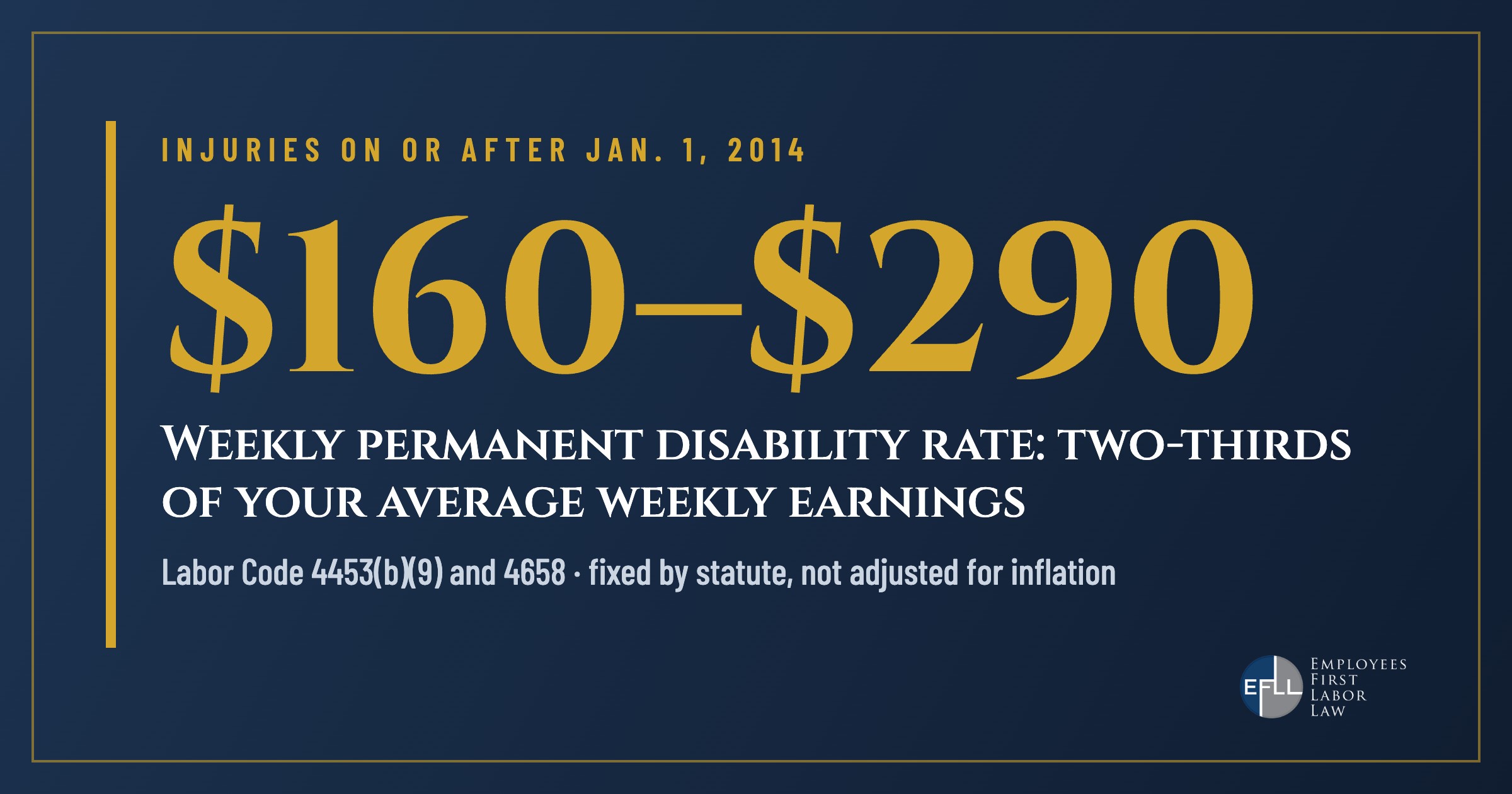
Permanent disability in California pays two-thirds of your average weekly earnings, between $160 and $290 a week for injuries on or after January 1, 2014, for a number of weeks set by your permanent disability rating. A 10% rating pays 30.25 weeks, or $4,840 to $8,772.50 in total. A 50% rating pays 271.25 weeks, or $43,400 to $78,662.50. Ratings of 70% or more also add a life pension, and a 100% rating is paid for life.
Those numbers surprise many injured workers, because permanent disability (PD) pays far less per week than temporary disability. In 2026, temporary disability can pay up to $1,764.11 a week, while PD is capped at $290 a week no matter how much you earned.
This guide gives you the full 2026 permanent disability money chart, explains how your weekly rate is figured, when payments start, and the other money you may be owed. If you want to understand how the rating percentage itself is built, read our companion guide, How ratings work: how permanent disability ratings are calculated in California.
- The weekly rate: PD pays two-thirds of your average weekly earnings, $160 to $290 a week for injuries on or after January 1, 2014 (Labor Code 4453(b)(9), 4658).
- The weeks: your rating sets the number of weeks under Labor Code 4658(e). A 10% rating is 30.25 weeks ($4,840 to $8,772.50); a 50% rating is 271.25 weeks ($43,400 to $78,662.50).
- Ratings of 70% or more add a life pension (up to $77.31 a week at 70% and $307.30 at 99.75% to start), and a 100% rating is paid for life at your temporary disability rate.
- The first PD payment is due within 14 days after your last temporary disability payment, then every two weeks (Labor Code 4650).
- You may also qualify for a job displacement voucher of up to $6,000 and a $5,000 Return-to-Work Supplement. To see how your rating itself was built, read how ratings work.
Permanent disability rating chart: what each rating pays in 2026
This chart applies to injuries on or after January 1, 2014. The weeks come from Labor Code section 4658(e). The totals are the weeks multiplied by the minimum weekly rate ($160) and the maximum weekly rate ($290). Your total will fall in this range depending on your earnings.
| PD rating | Weeks of PD | Total at $160/wk | Total at $290/wk | Life pension? |
|---|---|---|---|---|
| 1% | 3 | $480 | $870 | No |
| 5% | 15 | $2,400 | $4,350 | No |
| 10% | 30.25 | $4,840 | $8,772.50 | No |
| 15% | 50.5 | $8,080 | $14,645 | No |
| 20% | 75.5 | $12,080 | $21,895 | No |
| 25% | 100.75 | $16,120 | $29,217.50 | No |
| 30% | 131 | $20,960 | $37,990 | No |
| 35% | 166 | $26,560 | $48,140 | No |
| 40% | 201 | $32,160 | $58,290 | No |
| 45% | 236 | $37,760 | $68,440 | No |
| 50% | 271.25 | $43,400 | $78,662.50 | No |
| 55% | 311.25 | $49,800 | $90,262.50 | No |
| 60% | 351.25 | $56,200 | $101,862.50 | No |
| 65% | 391.25 | $62,600 | $113,462.50 | No |
| 70% | 433.25 | $69,320 | $125,642.50 | Yes, up to $77.31/wk to start |
| 75% | 513.25 | $82,120 | $148,842.50 | Yes, up to $115.96/wk to start |
| 80% | 593.25 | $94,920 | $172,042.50 | Yes, up to $154.61/wk to start |
| 85% | 673.25 | $107,720 | $195,242.50 | Yes, up to $193.27/wk to start |
| 90% | 753.25 | $120,520 | $218,442.50 | Yes, up to $231.92/wk to start |
| 95% | 833.25 | $133,320 | $241,642.50 | Yes, up to $270.57/wk to start |
| 99% | 897.25 | $143,560 | $260,202.50 | Yes, up to $301.50/wk to start |
| 100% | For life | Paid at your temporary disability rate for life | Not applicable (PTD) | |
A few notes on reading the chart:
- Ratings are set in quarter-percent steps, so your rating may fall between the rows. Our workers’ comp calculator can help you estimate yours.
- These are amounts before any attorney’s fee, and before credit for PD advances already paid.
- Injuries in 2013 used lower maximums for ratings under 70% ($230 a week under 55%, $270 a week from 55% to 69.75%). Injuries before 2013 follow older tables.
💡 Example: Carlos, a hypothetical delivery driver injured in 2024, earned $900 a week and receives a final rating of 20%. Two-thirds of $900 is $600, which is above the cap, so his PD rate is $290 a week. A 20% rating is 75.5 weeks, so his PD totals 75.5 × $290 = $21,895.
How the weeks are counted
The number of weeks grows faster as the rating goes up. Labor Code section 4658(e) assigns a number of weeks to each 1% of disability within each range, and the weeks are cumulative:
- 0.25% to 9.75%: 3 weeks for each 1%
- 10% to 14.75%: 4 weeks for each 1%
- 15% to 24.75%: 5 weeks for each 1%
- 25% to 29.75%: 6 weeks for each 1%
- 30% to 49.75%: 7 weeks for each 1%
- 50% to 69.75%: 8 weeks for each 1%
- 70% to 99.75%: 16 weeks for each 1%
So a 10% rating is 9.75% at 3 weeks (29.25 weeks) plus the next quarter point at 4 weeks (1 week), for 30.25 weeks. That is why moving from 69% to 70% adds 10 weeks, while moving from 4% to 5% adds only 3.
Watch: injured at work in California
Our attorneys explain what your employer must do after a work injury, and what to do in the first 24 hours to protect your claim.
How your weekly PD rate is calculated
Your weekly PD rate is two-thirds of your average weekly earnings (AWE) at the time of injury (Labor Code section 4658). For PD only, the law limits the AWE used to between $240 and $435 for injuries on or after January 1, 2014 (Labor Code section 4453(b)(9)). Two-thirds of those limits gives the $160 minimum and $290 maximum.
- If you earned $300 a week, your rate is $200 a week.
- If you earned $435 a week or more, your rate is the $290 maximum.
- If you earned $240 a week or less, your rate is the $160 minimum.
Average weekly earnings include more than your base hourly pay. Overtime, a second job and the value of some benefits can count, and mistakes are common. The PD rate is fixed by statute and does not rise with inflation each year. A 2025 bill to raise it, SB 555, has not been enacted as of October 2026.
We check your rating, your average weekly earnings and every payment the insurer owes you. Free, confidential case review.
Life pension for ratings of 70% to 99.75%
If your rating is at least 70% but less than 100%, you receive a life pension after all your PD weeks have been paid (Labor Code section 4659(a)). The pension is 1.5% of your average weekly earnings for each 1% of disability above 60%. For this purpose, average weekly earnings are capped at $515.38 for injuries on or after January 1, 2006.
That puts the maximum starting life pension at $77.31 a week at a 70% rating, $154.61 a week at 80%, and $307.30 a week at 99.75%. For injuries on or after January 1, 2003, the pension increases each January 1 by the percentage increase in the state average weekly wage (section 4659(c)).
💡 Example: Ana, a hypothetical worker earning more than $515.38 a week, is rated 80%. She first receives 593.25 weeks of PD, up to $172,042.50 at $290 a week. After that, she receives a life pension that starts at 1.5% × 20 × $515.38 = $154.61 a week.
100% permanent total disability
A 100% rating is permanent total disability. Instead of a set number of weeks, you are paid for the rest of your life at your temporary disability rate, based on your average weekly earnings under Labor Code section 4453 (section 4659(b)). These payments also get the annual state average weekly wage increase for injuries on or after January 1, 2003. Some injuries are presumed total by law. See our permanent total disability guide for who qualifies.

When permanent disability payments start
You do not have to wait for a final rating or a settlement to start getting PD. Under Labor Code section 4650(b), the first PD payment is due within 14 days after your last temporary disability payment, even if the extent of your permanent disability is not known yet. The insurer must keep paying until its reasonable estimate of your PD has been paid, or until the amount owed has been decided and paid. These early payments are often called PD advances.
- Every two weeks. After the first payment, PD is paid every two weeks on the day set with the first payment (section 4650(c)).
- Late payments. A late payment is increased by 10% and paid to you automatically, with limited exceptions (section 4650(d)).
- Back at work. Before an award, the insurer does not have to pay PD advances if your employer offered you a job paying at least 85% of your wages and compensation at the time of injury, or if you are working in a job paying at least 100% of them (section 4650(b)(2)).
Lump sum or biweekly payments
How you receive the rest of your PD depends on how your case ends.
- Stipulated award. PD continues every two weeks until the total is paid, and future medical care usually stays open. You can generally ask to reopen for new and further disability within five years of the date of injury (Labor Code section 5410). See what a stipulated award is.
- Compromise and release (C&R). You receive one lump sum, and the case usually closes, often including future medical care. The amount is negotiated and can be more or less than the chart value. See C&R vs. stipulated award.
- Commutation. When it makes an award or later, the Workers’ Compensation Appeals Board can, in limited situations, order future payments paid as a lump sum (Labor Code section 5100).
Before you take a lump sum, compare it with the chart value of your rating, the value of future medical care, and any life pension you would give up.
Other money: the job displacement voucher and $5,000 supplement
PD is not the only benefit tied to a permanent injury. For injuries on or after January 1, 2013, if you have permanent partial disability and your employer does not offer regular, modified or alternative work that meets the legal requirements, you are entitled to a Supplemental Job Displacement Benefit voucher of up to $6,000 for retraining or skill enhancement (Labor Code section 4658.7). Learn more in our job displacement voucher guide.
If you receive that voucher, you can also apply to the state’s Return-to-Work Supplement Program for a one-time $5,000 payment. You must apply within one year of the date the voucher was served on you.
Permanent disability terms, briefly
- AWE: average weekly earnings, the basis for your weekly rate.
- MMI / P&S: maximum medical improvement, or permanent and stationary, the point when your condition has stabilized and can be rated.
- WPI: whole person impairment, the doctor’s starting percentage under the AMA Guides. See our WPI guide.
- PDRS: the Permanent Disability Rating Schedule that turns WPI into a rating.
- Apportionment: a reduction for the part of your disability caused by something other than the work injury.
- PD advance: PD paid before your case is resolved.
Frequently asked questions
How much does permanent disability pay in California?
For injuries on or after January 1, 2014, PD pays $160 to $290 a week, depending on your earnings, for the number of weeks set by your rating. Totals range from $480 to $870 at a 1% rating up to $145,480 to $263,682.50 at 99.75%, plus a life pension at 70% or more.
How much is a 10% permanent disability rating worth?
A 10% rating is 30.25 weeks of PD, which is $4,840 at the minimum rate and $8,772.50 at the maximum rate.
How much is a 20% permanent disability rating worth?
A 20% rating is 75.5 weeks of PD, which is $12,080 to $21,895.
When do permanent disability payments start?
Generally within 14 days after your last temporary disability payment, and then every two weeks (Labor Code section 4650).
Is permanent disability taxable?
Workers’ compensation benefits paid under a workers’ compensation law are generally exempt from federal income tax (IRS Publication 525). If you also receive Social Security disability benefits, part of your workers’ comp may be treated differently, so check with a tax professional.
Does my PD go up every year?
Regular PD does not. The life pension and 100% permanent total disability payments increase each January 1 with the state average weekly wage for injuries on or after January 1, 2003.
Related guides
 Workers only. Never employers.
At Employees First Labor Law, we represent California workers only, never employers. Our team has recovered more than $200 million for our clients, and we prepare every case as if it is going to trial. We have offices in Pasadena, Irvine, Long Beach, Pomona, Riverside, Bakersfield and Fresno, and we serve workers throughout California. Meet our team.







If you have a permanent disability rating or a settlement offer, we can check whether the weekly rate, the number of weeks and any life pension are right before you sign. We represent injured workers throughout California.
- ✅ Free, confidential consultation
- ✅ We represent workers only, never employers
- ✅ Se habla español: Empleados Primero
This article provides general information about California law and is not legal advice for any specific situation. Reading it does not create an attorney-client relationship. Past results do not guarantee a similar outcome.