
Updated October 2026 · 10 min read
In most cases you cannot collect full workers’ comp temporary disability (TD) and California State Disability Insurance (SDI) for the same days, but there are real exceptions: SDI can pay you while your workers’ comp claim is delayed or denied, and it can pay the difference when your weekly TD check is smaller than your SDI benefit would be. You are allowed to apply for SDI while you are on workers’ comp. The EDD decides what, if anything, it can pay.
Getting this right matters. A worker who earns $1,200 a week gets about $800 a week in TD but might qualify for roughly $1,080 a week in SDI. If the insurer is slow to accept the claim, SDI can keep the rent paid. And if both programs pay for the same weeks, the EDD is paid back through a lien in your workers’ comp case, which you need to understand before you settle.
Below: the rules, 2026 benefit amounts, how to apply for SDI while a claim is pending, the EDD lien, and how permanent disability, Paid Family Leave and SSDI fit in.
- You generally cannot receive full workers’ comp TD and SDI for the same days in California (Unemployment Insurance Code 2629).
- If your weekly TD is lower than your SDI rate, SDI can pay you the difference.
- You can apply for SDI while on workers’ comp, especially if your claim is delayed or denied. The EDD can start paying if the insurer does not accept or pay within 14 days of the EDD’s notice.
- If both pay for the same weeks, the EDD is generally reimbursed through a lien in your workers’ comp case (Labor Code 4903(f)), not a bill to you.
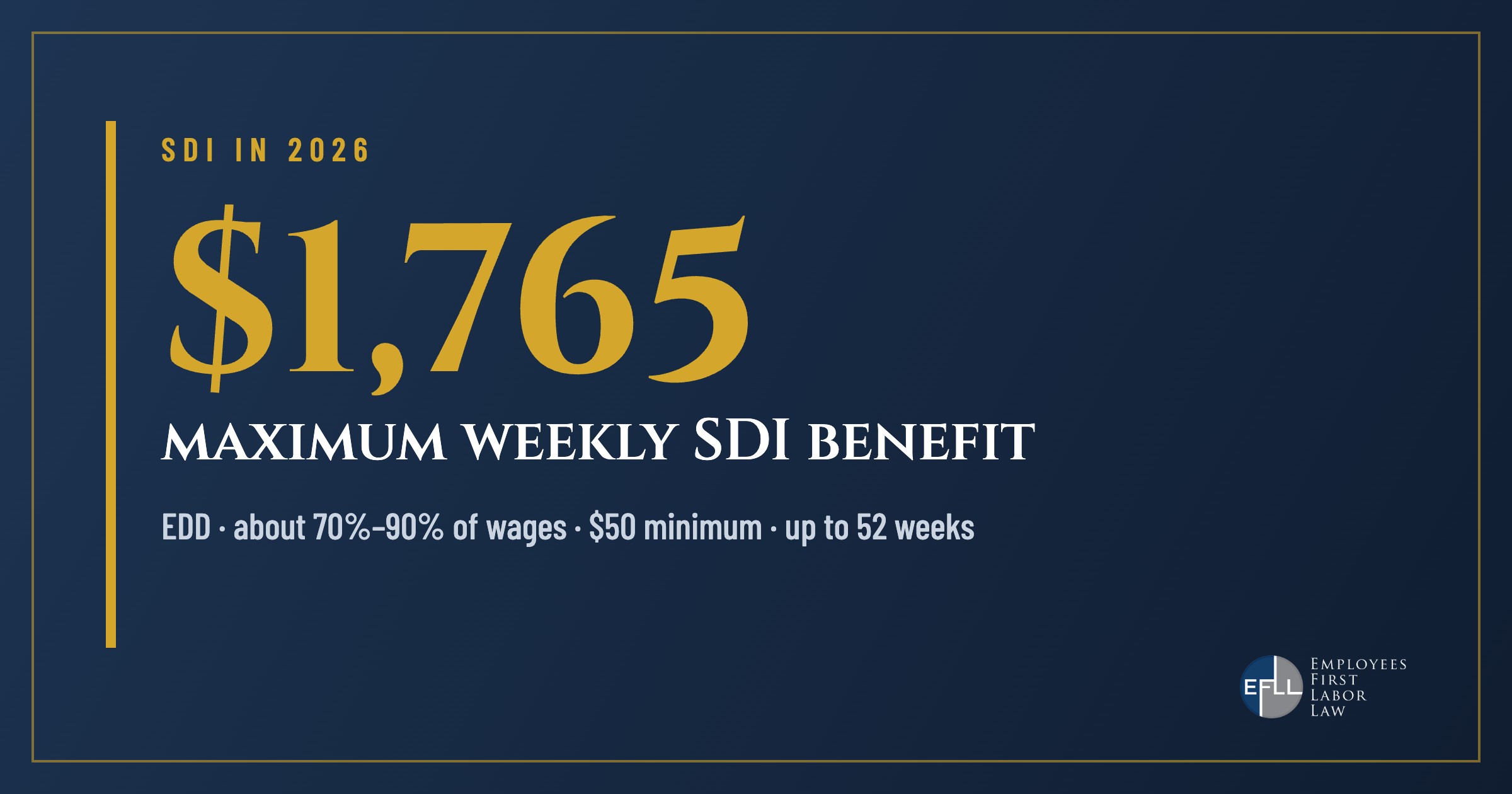
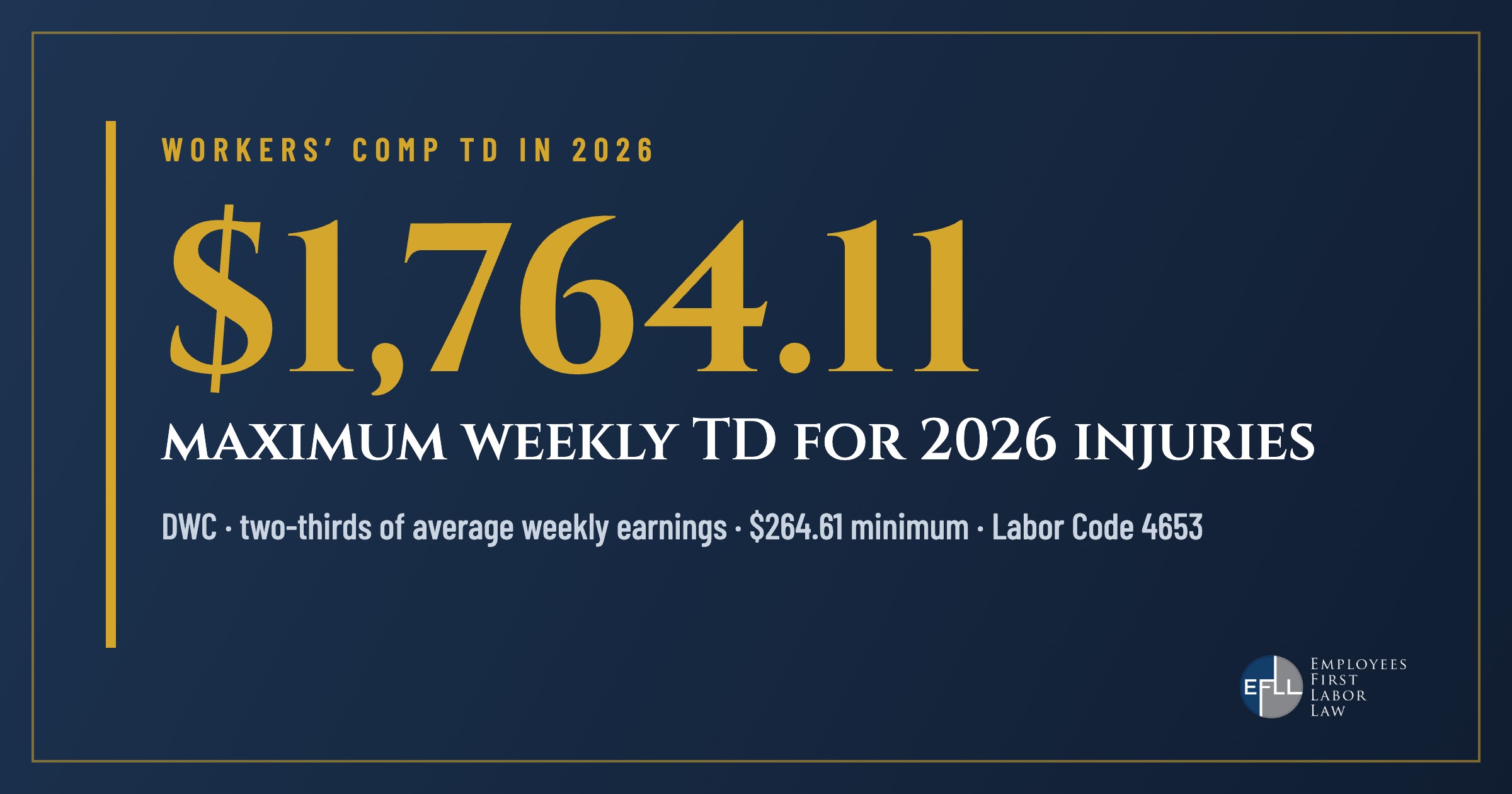
- 2026 figures: SDI pays $50 to $1,765 a week for up to 52 weeks; TD for 2026 injuries pays $264.61 to $1,764.11 a week.
Can you get workers’ comp and state disability at the same time in California?
The starting rule is in Unemployment Insurance Code section 2629. You are generally not eligible for SDI disability benefits for any day you receive, or are entitled to receive, “other benefits” in cash. The statute defines “other benefits” to include:
- Temporary disability indemnity under a workers’ compensation law of California, another state or the federal government
- Temporary disability benefits under an employer’s liability law
- Permanent disability benefits for the same injury or illness under a workers’ compensation law
The same section creates the most important exception. If those other benefits are less than the SDI amount you would otherwise receive, you can receive SDI for that day reduced by the amount of the workers’ comp benefit. In plain terms, SDI can top you up to your SDI rate, but the two programs together will not pay more than SDI alone would.
The EDD’s own workers’ compensation FAQ says the same thing: it is not common to receive both, but you may get full or partial SDI if your employer or its insurer delays benefits, denies benefits, pays a weekly workers’ comp benefit that is less than your SDI benefit, or pays only your medical expenses. The EDD’s advice is to file a claim and let it decide.
SDI vs. workers’ comp TD: 2026 comparison
Workers’ comp and SDI are separate systems with different payers and limits.
| Workers’ comp temporary disability (TD) | State Disability Insurance (SDI) | |
|---|---|---|
| What it covers | Wage loss from a work injury or illness | Wage loss from your own disability, normally one that is not work-related |
| Who pays | Your employer’s workers’ comp insurer (or a self-insured employer) | The EDD, funded by the SDI withholding on your paycheck |
| Weekly amount | Two-thirds of your average weekly earnings (Labor Code 4653) | About 70% to 90% of your weekly wages from the base period, depending on income |
| 2026 minimum and maximum | $264.61 to $1,764.11 per week for 2026 injuries | $50 to $1,765 per week |
| How long | Up to 104 compensable weeks within five years of the injury for most injuries (Labor Code 4656), longer for certain listed conditions | Up to 52 weeks |
| Waiting period | First 3 days unpaid unless the disability lasts more than 14 days or you are hospitalized (Labor Code 4652) | First 7 days of a new claim are unpaid |
| Medical care | Yes, paid by the insurer | No, SDI pays only cash benefits |
| Job protection | No direct job protection, but firing or punishing you for filing a claim is prohibited (Labor Code 132a) | None by itself; CFRA or FMLA may protect your job |
You can estimate your TD with our workers’ comp calculator, and learn how TD is paid and when it ends on our temporary disability benefits page.
Watch: injured at work in California
Our attorneys explain what your employer must do after a work injury, and what to do in the first 24 hours to protect your claim.
When SDI pays the difference
Because TD is two-thirds of your wages and SDI can be as high as 90% for lower and middle earners, your SDI rate can be higher than your TD rate. When that happens, Unemployment Insurance Code 2629(c) lets the EDD pay you the difference for each day you are otherwise eligible.
💡 Example: Maria earns a steady $1,200 a week, so her best quarter is about $15,600. Her TD rate is two-thirds of $1,200, or $800 a week. Her SDI rate falls in the 90% band, about $1,080 a week. If she is otherwise eligible, SDI can pay her the $280 difference each week, bringing her total to about $1,080 instead of $800. (This is a simplified illustration. The EDD makes the final calculation.)
The gap shrinks as income rises. Between about $65,120 and $83,725 a year, SDI is a flat $1,127 a week. Above that, SDI is 70% of weekly wages, close to the two-thirds TD rate, and both programs cap out near $1,765 a week, so high earners usually see little or no difference.
The EDD also lists one more situation: if workers’ comp is paying only your medical bills and no TD, you may qualify for SDI for the time you cannot work.
We can help you file for SDI, push the insurer to pay what it owes, and make sure the EDD lien is handled correctly. Free consultation.
Can I apply for disability while on workers’ comp? Filing when your claim is delayed or denied
Yes. You can file an SDI claim while you are on workers’ comp or while a workers’ comp claim is pending. This is most useful in three situations:
- The insurer is investigating. Insurers often take weeks to accept or deny a claim, and TD may not start right away.
- The claim was denied. While you fight a denied workers’ comp claim, SDI can replace part of your income.
- TD stopped. For example, TD ended but your doctor says you still cannot work.
Unemployment Insurance Code 2629.1 sets out what happens next. When you file, the EDD makes an initial decision about whether you are entitled to workers’ comp benefits. If it finds you are, it notifies you and your employer. That notice tells your employer it may owe interest and penalties. The EDD’s notice also counts as a claim for compensation and knowledge of the injury for purposes of Labor Code 5402.
If your employer or its insurer does not pay, or agree to pay, workers’ comp benefits within 14 days after the EDD’s notice, the EDD generally must start paying your disability benefits, as long as you are otherwise eligible. This keeps you from going without income while the employer decides.
Be honest on the SDI claim: tell the EDD the injury happened at work and that you filed, or plan to file, a workers’ comp claim. Hiding it can lead to an overpayment and penalties.
How the EDD lien works when both programs pay
Suppose SDI pays you while the workers’ comp claim is uncertain, and the insurer later accepts the claim or a judge finds it liable. The insurer now owes TD for weeks the EDD already covered. California handles this with a lien, not a bill to you.
Labor Code 4903(f) allows a lien in your workers’ comp case for unemployment compensation disability benefits paid while it was uncertain whether they were owed under the Unemployment Insurance Code or under workers’ comp. Under Unemployment Insurance Code 2629.1:
- An employer or insurer that accepts or is found liable is assessed for reimbursing the EDD, and must also pay interest.
- The employer pays a 10% penalty on the amount reimbursed if the Workers’ Compensation Appeals Board (WCAB) finds the failure to pay was unreasonable and no Labor Code 5814 penalty was already awarded for the delay.
- If the employer or insurer disputes liability, the WCAB decides the EDD’s right to reimbursement.
- The employer must reimburse the EDD within 60 days of accepting liability or of a final WCAB award.
💡 Example: Jose’s claim is delayed for 10 weeks, and SDI pays him $900 a week, or $9,000. The insurer then accepts the claim, and his TD rate is $700 a week. Instead of paying Jose $7,000 in back TD, the insurer generally reimburses the EDD for those weeks through the lien. Because his TD was lower than his SDI, the $200 a week difference was SDI he was entitled to anyway. (Simplified illustration; actual amounts depend on the EDD’s lien and the WCAB.)
EDD liens must be resolved before or as part of any settlement. An attorney checks that the lien amount matches the weeks that actually overlap, so you are not charged for the wrong period. For more on liens, see liens on a workers’ comp settlement.
Permanent disability and SDI
Once your doctor finds you have reached maximum medical improvement, TD usually ends and permanent disability (PD) payments may begin. PD counts as an “other benefit” under Unemployment Insurance Code 2629 when it is paid for the same injury or illness.
That means if you are still unable to work and file for SDI while receiving PD for the same injury, the EDD reduces your SDI by the PD amount. If your PD is less than your SDI rate, you may receive the difference. For injuries in 2014 or later, weekly PD for ratings under 100% is capped at $290, so the difference can be meaningful for workers who still cannot do any job.
Also keep the time limits in mind: TD generally stops after 104 compensable weeks within five years of the injury, and SDI stops after 52 weeks. To see what your PD rating is worth, read our guide to the permanent disability rating.
Paid Family Leave vs. SDI
People often say “SDI” for two different EDD programs:
- Disability Insurance (DI) pays you when you cannot work because of your own illness, injury or pregnancy, for up to 52 weeks.
- Paid Family Leave (PFL) pays you when you take time off to care for a seriously ill family member, bond with a new child, or for certain military family needs, for up to 8 weeks in a 12-month period. The weekly amount is also $50 to $1,765.
PFL is not for your own injury, but it may apply if you take time off to care for an injured family member. The EDD says receiving workers’ comp and PFL at the same time is also uncommon, with the same exceptions.
Neither DI nor PFL protects your job. Job protection comes from other laws, like CFRA and FMLA, and from disability accommodation rules. Our guide to SDI, Paid Family Leave and job protection explains how they fit together. If your condition is stress or mental health related, see how to request a leave of absence for stress or mental health.
Social Security Disability (SSDI) and workers’ comp
Social Security Disability Insurance is a federal program for long-term disability. It is separate from workers’ comp and SDI, and you can apply while your workers’ comp case is open.
Federal law (42 U.S.C. § 424a) allows Social Security to reduce SSDI if you also receive workers’ comp, or certain other public disability benefits, for the same months. The reduction generally applies when the combined benefits exceed 80% of your average earnings before you became disabled. How a workers’ comp settlement is worded can affect that reduction, so if you receive or expect SSDI, raise it with your attorney before you settle.
What to do if you are hurt at work and need income now
- Report the injury to your employer in writing and ask for a claim form (DWC-1). The EDD says to report a work injury as soon as possible and within 30 days.
- Get medical care and ask the doctor to put your work restrictions in writing.
- Track your TD. Note when payments should start, the weekly amount and any gaps.
- File for SDI if TD is delayed, denied, stopped or lower than your SDI rate. Tell the EDD the injury is work-related.
- Keep every EDD and insurer letter, including your Notice of Computation and any lien notices.
- Do not settle until the EDD lien is accounted for and you understand the effect on SDI and SSDI.
- Protect your job. Ask about CFRA or FMLA leave and keep records if you are pressured to return early.
Frequently asked questions
Can I collect workers’ comp and state disability at the same time in California?
Not in full for the same days. Under Unemployment Insurance Code 2629, SDI is reduced by any TD (or PD for the same injury) you receive. You can still receive SDI if your workers’ comp benefits are delayed, denied or lower than your SDI rate, or if workers’ comp is only paying medical bills.
Can I apply for disability while on workers’ comp?
Yes. The EDD says you can file a disability claim even if you were hurt at work, and it will decide whether you qualify. Report the injury as work-related on your claim.
Will I have to pay SDI back if my workers’ comp claim is approved later?
Usually not. The EDD is generally reimbursed by the employer or insurer through a lien in your workers’ comp case, out of TD owed for the same weeks. Problems arise when a worker hides the work injury or settles without dealing with the lien.
How much is SDI in 2026?
About 70% to 90% of your weekly wages from your base period, with a minimum of $50 and a maximum of $1,765 a week, for up to 52 weeks. The first 7 days of a new claim are an unpaid waiting period.
Does SDI protect my job while I am off work?
No. SDI and Paid Family Leave pay benefits but do not protect your job. CFRA, FMLA, pregnancy disability leave and disability accommodation laws may, depending on your employer and situation.
Related guides
 Workers only. Never employers.
At Employees First Labor Law, we represent California workers only, never employers. Our team has recovered more than $200 million for our clients, and we prepare every case as if it is going to trial. We have offices in Pasadena, Irvine, Long Beach, Pomona, Riverside, Bakersfield and Fresno, and we serve workers throughout California. Meet our team.







If you were hurt at work and your benefits are late, denied or too low, we can review your workers’ comp and SDI options and protect your case. Our attorneys represent injured workers across California.
- ✅ Free, confidential consultation
- ✅ We represent workers only, never employers
- ✅ Se habla español: Empleados Primero
This article provides general information about California law and is not legal advice for any specific situation. Reading it does not create an attorney-client relationship. Past results do not guarantee a similar outcome.