

Updated October 2026 · 11 min read
Work restrictions are your doctor’s written limits on what you can do at work after a job injury, and if your employer can’t accommodate them, California law generally entitles you to temporary disability pay while you heal or, for injuries since 2013, a $6,000 retraining voucher once your restrictions are permanent.
The clocks are short. Once your doctor reports permanent restrictions, your employer generally has 60 days to offer a job that fits them, and a Labor Code §132a discrimination claim generally must be filed within one year.
This guide covers what restrictions mean, what your employer must offer, what you’re owed if it can’t accommodate you, and what to do if it ignores them.
- Work restrictions are your doctor’s written limits on your job tasks, and any work your employer assigns must fit within them.
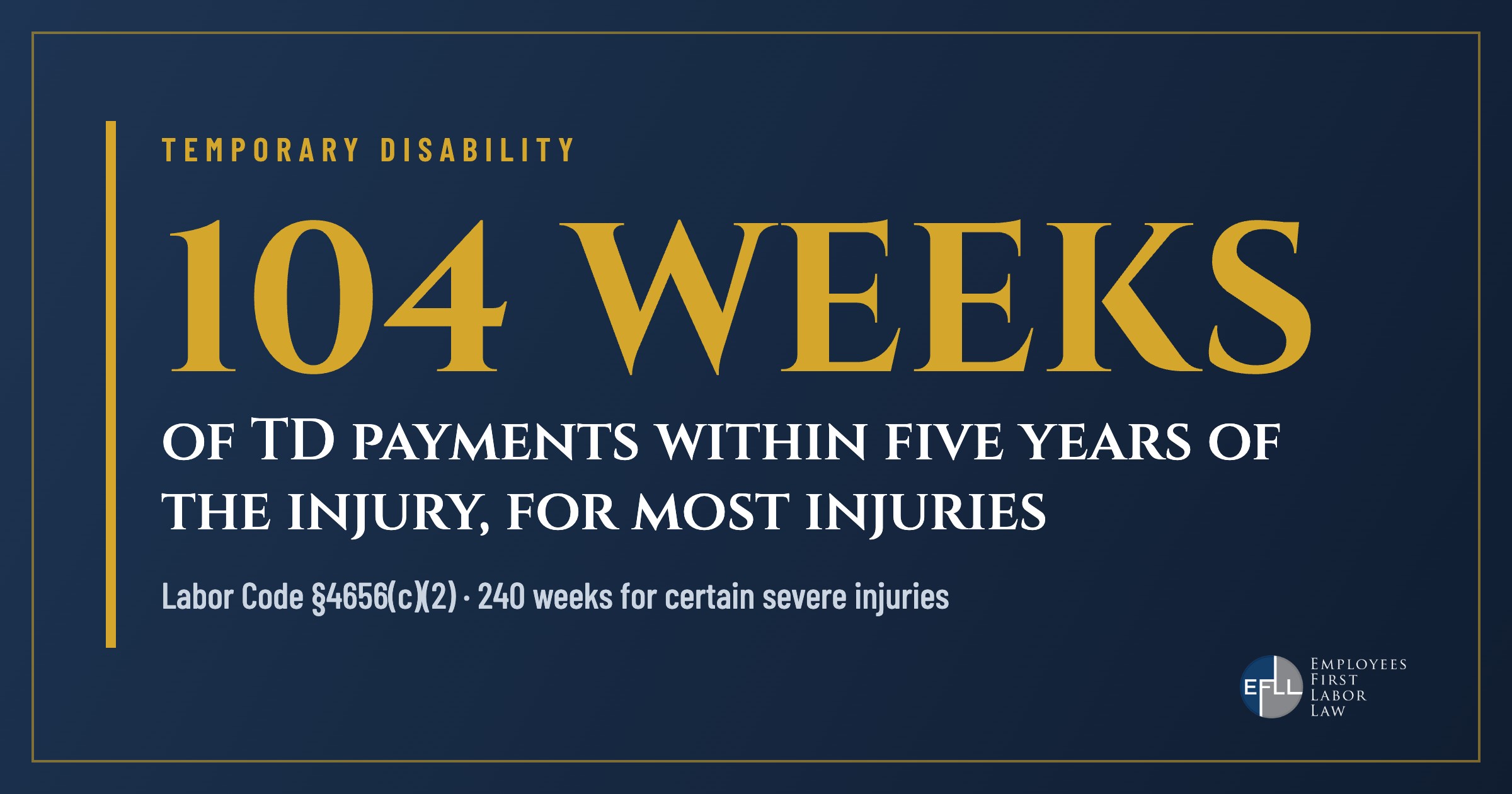
- If your employer can’t accommodate temporary restrictions, you’re generally owed temporary disability pay, capped at 104 weeks within five years for most injuries.
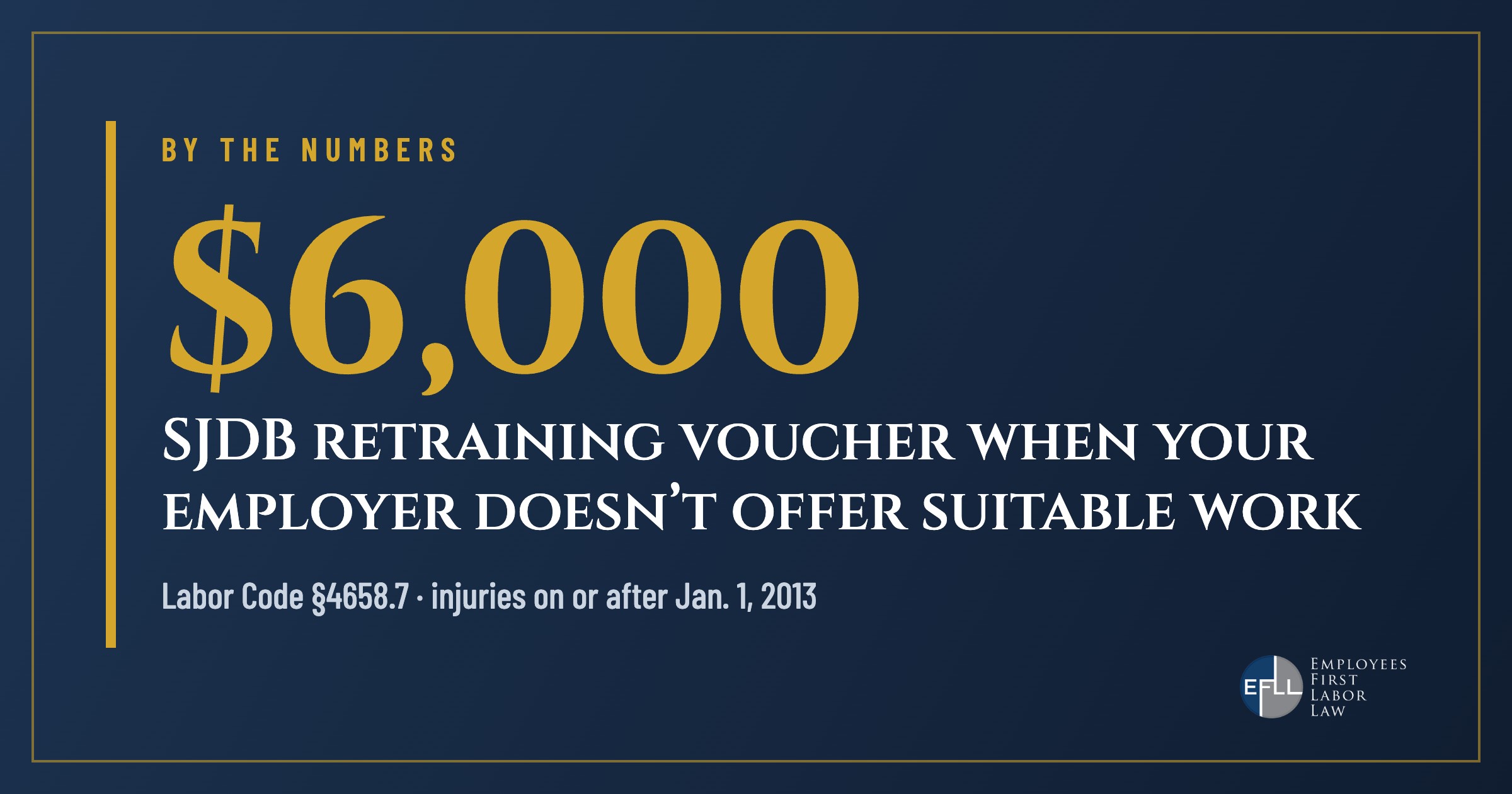
- For injuries on or after January 1, 2013, if you have a permanent partial disability and no qualifying job offer comes within 60 days after the claims administrator receives your doctor’s Return-to-Work & Voucher Report, you’re generally entitled to a $6,000 SJDB voucher.
- Under the FEHA, employers with 5 or more employees must reasonably accommodate a disability and engage in the interactive process; Labor Code §132a bars discrimination for being injured or filing a claim.
- If your employer ignores your restrictions, put everything in writing and act fast: a §132a claim generally must be filed within one year.
What Do Work Restrictions Mean? Temporary vs. Permanent Restrictions and Modified Duty
Common restrictions include no lifting over 10 pounds; no prolonged standing or walking; no repetitive use of the hands or arms; no bending, squatting, or kneeling; limits on pushing or pulling; reduced hours; and, after brain or psychiatric injuries, limits on certain mental or cognitive tasks.
- Temporary work restrictions apply while you’re still treating and recovering. Your treating doctor updates them as your condition changes, until you’re released to full duty or your condition becomes permanent.
- Permanent work restrictions are issued once your condition has stopped improving, called being “permanent and stationary” (P&S) or reaching maximum medical improvement (MMI). They are expected to last for the rest of your life.
- Modified duty (often called “light duty”) is not a restriction; it’s your employer’s answer to one: your regular job adjusted, or a different job, so you can work within your restrictions.
| Temporary restrictions | Permanent restrictions | |
|---|---|---|
| When they apply | While you’re treating and recovering | Once you’re permanent and stationary (MMI) |
| Where they’re written | Your treating doctor’s PR-2 progress reports | The final P&S report, or a QME or AME report |
| If your employer can’t accommodate them | Generally, temporary disability (TD) pay | For injuries on or after 1/1/2013, generally a $6,000 SJDB voucher (if you have a permanent partial disability) |
| Your job rights | FEHA accommodation and interactive-process duties apply if your condition qualifies as a disability and your employer has 5 or more employees | |
Your Doctor’s Restriction Note: The PR-2 and Final Reports
Your restrictions should always be in writing. While you’re treating, your primary treating physician records your work status on the Primary Treating Physician’s Progress Report (DWC Form PR-2), which gives three choices: remain off work until a set date; return to modified work on a set date with listed limitations or restrictions; or return to full duty with no limitations or restrictions.
A new PR-2 is required when your work status changes, and as a periodic report at least every 45 days. Once you’re permanent and stationary, the PR-2 is no longer used. Your permanent restrictions appear in your treating doctor’s final P&S report, or in a report from a Qualified Medical Evaluator (QME) or Agreed Medical Evaluator (AME). For injuries on or after January 1, 2013, the first of these doctors to find a permanent partial disability must also attach a Physician’s Return-to-Work & Voucher Report (Form DWC-AD 10133.36). It tells your employer your work capacities and activity restrictions, and it starts the 60-day clock on your employer’s job offer.
Ask for a copy of every report that sets or changes your restrictions, make sure they’re specific (“no lifting over 10 pounds,” not “light duty”), and if they don’t match what you can actually do, tell your doctor.
Watch: injured at work in California
Our attorneys explain what your employer must do after a work injury, and what to do in the first 24 hours to protect your claim.
Temporary Restrictions: Modified Duty or Temporary Disability Pay
While you’re healing, your employer may offer you modified or light-duty work that fits your temporary restrictions. If your employer can’t give you work that meets your restrictions, the claims administrator must generally pay you temporary disability (TD) benefits instead.
TD has time limits. For most injuries on or after January 1, 2008, TD is capped at 104 weeks of payments within five years of the date of injury (Labor Code §4656). A short list of severe injuries, including amputations, severe burns, and certain lung and eye injuries, has a longer 240-week cap.
If you’re offered modified duty, compare the actual tasks with your restrictions. If the job doesn’t fit, say so in writing.
That can trigger temporary disability pay, a $6,000 SJDB voucher, or FEHA accommodation duties. Get a free consultation to find out what you’re owed.
Can My Employer Accommodate My Restrictions?
Once your restrictions are permanent, your employer decides whether it can offer you one of three kinds of work, each defined by California law (Labor Code §4658.1):
- Regular work: your usual job, paying the same wages and compensation you earned when you were hurt, within a reasonable commuting distance of where you lived at the time of injury.
- Modified work: your regular job, changed so that you can perform all of its functions, paying at least 85% of your wages and compensation at the time of injury, within a reasonable commuting distance.
- Alternative work: a different job you’re able to perform, paying at least 85% of your wages and compensation at the time of injury, within a reasonable commuting distance.
For injuries on or after January 1, 2013, the offer must be made on the state form (Notice of Offer of Regular, Modified, or Alternative Work, Form DWC-AD 10133.35), must be for work lasting at least 12 months, and must come no later than 60 days after the claims administrator receives your doctor’s Return-to-Work & Voucher Report.
💡 Example: Carlos (a hypothetical worker) earned $1,000 a week in wages and compensation when he hurt his back. To count as modified or alternative work, a job offer must pay him at least $850 a week (85% of $1,000). An offer of $800 a week would not qualify.
If your employer offers a job that violates your medical restrictions, speak with a workers’ comp attorney right away. You are not required to accept unsafe work.
What If My Employer Cannot Accommodate My Work Restrictions?
What happens next depends on where you are in your case:
| Situation | What you’re generally owed | Rule |
|---|---|---|
| Still healing; no work within your temporary restrictions | Temporary disability (TD) pay, subject to TD’s time limits | DWC; Labor Code §4656 |
| Restrictions are permanent; injury on or after 1/1/2013; permanent partial disability; no valid offer within 60 days | A $6,000 Supplemental Job Displacement Benefit (SJDB) voucher | Labor Code §4658.7; 8 CCR §10133.31 |
| Restrictions are permanent, job or no job | Permanent disability benefits if a doctor finds a ratable permanent disability, based on your rating | Labor Code §§4658, 4660.1 |
| Restrictions qualify as a disability; employer has 5 or more employees | Reasonable accommodation (unless undue hardship) and a timely, good-faith interactive process | Gov. Code §12940(m), (n) |
Your permanent disability benefits are based on your disability rating, so they’re owed whether or not your employer has a job for you. And under the FEHA, if you can no longer do the essential functions of your own job even with accommodation, the employer must look for suitable vacant positions you’re qualified for and offer them to you (2 Cal. Code Regs. §11068). If your employer simply says “we have nothing for you” without talking through options, that’s a red flag.
The SJDB Voucher: $6,000 for Retraining
For injuries on or after January 1, 2013, the Supplemental Job Displacement Benefit is a $6,000 voucher, whatever your disability rating. You qualify if your injury caused a permanent partial disability and your employer doesn’t offer regular, modified, or alternative work within 60 days after the claims administrator receives your doctor’s Return-to-Work & Voucher Report. If you lost no time from work, or you went back to your same job with the same employer, the law treats you as having been offered and accepted regular work, and no voucher is issued. If no qualifying offer is made, the claims administrator must send you the voucher within 20 calendar days after the 60-day period ends.
The voucher can pay for training at a California public school or with a provider on the state’s eligible training provider list; licensing, certification, and testing fees; tools required by a training course; up to $1,000 for computer equipment; up to $500 for miscellaneous expenses; and up to 10% of the voucher ($600) for a licensed placement agency or vocational counselor.
💡 Example: Maria (a hypothetical worker) receives a $6,000 voucher. If she uses the full $1,000 computer allowance, the full $500 miscellaneous allowance, and $600 for a vocational counselor, that’s $2,100, leaving $3,900 for tuition, books, licensing fees, and required tools.
The voucher expires two years after it’s issued or five years after your date of injury, whichever is later, and it can’t be settled or traded for cash. If you receive a voucher, you may also qualify for the state’s one-time $5,000 Return-to-Work Supplement; the application must be received within one year after the voucher is served on you. For injuries from 2004 through 2012, the voucher ranged from $4,000 to $10,000 depending on your disability level, under different rules.
Can I Be Fired for Having Work Restrictions?
Generally not, if your employer can reasonably accommodate your restrictions. California is an at-will employment state, but that doesn’t let employers push out injured workers when accommodation is possible. If your restrictions qualify as a disability and can be reasonably accommodated without an undue hardship, an employer with 5 or more employees must accommodate them under the Fair Employment and Housing Act (FEHA), and must engage in a timely, good-faith interactive process with you (Gov. Code §12940(m), (n)). Separately, Labor Code §132a prohibits firing or discriminating against you because you were injured on the job or filed a workers’ comp claim.
If your employer refuses to discuss accommodations or fires you because of your restrictions, you may have discrimination, failure-to-accommodate, and §132a claims. See our guide on how to request a reasonable accommodation.
Is a Permanent Work Restriction a Disability?
Often, yes, but “disability” means different things under different laws. Under the FEHA, a physical condition is a disability if it limits a major life activity, and working counts. A condition “limits” an activity if it makes it difficult; it doesn’t have to make it impossible, and medication or assistive devices that help you aren’t counted (Gov. Code §12926). Under workers’ comp, “permanent disability” is a rating: a percentage that estimates how much your injury limits the kinds of work you can do. The two are separate, and your FEHA rights don’t depend on your workers’ comp rating.
What If My Employer Ignores My Work Restrictions?
Your employer has to honor your restrictions: any work it assigns you must fit within them. Warning signs include tasks outside your restrictions, being told to “push through it,” pressure to return to full duty early, claims that no modified work exists when it does, and threats to your job if you refuse.
- Get your restrictions in writing. Keep your latest PR-2 or doctor’s report, give a copy to your supervisor or HR, and keep proof that you did.
- Speak up politely but firmly, in writing. Explain that the task conflicts with your restrictions, ask for modified duties in writing, and offer to do work that fits.
- Keep a record. Write down dates, who gave the assignment, what was said, and who saw it. Save texts and emails.
- Report it. Tell HR and the workers’ comp claims administrator, and tell your doctor at your next visit, or sooner if your symptoms get worse.
- Don’t push through the pain. Doing work outside your restrictions can worsen your injury and undermine your case.
- Talk to a lawyer early. Some deadlines are as short as one year.
If you’re disciplined, demoted, or fired for following your doctor’s restrictions, that can support claims under Labor Code §132a and the FEHA. California safety law adds a separate, narrower protection: under Labor Code §6311, you can’t be laid off or fired for refusing work that would violate a safety law, standard, or order where the violation would create a “real and apparent hazard” to you or your co-workers. You can also file a complaint with Cal/OSHA, which by law must keep your name confidential unless you ask otherwise, and Labor Code §6310 protects you from retaliation for a good-faith safety complaint.
Deadlines and Time Limits That Matter
Several clocks can run at once, and missing one can cost you a benefit or a claim:
| Deadline or limit | Time | Rule |
|---|---|---|
| Employer’s offer of regular, modified, or alternative work (injuries on/after 1/1/2013) | 60 days after the claims administrator receives the Return-to-Work & Voucher Report | Labor Code §4658.7; 8 CCR §10133.31 |
| SJDB voucher expires | 2 years after issuance or 5 years after injury, whichever is later | DWC SJDB rules |
| Return-to-Work Supplement application | Received within 1 year after the voucher is served | DIR Return-to-Work Supplement Program |
| Temporary disability (most injuries on/after 1/1/2008) | Up to 104 weeks of payments within 5 years of injury | Labor Code §4656(c)(2) |
| §132a discrimination petition | Generally within 1 year of the discriminatory act or termination | Labor Code §132a |
| Safety-retaliation complaint to the Labor Commissioner | Generally within 1 year of the adverse action | Labor Code §§6310, 6311, 6312, 98.7 |
| FEHA complaint with the Civil Rights Department | Generally within 3 years | Gov. Code §12960 |
Frequently asked questions
What does “work restrictions” mean?
They are your doctor’s written limits on your job tasks after a work injury, such as how much you can lift. Temporary restrictions apply while you heal; permanent ones apply once you’re permanent and stationary.
What if my employer cannot accommodate my work restrictions in California?
While you’re healing, you’re generally owed temporary disability pay instead, subject to TD’s time limits. Once your restrictions are permanent, if your injury happened on or after January 1, 2013, you have a permanent partial disability, and your employer doesn’t make a valid offer within 60 days, you’re generally entitled to a $6,000 SJDB voucher. FEHA accommodation duties may also apply.
Can I be fired for having work restrictions?
Generally not, if your employer can reasonably accommodate them. Under the FEHA, an employer with 5 or more employees must accommodate a disability unless it causes an undue hardship, and must engage in the interactive process. Labor Code §132a separately prohibits discrimination because you were injured at work or filed a claim.
Is a permanent work restriction a disability?
Often, yes. Under the FEHA, a condition that makes a major life activity, including working, difficult is a disability. Your workers’ comp rating is a separate measure.
Can I refuse work outside my restrictions?
You shouldn’t perform tasks your doctor has said you can’t do. Decline the specific task calmly and in writing, offer to do work that fits, and talk to a lawyer if you’re disciplined or fired. Labor Code §6311 also protects refusing work that would violate a safety law and create a real and apparent hazard.
Related guides
 Workers only. Never employers.
At Employees First Labor Law, we represent California workers only, never employers. Our team has recovered more than $200 million for our clients, and we prepare every case as if it is going to trial. We have offices in Pasadena, Irvine, Long Beach, Pomona, Riverside, Bakersfield and Fresno, and we serve workers throughout California. Meet our team.







If your employer is ignoring your work restrictions, refusing to accommodate them, or pushing you out after a job injury, we can help. We handle your workers’ comp benefits and the employment claims that often come with them, including §132a discrimination and FEHA failure-to-accommodate claims.
- ✅ Free, confidential consultation
- ✅ We represent workers only, never employers
- ✅ Se habla español: Empleados Primero
This article provides general information about California law and is not legal advice for any specific situation. Reading it does not create an attorney-client relationship. Past results do not guarantee a similar outcome.