
Updated October 2026 · 7 min read
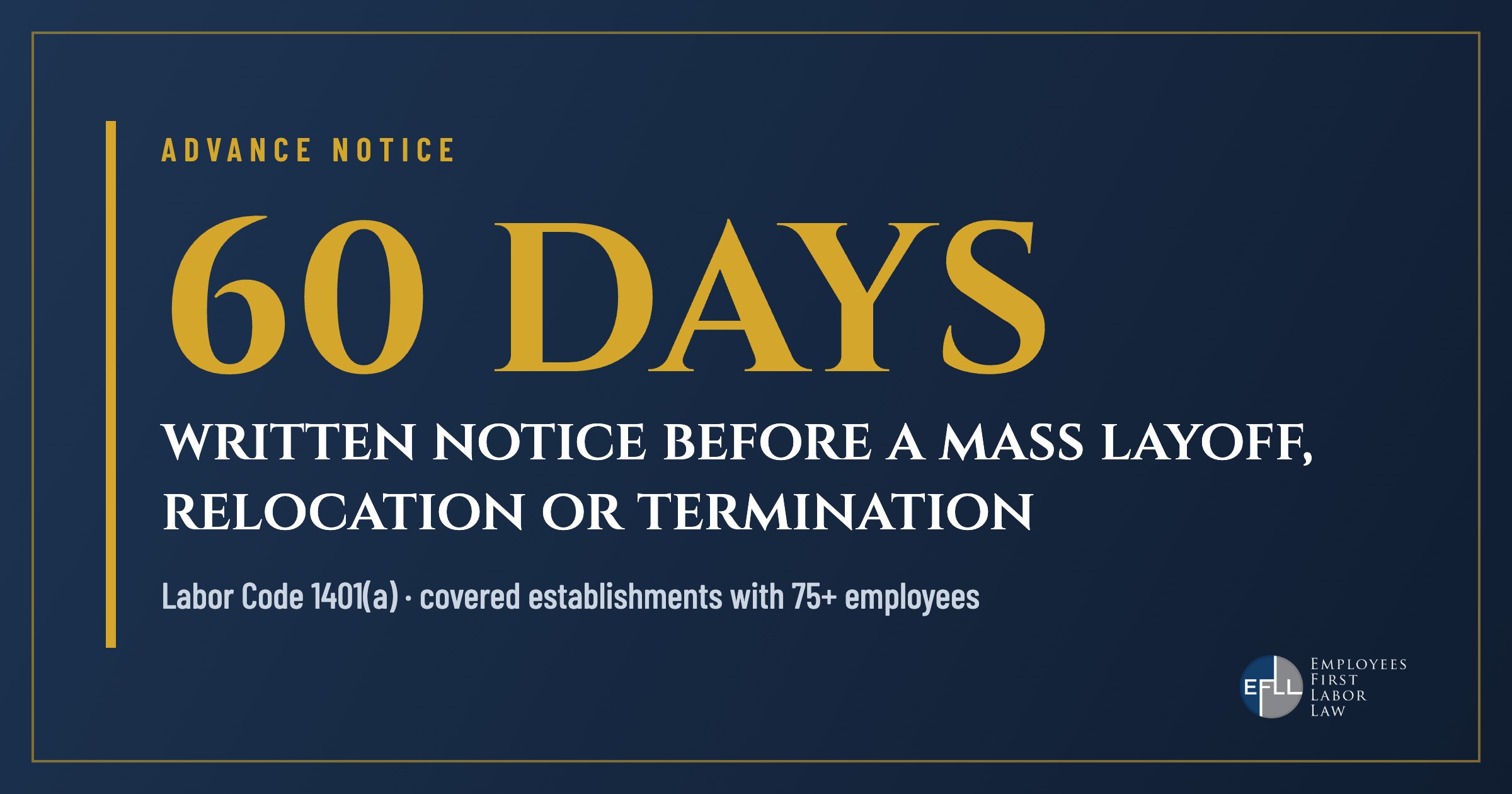
Labor Code §1401 is the core of California’s WARN Act (Cal-WARN): an employer may not order a mass layoff, relocation or termination at a covered establishment unless it gives written notice 60 days before the order takes effect to the affected employees, the Employment Development Department (EDD), the local workforce development board, and the chief elected official of each city and county where it happens. Since January 1, 2026, the notice must also tell workers about job services and CalFresh food assistance, and starting January 1, 2027, layoffs caused by artificial intelligence or automation must be labeled as such.
Sixty days’ notice gives workers time to look for a new job, line up health coverage and plan. When an employer skips it, each affected employee can be owed back pay and benefits for each day of the violation, up to 60 days.
This guide explains what §1401 says, who it covers, what the notice must contain in 2026, what changes in 2027, what you can recover, common disputes, and what to do if you are laid off.
- Labor Code §1401 requires 60 days’ written notice before a mass layoff, relocation or termination at a covered establishment.
- Notice goes to affected employees, the EDD, the local workforce development board, and city and county officials.
- Since January 1, 2026 (SB 617), notices must cover job services, the board’s contact information, CalFresh, and an employer email and phone number.
- Starting January 1, 2027 (SB 951), layoffs caused by AI or automation must be labeled “This notice is for a technology displacement.”
- Skipping notice can cost the employer back pay and benefits for up to 60 days per employee (§1402) and up to $500 a day in civil penalties (§1403).
What Labor Code §1401 says
As amended by Senate Bill 617 (Stats. 2025, ch. 229), effective January 1, 2026, §1401 requires:
- (a) 60 days’ written notice to the affected employees and to EDD, the local workforce development board, and the chief elected official of each city and county where the layoff, relocation or termination occurs.
- (b) Federal WARN elements. The notice must include the elements required by the federal Worker Adjustment and Retraining Notification Act.
- (c) Job services. The notice must say whether the employer plans to coordinate services, such as a rapid response orientation, through the local workforce development board, through another entity, or not at all. Either way it must include a working email and phone number for the board and a short statutory description of the board’s services. If the employer chooses to coordinate services, it must arrange them within 30 days of the notice.
- (d) CalFresh. A description of CalFresh, the CalFresh benefits helpline, and a link to the CalFresh website.
- (e) Employer contact. A working email address and phone number for the employer.
- (f) Exception. No notice is required if the layoff, relocation or termination is necessitated by a physical calamity or act of war.
Who is covered
The definitions in Labor Code §1400.5 decide whether Cal-WARN applies:
| Term | Definition |
|---|---|
| Covered establishment | An industrial or commercial facility, or part of one, that employs or has employed 75 or more people in the preceding 12 months |
| Mass layoff | A layoff of 50 or more employees at a covered establishment during any 30-day period |
| Layoff | A separation from a position for lack of funds or lack of work |
| Relocation | Moving all or substantially all operations 100 miles or more away |
| Termination | The cessation or substantial cessation of operations at a covered establishment |
| Employee | A person employed for at least 6 of the 12 months before notice is required |
A parent corporation is an employer for a covered establishment owned and operated by its subsidiary. Cal-WARN does not apply to seasonal employees hired with the understanding that the work was seasonal and temporary, or to the end of a particular project in broadcasting, motion pictures, or on-site construction, drilling, logging and mining (Wage Orders 11, 12 and 16) when workers were hired with the understanding that the job lasted only for the project.
Starting January 1, 2027: AI and automation layoffs
Senate Bill 951 (Stats. 2026, ch. 860), signed September 30, 2026, amends §§1400.5 and 1401 starting January 1, 2027. When a mass layoff, relocation or termination is caused in whole or in substantial part by an artificial intelligence system or other automated technology replacing or automating jobs, the notice must also include:
- The number, classification or occupation, and work location of the layoffs substantially due to AI or automation;
- The job functions those workers performed that will be automated;
- The specific category or type of AI system or other technology that substantially caused the displacement; and
- The statement “This notice is for a technology displacement” at the top of the notice.
EDD must publish a summary of these notices and a quarterly statewide summary of technology displacements. SB 951 also defines “artificial intelligence” in §1400.5 and directs EDD to report to the Legislature by January 1, 2028 on AI’s effects on hiring. Read more in our post on SB 951 and AI layoff notices.
You may be owed up to 60 days of back pay and benefits. We can review your notice, final pay and any severance offer before you sign. Free, confidential review.
What you can recover if the employer skips notice
Labor Code §1402 makes an employer that fails to give employees the required notice liable to each affected employee for:
- Back pay at the higher of the employee’s average regular rate over the last three years of employment or the final rate of pay; and
- The value of benefits the employee would have received, including medical expenses that an employee benefit plan would have covered.
Liability runs for the period of the violation, up to 60 days or half the number of days the employee worked for the employer, whichever is smaller. It is reduced by wages the employer paid for that period (other than vacation pay accrued earlier), voluntary and unconditional payments not legally required, and payments to third parties such as health premiums or retirement contributions for the period.
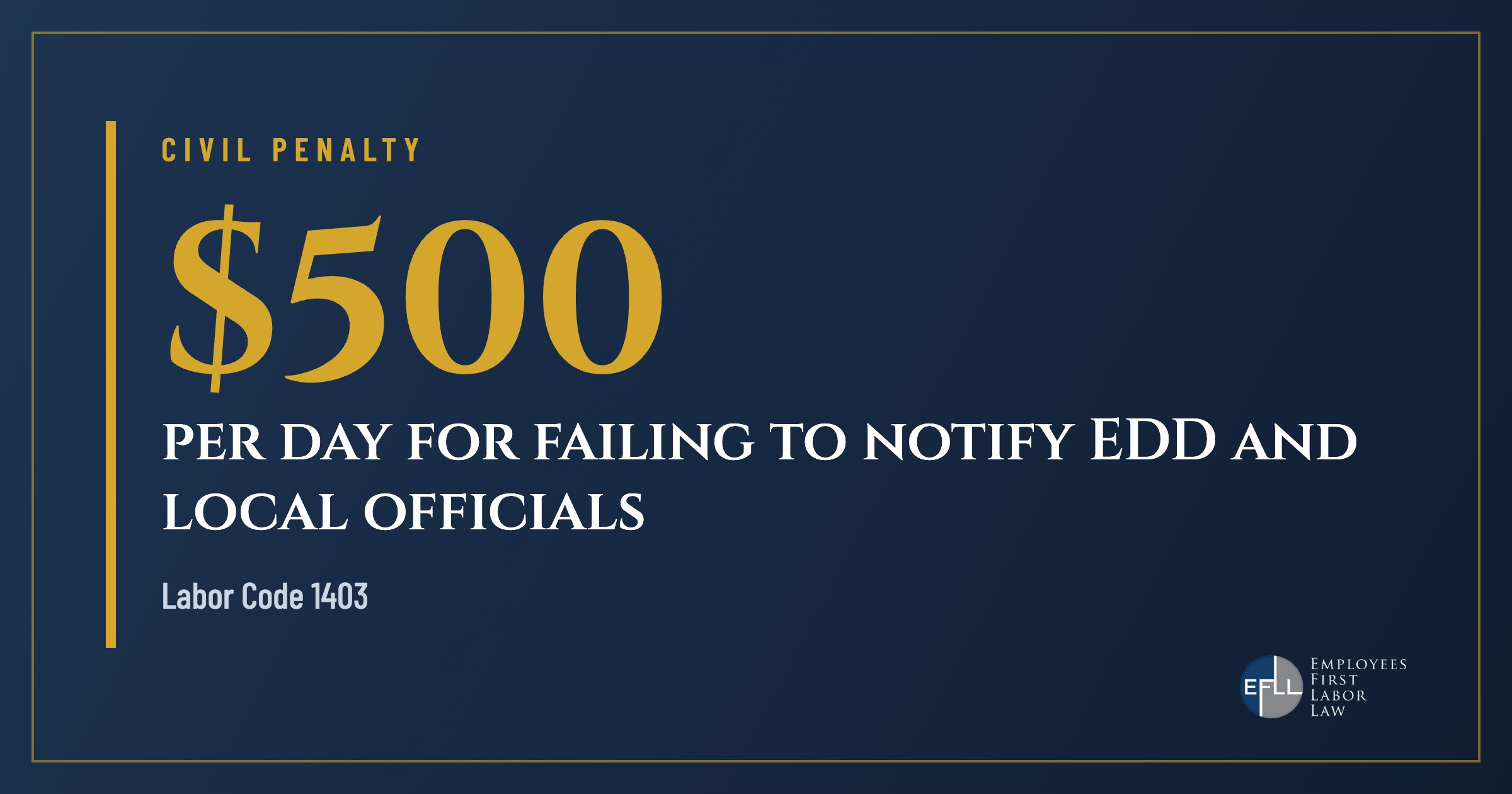
An employer that fails to notify EDD and local officials faces a civil penalty of up to $500 for each day of the violation (§1403), unless it pays employees what §1402 requires within three weeks of ordering the layoff. Under §1404, employees, a local government or an employee representative can sue, including on behalf of others similarly situated, and a prevailing plaintiff may recover reasonable attorney’s fees.
💡 Example: A distribution center with 300 workers lays off 120 of them with only two days’ notice. Kim has worked there for three years, so her liability period is capped at 60 days, because half of her roughly 1,095 days of employment is far more than 60. The employer owes her back pay at the higher of her average regular rate over the last three years or her final rate, plus the value of lost benefits, for the period of the violation up to 60 days. If the employer kept paying her wages for part of that period, those wages reduce what she is owed. (Hypothetical.)
Common disputes
- Counting to 50. Employers sometimes spread cuts over time. The test is 50 or more layoffs at a covered establishment within any 30-day period.
- Is the site a covered establishment? The 75-employee threshold looks back over the preceding 12 months.
- Who counts as an employee? Workers with less than 6 of the prior 12 months of service are not counted as “employees” under §1400.5.
- Physical calamity. The §1401(f) exception is limited to a physical calamity or act of war.
- Defective notices. Since 2026, a notice missing the job services, CalFresh or employer contact information does not meet §1401. Starting in 2027, a notice that hides an AI-driven layoff may not either.
- Severance releases. Employers often offer severance in exchange for a release of claims. Read it before you sign.
What to do if you are laid off
- Keep the notice and write down the date you got it and the date your job ends.
- Count the days. If the notice came less than 60 days before the layoff, note how many days short it was.
- Check the contents. Look for the job services statement, the board’s contact information, CalFresh information and an employer email and phone number.
- Get your final pay on time. Wages, including accrued vacation, are generally due on your last day when you are laid off.
- Don’t rush a severance agreement. See our guide to severance agreement review.
- Apply for unemployment right away. Our guide to unemployment after losing your job explains how.
- Look for patterns. If the people chosen were older, on leave, or had complained, there may be discrimination or retaliation claims too.
For a broader overview, read our guide to Cal-WARN notice rights, and check our California layoff tracker for recent WARN notices.
Related Labor Code sections
| Section | What it covers |
|---|---|
| §1400.5 | Definitions: covered establishment, mass layoff, relocation, termination, employee |
| §1402 | Back pay and benefits owed for missing notice |
| §1403 | Civil penalty of up to $500 a day for failing to notify officials |
| §1404 | Lawsuits, class actions and attorney’s fees |
| §1402.7 | EDD report on AI and hiring (added by SB 951) |
Frequently asked questions
How much notice does Labor Code 1401 require?
Sixty days’ written notice before the mass layoff, relocation or termination takes effect.
Does Cal-WARN apply to small employers?
Only if the site is a covered establishment, meaning it employs or has employed 75 or more people in the past 12 months. A mass layoff also requires 50 or more layoffs within 30 days at that establishment.
What changed on January 1, 2026?
SB 617 added required notice contents: whether the employer will coordinate job services with the local workforce development board, the board’s contact information and a description of its services, and information about CalFresh.
Do employers have to say if AI caused the layoff?
Starting January 1, 2027, yes. Under SB 951, a notice for a layoff caused in whole or substantial part by AI or other automation must say so at the top and describe the jobs, functions and technology involved.
What if my employer gave no notice at all?
You may be owed back pay and benefits for each day of the violation, up to 60 days or half your days of employment, whichever is less, under Labor Code 1402, and you can sue under §1404.
Does Cal-WARN stop my employer from laying me off?
No. It requires advance notice, not a reason for the layoff. But a layoff can still be illegal if workers were chosen because of discrimination or retaliation.
Related guides
 Workers only. Never employers.
At Employees First Labor Law, we represent California workers only, never employers. Our team has recovered more than $200 million for our clients, and we prepare every case as if it is going to trial. We have offices in Pasadena, Irvine, Long Beach, Pomona, Riverside, Bakersfield and Fresno, and we serve workers throughout California. Meet our team.







If you lost your job in a mass layoff, relocation or closure, we can check whether your employer followed Cal-WARN, paid your final wages on time and offered a fair severance. We represent California workers only, never employers.
- ✅ Free, confidential consultation
- ✅ We represent workers only, never employers
- ✅ Se habla español: Empleados Primero
This article provides general information about California law and is not legal advice for any specific situation. Reading it does not create an attorney-client relationship. Past results do not guarantee a similar outcome.