

Updated October 2026 · 6 min read
California Labor Code §2775 says that anyone who provides labor or services for pay is presumed to be an employee, not an independent contractor, unless the hiring business proves all three parts of the “ABC test.” If the business cannot prove even one part, the worker is an employee for purposes of the Labor Code, the Unemployment Insurance Code and the state’s wage orders.
The label on a contract does not decide the question. A worker paid on a 1099 who fails the ABC test is owed minimum wage, overtime, meal and rest breaks, expense reimbursement and access to workers’ compensation and unemployment benefits, the same as any other employee.
This guide explains the text of §2775, who it applies to, how the three prongs work, the exemptions in §§2776–2784 at a glance, what you can recover and the deadlines. For a worker-focused walkthrough with real-world examples, see our guide on independent contractor misclassification and the ABC test.
- Labor Code §2775 presumes anyone paid for labor or services is an employee, not an independent contractor.
- The hiring business must prove all three prongs: freedom from control, work outside its usual course of business, and an independently established business.
- The test applies under the Labor Code, the Unemployment Insurance Code and the wage orders.
- Sections 2776–2784 exempt certain relationships and occupations, where the older Borello test applies instead.
- Misclassified workers can recover wages, overtime, break premiums, expense reimbursement and penalties, generally within three years.
What Labor Code §2775 says
Section 2775 was added by Assembly Bill 2257, effective September 4, 2020. It codifies the California Supreme Court’s 2018 decision in Dynamex Operations West, Inc. v. Superior Court, which the statute itself names, and extends the test beyond the wage orders to the Labor Code and the Unemployment Insurance Code.
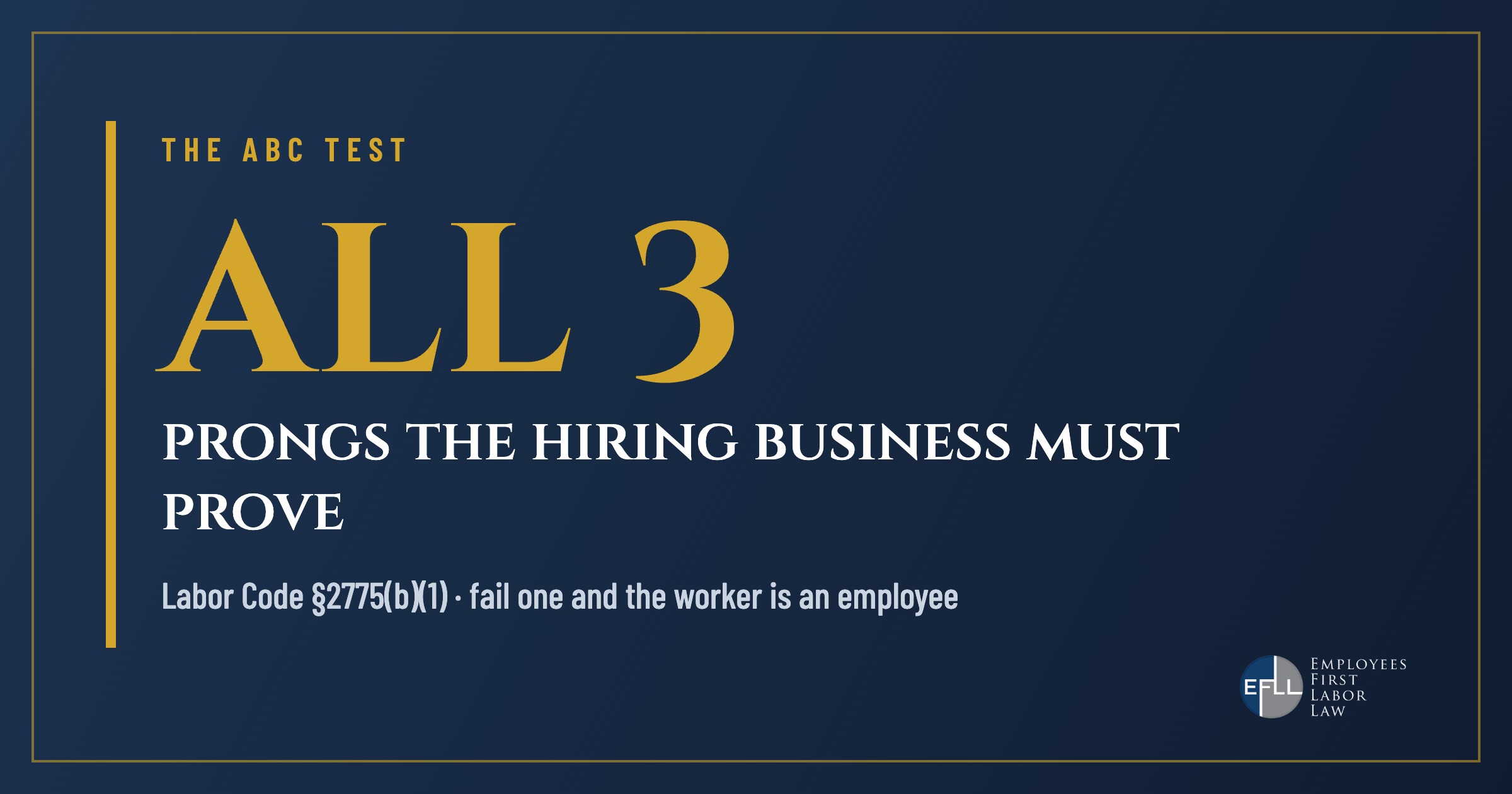
Under subdivision (b)(1), “a person providing labor or services for remuneration shall be considered an employee rather than an independent contractor unless the hiring entity demonstrates that all of the following conditions are satisfied”:
- (A) Freedom from control. The person is free from the hiring entity’s control and direction in performing the work, both under the contract and in fact.
- (B) Outside the usual course of business. The person performs work that is outside the usual course of the hiring entity’s business.
- (C) Independent business. The person is customarily engaged in an independently established trade, occupation or business of the same nature as the work performed.
Two more rules round out the section. Subdivision (b)(2) preserves exceptions that are expressly made elsewhere in the Labor Code, the Unemployment Insurance Code or a wage order. Subdivision (b)(3) says that if a court rules the ABC test cannot be applied in a particular context for reasons other than an express exception, the older multi-factor test from S. G. Borello & Sons, Inc. v. Department of Industrial Relations (1989) governs instead.
Who §2775 covers
The ABC test applies to anyone who provides labor or services for pay in California, whatever the paperwork calls them: freelancer, consultant, 1099 worker, owner-operator or “partner.” The burden is on the hiring entity. You do not have to prove you are an employee; the business has to prove you are not.
The test applies for purposes of the Labor Code, the Unemployment Insurance Code and the Industrial Welfare Commission wage orders. Workers’ compensation status follows the Labor Code’s definitions as well. Our guide to workers’ comp for misclassified contractors covers that side.
What counts as a violation
Section 2775 itself is a definition, not a penalty statute. The violation is treating an employee as a contractor and then denying the rights that come with employee status. Prong B is where many businesses fail: a cleaning company that calls its cleaners “contractors,” or a delivery company that calls its drivers “independent,” is having them do the very work the business exists to sell.
💡 Example: Jordan, a hypothetical worker, cleans homes for a residential cleaning company. He signs an “independent contractor agreement,” uses the company’s scheduling app, follows its checklists and is paid per job. Even if Jordan set his own hours, the company would struggle with prong B, because cleaning homes is the usual course of its business. Failing that one prong makes Jordan an employee.
If you fail to fit all three prongs, you may be owed wages, overtime and expenses. Get a free, confidential case review.
The exemptions in §§2776–2784 at a glance
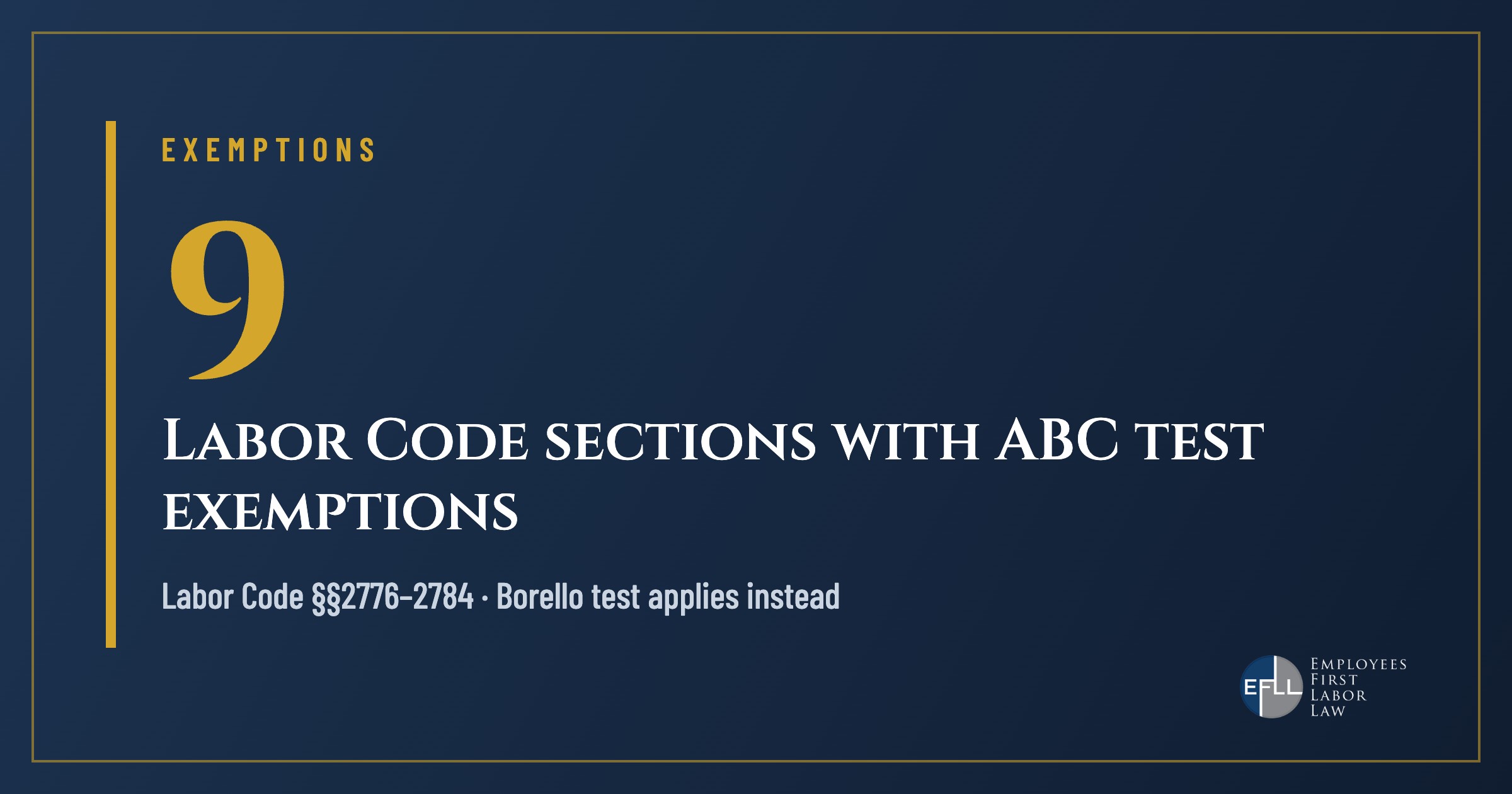
The Legislature carved out a number of relationships and occupations from the ABC test. In most of them, the Borello multi-factor test decides employee status instead, and many exemptions have detailed conditions the hiring entity must prove. This is an overview only.
| Section | Exemption (summary) |
|---|---|
| §2776 | Bona fide business-to-business contracting relationships that meet a list of conditions (written contract, separate business location, own clientele and more) |
| §2777 | Service providers working with clients through a referral agency, if listed conditions are met |
| §2778 | Certain “professional services,” such as marketing, human resources administration, travel agent services, graphic design, grant writing, fine art, enrolled agents and some photography and journalism work (amended effective January 1, 2026) |
| §2779 | Two sole proprietors or businesses working together at a single-engagement event, under listed conditions |
| §2780 | Certain occupations in creating, marketing, promoting or distributing sound recordings and musical compositions, such as recording artists, songwriters, lyricists, composers, managers of recording artists, record producers and directors, and musical engineers and mixers, under listed conditions |
| §2781 | Construction subcontractors who meet listed criteria, including a written subcontract and a Contractors State License Board license |
| §2782 | Data aggregators and research subjects, under listed conditions |
| §2783 | Specific occupations, including Department of Insurance licensees; licensed physicians, surgeons, dentists, podiatrists, psychologists and veterinarians; licensed lawyers, architects, landscape architects, engineers, private investigators and accountants; securities broker-dealers and investment advisers; direct sales salespersons; manufactured housing salespersons; commercial fishers; newspaper distributors and carriers; certain exchange visitor program participants; and competition judges (amended effective January 1, 2026) |
| §2784 | Motor clubs and individuals providing motor club services under contract with a third party |
An exemption does not automatically make someone a contractor. It only swaps the ABC test for the Borello analysis, which still looks at the business’s right to control the work and other factors. If the exemption’s conditions are not met, the ABC test applies.
Remedies and penalties
A misclassified worker can recover what an employee would have received, including:
- Minimum wage and overtime for all hours worked, including off-the-clock time.
- Meal and rest break premiums of one hour of pay for each day a compliant break was not provided.
- Expense reimbursement under Labor Code §2802 for the vehicle, phone, tools and supplies you paid for.
- Penalties for inaccurate wage statements and, after you leave, late final pay.
- Willful misclassification penalties of $5,000 to $25,000 per violation under Labor Code §226.8, assessed by the Labor and Workforce Development Agency or a court.
- Workers’ compensation and unemployment benefits, through the separate systems that handle them.
Public prosecutors can also act. Under Labor Code §2786, the Attorney General, district attorneys and certain city attorneys can sue for injunctive relief to stop ongoing misclassification.
Deadlines and where to file
| Claim | Where | General deadline |
|---|---|---|
| Unpaid wages, overtime, reimbursement | Labor Commissioner or court | 3 years (Code Civ. Proc. §338(a)); 4 years under the Unfair Competition Law |
| PAGA civil penalties for you and coworkers | LWDA notice, then court | 1 year (Code Civ. Proc. §340) |
| Work injury benefits | Workers’ compensation claim | Report the injury to your employer promptly; claim deadlines apply |
If you are not sure whether your claim belongs with the Labor Commissioner or in court, our guide on the Labor Commissioner vs. hiring a lawyer walks through the differences. You can also estimate what you may be owed with our wage and hour calculator.
Related Labor Code sections
- §§2776–2784: exemptions where the Borello test applies instead.
- §2785: states that the article is declaratory of existing law as to wage orders and related Labor Code violations.
- §2786: injunctive relief actions by public prosecutors to stop misclassification.
- §226.8: civil penalties for willful misclassification and for charging misclassified workers unlawful fees or deductions.
- §2802: reimbursement of necessary work expenses, often the largest item for misclassified drivers and tradespeople.
Frequently asked questions
Who has to prove I am an independent contractor?
The hiring business. Under §2775, you are presumed to be an employee, and the business must prove all three prongs of the ABC test to treat you as a contractor.
Does signing an independent contractor agreement make me a contractor?
No. The test looks at how the work is actually performed. Prong A requires freedom from control “both under the contract for the performance of the work and in fact.”
What happens if my occupation is on the exemption list?
Your status is decided under the Borello multi-factor test instead of the ABC test, and only if the exemption’s specific conditions are met. You can still be an employee under Borello.
Can I get workers’ comp if I was paid as a 1099 contractor?
If you were legally an employee, generally yes. Workers’ compensation coverage follows employee status, not the tax form.
How far back can a misclassified worker recover wages?
Generally three years for wage claims, or four years under the Unfair Competition Law. PAGA penalties have a one-year limitations period and require notice to the state first.
Related guides
 Workers only. Never employers.
At Employees First Labor Law, we represent California workers only, never employers. Our team has recovered more than $200 million for our clients, and we prepare every case as if it is going to trial. We have offices in Pasadena, Irvine, Long Beach, Pomona, Riverside, Bakersfield and Fresno, and we serve workers throughout California. Meet our team.






If you were paid on a 1099 but worked like an employee, we can review your status under the ABC test and pursue unpaid wages, overtime, reimbursement and misclassification penalties.
- ✅ Free, confidential consultation
- ✅ We represent workers only, never employers
- ✅ Se habla español: Empleados Primero
This article provides general information about California law and is not legal advice for any specific situation. Reading it does not create an attorney-client relationship. Past results do not guarantee a similar outcome.