

Updated October 2026 · 9 min read
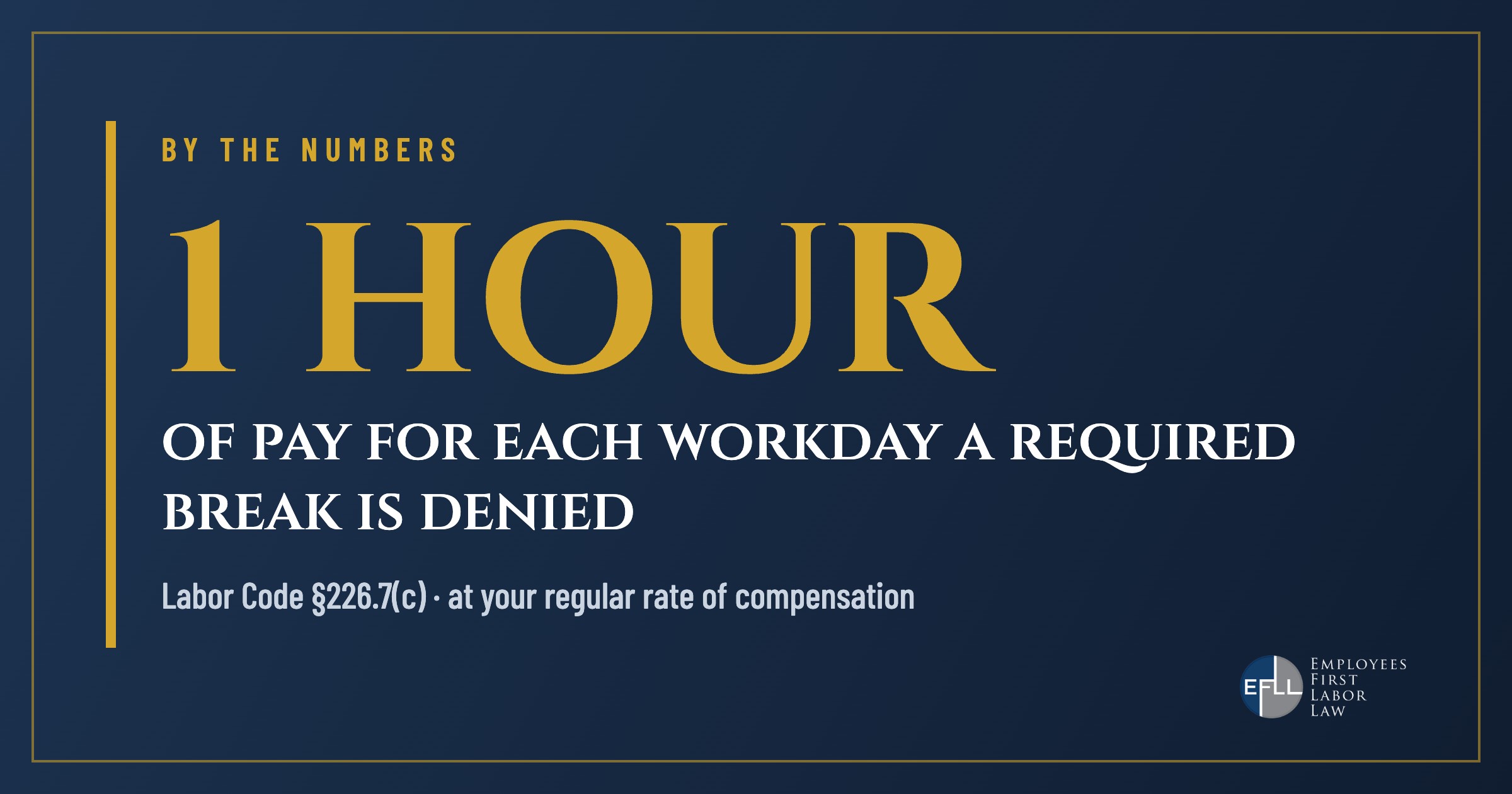
California Labor Code §226.7 requires your employer to pay you one additional hour of pay, at your regular rate of compensation, for each workday it fails to provide a meal, rest or heat-recovery period that California law requires. This extra hour is usually called “premium pay” or a “meal and rest break premium,” and it is the main remedy behind California’s break rules.
The money adds up. If you earn $25 an hour and your employer denies you a rest break on two days a week, you are owed $50 a week in premiums. Over a year of 50 working weeks, that is $2,500, and claims can generally reach back three years.
This page explains the text of §226.7 itself. For a practical guide to the break schedule and what to do when breaks are denied, see our article on California meal and rest break premiums.
- Labor Code §226.7 requires one extra hour of pay at your regular rate for each workday a required meal, rest or heat-recovery period is not provided.
- The premium must be paid at your regular rate of compensation, which includes shift differentials and nondiscretionary bonuses, not just base pay.
- Generally you can earn up to one meal premium and one rest premium per workday.
- The California Supreme Court has held that premiums are wages, so they belong on your pay stub and in your final paycheck.
- Most claims must be filed within three years of each missed break.
What Labor Code §226.7 says
Section 226.7 is short, and each subdivision does a specific job. In plain English:
- Subdivision (a) defines a “recovery period” as “a cooldown period afforded an employee to prevent heat illness.”
- Subdivision (b) says an employer may not require you to work during a meal, rest or recovery period that is required by a statute, or by a regulation, standard or order of the Industrial Welfare Commission (IWC), the Occupational Safety and Health Standards Board or Cal/OSHA.
- Subdivision (c) creates the remedy: if the employer fails to provide a required meal, rest or recovery period, it “shall pay the employee one additional hour of pay at the employee’s regular rate of compensation for each workday” that the period is not provided.
- Subdivision (d) says required rest and recovery periods count as hours worked, with no deduction from your wages.
- Subdivision (e) says the section does not apply to employees who are exempt from meal, rest or recovery requirements under other state laws or orders.
- Subdivision (f) contains a special rest-period rule for certain unionized security officers, discussed below. It is scheduled to expire on January 1, 2027.
Note that §226.7 does not set the break schedule. That comes from Labor Code §512, the IWC Wage Orders and Cal/OSHA’s heat regulations.
Where the break rules come from
To know whether you are owed a premium, you first need the rule that was broken. The table below shows the basic rules for most non-exempt employees. Your industry’s Wage Order (there are 17, found on the IWC Wage Orders page) can add details or exceptions.
| Break | Basic rule | Where it lives |
|---|---|---|
| Meal period | 30 minutes, off duty, for a workday over 5 hours; a second 30 minutes for a workday over 10 hours. Limited waivers allowed. | Labor Code §512; Wage Order section 11 |
| Rest period | 10 minutes net rest per 4 hours worked “or major fraction thereof” (the Labor Commissioner treats anything over 2 hours as a major fraction); not required if your total daily work time is under 3½ hours. Paid time. | Wage Order section 12 |
| Recovery (heat) period | A “preventative cool-down rest” in the shade when you feel the need to protect yourself from overheating. | Cal/OSHA heat rules, e.g., Cal. Code Regs., tit. 8, §3395 (outdoor work) |
| Premium for a missed break | One hour of pay at your regular rate of compensation for each workday the break is not provided. | Labor Code §226.7(c); Wage Order sections 11(B) and 12(B) |
Most meal-period disputes turn on timing: under the Labor Commissioner’s guidance, the first meal period must start no later than the end of your fifth hour of work, and the second no later than the end of your tenth hour. A late meal can trigger a premium just like a missed one.
Who §226.7 covers, and the exceptions
Section 226.7 protects most non-exempt (hourly and salaried non-exempt) employees in private employment in California. Several groups fall outside it or have special rules:
- Exempt employees. Executive, administrative and professional employees who meet the salary and duties tests under Labor Code §515 are exempt from the Wage Order break rules, so subdivision (e) takes them outside §226.7. If you were misclassified as exempt, though, you may be owed premiums for every missed break.
- Security officers (through 2026). Under §226.7(f), a registered security officer employed by a licensed private patrol operator may be required to stay on the premises, remain on call and carry and monitor a communication device during rest periods, but only if covered by a qualifying collective bargaining agreement. If a rest break is interrupted, the officer must be allowed to restart it. If the officer cannot get an uninterrupted 10-minute rest period per four hours or major fraction, the premium is one hour at the officer’s “regular base hourly rate.” This subdivision is repealed on January 1, 2027, when a new version of §226.7 without it takes effect. See our guide to security guard labor laws.
- Union and industry carve-outs. Labor Code §512 lets certain unionized workers follow meal-period terms in a qualifying union contract instead. Labor Code §226.75 has a separate rest-period rule for some safety-sensitive positions at petroleum facilities.
- Some commercial drivers. Federal regulators have determined that California’s meal and rest break rules are preempted for property-carrying commercial truck drivers covered by federal hours-of-service rules, and, in a separate 2020 determination upheld by the Ninth Circuit in June 2026, for passenger-carrying commercial drivers (such as bus drivers) covered by those rules.
If your employer pushes you to work through meal or rest breaks, you may be owed an extra hour of pay for each of those days. Our attorneys offer a free, confidential case review.
How the premium is calculated
The premium is one hour of pay at your “regular rate of compensation.” In 2021, the California Supreme Court held in Ferra v. Loews Hollywood Hotel, LLC that this phrase means the same thing as the “regular rate of pay” used for overtime. That means the premium must include nondiscretionary payments for work, such as shift differentials and nondiscretionary bonuses, not just your base hourly wage.
The premium is counted per workday. The Wage Orders set one premium for missed meal periods (section 11) and a separate premium for missed rest periods (section 12). In practice, that generally means up to one meal premium and one rest premium per workday, not one premium for every break missed that day.
💡 Example (hypothetical): Maria works 8-hour night shifts at a base rate of $22 an hour plus a $2 night differential on every hour, so her regular rate is $24. In one four-week period she works 20 shifts. She gets no timely meal period on 6 days and misses a rest break on 10 days (4 of those days are the same days). She is owed 6 meal premiums and 10 rest premiums: 16 × $24 = $384. If her employer paid the premiums at her $22 base rate (16 × $22 = $352), it would still owe her $32.
You can estimate your own numbers with our wage and hour calculator.
Premium pay counts as wages
In Naranjo v. Spectrum Security Services, Inc. (2022), the California Supreme Court held that break premiums are wages, not just a penalty. Because the extra hour also compensates for the work you performed during the missed break, it is subject to the same timing and reporting rules as other pay. That matters in three ways:
- Pay stubs. Premiums owed should appear on your itemized wage statement under Labor Code §226. See our guide to California pay stub requirements.
- Final pay. Premiums are part of the final wages due when you leave a job, so willfully unpaid premiums can support waiting time penalties under Labor Code §203.
- Interest. The same decision held that prejudgment interest on unpaid break premiums runs at the 7% constitutional default rate, not the 10% rate that applies to most unpaid wages.
Under Labor Code §558.1, an owner, director, officer or managing agent who causes a §226.7 violation can also be held personally liable as the employer.
Common employer defenses and tricks
These are the arguments and practices we see most often:
- “You chose to skip your break.” The Labor Commissioner’s guidance, following the Supreme Court’s Brinker decision, says the employer must relieve you of all duty, give up control over your time and not impede or discourage the break. It does not have to force you to stop working. Pressure or understaffing can still mean the break was not provided.
- On-call rest breaks. In Augustus v. ABM Security Services, Inc. (2016), the Supreme Court held that state law prohibits on-duty and on-call rest periods.
- Automatic meal deductions and rounding. Timekeeping systems that assume a 30-minute lunch was taken can hide missed or late meals. See time rounding and automatic meal deductions.
- Paying the premium at base rate. After Ferra, a premium paid only at base pay is short when you also earn differentials or nondiscretionary bonuses.
- Invalid waivers. A first meal can be waived only when the workday is no more than six hours, and an “on-duty” meal is allowed only when the nature of the work prevents relief and you signed a revocable written agreement.
Deadlines to claim break premiums
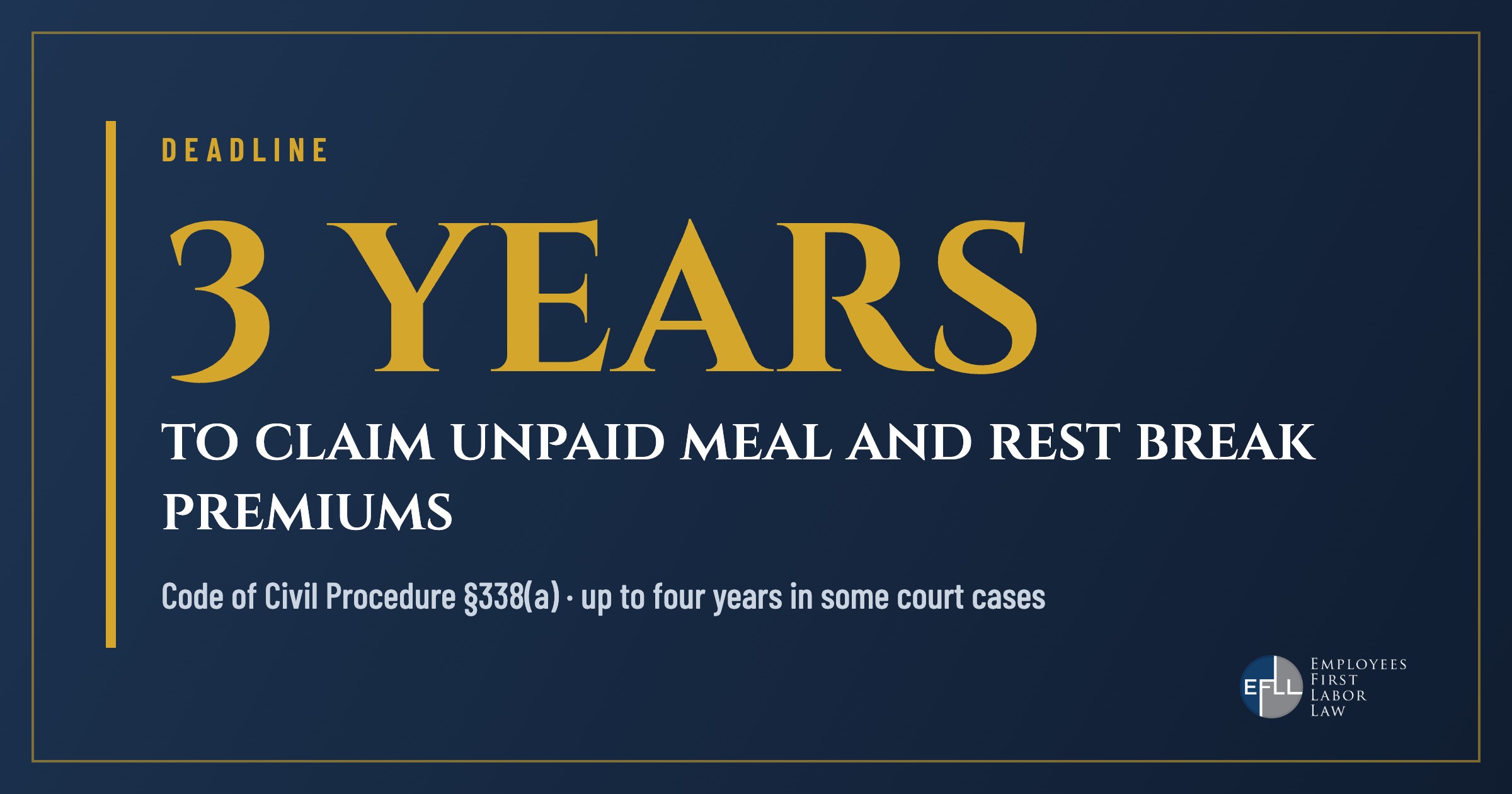
Because premiums are wages owed under a statute, the deadline for most claims is three years under Code of Civil Procedure §338(a). The Labor Commissioner’s Office lists unpaid meal and rest breaks among the claims that must be filed within three years.
In a court case, a claim under the Unfair Competition Law (Business and Professions Code §17208) can sometimes reach back four years for restitution. Penalty claims are shorter: civil penalties sought through the Private Attorneys General Act (PAGA) are generally subject to the one-year limit in Code of Civil Procedure §340.
Where to file a §226.7 claim
| Option | What it covers | Law |
|---|---|---|
| Labor Commissioner wage claim | Unpaid premiums and related penalties for you individually; free, with a conference and hearing | Labor Code §98 |
| Lawsuit in superior court | Premiums, interest, penalties; can be brought as a class action | Labor Code §226.7 |
| PAGA notice and lawsuit | Civil penalties for you and co-workers, shared with the state | Labor Code §§2699, 2699.3 |
| Arbitration | Individual claims, if you signed an enforceable arbitration agreement | Your agreement |
See Labor Commissioner claim versus lawyer to compare.
What to do if your breaks are being denied
- Write down every day your meal was late, cut short, interrupted or skipped, and every missed rest break, with the reason.
- Save your pay stubs and check for a line labeled as a meal or rest premium.
- Request your payroll records under Labor Code §226(b) and your time records.
- Do not sign a release or “break waiver” without understanding what you are giving up.
- Talk to an employment lawyer before the three-year window closes on your oldest violations.
Related Labor Code sections
- §512: meal period timing and waivers.
- §226: itemized wage statements; premiums must be reported.
- §203: waiting time penalties for unpaid final wages, including premiums.
- §558 and §558.1: civil penalties for hours and meal-period violations, and personal liability.
Frequently asked questions
How much is a missed meal or rest break worth in California?
One hour of pay at your regular rate of compensation for each workday the break was not provided, under Labor Code §226.7(c). Your regular rate includes nondiscretionary extras like shift differentials, not just base pay.
Can I get more than one premium in a day?
Generally, yes, but only one of each type. The Wage Orders provide one premium for meal-period violations and one for rest-period violations per workday, so a day with both a missed meal and a missed rest break is generally worth two hours of premium pay.
Does my employer have to pay the premium automatically?
Yes. The Supreme Court has held the premium is a wage that must be paid on time and shown on your pay stub. You should not have to ask for it.
What is a “recovery period”?
A cooldown period to prevent heat illness (§226.7(a)), such as the preventative cool-down rest in the shade that Cal/OSHA’s heat rules require. A denied recovery period triggers the same one-hour premium.
How far back can I claim unpaid break premiums?
Generally three years from each missed break under Code of Civil Procedure §338(a), and in some court cases up to four years under the Unfair Competition Law. PAGA penalty claims have a one-year limit.
Related guides
 Workers only. Never employers.
At Employees First Labor Law, we represent California workers only, never employers. Our team has recovered more than $200 million for our clients, and we prepare every case as if it is going to trial. We have offices in Pasadena, Irvine, Long Beach, Pomona, Riverside, Bakersfield and Fresno, and we serve workers throughout California. Meet our team.





We help California workers recover unpaid meal and rest break premiums, the wages tied to them, and the penalties the Labor Code allows. Tell us what happened at your job and we will explain your options.
- ✅ Free, confidential consultation
- ✅ We represent workers only, never employers
- ✅ Se habla español: Empleados Primero
This article provides general information about California law and is not legal advice for any specific situation. Reading it does not create an attorney-client relationship. Past results do not guarantee a similar outcome.