

Updated October 2026 · 8 min read
California Labor Code §512 requires employers to give non-exempt employees an unpaid, duty-free meal period of at least 30 minutes when they work more than five hours in a day, and a second 30-minute meal period when they work more than ten hours. It also sets the narrow conditions under which those meal periods can be waived, and lists the industries and union contracts that follow different rules.
Getting the timing wrong is expensive for employers. Each workday your meal period is missed, late or cut short, you are generally owed an extra hour of pay under Labor Code §226.7. At $24 an hour, two late lunches a week for a year (50 weeks) adds up to $2,400.
This page walks through the current text of §512, updated for the amendment that took effect January 1, 2026: what the statute requires, who is covered, the exceptions, a worked example, remedies, deadlines and where to file. For a broader guide to breaks, see our article on California meal and rest break premiums.
- Labor Code §512 requires a 30-minute meal period for a workday over 5 hours and a second one for a workday over 10 hours.
- The first meal can be waived only if the day is 6 hours or less; the second only if the day is 12 hours or less and the first was not waived.
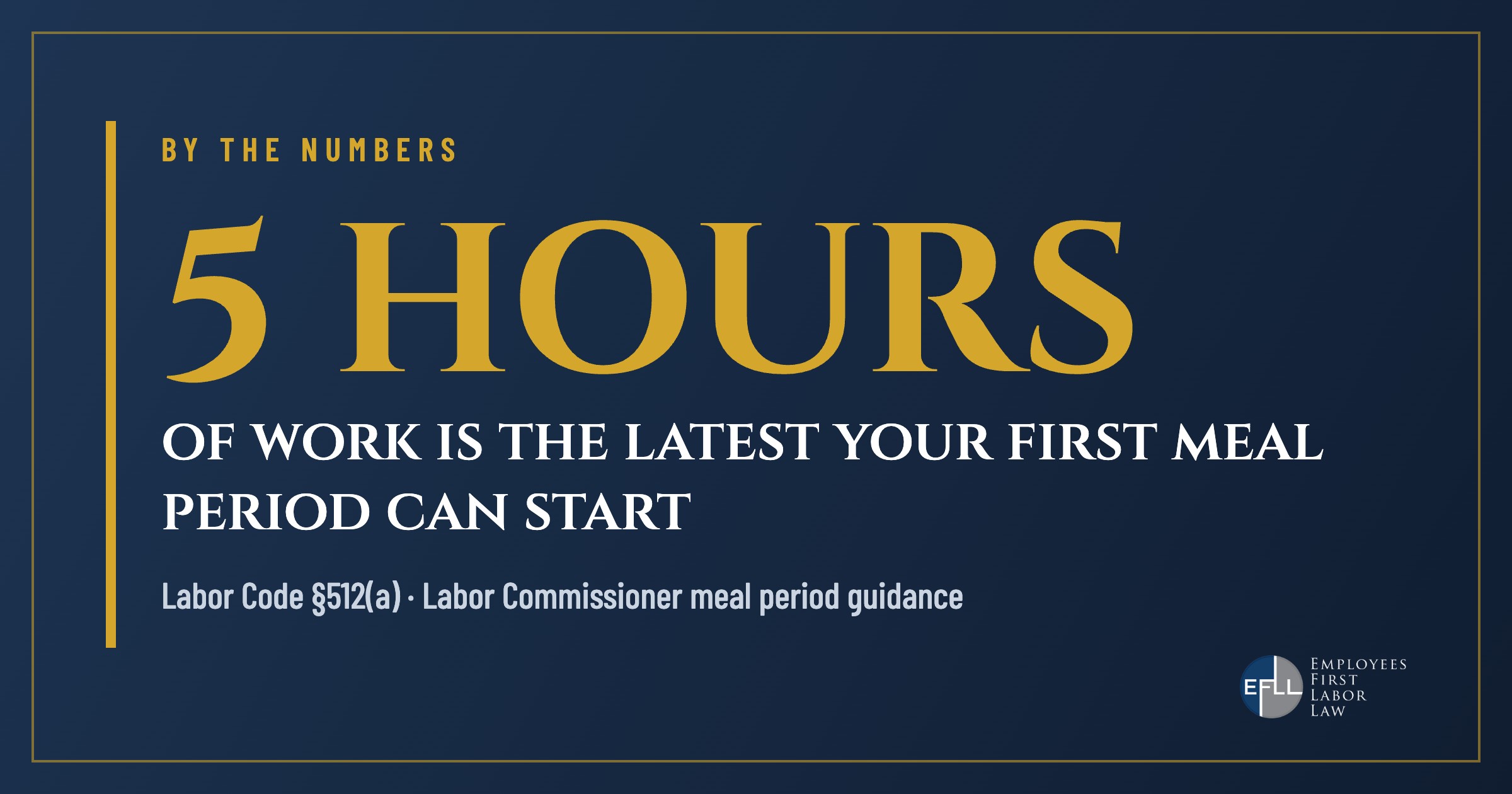
- Under the Labor Commissioner’s guidance, the first meal must start by the end of your fifth hour of work.
- Updated for 2026: SB 693 added water corporation employees to the union-contract exception. The general rules did not change.
- A late, short or missed meal generally earns one hour of premium pay per workday under Labor Code §226.7.
What Labor Code §512 says
Subdivision (a) contains the core rule. In plain English:
- An employer may not employ you for a work period of more than five hours per day without a meal period of at least 30 minutes.
- If your total work period for the day is no more than six hours, the first meal period may be waived “by mutual consent” of you and your employer.
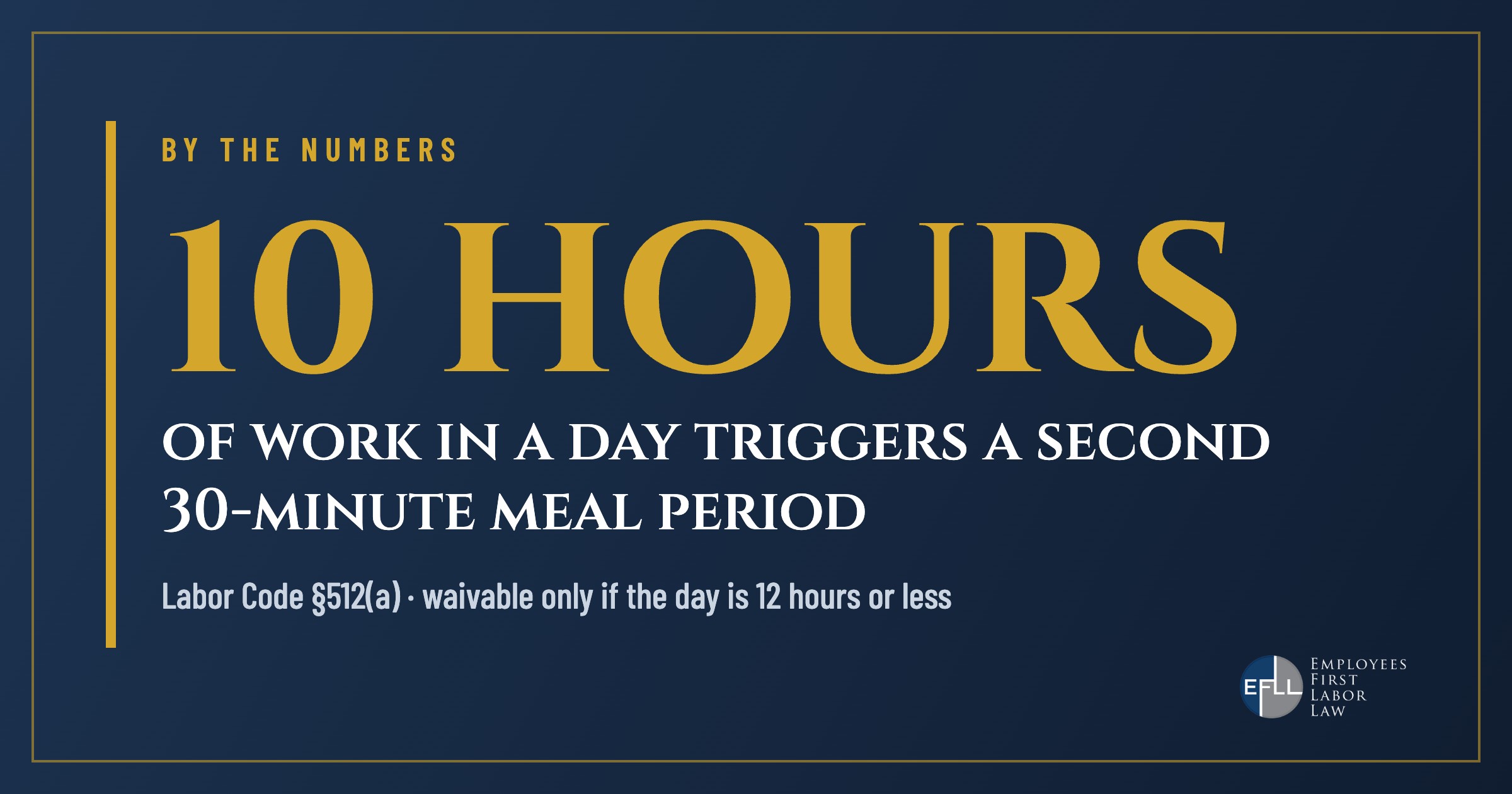
- An employer may not employ you for more than ten hours per day without a second meal period of at least 30 minutes.
- If your total hours worked are no more than 12, the second meal period may be waived by mutual consent, but “only if the first meal period was not waived.”
The rest of the section creates exceptions. Subdivision (b) lets the Industrial Welfare Commission (IWC) allow a meal period after six hours in a Wage Order if that is consistent with workers’ health and welfare, and gives a similar rule to certain commercial feed drivers serving remote rural customers. Subdivisions (c) through (g) cover the wholesale baking industry, motion picture and broadcasting workers, and several unionized occupations, discussed below.
What changed on January 1, 2026
Section 512 was amended by Senate Bill 693 (Stats. 2025, ch. 95), effective January 1, 2026. According to the Legislative Counsel’s Digest, the bill adds employees of a water corporation (as defined in Public Utilities Code §241) to the list of utility workers who can be covered by the collective bargaining exception in subdivisions (e) and (f). Before 2026, that list covered employees of electrical corporations, gas corporations and local publicly owned electric utilities.
For the vast majority of California workers, nothing changed. The five-hour and ten-hour rules, the waiver limits and the premium-pay remedy are the same as before.
Meal period timing and the “relieved of all duty” rule
Section 512 sets the thresholds. The details on timing and what counts as a real meal period come from the Wage Orders (section 11 of each order) and the Labor Commissioner’s guidance:
- Timing. The Labor Commissioner’s Office says the first meal period must be provided no later than the end of your fifth hour of work, and the second no later than the end of your tenth hour.
- Off duty. Your employer does not have to make sure no work is performed, but it must actually relieve you of all duty, give up control over your activities, give you a reasonable opportunity to take an uninterrupted 30 minutes, and not impede or discourage the break.
- On-duty meals. Under the Wage Orders, a meal period during which you are not relieved of all duty is an “on duty” meal period and counts as time worked. It is allowed only when the nature of the work prevents relief from all duty and you agreed in writing. The written agreement must say you can revoke it in writing at any time.
| Hours worked in the day | Meal periods required | Can it be waived? |
|---|---|---|
| 5 hours or less | None | Not applicable |
| More than 5, up to 6 | One | Yes, by mutual consent |
| More than 6, up to 10 | One | No |
| More than 10, up to 12 | Two | Second only, by mutual consent, and only if the first was not waived |
| More than 12 | Two | No |
Each workday without a compliant meal period can be worth an extra hour of pay. Our attorneys offer a free, confidential case review.
Who §512 covers, and the exceptions
Section 512 protects non-exempt employees covered by the IWC Wage Orders. These groups are treated differently:
- Exempt employees. Executives, administrators and professionals who meet the salary and duties tests are exempt. See our guide to the exempt duties test if you think you were misclassified.
- Unionized construction workers, commercial drivers, security officers and utility workers. Under subdivisions (e) and (f), the §512(a) rules do not apply if you are covered by a valid collective bargaining agreement that expressly provides for wages, hours and working conditions, meal periods, final and binding arbitration of meal-period disputes, premium pay for all overtime, and a regular hourly rate at least 30% above the state minimum wage. In 2026, that floor is $21.97 an hour ($16.90 × 1.3).
- Wholesale bakers under a qualifying union contract with a 35-hour, five-day workweek (subdivision (c)).
- Motion picture and broadcasting employees whose union contract provides meal periods and a monetary remedy (subdivision (d)).
- Health care employees. Wage Orders 4 and 5 let health care employees on shifts longer than eight hours voluntarily waive one of their two meal periods in a signed, revocable writing, and Labor Code §516(b) confirms those waivers are valid.
- Some commercial drivers. The Federal Motor Carrier Safety Administration has determined that California’s meal and rest break rules are preempted for property-carrying commercial drivers covered by federal hours-of-service rules, and, in a separate 2020 determination upheld by the Ninth Circuit in June 2026, for passenger-carrying commercial drivers (such as bus drivers) covered by those rules. Whether that applies to you depends on the type of vehicle and driving you do.
Worked example: a late first meal and a missing second meal
💡 Example (hypothetical): Jamal earns $24 an hour. On a Tuesday he clocks in at 7:00 a.m., takes a 30-minute lunch at 1:00 p.m., and clocks out at 6:30 p.m., for 11 hours of work. His first meal should have started by the end of his fifth hour of work, 12:00 p.m., so it was late. Because he worked more than 10 hours, he was also entitled to a second meal period, and he never signed a waiver. Under the Wage Orders, meal-period violations are paid at one premium per workday, so Jamal is owed $24 for that Tuesday. If the same thing happens twice a week for 50 weeks, he is owed 100 × $24 = $2,400.
You can run your own numbers with our wage and hour calculator.
Remedies for a §512 violation
Section 512 does not contain its own remedy. Violations are enforced through other sections:
- Premium pay (Labor Code §226.7). One additional hour of pay at your regular rate of compensation for each workday a compliant meal period was not provided. Your regular rate includes nondiscretionary extras such as shift differentials.
- Pay for time worked. If you worked through an unpaid lunch, you are also owed wages (and possibly overtime) for that time. See our guide to off-the-clock work.
- Civil penalties (Labor Code §558). Because §512 is in the same chapter as §558, a violation can trigger a civil penalty of $50 per underpaid employee per pay period for an initial violation and $100 for subsequent violations. Workers can pursue these penalties through the Private Attorneys General Act (PAGA).
- Derivative penalties. Unpaid premiums are wages, so they can support wage statement claims under §226 and waiting time penalties under §203 when you leave the job.
Deadlines
Claims for unpaid meal premiums are generally subject to the three-year statute of limitations in Code of Civil Procedure §338(a), and the Labor Commissioner’s Office lists unpaid meal and rest breaks among its three-year claims. Restitution under the Unfair Competition Law can reach back four years in court (Business and Professions Code §17208). PAGA penalty claims are generally subject to a one-year limit (Code of Civil Procedure §340). Each missed meal is a separate violation, so the oldest ones expire first.
Where to file
You can file a wage claim with the Labor Commissioner’s Office (Labor Code §98), file a lawsuit in superior court (individually or as a class action), send a PAGA notice to the Labor and Workforce Development Agency, or, if you signed an arbitration agreement, proceed in arbitration. Our article on Labor Commissioner claims versus hiring a lawyer walks through the trade-offs.
What to do if your meal periods are late or missing
- Keep a simple log: start time, lunch start and end, and whether you were interrupted or told to cut it short.
- Compare your log to your time records and pay stubs, especially if your employer uses automatic meal deductions. See time rounding and automatic meal deductions.
- Do not sign a meal waiver you do not understand. A waiver is only valid within the six-hour and twelve-hour limits.
- Save texts, schedules or messages that show pressure to skip or delay lunch.
- Talk to an employment lawyer before the three-year window closes.
Related Labor Code sections
- §226.7: one hour of premium pay for each workday a required meal, rest or recovery period is not provided.
- §510: daily and weekly overtime, which can apply to time worked through lunch.
- §516: limits on IWC meal-period orders and the health care meal waiver.
- §558 and §558.1: civil penalties for violations of the working-hours chapter, and personal liability for owners and managing agents.
- IWC Wage Orders, section 11: industry-specific meal-period rules.
Frequently asked questions
When does my lunch break have to start in California?
Under the Labor Commissioner’s guidance, your first 30-minute meal period must start no later than the end of your fifth hour of work. If you work more than ten hours, the second must start no later than the end of your tenth hour.
Can I waive my lunch break?
Only in limited situations. Under Labor Code §512(a), you and your employer can agree to waive the first meal period only if your workday is no more than six hours, and the second only if you work no more than 12 hours and did not waive the first.
What changed in Labor Code §512 in 2026?
Senate Bill 693, effective January 1, 2026, added employees of water corporations to the list of unionized utility workers who can follow a qualifying collective bargaining agreement instead of the standard meal-period rules. The general rules did not change.
Do I get paid for my meal period?
Not if you are fully relieved of duty. An off-duty meal period can be unpaid. If you are not relieved of all duty, the Wage Orders treat it as an on-duty meal period that counts as time worked and must be paid.
What if my employer makes me eat at my desk and answer the phone?
That is generally not a compliant off-duty meal period. Unless the strict on-duty meal conditions are met, you are owed pay for that time and one hour of premium pay for the day under Labor Code §226.7.
Related guides
 Workers only. Never employers.
At Employees First Labor Law, we represent California workers only, never employers. Our team has recovered more than $200 million for our clients, and we prepare every case as if it is going to trial. We have offices in Pasadena, Irvine, Long Beach, Pomona, Riverside, Bakersfield and Fresno, and we serve workers throughout California. Meet our team.





We help California workers recover unpaid meal period premiums, wages for time worked through lunch, and the penalties the Labor Code allows. Tell us about your schedule and we will explain your options.
- ✅ Free, confidential consultation
- ✅ We represent workers only, never employers
- ✅ Se habla español: Empleados Primero
This article provides general information about California law and is not legal advice for any specific situation. Reading it does not create an attorney-client relationship. Past results do not guarantee a similar outcome.