

Updated October 2026 · 6 min read
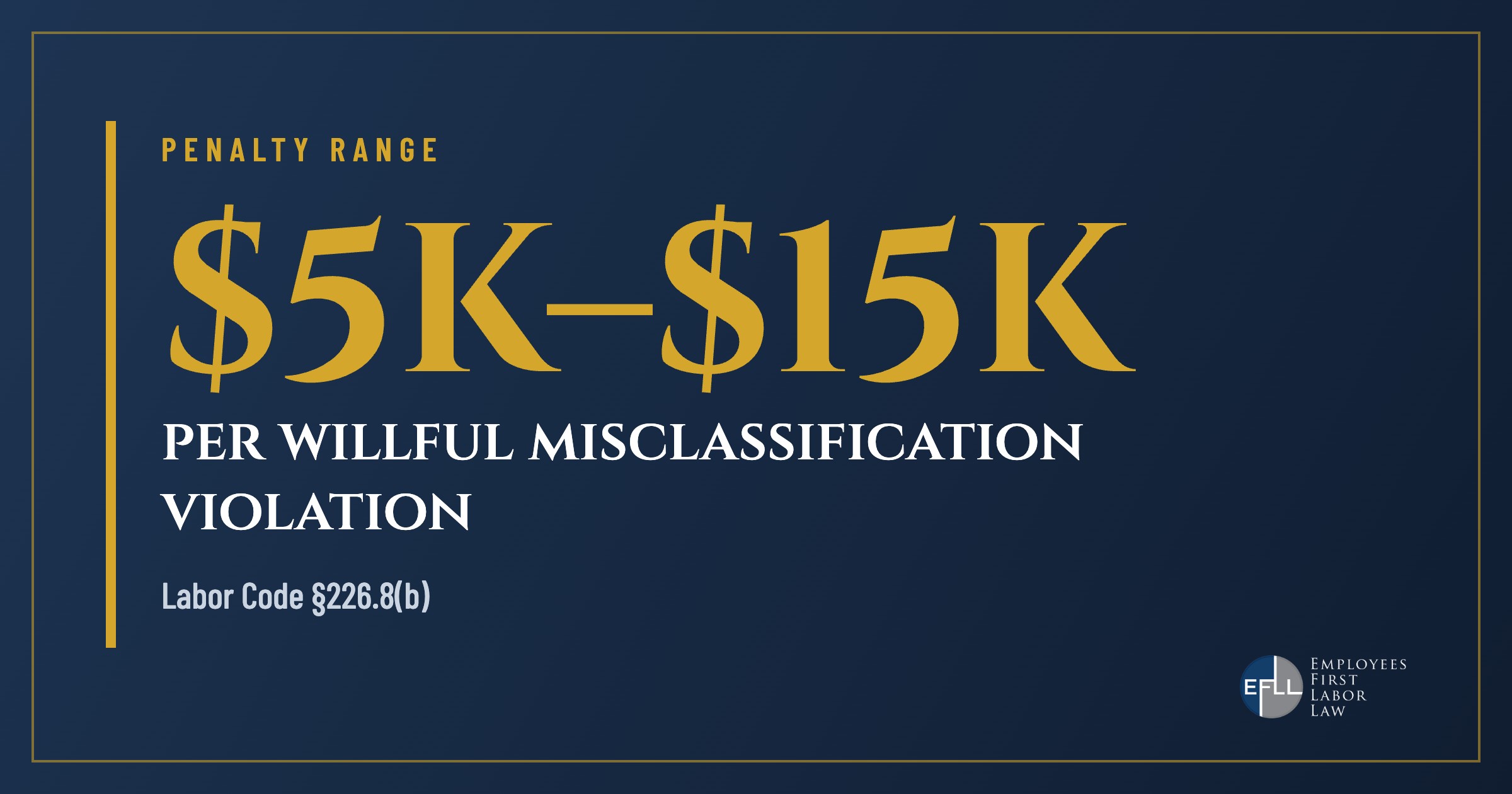
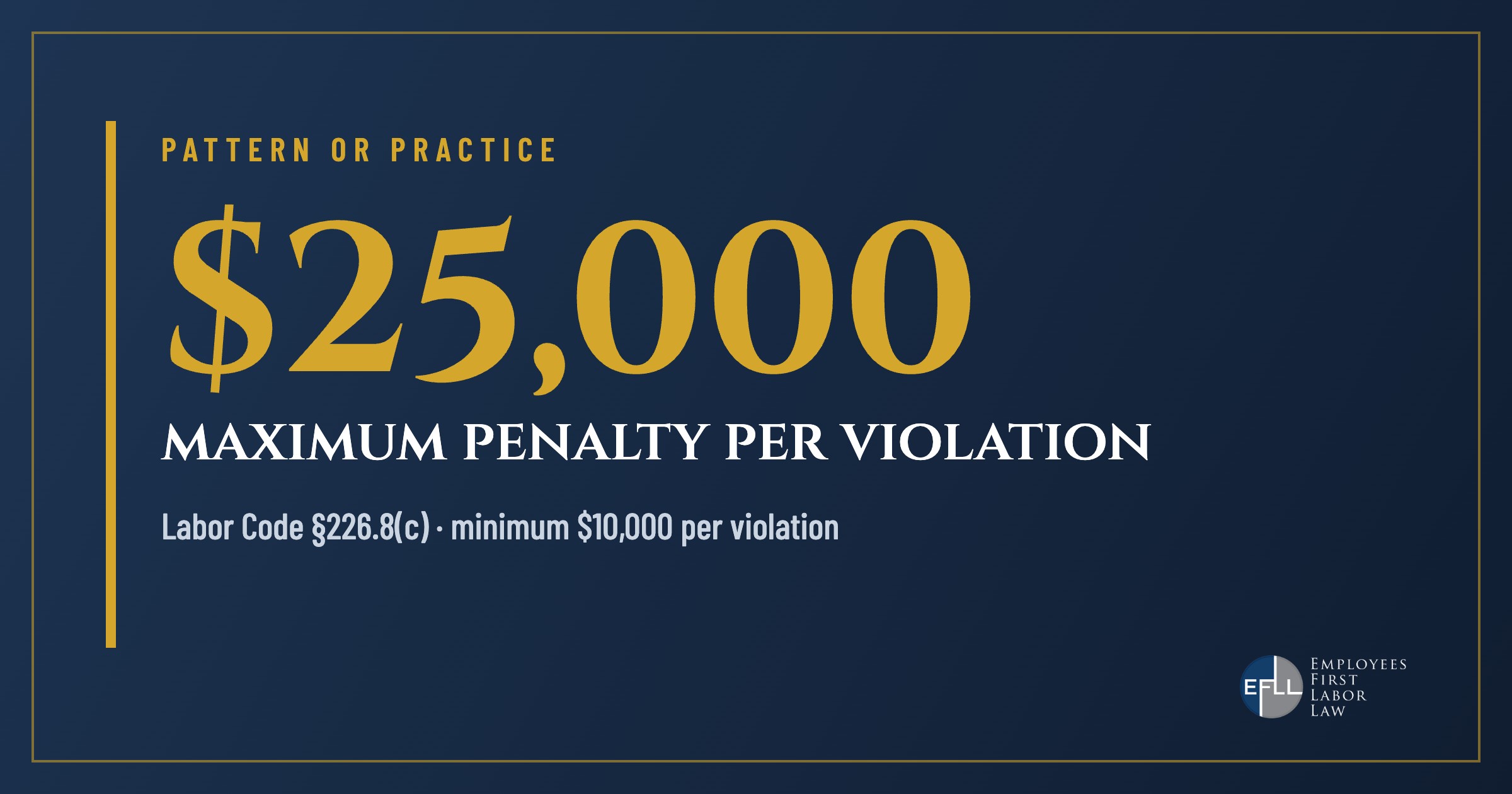
California Labor Code §226.8 makes it illegal to willfully misclassify a worker as an independent contractor, or to charge a willfully misclassified worker fees or deductions that would be illegal for an employee, and it sets civil penalties of $5,000 to $15,000 per violation, rising to $10,000 to $25,000 per violation for a pattern or practice. It also forces employers found in violation to publicly post a notice admitting it.
These penalties sit on top of everything else a misclassified worker can recover, such as unpaid overtime and expense reimbursement. For a business that has labeled a whole workforce as “contractors,” the exposure can be substantial.
This guide explains what §226.8 says, who it protects, what “willful” means, the penalty ranges, how the law is enforced and the deadlines. For the test that decides whether you are an employee in the first place, see our guide on independent contractor misclassification and the ABC test.
- Labor Code §226.8 bars willfully misclassifying workers as independent contractors and charging them fees or deductions that would be illegal for employees.
- Penalties run $5,000 to $15,000 per violation, or $10,000 to $25,000 for a pattern or practice.
- “Willful” means voluntarily and knowingly misclassifying someone to avoid employee status.
- Employers found in violation must post a signed public notice for one year, and successor businesses can be liable.
- Workers can recover the penalties through Labor Commissioner proceedings or PAGA, but not both for the same violation.
What Labor Code §226.8 says
Subdivision (a) makes two things unlawful for any person or employer:
- (a)(1) “Willful misclassification of an individual as an independent contractor.”
- (a)(2) Charging a willfully misclassified individual a fee, or making deductions from their compensation for any purpose, “including for goods, materials, space rental, services, government licenses, repairs, equipment maintenance, or fines,” where the charge would have violated the law if the individual had not been misclassified.
The rest of the section sets the penalties, requires a public notice, directs referrals to the Contractors State License Board for licensed contractors, gives the Labor Commissioner enforcement power and extends liability to successor businesses. The section was most recently amended by AB 1170, a nonsubstantive code-maintenance bill, effective January 1, 2026.
What “willful” means
Subdivision (i)(4) defines “willful misclassification” as “avoiding employee status for an individual by voluntarily and knowingly misclassifying that individual as an independent contractor.” An honest mistake about a close question is not the target. A business that knows its workers function as employees and labels them contractors anyway to avoid payroll costs is.
Who §226.8 covers
The statute applies to “any person or employer,” so it reaches the business that hired the worker and can reach others acting as the employer. Subdivision (h) adds successor liability: penalties and other actions under the section remain in effect against a successor corporation, owner or business that has one or more of the same principals or officers and is engaged in the same or a similar business.
The protected person is any individual who was willfully misclassified. Whether you were misclassified at all is decided under the ABC test in Labor Code §2775 or, for exempt occupations, the Borello test. If you also paid for your own vehicle, phone or tools, you may have a separate claim for expense reimbursement under Labor Code §2802.
What counts as a violation
Common fact patterns that can support a §226.8 claim include:
- Converting existing employees to “contractors” doing the same job, under the same supervisors, with no real change in how the work is done.
- Requiring “contractors” to follow detailed schedules, scripts and policies while denying overtime and breaks.
- Deducting truck leases, equipment fees, uniform charges, insurance or “fines” from a misclassified worker’s pay.
- Charging a misclassified worker rent for a booth, chair, space or desk where the deduction would be unlawful for an employee.
Willful misclassification carries heavy penalties on top of your unpaid wages. Get a free, confidential case review.
Remedies and penalties
| Finding | Civil penalty per violation | Subdivision |
|---|---|---|
| Willful misclassification or unlawful fees/deductions | $5,000 to $15,000 | §226.8(b) |
| Same violations as a pattern or practice | $10,000 to $25,000 | §226.8(c) |
| Licensed contractor found in violation | Order sent to the Contractors State License Board, which must begin disciplinary action within 30 days | §226.8(d) |
| Any finding of a violation of (a) | Public notice on the website (or, if there is no website, at each location where the violation occurred) for one year, signed by an officer | §226.8(e), (f) |
The penalties are imposed when the Labor and Workforce Development Agency (or one of its divisions) or a court “issues a determination” that the employer violated the section. A determination is an order, decision, award or citation for which the appeal time has expired and no appeal is pending.
The public notice must state that the agency or court found a serious violation by willfully misclassifying employees, that the employer has changed its business practices, that any employee who believes they are misclassified may contact the LWDA (with the agency’s mailing address, email and phone number), and that the notice is posted under a state order.
💡 Example: Suppose the Labor Commissioner finds that a hypothetical delivery company willfully misclassified 8 drivers as part of a pattern or practice. If each driver’s misclassification is treated as a separate violation, the penalty range under §226.8(c) would be $80,000 (8 × $10,000) to $200,000 (8 × $25,000), on top of the drivers’ unpaid wages and reimbursement.
Deadlines and where to file
Section 226.8 is enforced in three main ways:
- The Labor Commissioner. Under §226.8(g)(1), the Labor Commissioner may enforce the section through its wage claim, retaliation and citation procedures, including investigating, ordering temporary relief and filing a civil action. In proceedings brought for an individual employee, the Labor Commissioner may recover the §226.8 penalties as damages payable to that employee (§226.8(g)(2)).
- Public prosecutors. A public prosecutor, such as a district attorney, may also enforce the section and seek those damages.
- PAGA. A worker can seek §226.8 civil penalties on behalf of the state and coworkers under the Private Attorneys General Act, after giving written notice to the LWDA.
You cannot double-dip. Under §226.8(g)(2), an employee is entitled either to recover the damages provided by the section or to enforce a civil penalty under PAGA, “but not both, for the same violation.”
Timing matters. PAGA claims carry a one-year limitations period under Code of Civil Procedure §340, measured from the violation, and the notice to the state comes first. Wage and reimbursement claims that usually accompany a misclassification case generally have three years (Code Civ. Proc. §338(a)), or four years under the Unfair Competition Law. Because the deadlines differ, get advice early. Our guide on the Labor Commissioner vs. hiring a lawyer explains the options.
What to do if you think you were willfully misclassified
- Gather the paperwork. Keep your contractor agreement, 1099s, pay records, schedules, and any messages showing how the company directed your work.
- Track the deductions. List every fee, rental, equipment charge or “fine” taken from your pay, with dates and amounts.
- Write down the timeline. If you were converted from employee to contractor, note the date and whether anything about the job actually changed.
- Talk to a lawyer before the one-year PAGA deadline. A lawyer can tell you whether to pursue a Labor Commissioner claim, a lawsuit, a PAGA notice or a combination, and how to avoid giving up one remedy by choosing another.
Related Labor Code sections
- §2775: the ABC test that decides whether a worker is an employee.
- §§2776–2784: exemptions where the Borello test applies instead.
- §2802: reimbursement of necessary work expenses.
- §2699 (PAGA): civil penalties recovered by employees on behalf of the state.
- §2786: injunctive relief by public prosecutors to stop misclassification.
Misclassification also affects benefits. If you were hurt on the job while labeled a contractor, read our guide on workers’ comp for misclassified independent contractors.
Frequently asked questions
What is the penalty for misclassifying an employee in California?
For willful misclassification, $5,000 to $15,000 per violation, or $10,000 to $25,000 per violation if the employer engaged in a pattern or practice. These are in addition to other penalties and the worker’s unpaid wages.
What makes misclassification “willful”?
The statute defines it as voluntarily and knowingly misclassifying someone as an independent contractor to avoid employee status. Evidence often includes treating “contractors” exactly like employees or converting employees to contractor status with no real change in the work.
Can I sue my employer directly under §226.8?
The penalties are imposed after an agency or court determination. Workers typically pursue them through PAGA or through Labor Commissioner proceedings, where the penalties can be recovered as damages payable to the employee, but not both for the same violation.
Can a business charge me for equipment or space if I am a contractor?
If you were willfully misclassified, charges or deductions for goods, materials, space rental, equipment, repairs or fines that would be illegal for an employee violate §226.8(a)(2).
Does the employer have to admit the violation publicly?
Yes. After a determination, the employer must post a signed notice on its website, or at each location where the violation occurred if it has no website, for one year.
Related guides
 Workers only. Never employers.
At Employees First Labor Law, we represent California workers only, never employers. Our team has recovered more than $200 million for our clients, and we prepare every case as if it is going to trial. We have offices in Pasadena, Irvine, Long Beach, Pomona, Riverside, Bakersfield and Fresno, and we serve workers throughout California. Meet our team.







If a company labeled you a contractor to avoid overtime, benefits or expenses, or took fees out of your pay, we can evaluate your claims for wages, reimbursement and misclassification penalties.
- ✅ Free, confidential consultation
- ✅ We represent workers only, never employers
- ✅ Se habla español: Empleados Primero
This article provides general information about California law and is not legal advice for any specific situation. Reading it does not create an attorney-client relationship. Past results do not guarantee a similar outcome.