

Updated October 2026 · 10 min read
An MRI does not set the value of your workers’ comp case by itself, but it often decides how strong your medical evidence is: whether the injury is accepted, what treatment gets approved, and how the doctor rates your permanent disability. For back, neck, shoulder and knee injuries, the MRI is usually the clearest picture of what actually happened inside your body.
That is why the fight over an MRI matters. If the insurance company delays or denies the scan, your doctor may not be able to confirm a disc herniation or a torn tendon, and the rating that drives your settlement can come in lower than it should. Under California law, a routine MRI request must be decided within five business days, and you generally have only 30 days to challenge a denial.
This guide explains how MRI results affect your workers’ comp settlement in California: getting an MRI approved, fighting a denial, how findings shape your permanent disability rating, why “degenerative” findings matter, and how a rating becomes money.
- An MRI is evidence, not a price tag. It carries the most weight when it matches your symptoms, the doctor’s exam and how you were hurt.
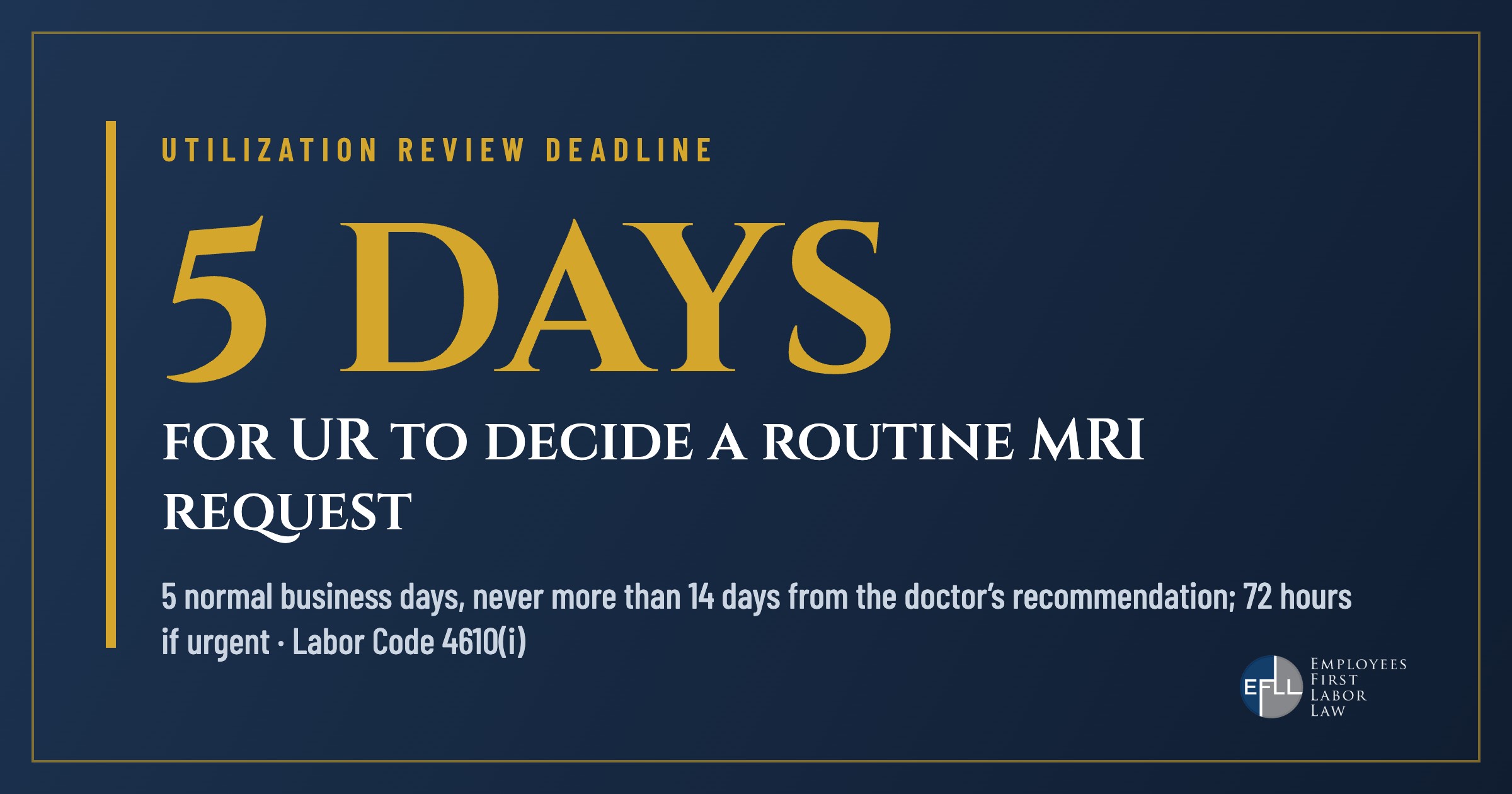
- Utilization review must decide a routine MRI request within 5 business days, and never more than 14 days from the doctor’s recommendation, or within 72 hours if urgent (Labor Code 4610).
- If UR denies the MRI, request Independent Medical Review within 30 days. The IMR reviewer decides on the records and does not examine you.
- “Degenerative” MRI findings can lead to apportionment under Labor Code 4663 and 4664, which can reduce the permanent disability the insurer pays, but the doctor must explain it.
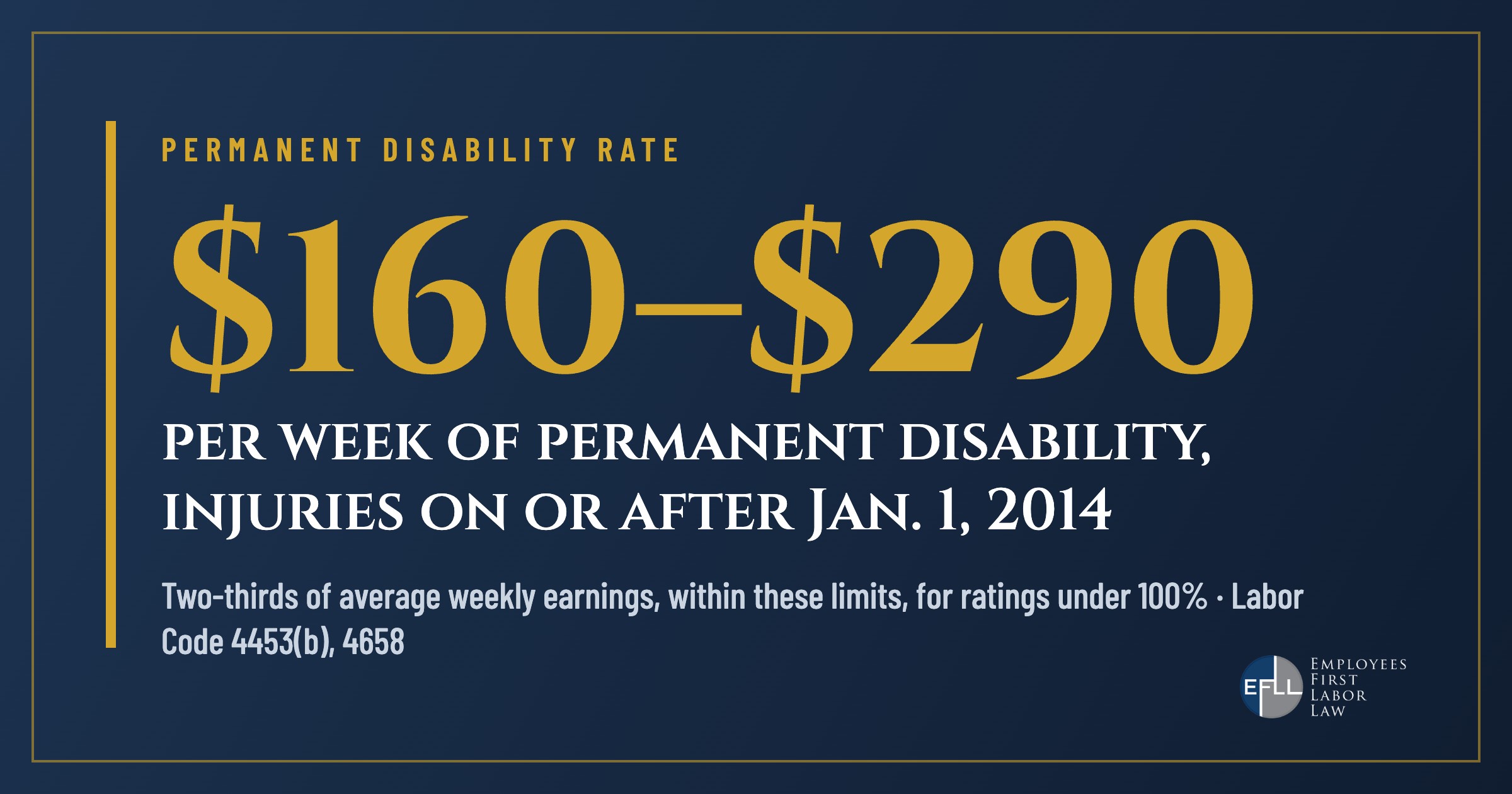
- Permanent disability is paid at $160–$290 a week for injuries since 2014, for a number of weeks set by your final rating.
What an MRI can and can’t prove in a workers’ comp case
X-rays mainly show bone. An MRI shows soft tissue: spinal discs, nerve roots, the spinal cord, ligaments, tendons, cartilage and the menisci of the knee. That makes it the standard test for injuries such as:
- Herniated or bulging discs in the lower back (often at L4-L5 or L5-S1) or neck
- Nerve root compression that causes sciatica or radiating arm pain
- Rotator cuff and labral tears in the shoulder
- Meniscus and ligament tears in the knee
- Tendon injuries in the wrist, elbow and ankle
An MRI is objective evidence, so insurers and judges give it weight. But it shows structure, not pain. It cannot, on its own, prove that your job caused the condition, and it cannot measure how much the injury limits what you can do. Many adults have some disc bulging or wear on an MRI without symptoms, so the insurance company may argue that what the scan shows is old.
What makes an MRI powerful is how well it matches the rest of your evidence: how the injury happened, your symptoms, and what your doctor finds on examination. A treating doctor or evaluator who ties those together is what moves a case.
How long does it take to get an MRI approved by workers’ comp?
Your primary treating physician asks for an MRI by sending a Request for Authorization (RFA) to the claims administrator. The request then goes through utilization review (UR), where a reviewer checks it against California’s treatment guidelines. Labor Code section 4610(i) sets the deadlines:
| Step | Deadline | Source |
|---|---|---|
| Routine (prospective) UR decision | Within 5 normal business days of receiving the RFA and needed information, and never more than 14 days from the doctor’s recommendation | Labor Code 4610(i)(1) |
| Urgent request (serious threat to your health or recovery) | Within 72 hours of receiving the needed information | Labor Code 4610(i)(3) |
| Notice of a denial or modification | To your doctor within 24 hours of the decision; in writing to you within 2 normal business days | Labor Code 4610(i)(4) |
| Request for Independent Medical Review | Within 30 days after the UR decision is served on you (10 days for drug formulary disputes) | Labor Code 4610.5(h) |
| IMR decision | Within 30 days of receiving the request and records; 3 days if expedited | Labor Code 4610.6(d) |
In practice, the total time also depends on how fast the RFA is sent and the scan is scheduled. Ask your doctor’s office when the RFA went out, and keep every letter you receive.
If your claim has not been accepted or denied yet, the employer still must authorize treatment within one working day after you file the claim form, up to $10,000 in medical care, until it decides the claim (Labor Code 5402(c)). That can include diagnostic testing.
Watch: injured at work in California
Our attorneys explain what your employer must do after a work injury, and what to do in the first 24 hours to protect your claim.
What if workers’ comp denies your MRI?
A UR denial is not the final word. If the reviewer says the MRI is not medically necessary, the next step is Independent Medical Review (IMR), run by the Division of Workers’ Compensation. The UR denial letter should explain how to request IMR. You must file the request within 30 days after the UR decision is served on you.
Know what IMR is and is not:
- It is a paper review. The IMR reviewer does not conduct a physical examination of you. The decision is based on the medical records and reports the parties submit, so make sure the records clearly explain why the MRI is needed.
- It is fast and binding. The decision is generally due within 30 days of receiving the request and supporting records, or 3 days in urgent cases. It binds both sides and can be appealed to the Workers’ Compensation Appeals Board only on narrow grounds, within 30 days.
- It is not an expedited hearing. Medical-necessity disputes over a UR denial go to IMR, not to a judge.
Your doctor can also submit a new RFA with better documentation, such as worsening symptoms, failed physical therapy, or new neurological findings. If the insurer refuses the scan because it disputes your claim itself rather than the medical need, that dispute generally goes to a workers’ comp judge instead. Missed UR deadlines and liability disputes are worth reviewing with an attorney.
Our workers’ comp attorneys track the UR and IMR deadlines and push for the testing your doctor ordered. Call for a free consultation.
How MRI findings affect causation and your PD rating
Causation. To get benefits, your injury must arise out of and occur in the course of employment. An MRI showing an acute finding in the body part you hurt, consistent with how you were injured, supports that link. If you had an earlier condition, work that aggravates it can still be a compensable injury.
Permanent disability rating. Once you reach maximum medical improvement, your treating doctor, or a QME or AME if there is a dispute, rates your impairment. California uses the AMA Guides to the Evaluation of Permanent Impairment, Fifth Edition. For injuries on or after January 1, 2013, the doctor’s whole person impairment (WPI) is multiplied by an adjustment factor of 1.4 and then adjusted for your occupation and age (Labor Code 4660.1).
The MRI feeds that rating but does not replace the exam. For spine injuries, the doctor looks at clinical findings such as nerve root signs, loss of motion and any surgery. Imaging that confirms those findings can support a higher impairment category. An MRI that shows a herniation but no matching symptoms or exam findings may add little.
MRI vs. symptoms. The reverse is also true. Real, documented symptoms count even when the MRI is unremarkable. Report every symptom to your doctor, including numbness, tingling, weakness and pain that travels into an arm or leg, so the record matches what you live with.
Degenerative findings and apportionment
Radiology reports often use words like “degenerative disc disease,” “desiccation,” “spondylosis” or “age-related changes.” Insurance companies read those words closely, because of apportionment.
Under Labor Code 4663, apportionment of permanent disability is based on causation. Every doctor who rates permanent disability must estimate what percentage was caused by the work injury and what percentage was caused by other factors, before or after it. Under Labor Code 4664, the employer is liable only for the percentage directly caused by the work injury, and a prior permanent disability award is conclusively presumed to still exist.
So a degenerative MRI can lower the part of your rating the insurer must pay. What matters is whether the doctor explains how and why the degeneration, rather than the work injury, caused part of your current disability. A conclusion that simply points to “degeneration” on a scan can be challenged. Apportionment applies to permanent disability; it generally does not reduce your right to medical treatment for the work injury.
💡 Example: Luis, a hypothetical warehouse worker, has an MRI showing a new L5-S1 herniation and mild degeneration at other levels. The QME rates his spine and apportions 20% of the permanent disability to pre-existing degeneration. If his rating before apportionment were 20%, it would drop to 16% after apportionment. The numbers are made up to show how apportionment works.
How a PD rating turns into settlement money
Permanent disability (PD) is paid in weeks. The final rating sets the number of weeks under the table in Labor Code 4658(e), and your earnings set the weekly rate: two-thirds of your average weekly earnings, but for injuries on or after January 1, 2014, never less than $160 or more than $290 a week for any rating under 100%.
| Final PD rating | Weeks of PD | Total at $160/week | Total at $290/week |
|---|---|---|---|
| 5% | 15 | $2,400 | $4,350 |
| 10% | 30.25 | $4,840 | $8,772.50 |
| 15% | 50.5 | $8,080 | $14,645 |
| 20% | 75.5 | $12,080 | $21,895 |
| 25% | 100.75 | $16,120 | $29,217.50 |
| 30% | 131 | $20,960 | $37,990 |
💡 Example (illustration only): Maria, a hypothetical worker injured in 2025, earned $900 a week. Two-thirds is $600, so her PD rate is capped at $290. If her final rating were 15%, she would receive 50.5 weeks × $290 = $14,645 in permanent disability. If the rating were 20%, it would be 75.5 weeks × $290 = $21,895. These are not predictions for any real case.
PD is only one part of a settlement. The value also depends on future medical care, any temporary disability still owed, and how you settle. If your employer does not offer regular, modified or alternative work, you may also qualify for a $6,000 Supplemental Job Displacement Benefit voucher for injuries on or after January 1, 2013 (Labor Code 4658.7). The voucher applies only to permanent partial disability. To run your own numbers, try our workers’ comp calculator, and see how PD ratings work and what they are worth.
L4-L5 and L5-S1 disc injuries: what the MRI means for settlement
L4-L5 and L5-S1, the lowest levels of the lumbar spine, are where lifting injuries often show up. There is no standard “L4-L5-S1 settlement” amount. Two workers with the same MRI can end up with very different ratings and settlements.
What moves the value is the combination of factors:
- Whether the herniation compresses a nerve root, and whether the exam confirms radiculopathy
- Whether you needed injections or surgery, and how you recovered
- Permanent work restrictions and whether your employer can accommodate them
- How much, if any, of the disability is apportioned to degeneration
- Your earnings, which set the weekly PD rate within the $160–$290 range
- Whether future medical care stays open
Neck injuries follow the same logic at the cervical levels. See our guide to neck and cervical spine injuries.
Future medical care and how you settle
MRI findings that point to likely future care, such as injections, surgery or ongoing pain management, affect both your rating and the value of your future medical rights.
California cases usually resolve in one of two ways. A stipulated award pays your PD and generally keeps future medical care open for the injury. A compromise and release (C&R) pays a lump sum and usually closes future medical care, so the amount must account for the treatment you may need later. Either way, a workers’ comp judge must approve the settlement. Our guide to C&R vs. stipulated award explains the trade-offs.
If an MRI your doctor recommended never happened, the settlement may rest on an incomplete picture. Resolve the testing dispute before you sign.
What to do: protecting your claim step by step
- Report every symptom to your treating doctor, including radiating pain, numbness and weakness.
- Ask whether an RFA for an MRI was sent, and note the date.
- Watch the calendar. A routine UR decision is due within 5 business days, and no more than 14 days from the recommendation.
- If you get a denial, file for IMR within 30 days of service of the UR decision, and make sure your doctor’s supporting records go with it.
- Get copies of the MRI report, the RFA, every UR and IMR letter, and any QME or AME report that discusses the imaging.
- Read the radiology report for words like “degenerative,” and ask your attorney how apportionment could affect your rating.
- Don’t settle on incomplete evidence. If testing is still pending, talk to a lawyer before signing.
Frequently asked questions
Does a herniated disc increase my workers’ comp settlement?
It can, but not automatically. A herniation that matches your symptoms and exam findings, especially with nerve involvement or surgery, can support a higher impairment rating. A herniation the doctor considers old, or one without matching symptoms, may add little.
Can workers’ comp deny an MRI?
Yes. Utilization review can deny or modify an MRI request it considers not medically necessary. You can challenge that by filing for Independent Medical Review within 30 days after the UR decision is served on you, and your doctor can submit a new request with better documentation.
How long does workers’ comp take to approve an MRI?
For a routine request, UR must decide within 5 normal business days of receiving the request and the information it needs, and never more than 14 days from your doctor’s recommendation. Urgent requests must be decided within 72 hours (Labor Code 4610(i)).
What if my MRI shows degeneration?
A degenerative finding does not by itself defeat your claim. It can lead a doctor to apportion part of your permanent disability to non-work causes under Labor Code 4663, but the doctor has to explain how the degeneration caused part of the disability, and that opinion can be challenged.
Does the IMR doctor examine me?
No. The IMR reviewer does not conduct a physical examination. The decision is based on the medical records and reports submitted, which is why your doctor’s documentation matters.
Do I need an MRI before a QME exam?
Not always. A QME reviews your medical records, including any imaging, and examines you. If important imaging has been denied or never done, raise it with your attorney before the evaluation so the record is as complete as possible.
Related guides
 Workers only. Never employers.
At Employees First Labor Law, we represent California workers only, never employers. Our team has recovered more than $200 million for our clients, and we prepare every case as if it is going to trial. We have offices in Pasadena, Irvine, Long Beach, Pomona, Riverside, Bakersfield and Fresno, and we serve workers throughout California. Meet our team.







If workers’ comp denied your MRI, or a doctor is blaming your injury on “degeneration,” our attorneys can review your records, challenge the denial or the apportionment, and work to make sure your settlement reflects your real medical condition.
- ✅ Free, confidential consultation
- ✅ We represent workers only, never employers
- ✅ Se habla español: Empleados Primero
This article provides general information about California law and is not legal advice for any specific situation. Reading it does not create an attorney-client relationship. Past results do not guarantee a similar outcome.