

Updated October 2026 · 10 min read
There is no official “average” workers’ comp settlement for CRPS in California. A CRPS workers’ comp settlement is built from the same benefits as any other claim: your permanent disability rating, temporary disability, future medical care and, in many cases, a job retraining voucher. Neither the Division of Workers’ Compensation (DWC) nor the Workers’ Compensation Appeals Board (WCAB) publishes settlement averages by diagnosis, and numbers quoted online ignore the facts that set the value of your case.
Complex regional pain syndrome (CRPS) is a chronic pain condition that can follow even a minor work injury. Because it rarely shows up clearly on an MRI or X-ray, insurers often question it, and the way it is diagnosed, rated and treated can change a claim’s value significantly.
This guide explains how California values a CRPS claim, step by step: diagnosis and documentation, how the permanent disability rating is built, how a rating turns into dollars, temporary disability, future medical care, apportionment, and how to choose between a compromise and release and a stipulated award.
- There is no official average CRPS workers’ comp settlement in California. Value is built from your permanent disability rating, temporary disability, future medical care and other benefits.
- A well-documented diagnosis, usually under the Budapest criteria, and a rating under the AMA Guides, 5th Edition (WPI × 1.4 for injuries since 2013), drive the permanent disability number.
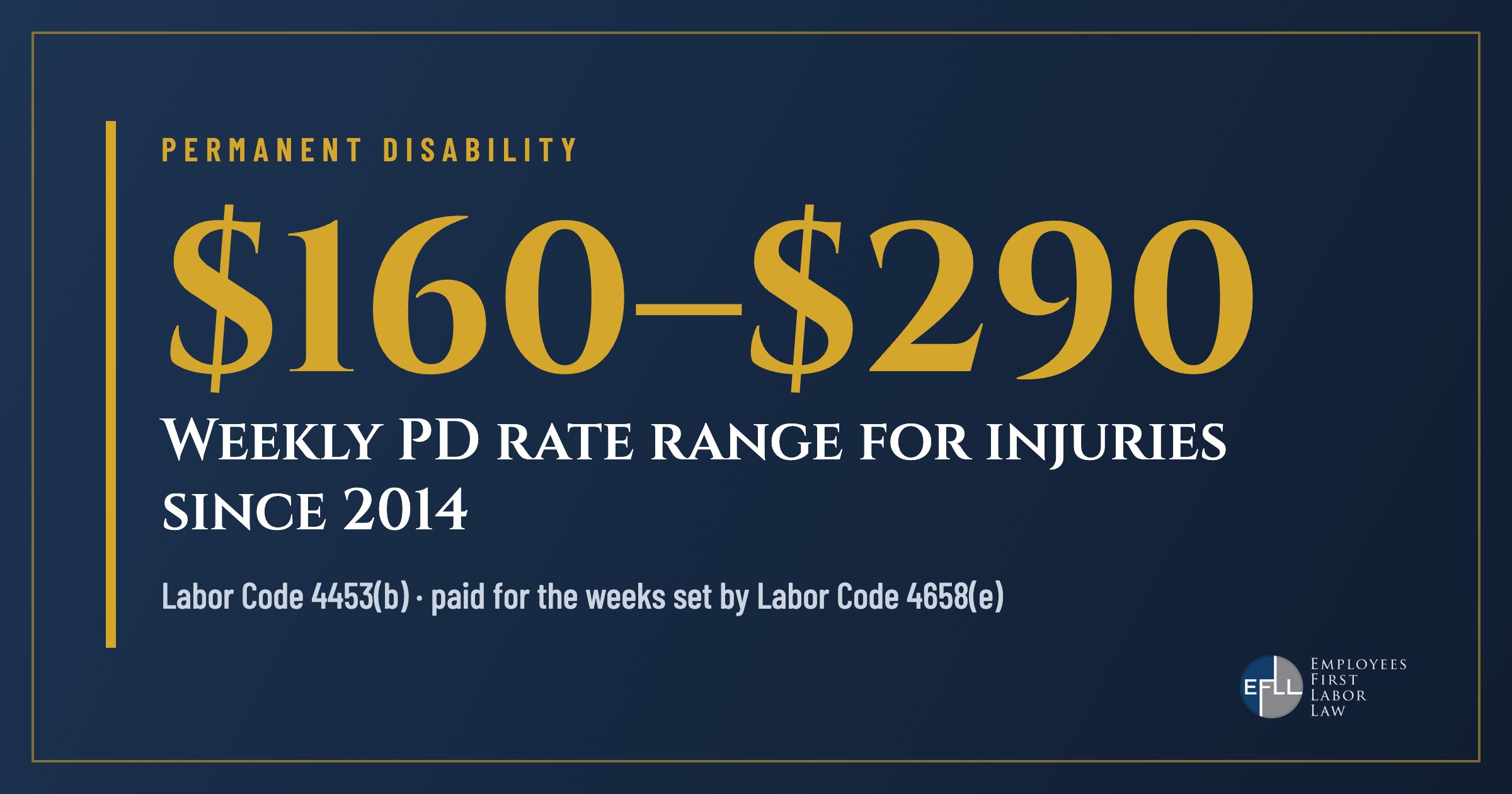
- Permanent disability for injuries since 2014 is paid at $160 to $290 a week for a set number of weeks: a 30% rating equals 131 weeks, or $20,960 to $37,990.
- Temporary disability is two-thirds of your average weekly earnings (2026 range $264.61 to $1,764.11), generally for up to 104 weeks within five years of the injury.
- Future medical care, such as nerve blocks or a spinal cord stimulator, is often the biggest variable, so do not sign a compromise and release until its cost is accounted for.
What CRPS is and why it is compensable
CRPS is chronic pain, usually in an arm, hand, leg or foot, that is out of proportion to the original injury. It often follows a crush injury, fracture, sprain, surgery (including carpal tunnel surgery) or a nerve injury. The severity of the first injury does not always predict how severe CRPS becomes; a sprain can lead to lasting disability.
Common signs include:
- Burning or stabbing pain that does not match the original injury
- Pain from light touch or cold (allodynia) and heightened sensitivity
- Swelling, stiffness and reduced range of motion
- Changes in skin color, temperature or texture in the affected limb
- Abnormal sweating and changes in hair or nail growth
- Weakness and, over time, muscle wasting
Type I (once called reflex sympathetic dystrophy) occurs without a confirmed nerve injury; Type II (once called causalgia) follows one. Either type is covered when it results from a work injury, including as a compensable consequence of an accepted injury or of the surgery that treated it.
Is there an average CRPS workers’ comp settlement?
No reliable average exists, and you should be skeptical of any website that quotes one. Two workers with the same diagnosis can have very different cases because California pays benefits by formula, not by diagnosis. The main drivers are:
- Your permanent disability (PD) rating, which depends on the doctor’s impairment findings, your age and your occupation
- Your earnings, which set your temporary and permanent disability rates
- Future medical needs, such as nerve blocks, medications or a spinal cord stimulator
- Apportionment to other causes, which can reduce the PD you are paid
- How the case closes: a lump-sum compromise and release, or a stipulated award that leaves future medical care open
The rest of this guide walks through each factor. To estimate the PD portion from a rating, you can also use our California workers’ comp calculator.
Watch: injured at work in California
Our attorneys explain what your employer must do after a work injury, and what to do in the first 24 hours to protect your claim.
Step 1: Diagnosis and documentation
Everything starts with a well-documented diagnosis. Insurers often call CRPS “subjective” or “exaggerated” because it cannot be confirmed by a single test. Doctors widely use the Budapest criteria, which look for continuing pain out of proportion to the inciting event, reported symptoms and observed signs in several categories (sensory, vasomotor, sudomotor/edema and motor/trophic), and no other diagnosis that better explains the condition. We explain each criterion in detail in our guide to proving CRPS with the Budapest criteria.
Strong documentation usually includes:
- Repeated exam findings recorded on more than one visit, since CRPS signs can come and go
- Side-by-side comparisons of the injured and uninjured limbs (temperature, color, swelling, range of motion, grip strength)
- Specialist evaluation by a pain management physician or neurologist
- Testing your doctor considers appropriate to support the diagnosis or rule out other causes
- A clear timeline linking the onset of symptoms to the work injury or the surgery that treated it
Delays in diagnosis are common. If a requested test or referral is denied, your doctor’s request can be challenged through utilization review and independent medical review.
We help injured workers document CRPS, challenge treatment denials and weak QME reports, and value settlements that account for future care. Ask for a free consultation.
How the permanent disability rating is built for CRPS
For injuries on or after January 1, 2013, Labor Code 4660.1 controls. The evaluating doctor (your treating physician, a QME or an AME) measures your impairment under the AMA Guides to the Evaluation of Permanent Impairment, 5th Edition, and expresses it as a whole person impairment (WPI). The WPI is multiplied by 1.4, then adjusted for your occupation and your age at the time of injury to produce the final rating.
Three rules matter especially in CRPS cases:
- The scheduled rating can be rebutted. In its 2009 en banc decision in Almaraz/Guzman, the WCAB held that a physician may use any chapter, table or method within the AMA Guides that most accurately reflects the worker’s impairment, as long as the doctor stays within the four corners of the Guides and explains why. Labor Code 4660.1(h) states that the Legislature did not intend to overrule the Court of Appeal’s 2010 Guzman decision. Because standard CRPS ratings can understate real-world loss of function, a well-reasoned alternative rating can make a substantial difference.
- Combining body parts. Ratings for more than one body part are normally combined using the Combined Values Chart. In Vigil v. County of Kern (2024), the WCAB held that impairments may instead be added when the evidence shows their effects on activities of daily living do not overlap, or overlap in a way that amplifies them. This can matter when CRPS spreads or affects more than one limb.
- Limits on add-ons. For 2013 and later injuries, impairment ratings for sleep dysfunction, sexual dysfunction or psychiatric disorder arising out of a compensable physical injury generally cannot increase the rating, unless the psychiatric injury resulted from a violent act or a catastrophic injury (Labor Code 4660.1(c)). You can still receive treatment for those conditions.
If a QME report is incomplete or misapplies the Guides, it can be challenged; see how to dispute a QME or AME report.
How a CRPS rating turns into dollars
Permanent partial disability is paid at two-thirds of your average weekly earnings, but for injuries on or after January 1, 2014, the weekly rate cannot be less than $160 or more than $290 (Labor Code 4453(b)). Anyone earning about $435 a week or more receives the $290 maximum. The number of weeks comes from the schedule in Labor Code 4658(e), and the weeks grow faster as the rating rises.
| Final PD rating | Weeks of PD (LC 4658(e)) | Total PD at $160–$290/week |
|---|---|---|
| 10% | 30.25 | $4,840 – $8,772.50 |
| 20% | 75.5 | $12,080 – $21,895 |
| 30% | 131 | $20,960 – $37,990 |
| 50% | 271.25 | $43,400 – $78,662.50 |
| 70% | 433.25 | $69,320 – $125,642.50, plus a life pension |
These figures are permanent disability payments only, for injuries on or after January 1, 2014. They are not settlement amounts. They do not include temporary disability, future medical care or the voucher, and PD already advanced is credited against the total. A rating of 70% or more also carries a life pension after the PD weeks run out (Labor Code 4659), and a 100% rating is permanent total disability paid for life.
💡 Example: Maria, a warehouse worker earning $1,200 a week, develops CRPS in her right hand after a crush injury in 2025. Her final rating, after the 1.4 multiplier and age and occupation adjustments, is 30%. Her PD rate is the $290 maximum, and 30% equals 131 weeks, so her PD is 131 × $290 = $37,990. If a doctor instead apportioned part of her disability to a prior condition and her rating fell to 24%, she would receive 95.5 weeks, or $27,695, a difference of $10,295. This is a hypothetical illustration, not a prediction for any case.
For a deeper look at ratings, see what a permanent disability rating is worth.
Temporary disability while you treat
While you are off work or on restrictions your employer cannot accommodate, you are generally entitled to temporary disability at two-thirds of your average weekly earnings (Labor Code 4653). For injuries in 2026, the weekly rate is at least $264.61 and at most $1,764.11 (for 2025 injuries, $252.03 and $1,680.29). Maria, earning $1,200 a week, would receive $800 a week.
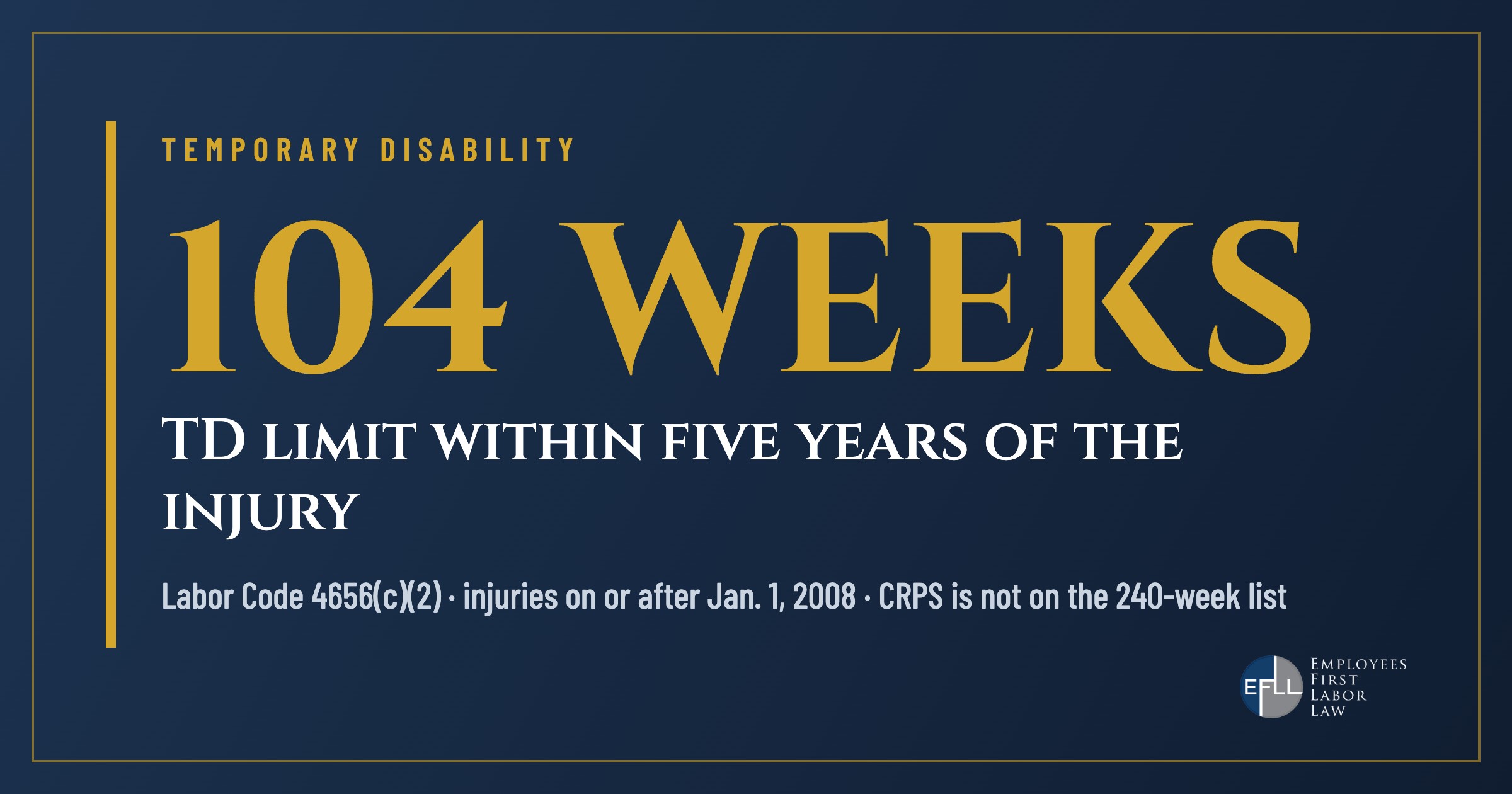
For injuries on or after January 1, 2008, temporary disability generally cannot exceed 104 compensable weeks within five years of the date of injury (Labor Code 4656(c)(2)). CRPS is not on the short list of conditions that qualify for the 240-week extension, such as amputations and severe burns. Because CRPS treatment can be long, the limit sometimes runs out before a case settles.
Future medical care: the biggest variable
For many CRPS claimants, the cost of future care outweighs the permanent disability money. Depending on your doctors’ recommendations, ongoing care may include sympathetic nerve blocks, physical and occupational therapy, desensitization programs, medications, psychological pain management and, in some cases, a spinal cord stimulator trial and implant, along with future battery replacements and programming. This is general information, not medical advice; your treating doctors decide what care is appropriate for you.
In California, treatment requests are measured against the DWC’s Medical Treatment Utilization Schedule (MTUS), which includes a chronic pain guideline. Requests for expensive care, such as a stimulator, can be denied in utilization review and may need to be pursued through IMR. Our pain management guide covers this process in more detail.
Apportionment: how it can reduce your award
Apportionment of permanent disability is based on causation (Labor Code 4663). The evaluating doctor must estimate what percentage of your permanent disability was caused by the work injury and what percentage was caused by other factors, before or after the injury. Your employer is liable only for the percentage directly caused by the work injury (Labor Code 4664).
In CRPS cases, insurers sometimes argue that prior injuries or other conditions caused part of the disability. Apportionment must be supported by substantial medical evidence explaining how and why another factor contributes, so a conclusory opinion can be challenged.
Compromise and release vs. stipulated award for CRPS
Most CRPS claims close in one of two ways. With a stipulated award, you receive your PD payments and keep the right to future medical treatment for the injury. You can generally petition to reopen for new and further disability within five years of the date of injury (Labor Code 5410). With a compromise and release (C&R), you receive a lump sum and usually give up future medical care, so the price must account for what that care would cost over your lifetime.
Because CRPS care can be lifelong and expensive, a C&R that undervalues, for example, a likely spinal cord stimulator can leave you paying for care yourself. If you receive or expect to receive Medicare, a settlement of future medical care may also need to account for Medicare’s interests. A C&R is not valid unless the WCAB approves it (Labor Code 5001), and in its 2026 en banc decision in Gaines v. ABM Aviation, the WCAB confirmed that a workers’ compensation settlement is enforceable only after Appeals Board approval and that the judge must determine whether it is adequate. For a side-by-side comparison, read C&R vs. stipulated award and should you accept a settlement offer.
Two other benefits are often part of the picture. For injuries on or after January 1, 2013, if you have permanent partial disability and your employer does not offer qualifying regular, modified or alternative work, you can receive a supplemental job displacement voucher of up to $6,000 for retraining (Labor Code 4658.7). Workers who receive the voucher may also apply for the state’s one-time $5,000 Return-to-Work Supplement within one year of the date the voucher was served.
What to do to protect the value of a CRPS claim
- Report symptoms early and specifically. Describe burning pain, sensitivity to touch, color or temperature changes and swelling at every visit.
- Document changes. Keep a symptom log and dated photos, since signs can fluctuate.
- Ask for a specialist referral. A pain management physician or neurologist is usually best placed to document the Budapest criteria.
- Keep every appointment. Gaps in treatment are commonly used to dispute the severity of CRPS.
- Review the QME or AME report carefully for rating method, apportionment and future medical recommendations before discussing settlement.
- Do not sign a C&R until you know the likely cost of your future care.
Frequently asked questions
What is the average workers’ comp settlement for CRPS in California?
No official source publishes one. Value depends on your permanent disability rating, earnings, future medical needs, apportionment and whether you settle by C&R or stipulated award. A 30% rating, for example, equals 131 weeks of PD, or $20,960 to $37,990 for injuries since 2014, before any future medical value.
Can I get a spinal cord stimulator through workers’ comp?
Possibly, if your treating doctor requests it and it is supported under the MTUS. Requests are often disputed in utilization review, and a denial can be appealed through independent medical review.
How long does temporary disability last for CRPS?
For injuries on or after January 1, 2008, temporary disability is generally capped at 104 compensable weeks within five years of the injury. CRPS is not one of the listed conditions that qualify for 240 weeks.
Should I take a lump sum or keep future medical for CRPS?
It depends on your expected care, health insurance and Medicare status. Because CRPS treatment can be costly and long-term, many workers benefit from keeping future medical care or from a C&R priced to cover it. Get advice before signing.
Can a CRPS claim be denied because it does not show on an MRI?
Insurers sometimes try, but CRPS is a clinical diagnosis. A denial can be challenged with specialist findings, documented signs, and medical-legal evaluation. If your claim was denied, see our page on denied workers’ comp claims.
Related guides
 Workers only. Never employers.
At Employees First Labor Law, we represent California workers only, never employers. Our team has recovered more than $200 million for our clients, and we prepare every case as if it is going to trial. We have offices in Pasadena, Irvine, Long Beach, Pomona, Riverside, Bakersfield and Fresno, and we serve workers throughout California. Meet our team.







If you have CRPS after a work injury anywhere in California, our workers’ compensation attorneys can review your medical records, your rating and any settlement offer, and explain what your claim may be worth before you sign anything.
- ✅ Free, confidential consultation
- ✅ We represent workers only, never employers
- ✅ Se habla español: Empleados Primero
This article provides general information about California law and is not legal advice for any specific situation. Reading it does not create an attorney-client relationship. Past results do not guarantee a similar outcome.