


Updated October 2026 · 9 min read
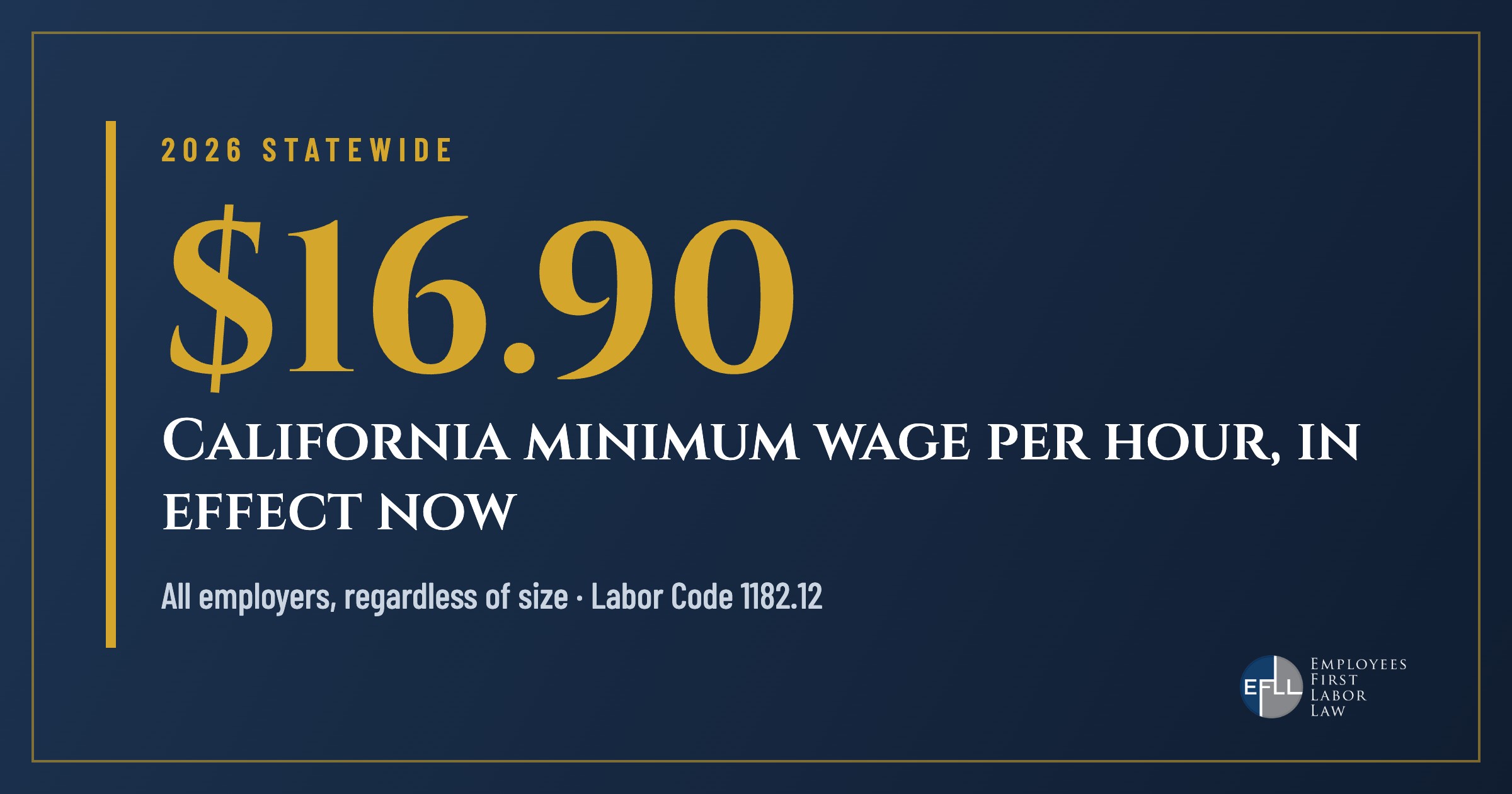
The California minimum wage for 2026 is $16.90 an hour for every employer, regardless of size, and it rises to $17.40 an hour on January 1, 2027. Those are statewide floors. If you work in one of about 40 cities and counties with their own minimum wage, such as Los Angeles, San Francisco, San Jose, San Diego or Pasadena, your employer must pay the higher local rate. For every city’s current rate, see our California minimum wage by city guide, which we keep up to date as cities announce new rates.
Small differences add up. A full-time worker in the City of Los Angeles who is paid the $16.90 state rate instead of the $18.42 city rate loses $60.80 a week, more than $3,000 a year, before overtime. The minimum wage also sets the minimum salary for exempt employees and the lowest possible overtime rate.
Below: the 2026 and 2027 statewide rates, local rates in the largest cities, fast food and health care wages, the exempt salary threshold, and what you can recover if you were underpaid.
- $16.90 an hour is the California minimum wage for 2026, for every employer regardless of size (Labor Code 1182.12).
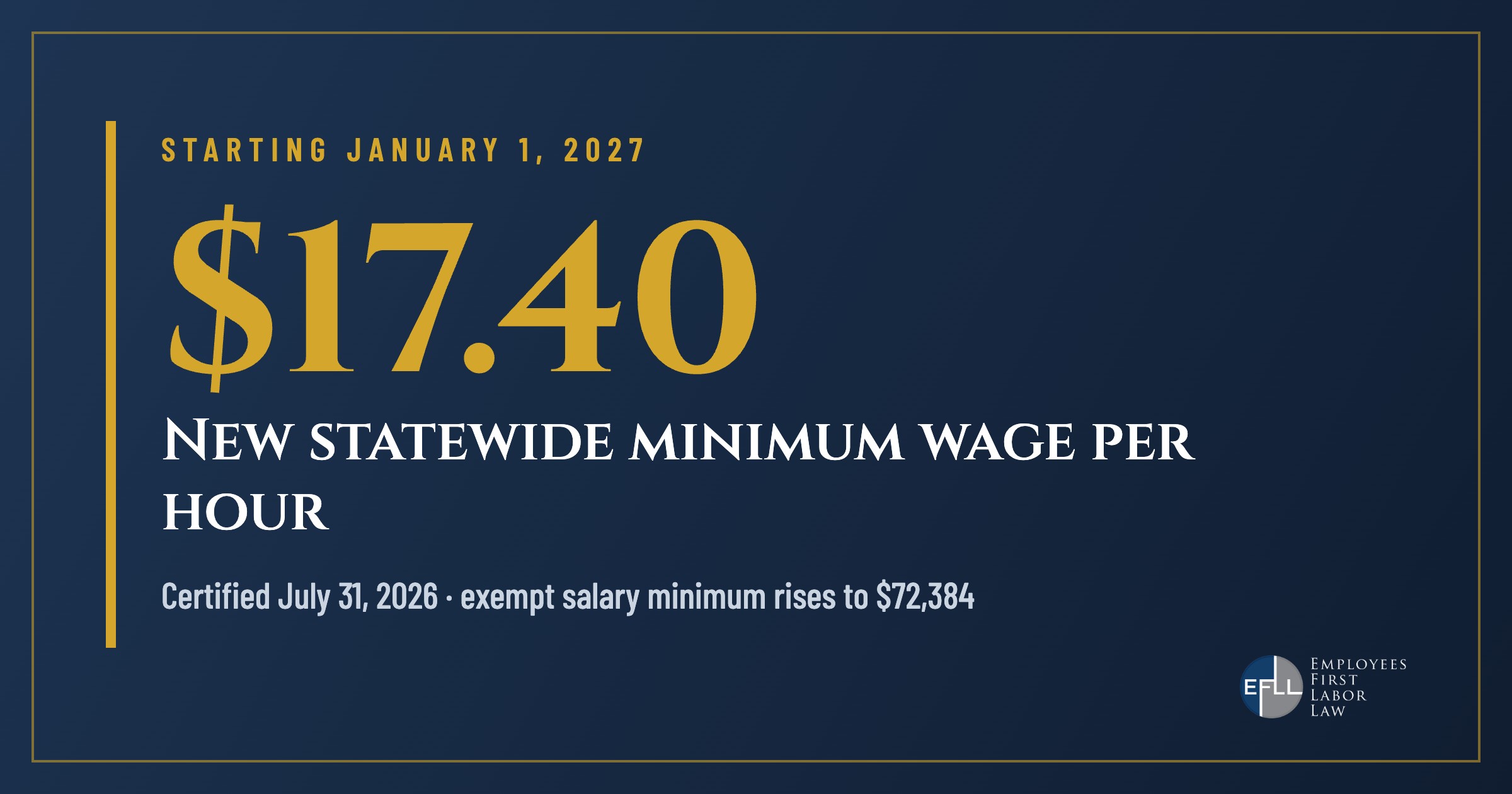
- $17.40 an hour starts January 1, 2027. The Department of Finance certified the increase on July 31, 2026.
- About 40 cities and counties require more, up to $20.34 in Emeryville. Your employer must pay the highest rate that applies where you work.
- Fast food workers at national chains earn at least $20.00; covered health care workers earn $19.28 to $25.00, depending on the facility.
- Underpaid? For state minimum wage violations, Labor Code 1194 and 1194.2 let you recover the unpaid wages, an equal amount in liquidated damages, interest and attorney’s fees.
California minimum wage 2026 and 2027 at a glance
California has one statewide minimum wage for all employers. The old split between small and large employers ended in 2023, and the rate is now adjusted each year for inflation under Labor Code 1182.12.
| Rate | 2026 | Starting January 1, 2027 |
|---|---|---|
| Statewide minimum wage | $16.90/hour | $17.40/hour |
| Overtime at minimum wage (1.5×) | $25.35/hour | $26.10/hour |
| Double time at minimum wage (2×) | $33.80/hour | $34.80/hour |
| Exempt employee minimum salary | $70,304/year | $72,384/year |
| Fast food (national chains) | $20.00/hour | $20.00/hour unless the Fast Food Council approves an increase |
| Covered health care workers (SB 525) | $19.28 to $25.00/hour, by facility type | Next increases on July 1, 2027 for some facility types |
Overtime is figured from your regular rate of pay, which is often higher than the minimum wage, so these overtime figures are the legal minimums. The minimum wage applies to every hour you work, including training and required meetings.
Why the minimum wage rises to $17.40 in 2027
California’s minimum wage goes up automatically each year. Under Labor Code 1182.12, the state Department of Finance calculates an adjustment based on the change in the national consumer price index, capped at 3.5% a year, and the new rate takes effect the following January 1.
On July 31, 2026, the Department of Finance certified that the statewide minimum wage will rise to $17.40 an hour on January 1, 2027. The Department of Industrial Relations announced the new rate in a news release. It applies to all employers, regardless of size.
💡 Example: Maria works 40 hours a week at the state minimum wage in Long Beach, which has no general local minimum wage. In 2026 she earns $676.00 a week (40 × $16.90). For hours worked on or after January 1, 2027, she must earn at least $696.00 a week (40 × $17.40). That is $20.00 more each week, or $1,040 more over 52 weeks.
Watch your first 2027 paycheck: if a pay period spans New Year’s Day, hours worked on or after January 1 must be paid at the new rate.
City and county minimum wages in 2026
About 40 California cities and counties have minimum wage ordinances that set a higher floor than the state. When more than one rate applies, your employer must pay the highest one. Local ordinances generally cover work performed inside the city or county limits, even if your employer is based elsewhere.
Emeryville has the highest general minimum wage in California: $20.34 an hour since July 1, 2026. Here are 2026 rates for the state’s largest cities and other places where many of our clients work:
| City or county | 2026 rate | In effect since | Next change |
|---|---|---|---|
| Los Angeles (city) | $18.42 | July 1, 2026 | Expected July 1, 2027 |
| Los Angeles County (unincorporated areas) | $18.47 | July 1, 2026 | Expected July 1, 2027 |
| San Diego (city) | $17.75 | January 1, 2026 | January 1, 2027 (not yet announced) |
| San Jose | $18.45 | January 1, 2026 | January 1, 2027 (not yet announced) |
| San Francisco | $19.61 | July 1, 2026 | Expected July 1, 2027 |
| Oakland | $17.34 | January 1, 2026 | January 1, 2027 (at least $17.40, the state rate) |
| Pasadena | $18.57 | July 1, 2026 | Expected July 1, 2027 |
| Santa Monica | $18.47 | July 1, 2026 | Expected July 1, 2027 |
| West Hollywood | $20.25 | January 1, 2026 | January 1, 2027 (not yet announced) |
| Emeryville | $20.34 | July 1, 2026 | Expected July 1, 2027 |
| Hayward (26 or more employees) | $17.79 | January 1, 2026 | $18.39 on January 1, 2027 |
| Long Beach (no general local minimum wage) | $16.90 (state rate) | January 1, 2026 | $17.40 on January 1, 2027 |
Some cities set different rates by employer size. In Hayward, employers with 25 or fewer employees pay the state rate, and Novato and Sonoma also have size-based tiers. For all of the roughly 40 local rates, including Mountain View ($19.70), Sunnyvale ($19.50) and Richmond ($19.18), see our California minimum wage by city page.
Many workers are still paid the old rate after an increase, or the state rate in a city that requires more. Our attorneys will review your pay stubs in a free, confidential consultation.
What changes for local rates on January 1, 2027
Most 2027 local rates have not been announced yet. Cities that adjust on January 1, including San Diego, San Jose, Oakland, West Hollywood and the cities in San Mateo County, typically publish their new rates between September and December. Cities that adjust on July 1, including Los Angeles, Pasadena, San Francisco and Berkeley, usually announce in the spring.
Hayward has already announced its 2027 rate: $18.39 an hour for employers with 26 or more employees, starting January 1, 2027. Smaller Hayward employers will pay the state rate of $17.40.
The state rate becomes the floor. Oakland’s 2026 rate of $17.34 is lower than the new $17.40 state rate, so unless Oakland announces a higher 2027 rate, Oakland workers must be paid at least $17.40 starting January 1, 2027. The same is true for the small-employer tiers in Hayward, Novato and Sonoma (Sonoma’s is $17.38), and for San Francisco’s $17.35 rate for government-supported employees, unless those cities set higher 2027 rates. Check your rate again in January and July; we update our city-by-city guide as new rates are confirmed.
Fast food and health care minimum wages
Fast food: $20.00 an hour
Since April 1, 2024, employees of fast food restaurants that are part of a national chain with more than 60 establishments nationwide must be paid at least $20.00 an hour (AB 1228). The law allows the Fast Food Council to raise the rate each year by the lesser of 3.5% or inflation, but as of October 2026 no increase has taken effect, so the rate remains $20.00.
Health care: $19.28 to $25.00 an hour
Under SB 525, workers at covered health care facilities have their own minimum wage. It covers nurses and caregivers, and also janitors, housekeepers, food service, clerical, scheduling, security and gift shop workers. Rates in effect since July 1, 2026:
- Large health systems (10,000 or more full-time-equivalent employees) and dialysis clinics: $25.00, adjusted for inflation starting January 1, 2028.
- Safety-net hospitals with a high governmental payor mix and independent rural hospitals: $19.28, rising about 3.5% (to roughly $19.95) on July 1, 2027.
- Community clinics, rural health clinics and certain urgent care clinics: $22.00, rising to $25.00 on July 1, 2027.
- All other covered health care facilities: $23.00, rising to $25.00 on July 1, 2028.
Which tier applies depends on the type and size of the facility. Our SB 525 health care minimum wage guide explains who is covered.
Exempt employees: minimum salary rises to $72,384
To be exempt from overtime under the executive, administrative or professional exemptions, a California employee generally must earn a monthly salary of at least two times the state minimum wage for full-time work (Labor Code 515(a)) and must primarily perform exempt duties. The threshold is tied to the state minimum wage, not local rates.
- 2026: $16.90 × 2 × 2,080 hours = $70,304 a year ($5,858.67 a month)
- 2027: $17.40 × 2 × 2,080 hours = $72,384 a year ($6,032 a month)
If your salary is below the threshold, you are owed overtime no matter what your job title says. Even if it meets the threshold, you may still be misclassified if most of your time goes to non-exempt work. See our exempt salary guide and our guide to the duties test for exempt employees.
No tip credit and other minimum wage violations
California does not allow a tip credit. Your employer must pay you the full minimum wage, or the higher local rate, before tips, and tips belong to the employees (Labor Code 351). Common minimum wage violations include:
- Continuing to pay the old rate after January 1 or after a July 1 local increase.
- Paying the state rate in a city that requires more.
- Counting tips toward the hourly wage.
- Not paying for off-the-clock work, such as pre-shift meetings, training or closing duties.
- Unlawful deductions, such as for cash shortages, breakage or required uniforms (generally illegal even when your pay stays above minimum wage).
Use our wage and hour calculator to estimate what you may be owed.
What to do if you are paid less than minimum wage
Under Labor Code 1194, you can recover the full amount of unpaid minimum wages plus interest, attorney’s fees and costs. Under Labor Code 1194.2, you can also recover liquidated damages equal to the unpaid wages plus interest, which effectively doubles the recovery. A court or the Labor Commissioner may reduce or deny liquidated damages only if the employer proves it acted in good faith and had reasonable grounds to believe it was not violating the law. Waiting time penalties (Labor Code 203), wage statement penalties (Labor Code 226) and PAGA penalties may also apply.
💡 Example: José works 40 hours a week in the City of Los Angeles, where the minimum wage has been $18.42 since July 1, 2026, but his employer pays him the $16.90 state rate. He is shorted $1.52 an hour, or $60.80 a week. For the first 12 weeks after July 1, he is owed $729.60 in unpaid wages. Under the Los Angeles Minimum Wage Ordinance, he can also seek penalties of up to $120 for each day the violation continued, plus interest and attorney’s fees and costs.
- Find your rate. Check the state, city and industry rates that apply where you work, using the tables above and our city-by-city guide.
- Gather records. Keep pay stubs, schedules and texts or emails about your pay. You have the right to request your payroll records (Labor Code 226(b)) and your personnel file (Labor Code 1198.5).
- Track your hours. Write down the hours you actually worked, including off-the-clock time.
- Act promptly. Wage claims generally must be brought within three years (Code of Civil Procedure 338), or four years when paired with an unfair competition claim (Business and Professions Code 17208).
- Choose your path. You can file a wage claim with the Labor Commissioner or bring a lawsuit with an attorney. See our guide on Labor Commissioner claims vs. hiring a lawyer.
- Know you are protected. Your employer cannot retaliate against you for complaining about unpaid wages (Labor Code 98.6).
Underpayment is often the tip of the iceberg: employers that miss minimum wage increases often also underpay overtime or skip meal and rest break premiums. Our wage and hour attorneys review the whole picture.
Frequently asked questions
What is the California minimum wage in 2026?
$16.90 an hour for all employers statewide, effective January 1, 2026. Higher local or industry rates apply in some cities and industries.
What will the California minimum wage be in 2027?
$17.40 an hour starting January 1, 2027, as certified by the Department of Finance on July 31, 2026. The exempt salary minimum rises to $72,384 a year.
Which California city has the highest minimum wage?
Emeryville, at $20.34 an hour since July 1, 2026. In Los Angeles County, West Hollywood is highest at $20.25 for non-hotel workers.
Does the $17.40 state rate override a lower city rate?
Yes. Your employer must pay whichever rate is highest. If a city’s rate is below $17.40 on January 1, 2027, the state rate applies.
Will fast food workers get a raise in 2027?
Not automatically. The fast food minimum wage stays at $20.00 an hour unless the Fast Food Council approves an increase. It is already above the $17.40 state rate.
Related guides
 Workers only. Never employers.
At Employees First Labor Law, we represent California workers only, never employers. Our team has recovered more than $200 million for workers, and we prepare every case as if it is going to trial. We have offices in Pasadena, Irvine, Long Beach, Pomona, Riverside, Bakersfield and Fresno, and we serve workers throughout California. Meet our team.





If you were paid less than the state, city or industry minimum wage, we can help you recover the unpaid wages plus liquidated damages or penalties (depending on which law applies) and interest. We represent workers only, never employers.
- ✅ Free, confidential consultation
- ✅ No fee unless we win
- ✅ Se habla español: Empleados Primero
This article provides general information about California law and is not legal advice for any specific situation. Reading it does not create an attorney-client relationship. Past results do not guarantee a similar outcome.