

Updated October 2026 · 9 min read
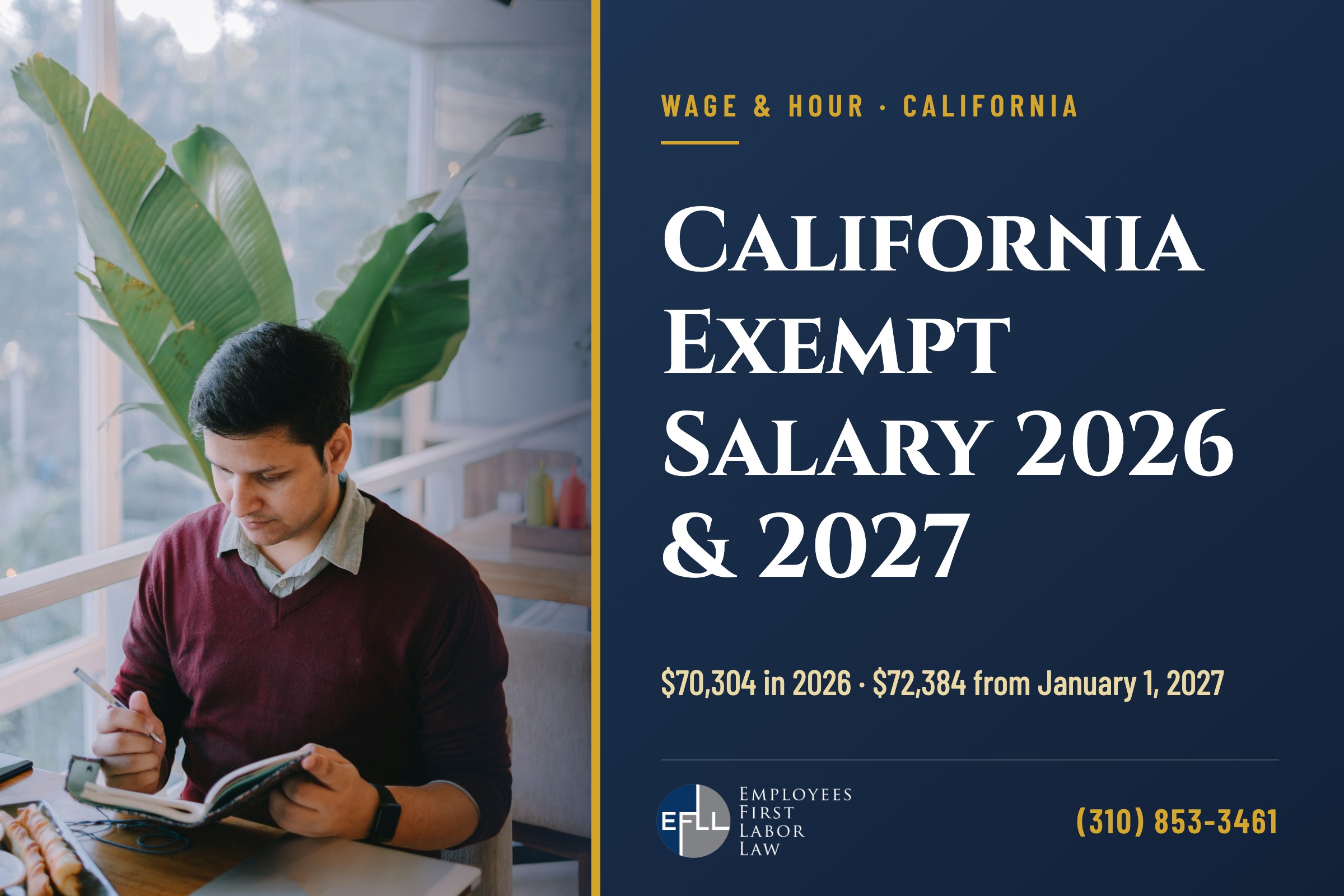
The California exempt salary minimum is $70,304 a year in 2026, and it rises to $72,384 a year on January 1, 2027. If you are paid less than that and your employer calls you “exempt,” you are very likely owed overtime. And even if you earn more, you are only exempt if your actual day-to-day duties meet one of California’s strict duties tests.
A lot of money rides on that label. A salaried worker at the 2026 threshold who is misclassified as exempt and puts in 50-hour weeks can lose more than $20,000 a year in unpaid overtime, before meal and rest break premiums and penalties. Many people never find out, because “salaried” and “exempt” sound like the same thing. They are not.
This guide covers the 2026 and 2027 figures, who the threshold applies to, the three duties tests, how local minimum wages fit in, and what you can recover if your employer got it wrong.
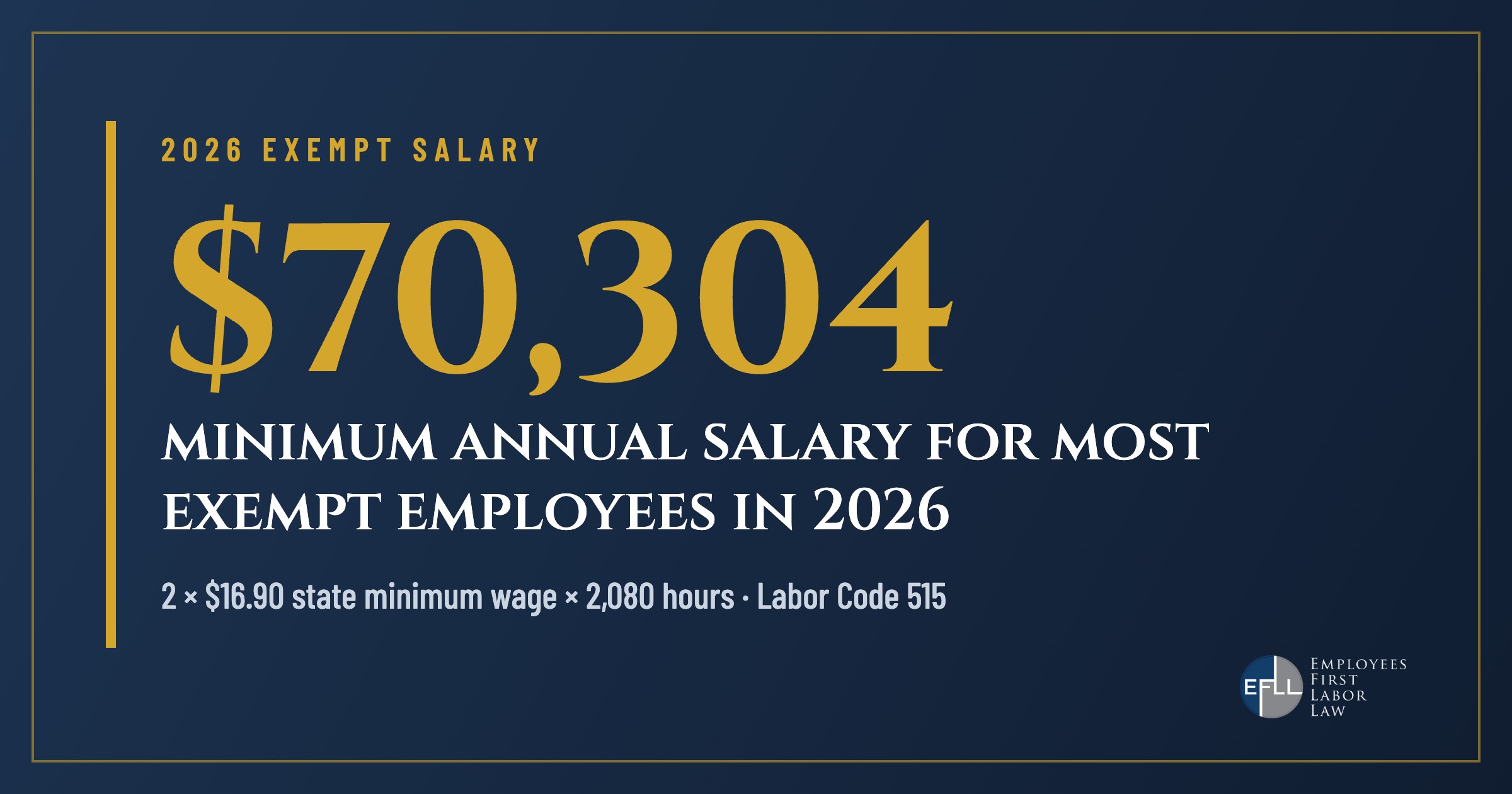
- The California exempt salary is $70,304 a year in 2026 (2 × the $16.90 state minimum wage × 2,080 hours).
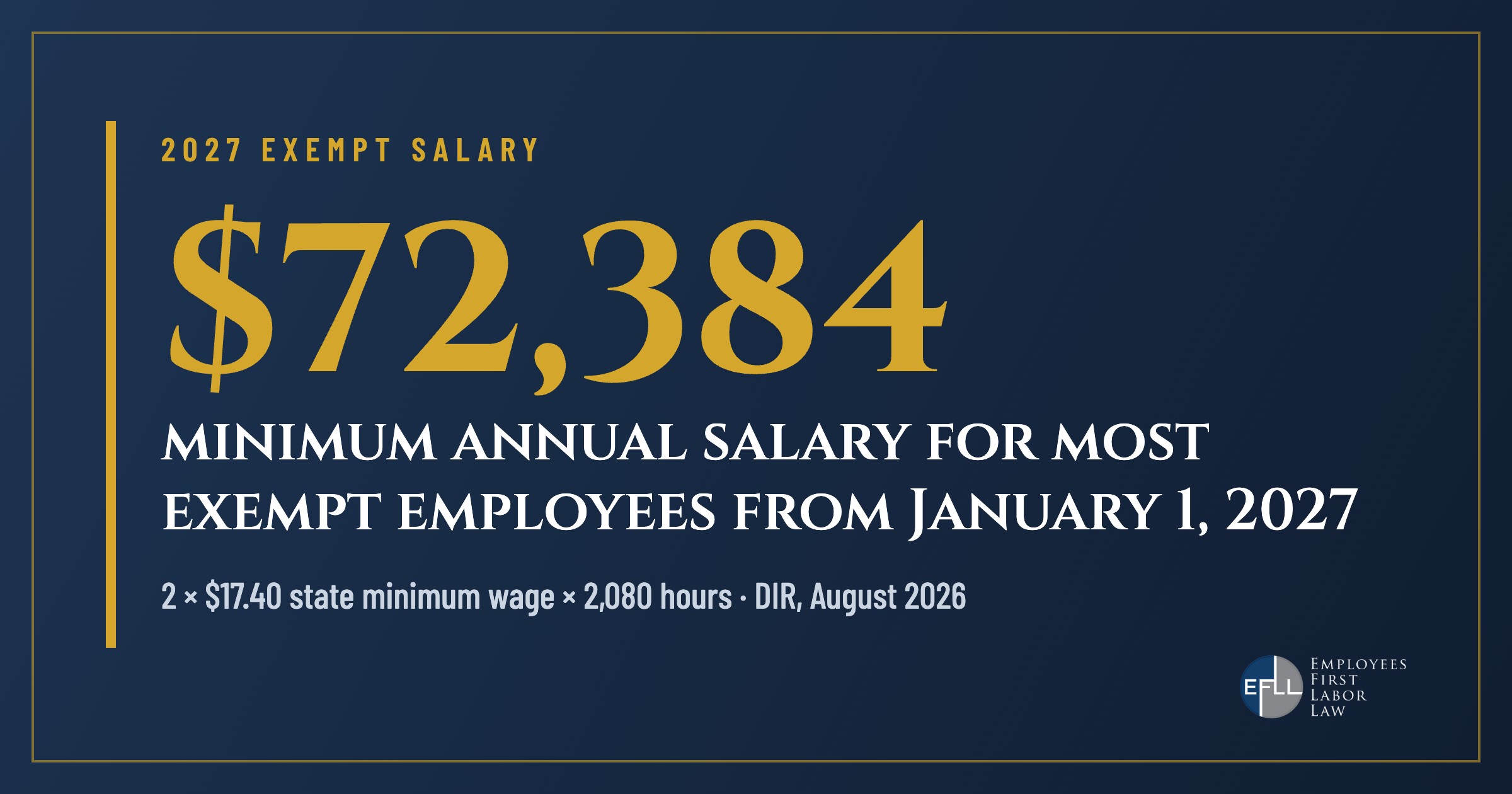
- It rises to $72,384 a year on January 1, 2027, when the state minimum wage goes to $17.40.
- Salary alone is not enough: you must also meet the executive, administrative or professional duties test and spend more than half your time on exempt work.
- The threshold is based on the state minimum wage; higher city minimums generally do not raise it.
- If you were misclassified, you may recover overtime (generally 3 years, up to 4 under the UCL), meal and rest premiums, waiting time and pay stub penalties.
California exempt salary 2026 and 2027 at a glance
Under Labor Code section 515, most exempt employees must earn a monthly salary equal to at least two times the state minimum wage for full-time employment. Full-time means 40 hours a week, or 2,080 hours a year. The formula is: state minimum wage × 2 × 2,080 hours.
- 2026: $16.90 × 2 × 2,080 = $70,304 a year
- 2027: $17.40 × 2 × 2,080 = $72,384 a year, effective January 1, 2027
The California Department of Industrial Relations announced the $17.40 state minimum wage for 2027, and the matching $72,384 exempt salary, in August 2026. Employers have until January 1, 2027 to raise exempt salaries to at least $72,384 or start treating those workers as nonexempt, with overtime and breaks.
| Year | State minimum wage | Exempt salary (annual) | Monthly | Weekly |
|---|---|---|---|---|
| 2023 | $15.50 | $64,480 | $5,373.33 | $1,240 |
| 2024 | $16.00 | $66,560 | $5,546.67 | $1,280 |
| 2025 | $16.50 | $68,640 | $5,720 | $1,320 |
| 2026 | $16.90 | $70,304 | $5,858.67 | $1,352 |
| 2027 | $17.40 | $72,384 | $6,032 | $1,392 |
Because the threshold is tied to the state minimum wage, it goes up every time the state minimum wage goes up. Older figures still matter: if you are owed back pay for 2024 or 2025, the threshold in effect for each of those years applies to that period.
Who the salary threshold applies to
The salary floor applies to California’s three main “white-collar” exemptions: executive, administrative and professional. These are the exemptions employers most often use for managers, supervisors, office staff, analysts, coordinators and other salaried employees.
- It must be a true salary. Generally, you must receive a fixed, predetermined amount each pay period that is not reduced because work was slow or you had a short day. An employer that docks your pay for partial-day absences may lose the exemption.
- Job titles do not decide anything. “Manager,” “coordinator” or “specialist” on your offer letter means nothing if your actual work does not meet a duties test.
- California’s threshold is far higher than federal law. The federal salary level under the Fair Labor Standards Act is much lower. When state and federal law differ, California workers get the more protective rule.
- Some jobs have different rules. Outside salespeople have no salary test at all. Certain computer software professionals and licensed physicians paid by the hour have separate pay minimums that the state updates each year. Covered health care employees must earn the greater of 1.5 times the health care worker minimum wage or two times the state minimum wage for full-time work to be exempt.
Registered nurses are a special case. Under Labor Code section 515(f), nurses employed to practice nursing generally cannot be classified as exempt professionals. They may qualify only if they individually meet the executive or administrative test, and certain advanced practice nurses are treated differently.
Salary alone isn’t enough: the three duties tests
Earning more than $70,304 does not make you exempt. Your employer must also prove that you meet a duties test and that you are “primarily engaged” in exempt work. Under Labor Code section 515(e), that means more than half of your working time. California courts treat exemptions narrowly, and the employer carries the burden of proving that one applies.
| Exemption | What your job must involve (in general) | Common misclassification |
|---|---|---|
| Executive | Managing the business or a recognized department; regularly directing the work of two or more other employees; real authority, or real weight, on hiring, firing and promotions; regular use of discretion and independent judgment | “Assistant managers” who spend most of the day running a register, stocking or doing the same work as the crew |
| Administrative | Office or non-manual work directly related to management policies or general business operations; regular use of discretion and independent judgment on matters of significance | Customer service, data entry, claims processing and other roles that follow set procedures |
| Professional | A licensed profession (law, medicine, dentistry, optometry, architecture, engineering, teaching or accounting), a learned profession requiring advanced specialized education, or genuinely original artistic work; regular use of discretion and judgment | Paralegals, junior “analysts” and technicians whose work is routine or closely supervised |
California looks at what you actually do, week to week, not what your job description says. If most of your time goes to routine, hands-on or closely supervised work, the exemption likely fails even if your salary is well above the threshold. For a deeper walk-through, read our guide on misclassified exempt employees and the duties test.
Your job may not qualify as exempt, even if your salary is above $70,304. Get a free, confidential review of your classification and what unpaid overtime could be worth.
How local minimum wages fit in
Many California cities and counties, including Los Angeles, San Francisco, Pasadena and others, set local minimum wages above the state rate. A common question is whether those higher local rates raise the exempt salary threshold.
The exempt salary test in Labor Code section 515 is calculated from the state minimum wage. Local ordinances set hourly minimums for nonexempt workers; they generally do not change the state formula. So in most cases the exempt floor is $70,304 in 2026 statewide, whether you work in Fresno or West Hollywood. Statewide industry rules, like the health care rule above, are the main exception.
Local rates still matter. If you are misclassified, you are treated as a nonexempt employee, which means at least the local minimum wage for every hour worked, plus overtime. You can check your city’s current rate on our California minimum wage by city page.
Signs you may be misclassified
Watch for these warning signs:
- ✅ Your salary is below $70,304 in 2026 (or will be below $72,384 in 2027) and you are not paid overtime.
- ✅ Your pay is cut when you work fewer hours or leave early.
- ✅ You spend most of your day doing the same work as hourly coworkers.
- ✅ You follow scripts, checklists or manuals, and need approval for most decisions.
- ✅ You “supervise” people but have no real say in hiring, firing or discipline.
- ✅ You regularly work more than 8 hours a day or 40 hours a week, often without real breaks.
If several of these apply, it is worth a closer look. Our wage and hour calculator can give you a rough sense of what unpaid overtime may be worth.
What you can recover if you were misclassified
If you were wrongly treated as exempt, the law treats you as a nonexempt employee for that period. That opens up several types of recovery:
- Unpaid overtime. Time and a half after 8 hours in a day or 40 in a week (and for the first 8 hours on a seventh consecutive workday), and double time after 12 hours in a day (Labor Code section 510). For a salaried worker, the regular hourly rate is generally the weekly salary divided by 40 (Labor Code section 515(d)).
- Meal and rest break premiums. One extra hour of pay at your regular rate for each workday a required meal break was not provided, and one for each workday a required rest break was not provided (Labor Code section 226.7).
- Waiting time penalties. If you have left the job and your employer willfully failed to pay all wages owed, including the overtime, you may be owed up to 30 days of wages (Labor Code section 203). A genuine, good-faith dispute over whether wages were owed can be a defense.
- Pay stub penalties. Misclassified workers’ pay stubs usually leave out hours worked and hourly rates. When the violation is knowing and intentional, penalties are generally $50 for the first pay period and $100 for each later pay period, up to $4,000 (Labor Code section 226(e)).
- Interest, attorney’s fees and civil penalties. Unpaid wages earn interest, and employees who win unpaid overtime claims can recover attorney’s fees (Labor Code section 1194). Some cases also support penalties under the Private Attorneys General Act (PAGA).
💡 Example: Maria earns $70,304 a year as an “office manager” but mostly answers phones and processes orders. Her weekly salary is $1,352, so her regular rate is $33.80 an hour and her overtime rate is $50.70. She works 10 hours a day, five days a week: 10 overtime hours a week, or $507. Over 48 working weeks, that is $24,336 a year, or $73,008 over three years at the same salary, before break premiums, penalties and interest. If she quits and the overtime is not paid with her final wages, waiting time penalties could add about $8,112 (30 days × her $270.40 daily salary).
Misclassification is often the tip of the iceberg. The same employers frequently have problems with off-the-clock work, expense reimbursement and final pay. Our wage and hour attorneys review the whole picture.
Deadlines to file a misclassification claim
Time limits are strict, and every week you wait can cost you the oldest week of back pay.
- Unpaid overtime and wages: generally 3 years (Code of Civil Procedure section 338).
- Unfair Competition Law claim for unpaid wages: up to 4 years (Business and Professions Code section 17208).
- Pay stub penalties: generally 1 year.
- Waiting time penalties: generally 3 years from when your final pay was due.
You can file a claim with the Labor Commissioner or bring a lawsuit. Each route has pros and cons; see our comparison of a Labor Commissioner wage claim vs. hiring a lawyer.
What to do if you think you are misclassified
- Write down your hours. Start a private log of when you start, stop and take breaks. Notes made at the time are strong evidence.
- Save your pay stubs and offer letter. Keep copies outside your work email and devices.
- List what you actually do. Estimate what share of your week goes to each task. This is the heart of the duties test.
- Request your records. You have a right to your payroll records and personnel file. See how to request them.
- Do not sign a release without advice. Some employers offer small payments in exchange for a waiver once they spot the problem.
- Talk to an employment lawyer. A free review can tell you whether you are likely exempt and what your claim may be worth. Retaliating against you for raising wage concerns is illegal.
Frequently asked questions
What is the California exempt salary for 2026?
$70,304 a year ($5,858.67 a month, $1,352 a week) for most executive, administrative and professional employees. It is two times the $16.90 state minimum wage times 2,080 hours.
What will the exempt salary be in 2027?
$72,384 a year ($6,032 a month, $1,392 a week), effective January 1, 2027, based on the new $17.40 state minimum wage announced by the Department of Industrial Relations.
If I earn more than $70,304, am I automatically exempt?
No. Your employer must also show you meet a duties test and spend more than half your time on exempt work. Many well-paid employees are misclassified.
Does a higher city minimum wage raise the exempt salary?
Generally no. The state salary test is based on the state minimum wage. Local minimums matter for nonexempt workers, including misclassified ones.
Can my employer switch me to hourly when the threshold rises?
Yes. An employer may reclassify you as nonexempt rather than raise your salary. From then on, you must be paid overtime and get meal and rest breaks.
Related guides
 Workers only. Never employers.
At Employees First Labor Law, we represent California workers only, never employers. Our team has recovered more than $200 million for workers, and we prepare every case as if it is going to trial. We have offices in Pasadena, Irvine, Long Beach, Pomona, Riverside, Bakersfield and Fresno, and we serve workers throughout California. Meet our team.







If you are salaried and not paid overtime, we can review your pay and your actual duties to see whether you were misclassified. We help California workers recover unpaid overtime, break premiums and penalties.
- ✅ Free, confidential consultation
- ✅ No fee unless we win
- ✅ Se habla español: Empleados Primero
This article provides general information about California law and is not legal advice for any specific situation. Reading it does not create an attorney-client relationship. Past results do not guarantee a similar outcome.