

Updated October 2026 · 9 min read
In California, restaurant workers must be paid the full minimum wage before tips, every tip belongs to the workers rather than the owner or managers, and most fast food workers at national chains must earn at least $20 an hour. On top of that, you are owed meal and rest breaks, extra pay for split shifts and short shifts, and employer-provided uniforms.
These rules add up. A server who misses a meal break twice a week is owed an extra hour of pay for each of those days, and a cook sent home an hour into a six-hour shift is still owed pay for three hours.
This guide covers restaurant worker rights in California: minimum wage and the fast food wage, tips and tip pools, service charges, breaks, split shifts and reporting time pay, uniforms, and what to do if your employer breaks the rules.
- California has no tip credit: you must get the full minimum wage before tips, $16.90 an hour statewide in 2026 and more in many cities.
- Most workers at limited-service chains with more than 60 establishments nationally must be paid at least $20 an hour.
- Every tip belongs to the workers; owners and managers cannot take any part, and card tips must be paid in full by the next regular payday.
- A missed meal or rest break earns an extra hour of pay; split shifts and short shifts can trigger extra pay under Wage Order 5.
- If your employer requires a uniform, it must provide and maintain it.
Which rules cover restaurant workers
Restaurant jobs are governed by three layers of law:
- The Labor Code, which sets statewide rules on minimum wage, overtime, tips and meal periods.
- Industrial Welfare Commission Wage Order 5 (Cal. Code Regs., tit. 8, § 11050), the “public housekeeping” order. It expressly covers restaurants, night clubs, taverns, bars, cocktail lounges, lunch counters, cafeterias, and catering and banquet businesses, among others. See our guide to Wage Order 5.
- Local ordinances, which can set higher minimum wages or extra rules for hospitality workers in some cities.
Minimum wage: no tip credit in California
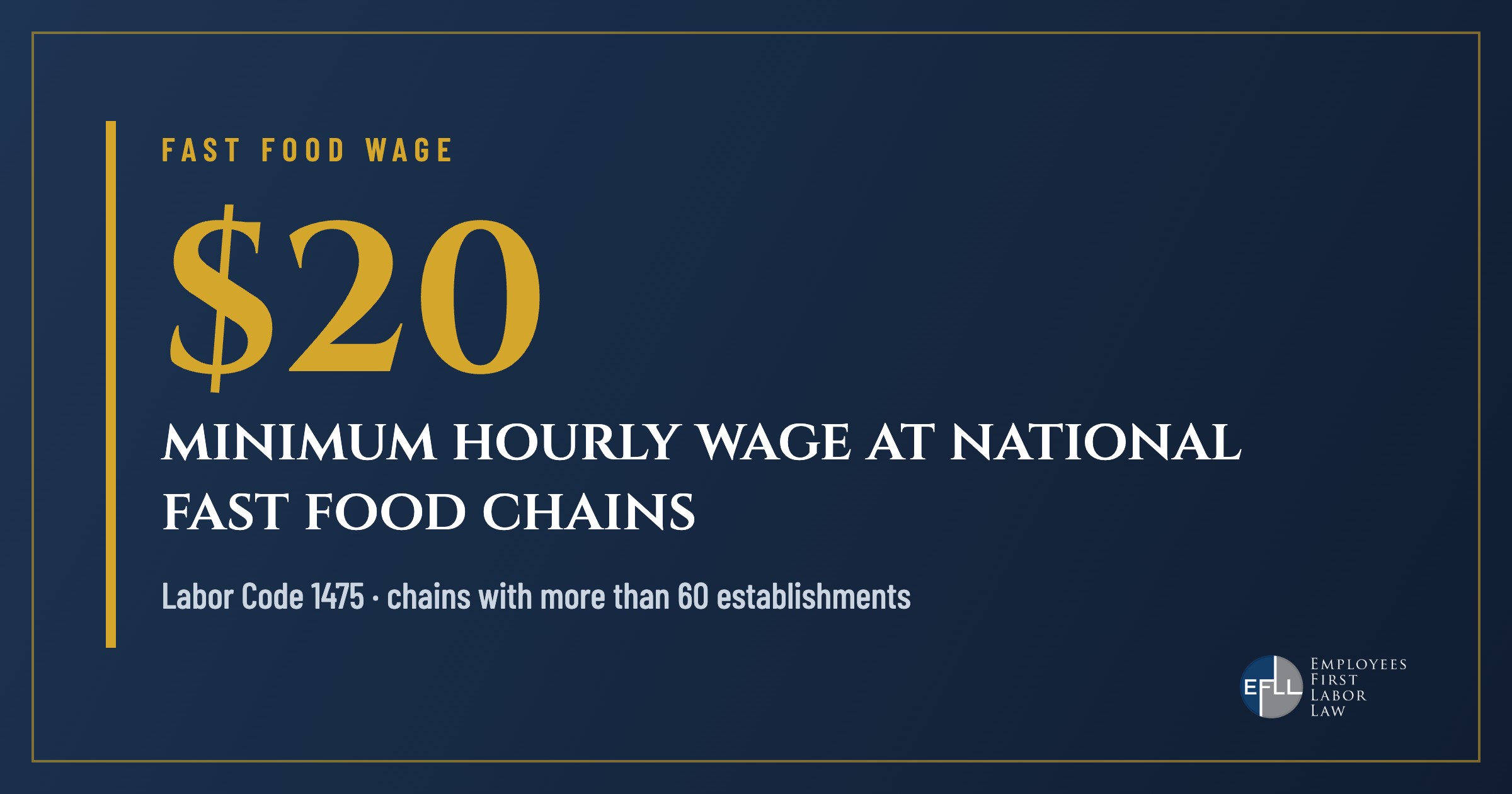
California does not allow a “tip credit.” Under Labor Code section 351, an employer cannot count any part of your tips toward the wages it owes you. You must receive at least the full minimum wage for every hour worked, and your tips come on top.
The statewide minimum wage is $16.90 an hour in 2026 and rises to $17.40 on January 1, 2027. Many cities set higher rates, and your employer must pay whichever rate is highest where you work. Check the current rate for your city on our California minimum wage by city page, or estimate what you’re owed with our wage and hour calculator.
Overtime rules apply in full: time and a half over 8 hours in a day or 40 in a week and for the first 8 hours on a seventh straight workday, and double time over 12 hours in a day or over 8 hours on that seventh day (Labor Code 510).
The $20 fast food minimum wage
Since April 1, 2024, “fast food restaurant employees” must be paid at least $20 an hour (Labor Code 1475). The law covers limited-service restaurants, where customers order and pay before eating with little or no table service, that belong to a national fast food chain of more than 60 establishments nationally (Labor Code 1474). It applies to franchise locations as well as company-owned stores.
Some locations are excluded even if the brand is covered, including restaurants:
- Inside a large grocery store, when the grocery employer employs the restaurant workers
- That have baked and sold stand-alone bread on site since September 15, 2023
- In an airport, hotel, large event center, theme park, museum or gambling establishment
- Operating under a concession contract on certain public land or on a single company’s office campus
A Fast Food Council can raise the fast food minimum wage once a year, by no more than the lesser of 3.5% or the change in a federal consumer price index. A city cannot set a higher wage just for fast food workers, but a higher citywide minimum wage still applies to them.
Salaried fast food managers generally must earn at least twice the fast food minimum wage for a full-time schedule, or $83,200 a year at $20 an hour, to be exempt from overtime.
We can review your pay stubs, tip reports and schedules in a free, confidential consultation.
Your tips belong to you
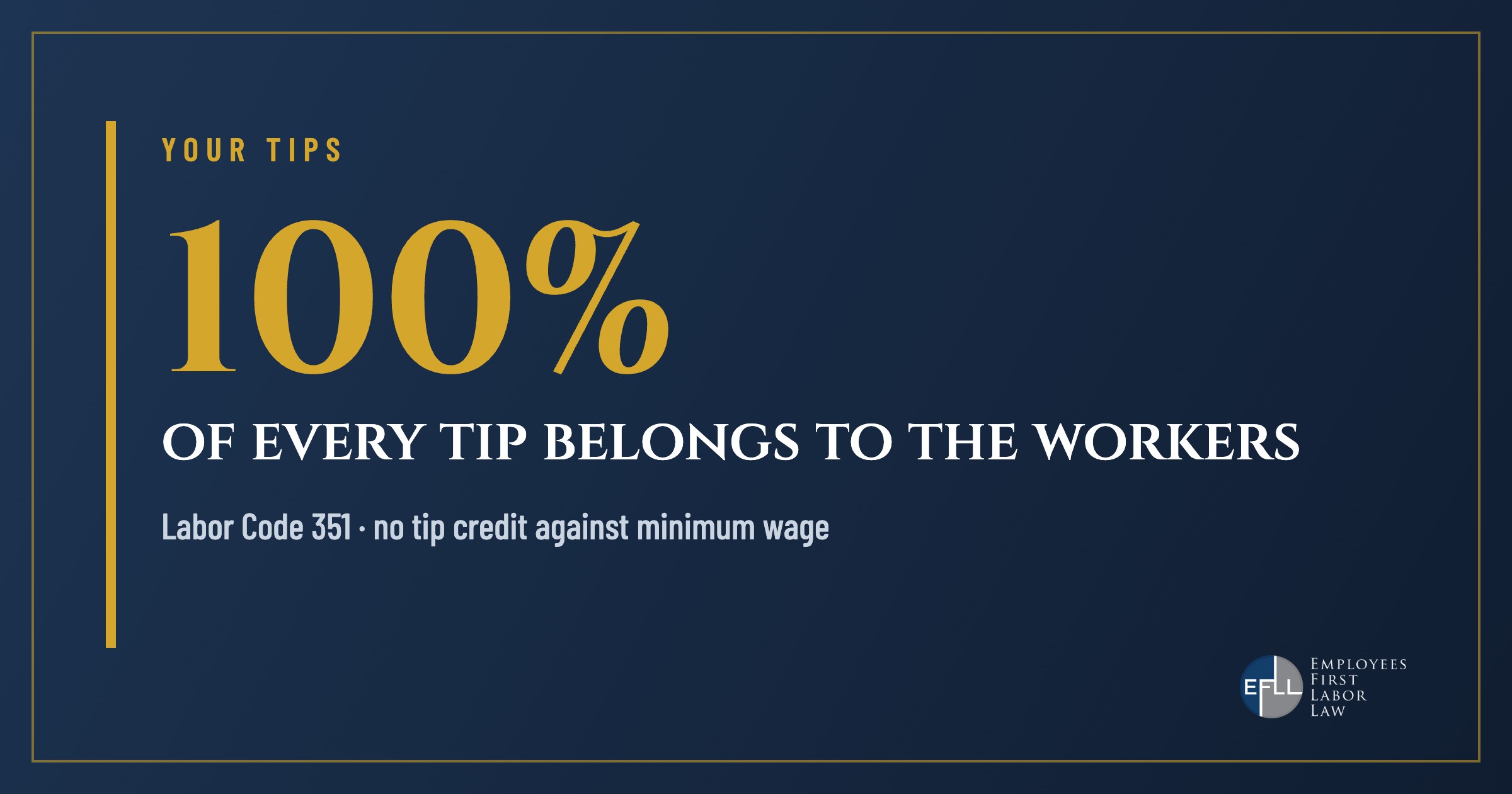
Labor Code section 351 declares every tip “the sole property” of the employee or employees it was left for. Your employer and its agents cannot:
- Take, collect or keep any part of a tip
- Deduct anything from your wages because you received tips
- Count tips toward your wages
- Subtract credit card processing fees from tips paid by card
Tips paid by credit card must reach you no later than the next regular payday after the customer authorized the payment. Employers must also keep accurate records of the tips they receive (Labor Code 353). Since January 1, 2026, the Labor Commissioner can issue citations or sue for tips taken or withheld (Labor Code 351(b), as amended by SB 648).
An “agent” includes anyone other than the employer who has authority to hire or fire employees, or to supervise, direct or control their work (Labor Code 350(d)). That is why owners, managers and supervisors generally cannot share in workers’ tips. Employer-required tip pools among the employees who serve customers are a separate question; our guide to tip pooling rules in California explains who can and cannot share in a pool.
Service charges vs. tips
A tip, legally called a gratuity, is money a customer gives or leaves for an employee over and above the amount due for the food, drinks or service (Labor Code 350(e)). A mandatory service charge printed on the bill is different: it is part of what the customer owes, so it is not automatically a tip.
California’s “junk fee” law limits how restaurants present mandatory charges. Under Civil Code section 1770, subdivision (a)(29), as amended by SB 1524 (2024), a restaurant may add a mandatory fee to food and drink prices only if the fee is clearly and conspicuously displayed, with an explanation of its purpose, on any menu, ad or display that shows prices. That rule protects customers; it does not by itself require the restaurant to give the fee to staff.
Two practical points for workers:
- If a customer leaves extra money on top of the bill, including a tip added to a service charge, that extra amount is a gratuity and belongs to the workers.
- Some local ordinances, especially for hotel and hospitality workers, regulate where service charges go. Check the city guides linked from our minimum wage by city page, such as our Los Angeles worker rights guide.
Meal and rest breaks
Restaurant shifts are busy, but the break rules still apply (Labor Code 512; Wage Order 5, sections 11 and 12):
| Situation | Rule | Source |
|---|---|---|
| Shift over 5 hours | 30-minute meal period, relieved of all duty; can be waived by mutual consent if the shift is no more than 6 hours | Labor Code 512(a) |
| Shift over 10 hours | Second 30-minute meal period; can be waived if the shift is no more than 12 hours and the first was not waived | Labor Code 512(a) |
| Every 4 hours or major fraction | Paid 10-minute rest break (none required under 3½ hours) | Wage Order 5, § 12(A) |
| On-duty meal | Only when the work prevents relief and you agreed in writing; revocable in writing; paid | Wage Order 5, § 11(A) |
| Missed or late break | One extra hour of pay at your regular rate per workday, for meal and for rest | Wage Order 5, §§ 11(B), 12(B) |
If you are required to eat on the premises, your employer must designate a suitable place to eat.
💡 Example: Sofia earns $18 an hour as a server. For 10 weeks, her manager has her skip her meal break two days a week during the lunch rush. She is owed 20 meal period premiums: 20 × $18 = $360, separate from any missed rest breaks. (Hypothetical.)
Our guide to meal and rest break premiums explains how premiums are calculated.
Split shifts and reporting time pay
Split shifts. A split shift is a schedule interrupted by unpaid, non-working time set by the employer, other than normal meal or rest breaks, such as working lunch and then coming back for dinner. Wage Order 5, section 4(C), requires one extra hour of pay at the minimum wage for that day, unless you live at the workplace.
Reporting time pay. If you report for a scheduled shift but are not put to work or are given less than half your usual or scheduled day’s work, you must be paid for half of that scheduled day, at least 2 hours and no more than 4, at your regular rate (Wage Order 5, section 5). If you are called back a second time in one day and given less than 2 hours of work, you are owed 2 hours. There are narrow exceptions, such as utility failures or events outside the employer’s control.
💡 Example: Dev is scheduled for a 6-hour shift at $17 an hour. The night is slow, and he is sent home after 1 hour. He is owed pay for half his scheduled shift, 3 hours, or $51, rather than $17 for the one hour he worked. (Hypothetical.)
For more detail, see split-shift and reporting time pay.
Uniforms, tools and meal credits
If your employer requires a uniform, including clothing “of distinctive design or color,” it must provide and maintain it (Wage Order 5, section 9(A)). Required tools and equipment must also be provided, with a limited exception for hand tools when you earn at least twice the minimum wage. Other necessary job costs, such as using your own car for deliveries, must be reimbursed (Labor Code 2802).
Employers can count meals or lodging toward the minimum wage only with a voluntary written agreement, and only up to the amounts listed in the wage order (Wage Order 5, section 10(C)).
What to do if your restaurant breaks the rules
- Keep your own records. Note your clock-in and clock-out times, breaks taken or missed, split shifts, early send-homes and your daily tips.
- Save your pay stubs and tip reports. Compare card tips on your stubs to what customers wrote on receipts.
- Photograph the schedule so you can prove what shift you were scheduled for.
- Ask in writing for your payroll records and any meal agreement or on-duty meal agreement you signed.
- Know you’re protected. Labor Code 98.6 prohibits retaliation for complaining that you are owed unpaid wages or for filing a claim.
- Act within the deadline. Wage claims generally must be brought within three years (Code of Civil Procedure 338), or four years under the Unfair Competition Law (Business and Professions Code 17208).
Restaurant problems often affect everyone on the same schedule, which can support a group or PAGA claim. A lawyer can tell you whether a Labor Commissioner claim or a lawsuit makes more sense.
Frequently asked questions
Can my restaurant pay me less than minimum wage because I get tips?
No. California has no tip credit. You must get the full minimum wage for every hour, and tips are extra (Labor Code 351).
Can my manager take part of the tip pool?
Generally, no. Owners and “agents” who can hire, fire, supervise or direct employees cannot take any part of workers’ tips. See our tip pooling guide for the details.
Does the $20 fast food wage apply to my job?
It applies if you work at a limited-service restaurant in a national chain with more than 60 establishments, unless your location falls under an exemption such as a grocery store, airport, hotel or on-site bakery. A higher local minimum wage still applies if it is more than $20.
Does a mandatory service charge have to go to the servers?
Not under state law alone. A mandatory charge is part of the bill, not a tip, though the restaurant must disclose it clearly on the menu. Some local ordinances and the way a charge is described can change that, so ask a lawyer if a “staff” charge isn’t reaching you.
What are restaurant worker rights in California if I’m sent home early?
If you get less than half your scheduled shift, you are generally owed pay for half the shift, at least 2 and no more than 4 hours, under Wage Order 5’s reporting time rule.
Related guides
 Workers only. Never employers.
At Employees First Labor Law, we represent California workers only, never employers. Our team has recovered more than $200 million for our clients, and we prepare every case as if it is going to trial. We have offices in Pasadena, Irvine, Long Beach, Pomona, Riverside, Bakersfield and Fresno, and we serve workers throughout California. Meet our team.




We represent California servers, cooks, bartenders, dishwashers and fast food workers in unpaid wage, tip, break and overtime cases. We can review your records and explain what you may be owed.
- ✅ Free, confidential consultation
- ✅ We represent workers only, never employers
- ✅ Se habla español: Empleados Primero
This article provides general information about California law and is not legal advice for any specific situation. Reading it does not create an attorney-client relationship. Past results do not guarantee a similar outcome.