

Updated October 2026 · 6 min read
California Wage Order 17 is the catch-all wage order: it covers any industry or occupation that was not covered by one of the Industrial Welfare Commission’s wage orders in effect in 1997, along with any employees not specifically exempted from them. It gives those workers daily overtime after 8 hours, meal periods, rules for alternative workweeks and make-up time, and a minimum salary test for exempt employees.
In practice, very few jobs fall under Order 17. The Labor Commissioner’s own classification guide states that it has not identified any occupations that meet the definition of “miscellaneous employees.” So if an employer tells you that your job is governed only by Order 17, that claim deserves a close look. Order 17 is much shorter than the other orders, and an employer that applies it by mistake may skip protections you are owed, such as rest breaks and reporting time pay.
This guide explains what Wage Order 17 covers, what it includes and leaves out, how it fits with the Labor Code, and what to do if your employer is misapplying it. For help figuring out which order covers you, start with our California wage orders guide.
- Wage Order 17 covers only jobs not covered by any wage order in effect in 1997, so it is a safety net, not a common order.
- The Labor Commissioner says it has not identified any occupations that fit Order 17.
- Order 17 requires daily overtime after 8 hours, meal periods with a one-hour premium, and secret-ballot votes for alternative workweeks.
- It has no rest period or reporting time sections, which is why a misapplied Order 17 can cost workers money.
- Labor Code rights such as expense reimbursement and accurate pay stubs apply no matter which order covers you.
Why Wage Order 17 exists
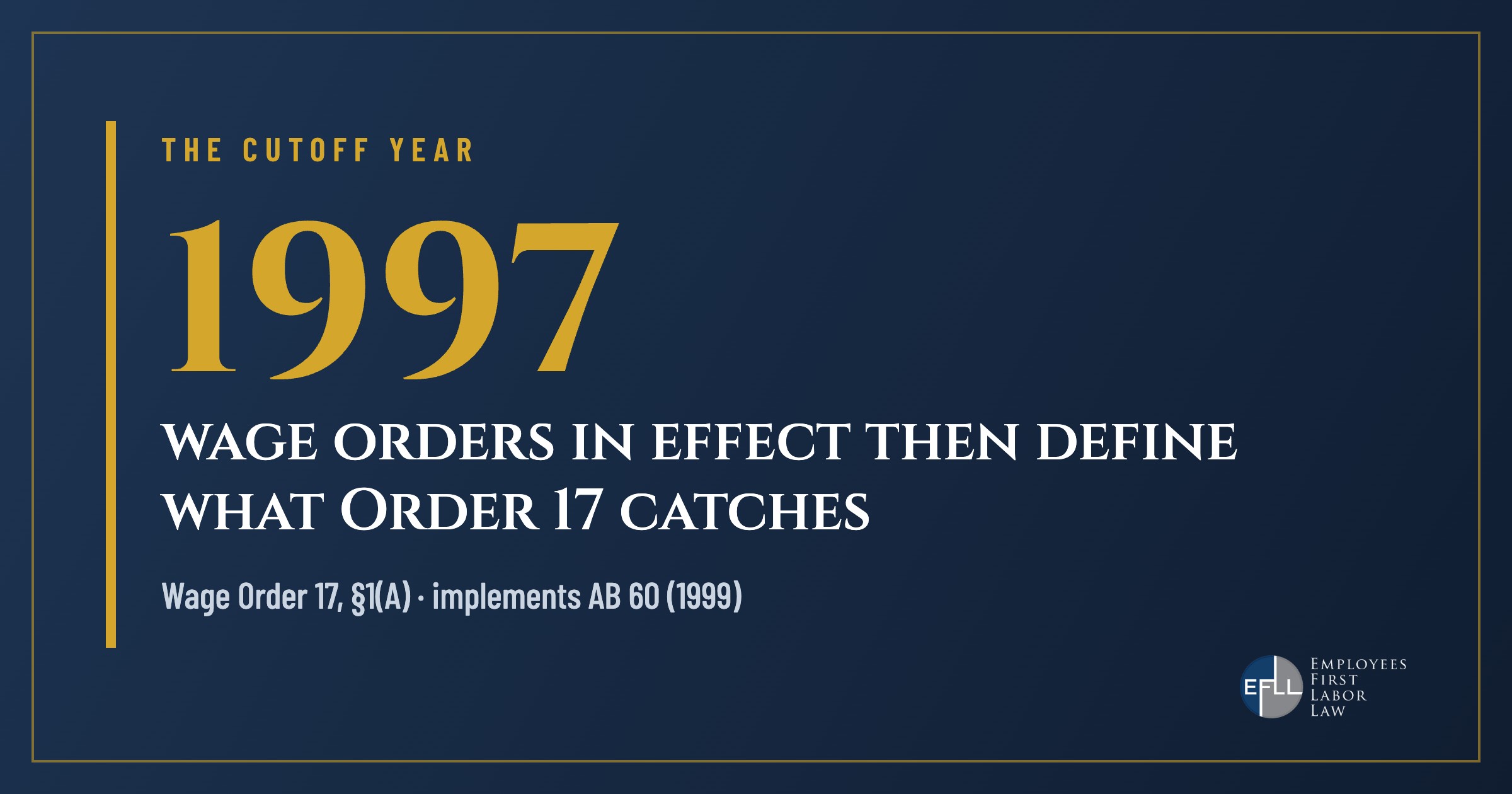
In 1999, the Legislature passed the Eight-Hour-Day Restoration and Workplace Flexibility Act, known as AB 60, which restored daily overtime after 8 hours for most California workers (Labor Code 510). Wage Order 17 was adopted to implement that law. Section 1(A) says the order covers “any industry or occupation not previously covered by, and all employees not specifically exempted in, the Commission’s wage orders in effect in 1997, or otherwise exempted by law.”
In other words, Order 17 is a safety net. If no other order reaches your job, Order 17 makes sure the basic AB 60 protections still apply.
Does Wage Order 17 apply to you?
Probably not. Wage Orders 1 through 16 cover a very wide range of work, and two of them are especially broad:
- Wage Order 4 covers professional, technical, clerical, mechanical and similar occupations, such as office workers, technicians, mechanics, drivers and many other jobs, whenever the business is not covered by an industry order.
- Wage Order 5 covers the public housekeeping industry, including restaurants, hotels, hospitals and businesses that provide meals, lodging or cleaning services.
The Labor Commissioner first asks whether the business is covered by an industry order, and then whether the job fits an occupational order (Orders 4, 14, 15, 16 and 17). Order 17 is the last stop. If your pay stubs, policies or posters say you are covered “only by Order 17,” ask your employer why, and keep a copy of the answer.
What Wage Order 17 includes
| Topic | What Order 17 says |
|---|---|
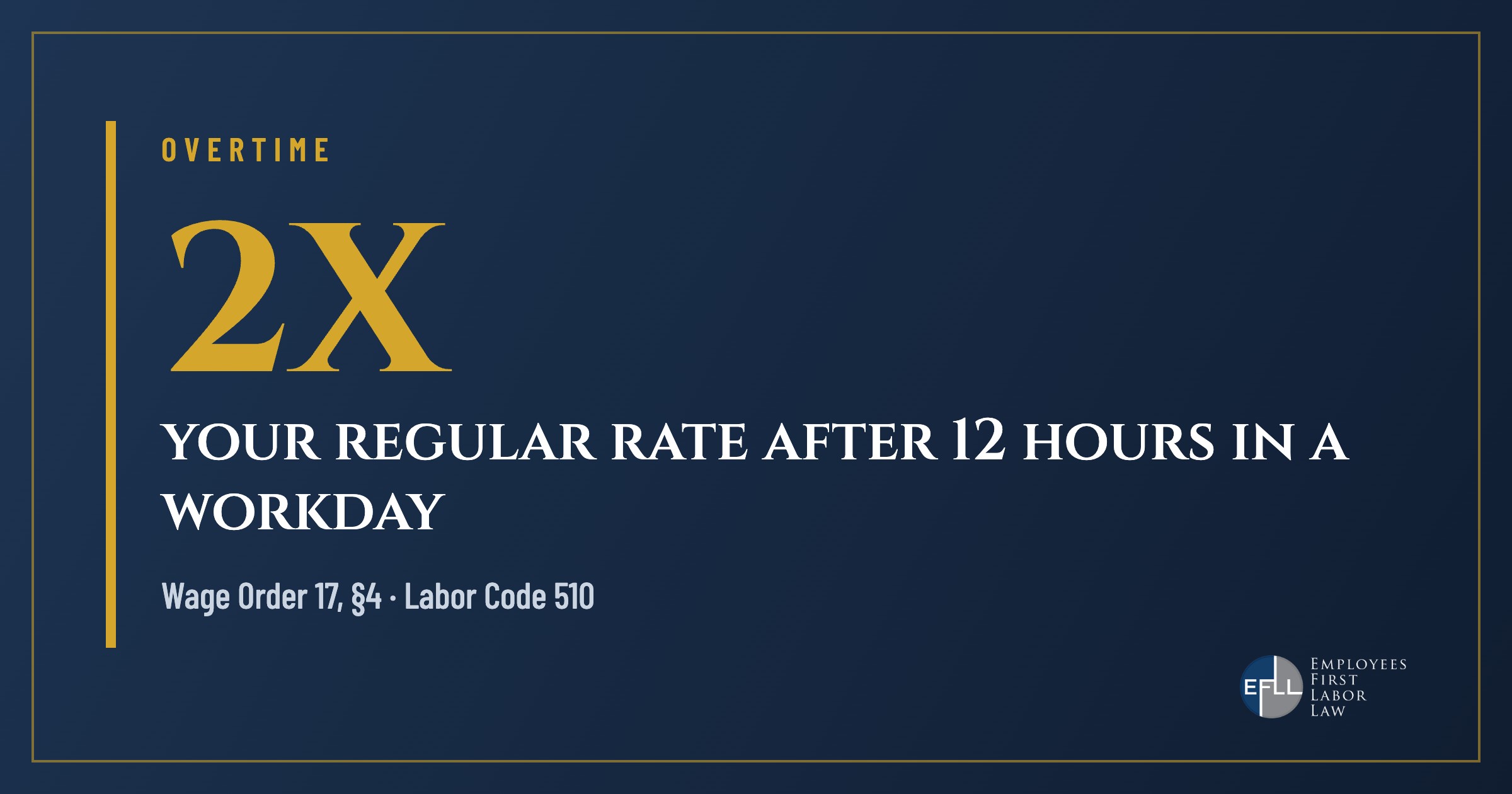
| Daily and weekly overtime | 1.5 times the regular rate over 8 hours a day, over 40 a week, and the first 8 hours on the seventh consecutive day; double time over 12 hours a day and over 8 on the seventh day |
| Alternative workweeks | Up to 10 hours a day within 40 hours, only after a two-thirds secret-ballot vote; at least 4 hours per shift |
| Meal periods | 30 minutes when working more than 5 hours, second meal after 10 hours, one hour of pay for each workday a meal period is not provided |
| Make-up time | Allowed only on the employee’s signed written request, in the same workweek, and still subject to overtime past 11 hours a day or 40 a week |
| Exemptions | Executive, administrative or professional employees primarily doing exempt duties and earning at least twice the state minimum wage for full-time work; certain hourly computer software employees paid at least $58.85 an hour in 2026 are exempt from daily overtime |
| Union contracts | Overtime and alternative workweek sections do not apply under a qualifying collective bargaining agreement |
| Penalties | $50 per underpaid employee per pay period for a first violation, $100 for later violations, plus unpaid wages |
An employer cannot reduce your regular hourly rate because an alternative workweek is adopted or repealed, and you cannot be fired or punished for supporting or opposing one. A salaried nonexempt employee’s overtime rate is based on one-fortieth of the weekly salary.
💡 Example (hypothetical): Kim earns $25 an hour and her manager switches her to four 10-hour days without holding a secret-ballot election. Without a valid alternative workweek, the 9th and 10th hours each day are overtime. Kim is owed 32 × $25 = $800, plus 8 × $37.50 = $300, for $1,100 a week. Paying her straight time for 40 hours ($1,000) shorts her $100 every week.
That is rarely correct, and it can mean missing rest breaks and other pay. Get a free, confidential review.
What Wage Order 17 leaves out
Order 17 is only a few pages long. Orders 1 through 16 generally include these topics (the exact list varies by order), but Order 17 does not contain sections on:
- Rest periods
- Reporting time pay
- Split-shift premiums
- Uniforms and equipment
- Meals and lodging definitions
- Seats, temperature and change rooms
That is one reason the order that applies to your job matters so much. If your work is actually covered by Order 4, 5 or another order, you are entitled to that order’s rest breaks, reporting time pay and other protections. Many rights also come from statutes that apply regardless of the wage order. For example, Labor Code 2802 requires employers to reimburse necessary work expenses, and Labor Code 226 requires accurate itemized pay stubs. See our guides to expense reimbursement and pay stub requirements.
Minimum wage under Wage Order 17
Order 17 refers to the state’s general minimum wage order for the minimum wage and meals and lodging credits. Under the current order (MW-2026), the minimum wage is $16.90 an hour for every employer regardless of size, rising to $17.40 on January 1, 2027. Fast food restaurant and covered health care employers must pay higher sector minimums, and many cities set higher local rates; see our minimum wage by city page.
Meals or lodging can count toward the minimum wage only with a voluntary written agreement and only up to the 2026 limits in MW-2026, such as $79.46 a week for a room occupied alone and $6.10, $8.42 and $11.28 for breakfast, lunch and dinner.
How to enforce your rights
- Find out which order your employer says applies. The wage order must be posted where employees can read it.
- Compare your job to Orders 1 through 16. The DLSE’s “Which IWC Order?” guide lists hundreds of businesses and jobs.
- Track your hours and breaks, including any rest breaks you were never offered.
- File a wage claim or talk to a lawyer. A worker who wins an overtime or minimum wage lawsuit can recover interest, attorney’s fees and costs (Labor Code 1194). See wage claims vs. hiring a lawyer.
- Mind the deadline: generally 3 years for unpaid wages, or 4 with an unfair competition claim.
Retaliation for asking about your pay is illegal (Labor Code 98.6).
Frequently asked questions
What jobs does Wage Order 17 cover?
Only jobs not covered by any of the other wage orders in effect in 1997. The Labor Commissioner’s guide says it has not identified any occupations that meet that definition, so Order 17 rarely applies.
Does Wage Order 17 require rest breaks?
Order 17 has no rest period section. That is a strong reason to check whether another order, such as Order 4 or 5, actually covers your job, because those orders require paid 10-minute rest breaks.
Is overtime after 8 hours required under Wage Order 17?
Yes. Order 17 requires 1.5 times the regular rate after 8 hours in a day and 40 in a week, and double time after 12 hours, unless a valid alternative workweek was adopted.
Can my employer use Order 17 to avoid paying meal break premiums?
No. Order 17 requires meal periods and one hour of pay for each workday a required meal period is not provided.
Where can I read Wage Order 17?
The Department of Industrial Relations posts IWC Order 17-2001 on its wage orders page, along with the current minimum wage order.
Related guides
 Workers only. Never employers.
At Employees First Labor Law, we represent California workers only, never employers. Our team has recovered more than $200 million for our clients, and we prepare every case as if it is going to trial. We have offices in Pasadena, Irvine, Long Beach, Pomona, Riverside, Bakersfield and Fresno, and we serve workers throughout California. Meet our team.





We represent California workers in overtime, break and misclassification claims. We can help you figure out which wage order covers your job and recover what you are owed.
- ✅ Free, confidential consultation
- ✅ We represent workers only, never employers
- ✅ Se habla español: Empleados Primero
This article provides general information about California law and is not legal advice for any specific situation. Reading it does not create an attorney-client relationship. Past results do not guarantee a similar outcome.