
Updated October 2026 · 7 min read
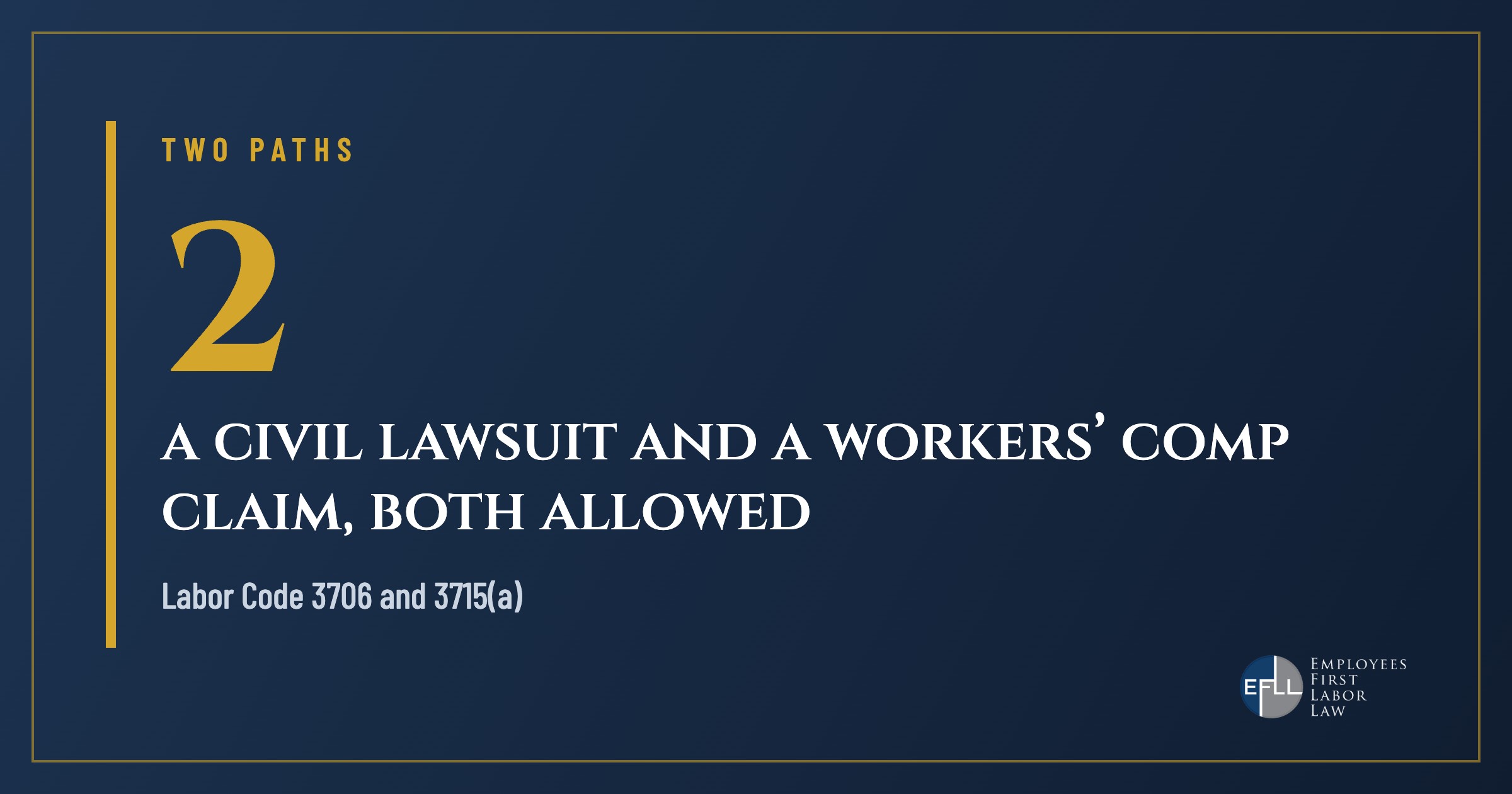
If your California employer was required to carry workers’ compensation insurance and did not, Labor Code §3706 lets you, or your dependents if you died, sue the employer in civil court for full damages, and §3708 presumes the injury was caused by the employer’s negligence. Under §3715 you can also file a workers’ comp claim with the Workers’ Compensation Appeals Board (WCAB), and if the employer does not pay the award, the state’s Uninsured Employers Benefits Trust Fund (UEBTF) may pay it under §3716.
Normally workers’ comp is your only remedy against your employer. Labor Code §3600 lists §3706 as one of the specific exceptions. An employer that skips coverage loses that protection and faces a lawsuit in which it starts out presumed at fault.
This guide explains what §§3706 and 3715 say, who they cover, how the presumption and the state fund work, what employers face, common disputes, and the steps to take if you were hurt working for an uninsured employer.
- Labor Code §3706 lets an injured worker, or the worker’s dependents, sue an employer that failed to carry workers’ comp for full civil damages.
- Under §3708, the employer is presumed negligent and cannot blame the worker, assumption of risk or a co-worker.
- Under §3715, you can also file a workers’ comp claim with the WCAB, and the Uninsured Employers Benefits Trust Fund may pay the award if the employer doesn’t.
- The fund pays only after the employer is properly served, and it does not pay penalties or interest.
- Uninsured employers face criminal charges under §3700.5 and penalty assessments of up to $100,000 in most cases under §3722.
What Labor Code §3706 says
Section 3706 is one sentence: if any employer “fails to secure the payment of compensation,” an injured employee or the employee’s dependents “may bring an action at law against such employer for damages, as if this division did not apply.” In other words, the usual workers’ comp limits do not protect the employer, and you can seek the full range of civil damages, such as lost earnings, medical costs, and pain and suffering.
The sections that follow make that lawsuit much stronger:
- Presumption of negligence (§3708). The injury is presumed to be “a direct result” of the employer’s negligence, and the employer has the burden of proving otherwise.
- Lost defenses (§3708). The employer cannot argue that you were contributorily negligent, that you assumed the risk, or that a co-worker caused the injury. No contract or rule can restore those defenses.
- Attorney’s fees and credits (§3709). A judgment must include a reasonable attorney’s fee fixed by the court. Any workers’ comp the employer paid is credited against the judgment, and the state has a first lien for anything the uninsured employers fund paid you.
One exception: §3708’s presumption does not apply to certain household workers employed by the owner or occupant of a home (defined in §3351(d)), except those described in §3715(b).
What Labor Code §3715 says
Section 3715 gives you a second path. In addition to suing under §3706, an injured employee of an illegally uninsured employer, or the dependents if the worker died, may file an application with the WCAB. The WCAB decides the claim the same way as any other and makes the award you would have received if the employer had been insured. The employer must pay the award or post a bond.
Household workers have special rules. Section 3715(b) allows a WCAB claim for a household domestic worker employed by one employer for over 52 hours a week, a part-time gardener at a private home who regularly works more than 44 hours a month, and certain casual workers on jobs expected to last at least 10 working days with a labor cost of at least $100.
The state can also find an employer prima facie illegally uninsured. Under §3715(c), evidence that counts includes the employer’s failure to answer a written demand for proof of coverage within 10 days, no record of insurance with the Workers’ Compensation Insurance Rating Bureau, and your own unrebutted declaration under penalty of perjury that you worked there and were hurt on the job.
Watch: injured at work in California
Our attorneys explain what your employer must do after a work injury, and what to do in the first 24 hours to protect your claim.
How the Uninsured Employers Benefits Trust Fund pays
Under §3716(a), if the uninsured employer does not pay the award, or does not post the required bond within 10 days after notice of the award, the award is paid from the UEBTF on application by the person entitled to it. The DWC describes the UEBTF as a special unit that may pay benefits to workers hurt while working for an illegally uninsured employer, and that pursues the employer for reimbursement, including liens on its property.
The fund has limits:
- Service on the employer comes first. The fund is not liable, and cannot be joined, unless the employer has appeared in the case or has been served with the application and a special notice of lawsuit (§3716(d)). You must name a real legal person or business as the employer.
- Benefits only. The fund pays benefits an insured employer would have owed, but not penalties or interest (§3716.2).
- Cumulative injuries. For occupational disease and cumulative trauma, the fund generally is not liable if any employer during the liability period was insured, permissibly self-insured or legally uninsured (§3716(b)).
- Medi-Cal. The fund does not pay for treatment already provided or paid by Medi-Cal (§3716(c)).
You may have both a workers’ comp claim and a civil lawsuit in which the employer is presumed at fault. We can help you identify the right business and serve it properly. Free case review.
Both paths at once: how they fit together
| Civil lawsuit (§3706) | WCAB claim (§3715) | |
|---|---|---|
| Where | Superior court | Workers’ Compensation Appeals Board |
| Fault | Negligence presumed; employer must rebut (§3708) | No-fault |
| What you can recover | Full civil damages, plus a reasonable attorney’s fee in the judgment (§3709) | Standard workers’ comp benefits |
| Who pays if the employer won’t | Collected from the employer’s assets | UEBTF, after the employer is served and fails to pay (§3716) |
| Overlap | Compensation paid is credited against a civil judgment, and the state has a first lien for UEBTF payments (§3709) | |
💡 Example: Luis, a framer, falls from a ladder while working for a small contractor that never bought workers’ comp coverage. He files a WCAB claim, and when the contractor ignores the award, the UEBTF pays $60,000 in medical care and temporary disability. Luis also sues the contractor under §3706. The contractor is presumed negligent and cannot blame Luis for not using fall protection. If Luis wins a $300,000 judgment, the state’s $60,000 lien is paid first from the judgment, leaving $240,000, and the court adds a reasonable attorney’s fee to the judgment. (Hypothetical and simplified.)
What uninsured employers face
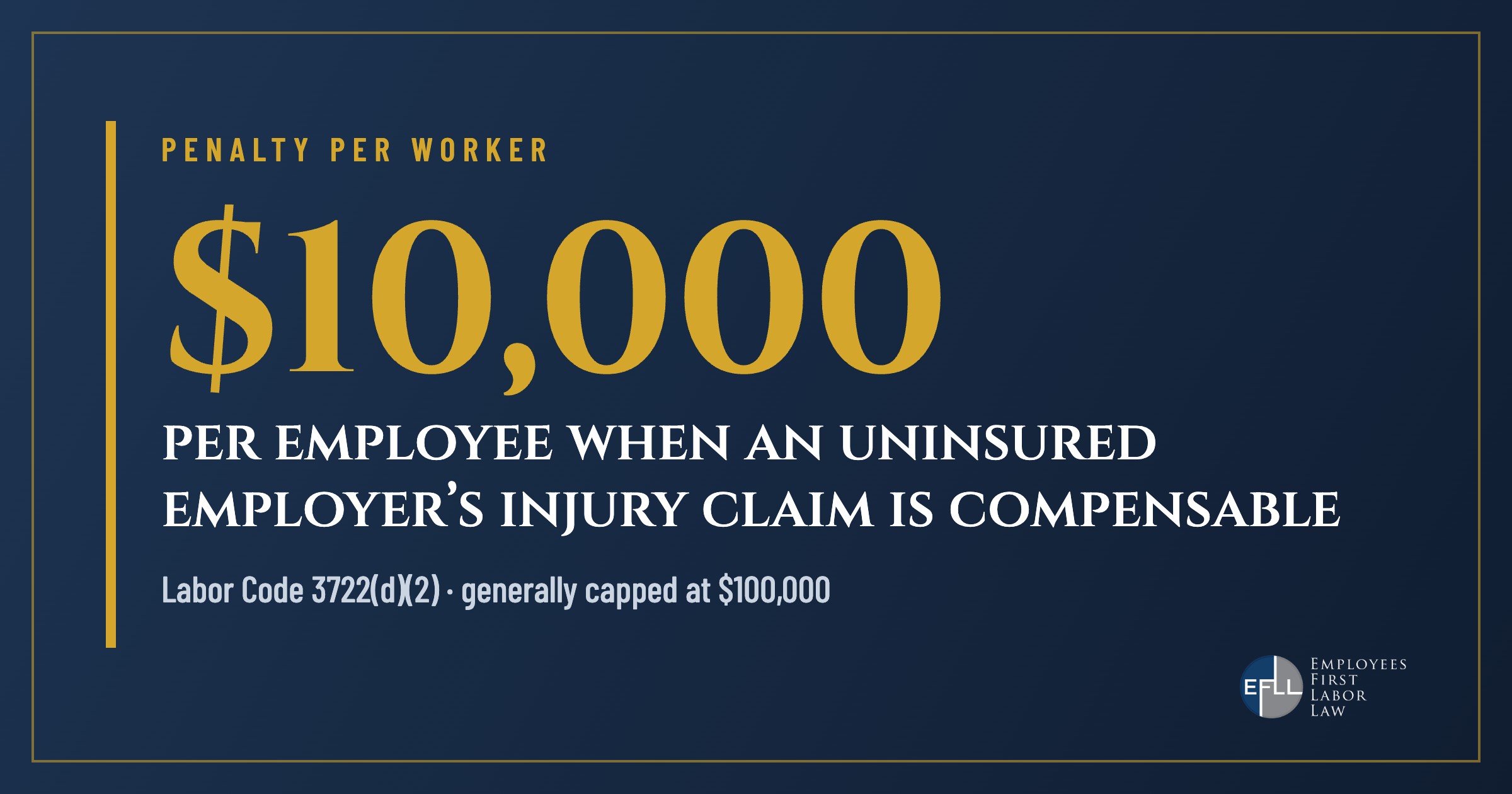
Going without coverage is not just a civil problem. Under §3700.5, failing to secure coverage, when the employer knew or reasonably should have known of the duty, is a misdemeanor punishable by up to one year in county jail, a fine of at least $10,000, or both, with higher fines for repeat convictions. The DIR can also assess penalties under §3722, including $2,000 per employee in noncompensable cases and $10,000 per employee when the injury claim is compensable, generally capped at $100,000.
The state can go after the people behind the business, too. Under §3717, when a corporation is the uninsured employer, its parent company and substantial shareholders (generally those owning at least 15 percent) are jointly and severally liable to the state for awards it paid. Read more in our guide to Labor Code §3700 and the duty to provide coverage.
Common disputes
- “You weren’t an employee.” Uninsured employers often claim workers were independent contractors. Under §3351(i), anyone who is an employee under the ABC test in §2775 is an employee for workers’ comp. See our guide on misclassified independent contractors.
- Immigration status. Section 3351 covers people employed “whether lawfully or unlawfully,” including non-citizens.
- Which entity was the employer. Because the UEBTF requires service on a real legal entity, identifying the correct business name and owner matters.
- Whether coverage existed. An employer may claim a policy that the insurer denies. A written denial from the named insurer is itself prima facie evidence of no coverage (§3715(c)).
- Rebutting the presumption. In the civil case, the employer will try to prove it was not negligent.
What to do if your employer has no workers’ comp
- Get medical care first and tell every provider the injury happened at work.
- Report the injury in writing and ask for a claim form and the name of the insurer.
- Write down everything about the business: legal name, owner, address, license numbers, vehicles, job sites and who paid you.
- Keep proof you worked there: pay stubs, texts, schedules, photos and co-worker names.
- Contact a DWC Information and Assistance officer or a lawyer about filing with the WCAB and serving the special notice of lawsuit.
- Talk to a lawyer about a §3706 lawsuit, which can recover more than workers’ comp benefits.
- Do not sign anything the employer offers until you understand what you are giving up.
Our guide to what to do when your employer doesn’t have workers’ comp insurance covers the practical steps in more detail.
Related Labor Code sections
| Section | What it covers |
|---|---|
| §3700 | Every employer must secure workers’ comp coverage |
| §3700.5 | Criminal penalties for failing to carry coverage |
| §3602 | The exclusive remedy rule and its exceptions |
| §3708–§3709 | Presumption of negligence, lost defenses, attorney’s fees and liens |
| §3716–§3717 | UEBTF payments and recovery from employers and owners |
| §3722 | Penalty assessments against uninsured employers |
Frequently asked questions
Can I sue my employer if it didn’t have workers’ comp insurance?
Yes. Labor Code 3706 allows a civil lawsuit for damages against an employer that failed to secure workers’ comp, and §3708 presumes the employer was negligent.
Can I still get workers’ comp benefits?
Yes. Under §3715 you can file a claim with the WCAB in addition to suing. If the employer does not pay the award, the Uninsured Employers Benefits Trust Fund may pay it.
Does the state fund pay penalties and interest?
No. Under §3716.2, the fund pays only the benefits an insured employer would have owed, not penalties or interest. The state may pursue those amounts from the employer.
Do I need to know the employer’s legal name?
It matters. The fund is not liable until the employer has appeared or been served with your application and a special notice of lawsuit, and the notice must name a legal person or entity as the employer.
Can my family sue if I was killed at work for an uninsured employer?
Yes. Both §3706 and §3715 extend to dependents when the injury causes death. See our guide to workers’ comp death claims.
Related guides
 Workers only. Never employers.
At Employees First Labor Law, we represent California workers only, never employers. Our team has recovered more than $200 million for our clients, and we prepare every case as if it is going to trial. We have offices in Pasadena, Irvine, Long Beach, Pomona, Riverside, Bakersfield and Fresno, and we serve workers throughout California. Meet our team.







If you were injured working for an employer that had no workers’ comp insurance, we can pursue the uninsured employer in civil court and help you get benefits through the WCAB and the state fund. We represent injured California workers and their families, never employers.
- ✅ Free, confidential consultation
- ✅ We represent workers only, never employers
- ✅ Se habla español: Empleados Primero
This article provides general information about California law and is not legal advice for any specific situation. Reading it does not create an attorney-client relationship. Past results do not guarantee a similar outcome.