

Updated October 2026 · 6 min read
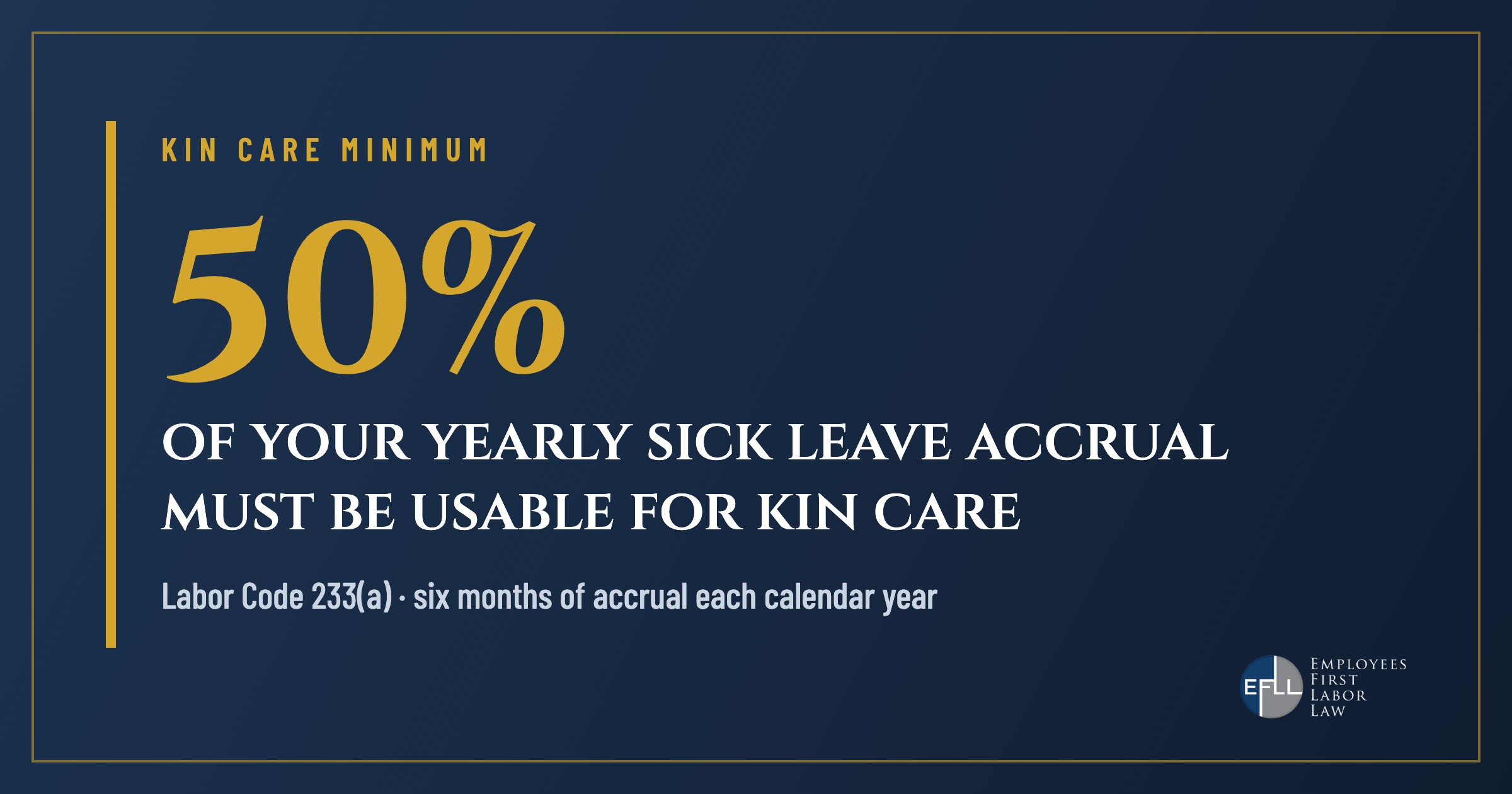
Labor Code §233, California’s “kin care” law, requires every employer that provides sick leave to let you use, each calendar year, at least the amount of sick leave you would accrue in six months (half your annual accrual) for the reasons listed in the paid sick leave law, including caring for a sick family member, and Labor Code §234 makes it automatically illegal to count that protected time against you under an attendance policy. You decide whether a day off is designated as kin care, and an employer cannot fire, demote, suspend or punish you for using it.
Kin care matters most when your employer gives more sick leave than the state minimum. If your company provides 12 sick days a year, for example, §233 guarantees that at least 6 of them can be used to care for a child, parent, spouse or other family member.
This guide explains what §§233 and 234 say, who counts as family, how kin care fits with California’s paid sick leave law, your remedies, common disputes and what to do if your employer penalizes you.
- Labor Code §233 lets you use at least half of your annual sick leave accrual each calendar year to care for a family member or for other paid sick leave purposes.
- It applies to every employer that provides sick leave, including public employers, and you decide when to designate leave as kin care.
- “Family” includes children of any age, parents and parents-in-law, spouses, registered domestic partners, grandparents, grandchildren, siblings and one designated person.
- Under §234, an attendance policy that counts kin care toward discipline is a per se violation.
- Remedies include reinstatement, actual damages or one day’s pay (whichever is greater), and attorney’s fees if you win in court.
What Labor Code §233 says
- (a) The kin care minimum. An employer that provides sick leave must let you use, in any calendar year, your accrued and available sick leave in an amount not less than what you would accrue in six months at your current rate, for the reasons in Labor Code §246.5(a). The choice to designate leave for these reasons is “at the sole discretion of the employee.” Section 233 does not extend the maximum leave under the California Family Rights Act (CFRA) or the federal Family and Medical Leave Act (FMLA).
- (b) Definitions. “Employer” includes the state and local governments. “Family member” has the same meaning as in the paid sick leave law (§245.5). “Sick leave” means accrued increments of paid leave an employer provides for absences for §246.5(a) reasons. It does not include ERISA welfare plan benefits, insurance benefits, workers’ comp, unemployment disability benefits, or benefits not paid from the employer’s general assets.
- (c) No retaliation. An employer may not deny the right to use sick leave, or discharge, threaten to discharge, demote, suspend, or in any manner discriminate against an employee for using or trying to use sick leave for a family member’s illness or preventive care, or any other §246.5(a) reason.
- (d)–(f) Remedies. Reinstatement and actual damages or one day’s pay, whichever is greater, plus appropriate equitable relief. The Labor Commissioner enforces the section on complaint, or you may sue in court, where a prevailing employee may recover reasonable attorney’s fees. These remedies are in addition to any others.
What Labor Code §234 says
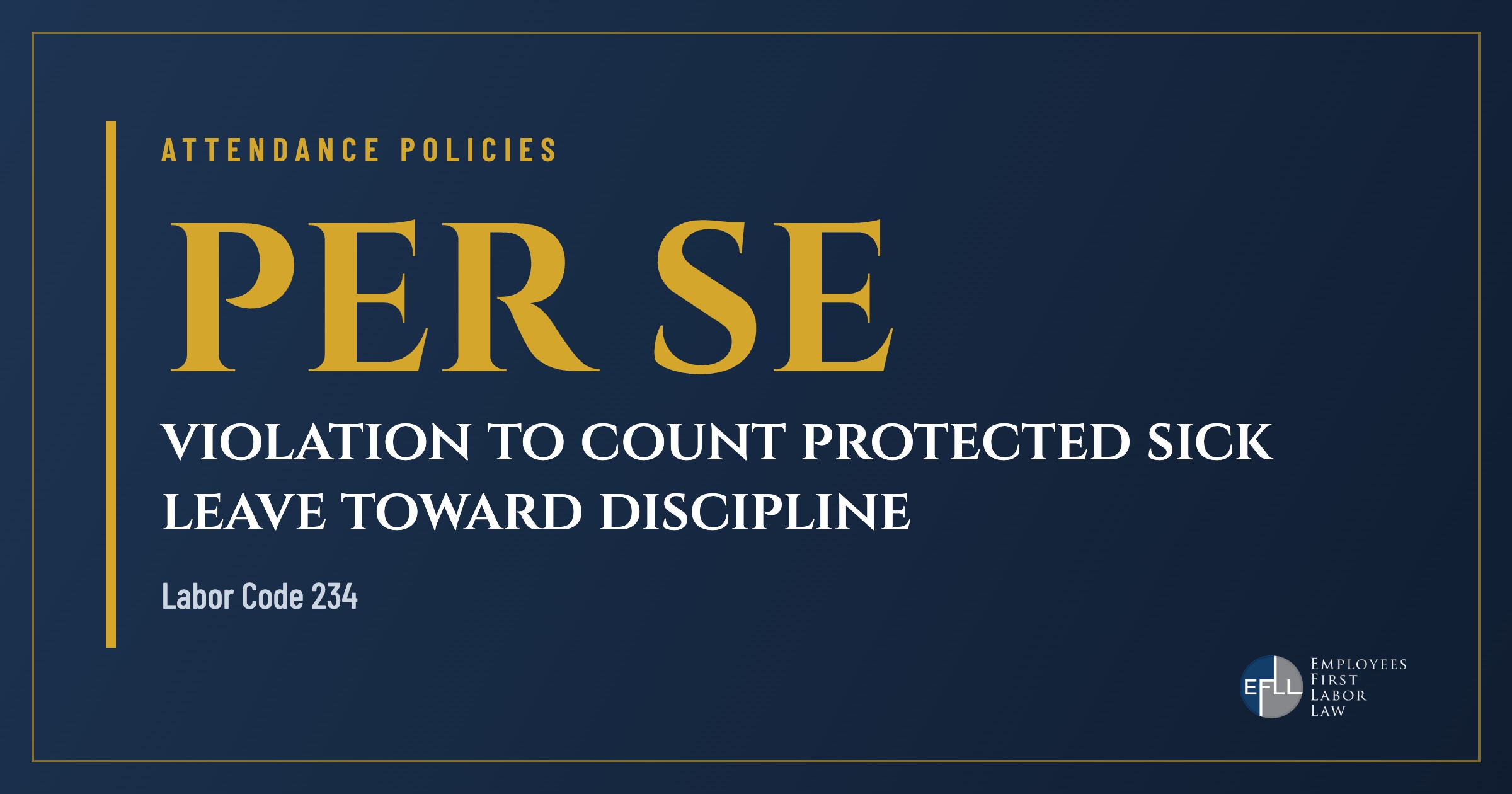
Section 234 is one sentence with real teeth: an employer absence control policy that counts sick leave taken under §233 as an absence that may lead to or result in discipline, discharge, demotion or suspension is a per se violation of §233. An employee working under that kind of policy is entitled to appropriate legal and equitable relief.
In practice, “points,” “occurrences” or “unexcused absence” systems that count protected sick days toward discipline violate the law, even if no one has been fired yet.
Who counts as a family member
Because §233 borrows the paid sick leave definition in §245.5(c), kin care covers your:
| Family member | Details |
|---|---|
| Child | Biological, adopted or foster child, stepchild, legal ward, or a child to whom you stand in loco parentis, regardless of age or dependency status |
| Parent | Biological, adoptive or foster parent, stepparent or legal guardian of you or your spouse or registered domestic partner, or a person who stood in loco parentis when you were a minor |
| Spouse or registered domestic partner | Yes |
| Grandparent, grandchild, sibling | Yes |
| Designated person | A person you identify when you request paid sick days; your employer may limit you to one designated person per 12-month period |
Attendance points for protected sick leave violate California law. We can review your employer’s policy and your write-ups for free.
What you can use kin care for
Section 233 covers the purposes listed in Labor Code §246.5(a), which include:
- Diagnosis, care or treatment of an existing health condition of, or preventive care for, you or a family member;
- Time off described in Government Code §12945.8, which covers jury duty, appearing in court as a witness under a subpoena or court order, and certain time off for crime victims and their family members; and
- For outdoor agricultural employees, avoiding smoke, heat or flooding conditions created by a declared state or local emergency.
How kin care fits with paid sick leave
California’s paid sick leave law already lets you use your paid sick days for family members. Under §246, most employees accrue at least one hour for every 30 hours worked, and an employer may limit use to 40 hours or five days a year and may cap accrual at 80 hours or 10 days. Section 233 adds a separate floor for employers that provide more generous sick leave: half of whatever you accrue each year must be available for kin care.
💡 Example: Teresa’s employer gives her one sick day a month, or 12 days a year. Under §233, she must be allowed to use at least 6 of those days each calendar year (12 × 6/12 = 6) to care for her mother after surgery or take her son to the doctor. When she uses 3 days for her mother, her employer records them as “occurrences” under its attendance policy and issues a written warning. Under §234, that policy is a per se violation, and the warning should be withdrawn. (Hypothetical.)
Common disputes
- Attendance points. The most common violation is counting protected sick days toward a points or occurrence system (§234).
- Is it “sick leave”? Section 233 applies to accrued, paid sick leave. Disability insurance and some plan benefits are excluded by definition, which can create disputes over how an employer’s plan is structured.
- Finding a replacement. Under §246.5(b), an employer may not require you to find a replacement worker as a condition of using paid sick days.
- Who decides? Under §233(a), designating sick leave for kin care is your choice, not your employer’s.
- Retaliation timing. Under the paid sick leave law, adverse action within 30 days of a sick leave complaint, cooperation with an investigation or opposition to an unlawful policy creates a rebuttable presumption of retaliation (§246.5(c)(2)).
- Longer absences. When a family member’s serious health condition requires more time off, CFRA or FMLA leave may apply.
What to do if you are penalized for kin care
- Put requests in writing. A text or email saying you need sick leave to care for a family member creates a record.
- Get the policy. Ask for a copy of the attendance or points policy and your attendance record.
- Save write-ups and messages that mention your absences.
- Check your pay stubs for sick leave balances, which employers must report.
- Act promptly. A retaliation complaint with the Labor Commissioner generally must be filed within one year (Labor Code §98.7), or you can sue in court.
- Talk to a lawyer if you were disciplined, demoted, suspended or fired.
Our guide to California paid sick leave rights covers accrual, carryover and pay rules in detail.
Related Labor Code sections
| Section | What it covers |
|---|---|
| §245.5 | Definitions, including family member and designated person |
| §246 | Paid sick leave accrual, use and caps |
| §246.5 | Permitted uses and anti-retaliation rules for paid sick days |
| §98.7 | Retaliation complaints to the Labor Commissioner |
| Gov. Code §12945.2 | CFRA family and medical leave |
For longer family leave, see FMLA vs. CFRA in California, and if you lost a loved one, see our guide to bereavement leave. If you were punished for using protected leave, learn about retaliation claims in California.
Frequently asked questions
How much sick leave can I use for kin care?
At least the amount you would accrue in six months at your current rate, in each calendar year, if your employer provides sick leave. That is half of your annual accrual.
Does kin care apply to my employer?
Section 233 applies to any employer that provides sick leave, including public employers.
Can my employer count kin care days as absences?
No. Under Labor Code §234, an attendance policy that counts protected sick leave toward discipline, discharge, demotion or suspension is a per se violation.
Can I use kin care for my grandmother or a close friend?
Grandparents are covered family members. A close friend may qualify as your “designated person,” and your employer may limit you to one designated person per 12-month period.
Does kin care give me extra days off?
No. It guarantees how much of the sick leave you already accrue can be used for family reasons. It does not add leave or extend CFRA or FMLA leave.
What can I recover if my employer violates §233?
Reinstatement and actual damages or one day’s pay, whichever is greater, plus equitable relief, and reasonable attorney’s fees if you prevail in court.
Related guides
 Workers only. Never employers.
At Employees First Labor Law, we represent California workers only, never employers. Our team has recovered more than $200 million for our clients, and we prepare every case as if it is going to trial. We have offices in Pasadena, Irvine, Long Beach, Pomona, Riverside, Bakersfield and Fresno, and we serve workers throughout California. Meet our team.




If you were denied sick leave, disciplined or fired for caring for a sick family member, we can help you enforce your kin care and paid sick leave rights and pursue retaliation claims. We represent California workers only, never employers.
- ✅ Free, confidential consultation
- ✅ We represent workers only, never employers
- ✅ Se habla español: Empleados Primero
This article provides general information about California law and is not legal advice for any specific situation. Reading it does not create an attorney-client relationship. Past results do not guarantee a similar outcome.