
Updated October 2026 · 8 min read
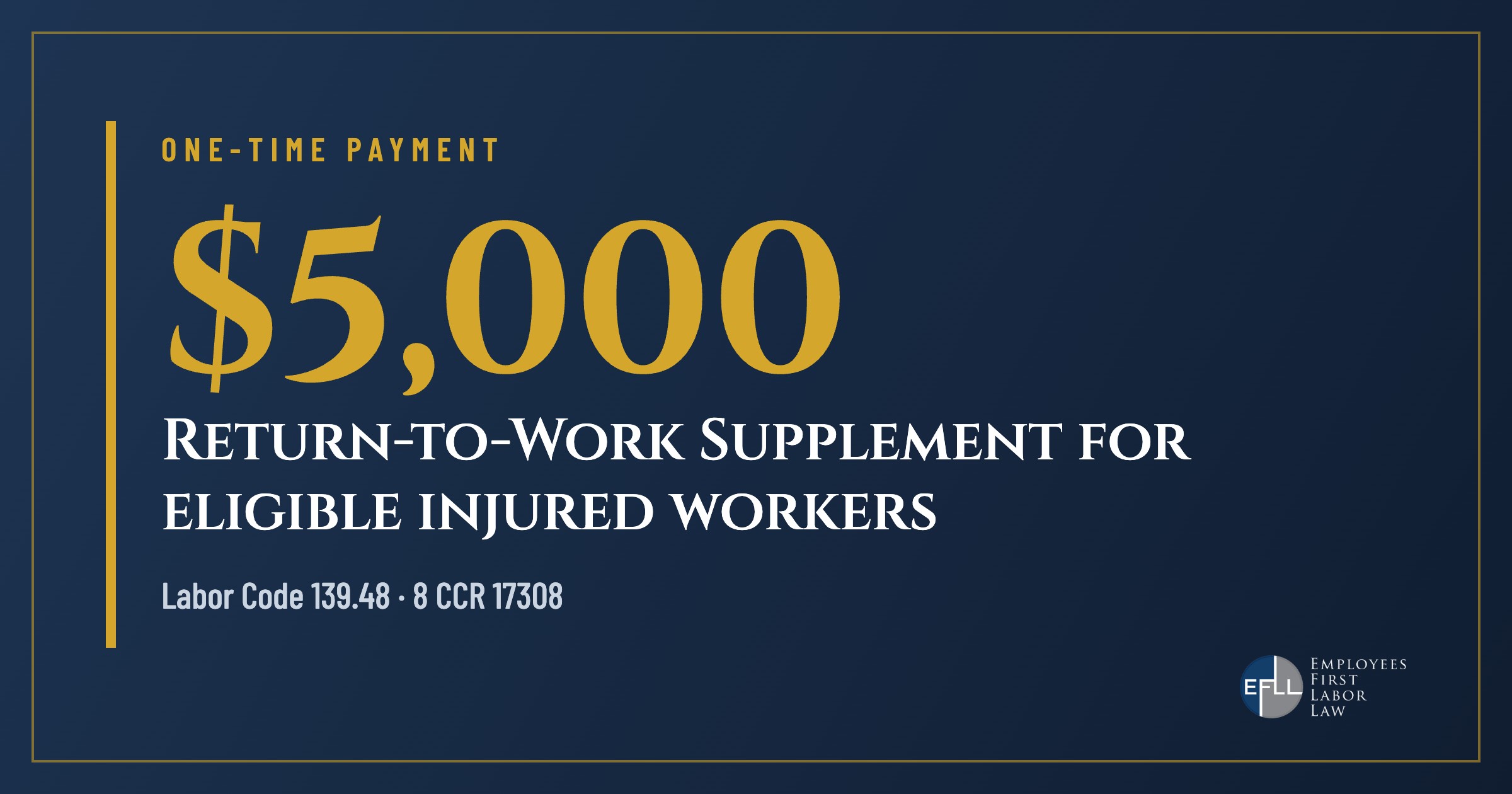
Labor Code §139.48 created California’s Return-to-Work Supplement Program, which pays a one-time $5,000 to injured workers who were hurt on or after January 1, 2013 and received a Supplemental Job Displacement Benefit (SJDB) voucher. You apply online with the Department of Industrial Relations, and the program must receive your application within one year of the date the voucher was served on you.
The money is easy to miss. It does not come from your employer or the insurance company, it is not part of your permanent disability award, and nobody files for it on your behalf. A worker who receives a $6,000 SJDB voucher and then lets the one-year window close can lose the $5,000 entirely.
This guide explains what Labor Code 139.48 says, who qualifies, how much is paid and when, the deadline, how to apply, the disputes we see most often, and how the supplement fits with related sections of the Labor Code.
- Labor Code §139.48 created the Return-to-Work Supplement Program, which pays a one-time $5,000.
- You qualify if you were injured on or after January 1, 2013 and received a Supplemental Job Displacement Benefit (SJDB) voucher.
- The program must receive your online application within one year of the date the voucher was served on you.
- The state decides within 60 days of a complete application and pays within 25 days after the decision.
- The supplement is separate from, and not deducted from, your permanent disability award or the $6,000 voucher.
What Labor Code §139.48 says
Section 139.48 is short. In plain English, it does three things:
- Creates the program. Subdivision (a) sets up a return-to-work program inside the Department of Industrial Relations (DIR), run by the DIR Director and funded with $120 million a year from the Workers’ Compensation Administration Revolving Fund. Its stated purpose is to make supplemental payments to workers “whose permanent disability benefits are disproportionately low in comparison to their earnings loss.”
- Leaves the details to regulations. Subdivision (b) says eligibility and payment amounts are set by regulations the Director adopts, based on studies done with the Commission on Health and Safety and Workers’ Compensation. The Director’s decisions can be reviewed at the trial level of the Workers’ Compensation Appeals Board (WCAB) on the same grounds as a petition for reconsideration.
- Limits it to newer injuries. Subdivision (c) says the section applies only to injuries on or after January 1, 2013.
The working rules are in the regulations, California Code of Regulations, title 8, sections 17300 to 17310. Those rules tie eligibility to the SJDB voucher and set the $5,000 amount.
Who qualifies for the $5,000 supplement
Under 8 CCR §17302, you are eligible if you received an SJDB voucher for an injury that occurred on or after January 1, 2013. The program does not look at your impairment rating or your income. If you got the voucher and you apply on time with a complete application, the regulations say the application will be approved.
That makes the real question whether you were entitled to the voucher. Under Labor Code §4658.7, a worker with permanent partial disability gets the $6,000 voucher unless the employer offers regular, modified or alternative work that meets two conditions:
- The offer is made no later than 60 days after the claims administrator receives the doctor’s report finding you permanent and stationary with permanent partial disability.
- The job lasts at least 12 months.
The Division of Workers’ Compensation (DWC) also explains that a qualifying offer must be work you can perform, must pay at least 85 percent of your wages and compensation at the time of injury, and must be within a reasonable commuting distance of where you lived when you were hurt. If the employer never makes a qualifying offer, the voucher is due within 20 days after the time to make one runs out.
One supplement per injury. Under §17302(b), you cannot receive a second supplement unless you receive a new voucher for a later injury that happened after you received every earlier supplement.
Watch: injured at work in California
Our attorneys explain what your employer must do after a work injury, and what to do in the first 24 hours to protect your claim.
How much is paid, and when
The regulations set the amount and the timeline:
| Step | What the rule says | Source |
|---|---|---|
| Amount | $5,000, paid in one lump sum directly to you | 8 CCR §17308 |
| Decision | Within 60 days after the program receives a complete application | 8 CCR §17307 |
| Payment | Within 25 days after the decision | 8 CCR §17308 |
| Assignment | The payment cannot be assigned to anyone before it is paid | 8 CCR §17308 |
| Appeal | File with the WCAB within 20 days of service of the decision | 8 CCR §17309 |
The Director may adjust the amount based on further studies, but the DIR program page and FAQ list the supplement as $5,000. The supplement is in addition to your permanent disability payments and your voucher. It is not deducted from either.
💡 Example: Maria, a warehouse worker, hurt her shoulder in 2024. Her doctor found her permanent and stationary with permanent partial disability, and her employer had no modified job for her. The insurer served her SJDB voucher on March 3, 2026. Maria uploads her voucher and applies for the supplement in January 2027, well inside one year. If her application is complete, the program decides within 60 days and pays within 25 days after that. Together with the $6,000 voucher, Maria receives $11,000 in return-to-work benefits on top of her permanent disability award. (Hypothetical.)
If your employer claimed a job offer or the insurer never served the voucher, you may be missing both the $6,000 voucher and the $5,000 supplement. Get a free, confidential case review.
The one-year deadline
Under 8 CCR §17304(a), the Return-to-Work Supplement Program must receive your application within one year from the date the voucher was served on you. Mailing it or starting it is not enough. Count from the service date on the voucher’s proof of service, which is page 6 of the DWC voucher form.
Do not confuse this deadline with the voucher’s own expiration. Under §4658.7(f), the voucher itself expires two years after it is furnished or five years after the date of injury, whichever is later. The supplement deadline is shorter and runs separately.
Under 8 CCR §17303, a voucher must come with a cover sheet from the claims administrator explaining the supplement and the one-year deadline, unless DWC has added that notice to the voucher form itself. If you never got that notice, still apply as soon as possible and keep a copy of everything you were sent.
How to apply
The application is online only (8 CCR §17305). If you do not have internet access, every DWC district office has a kiosk with a computer, scanner and printer. You will need:
- The entire SJDB voucher, including the signed proof of service on page 6, as a PDF or TIFF file.
- Your Adjudication (ADJ) case number, if you have one. DWC’s public case search can help you find it.
- Your workers’ compensation claim number from the insurer or claims administrator.
- The date the voucher was served on you.
The application also asks for your name, address, contact details and Social Security or tax ID number, and you sign it under penalty of perjury (8 CCR §17306). For questions, the program lists RTWSP@dir.ca.gov and (510) 286-0787, and DWC Information and Assistance officers can be reached at 1-800-736-7401.

Common disputes
Most problems with the supplement start earlier in the case, with the voucher:
- No voucher because of a “job offer.” Employers sometimes claim they offered modified work. If the offer came too late, was for less than 12 months, or did not meet the other requirements, you may still be entitled to the voucher, and then to the supplement. These disputes go to a workers’ compensation judge.
- Late or missing voucher. If the voucher was never served, the supplement clock has not started, but neither has your benefit. Push for the voucher.
- Settlement language. Section 4658.7(g) says the SJDB benefit cannot be settled or commuted. Be wary of any settlement that seems to trade it away.
- Denied application. If the program denies your application, you can appeal to the WCAB within 20 days of service of the decision. The appeal must include your name, the ADJ number of the case where the voucher was issued, and a clear statement of the facts, and a copy must be served on the program in Oakland.
- Missed deadline. The regulation says the application must be received within one year. If you are near or past the deadline, talk to a lawyer right away.
What to do if you received an SJDB voucher
- Find the service date. Look at the proof of service on page 6 of your voucher and write down the date. Put the one-year deadline on your calendar.
- Scan the whole voucher. Save all six pages as one PDF or TIFF.
- Gather your numbers. Find your ADJ number and your claim number.
- Apply online early. Do not wait until the last month.
- Keep proof. Save a screenshot or confirmation of your submission and any emails from the program.
- Watch for the decision. If you are denied, calendar the 20-day appeal deadline the same day.
- Use the voucher too. The $6,000 voucher pays for approved retraining, licensing fees, tools and more. Our guide to vocational rehabilitation benefits explains how.
Related Labor Code sections
| Section | What it covers |
|---|---|
| §4658.7 | The $6,000 SJDB voucher that unlocks the supplement |
| §4660.1 | How permanent disability is rated for 2013 and later injuries |
| §4658 | How many weeks of permanent disability you are paid |
| §5405 | The general one-year deadline to start workers’ comp proceedings |
The supplement exists because permanent disability payments often fall short of what injured workers actually lose in earnings. To see what your permanent disability may be worth, read our guide to permanent disability ratings or try our workers’ comp calculator. If you are weighing an offer, see should I accept a workers’ comp settlement offer.
Frequently asked questions
Is the Return-to-Work Supplement paid by my employer’s insurance company?
No. The supplement is paid by the state’s Return-to-Work Supplement Program, funded under Labor Code 139.48. Your insurer’s role is to issue the SJDB voucher that makes you eligible.
Do I need a lawyer to apply?
No. The application is online and designed for injured workers to complete themselves. A lawyer can help if you never received a voucher, if your employer claims it made a job offer, or if your application is denied.
Does the supplement reduce my permanent disability or my settlement?
No. The supplement is a separate payment from the state. It is not part of your permanent disability award and is not deducted from it.
Can I get the supplement if my injury happened before 2013?
No. Labor Code 139.48 applies only to injuries on or after January 1, 2013, and eligibility requires the SJDB voucher used for those injuries.
What if my application is denied?
You can appeal to the Workers’ Compensation Appeals Board within 20 days of service of the decision. Include your name, the ADJ number, and a clear statement of why the decision is wrong, and serve a copy on the program.
Can I apply if I already settled my case?
Eligibility turns on receiving the voucher and applying within one year of its service, not on whether your case has settled. If your voucher was served within the last year, apply now.
Related guides
 Workers only. Never employers.
At Employees First Labor Law, we represent California workers only, never employers. Our team has recovered more than $200 million for our clients, and we prepare every case as if it is going to trial. We have offices in Pasadena, Irvine, Long Beach, Pomona, Riverside, Bakersfield and Fresno, and we serve workers throughout California. Meet our team.







If you were hurt at work and could not return to your old job, we can check whether you are owed the SJDB voucher, the Return-to-Work Supplement and a fair permanent disability award. Our attorneys represent injured California workers in every stage of a workers’ comp case.
- ✅ Free, confidential consultation
- ✅ We represent workers only, never employers
- ✅ Se habla español: Empleados Primero
This article provides general information about California law and is not legal advice for any specific situation. Reading it does not create an attorney-client relationship. Past results do not guarantee a similar outcome.