
Updated October 2026 · 7 min read
Labor Code §§4700–4703 set California’s workers’ compensation death benefits: when a work injury or illness causes death, the employer must pay reasonable burial expenses of up to $10,000 (for injuries on or after January 1, 2013) and a death benefit to the worker’s dependents of $250,000 for one total dependent, $290,000 for two, and $320,000 for three or more (for injuries on or after January 1, 2006). The benefit is paid in installments at the worker’s temporary disability rate, never less than $224 a week, and payments for minor children continue until the youngest turns 18.
These are no-fault benefits. Families do not have to prove the employer was careless, only that the death was caused by the job. But the amounts depend on who counts as a “dependent,” and the deadline to file is short.
This guide explains what each section says, who qualifies as a dependent, how much is paid, how and when it is paid, the deadlines, common disputes, and what families should do next.
- Labor Code §§4700–4703 require the employer to pay burial expenses and a death benefit when a work injury or illness causes death.
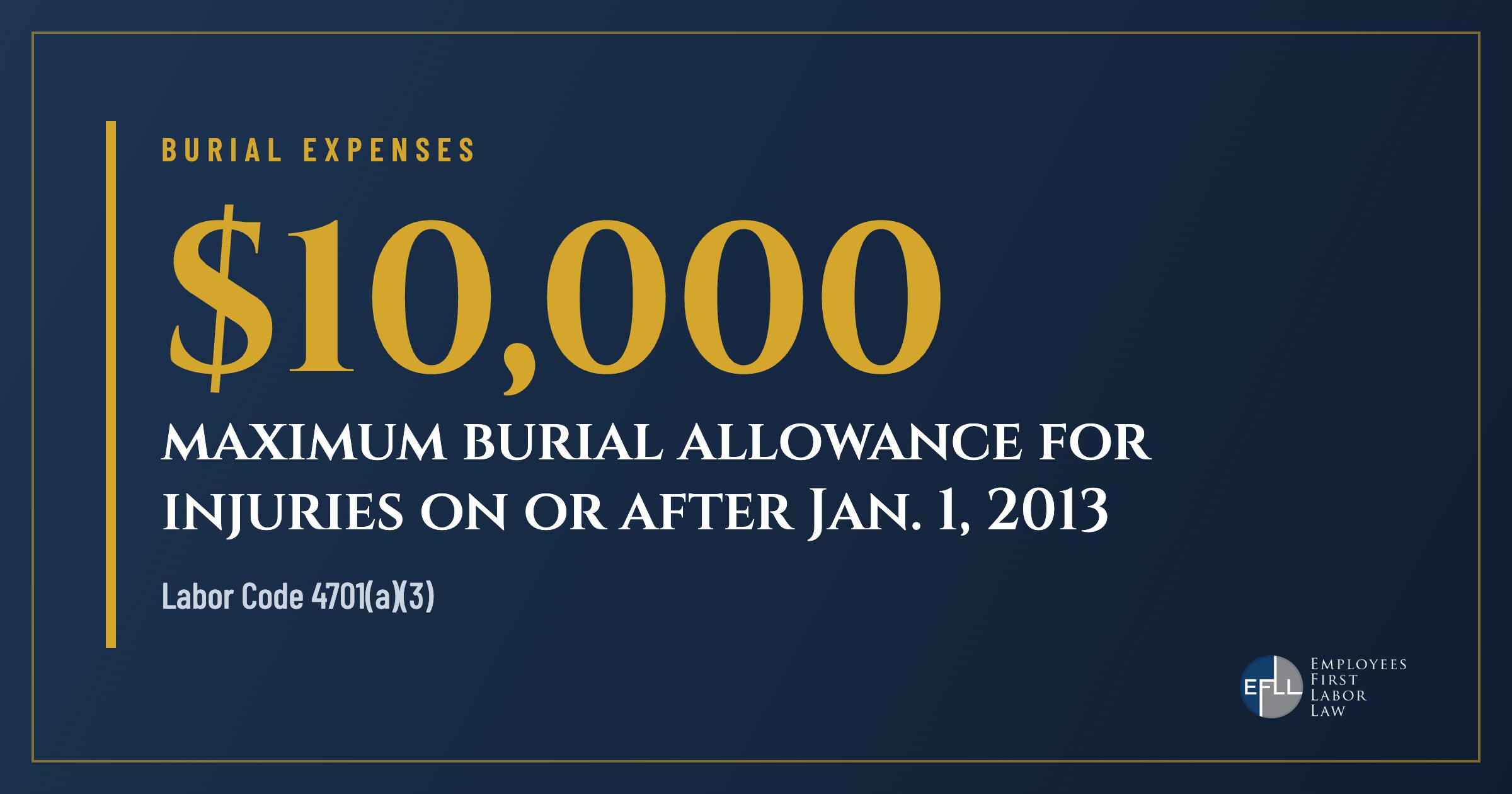
- Burial expenses are covered up to $10,000 for injuries on or after January 1, 2013.
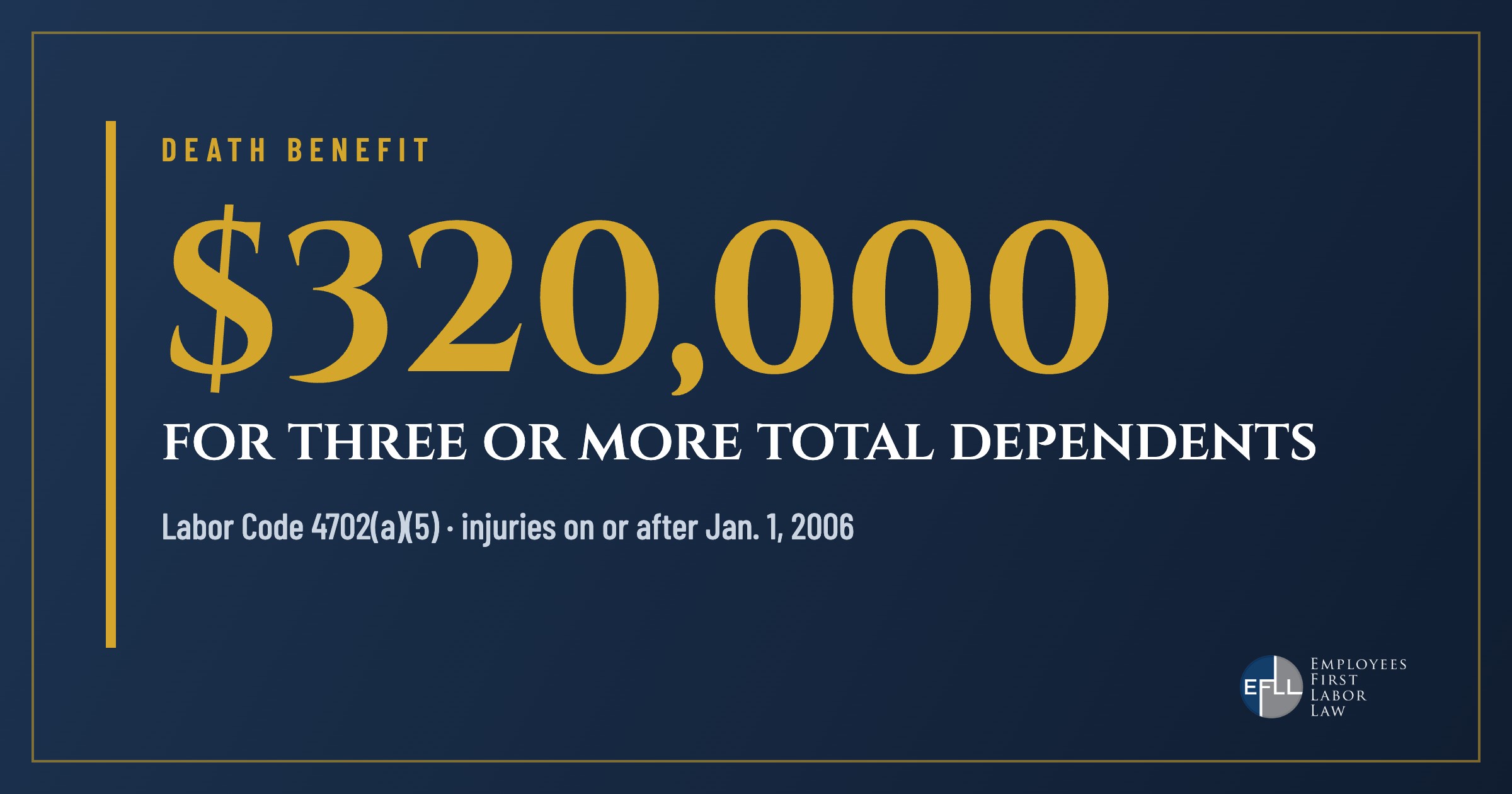
- The death benefit is $250,000 for one total dependent, $290,000 for two and $320,000 for three or more (injuries on or after January 1, 2006).
- It is paid in installments at the worker’s temporary disability rate, never less than $224 a week, and continues until the youngest minor child turns 18.
- Most claims must be filed within one year of the death and generally no more than 240 weeks after the injury (Labor Code 5406).
What Labor Code §§4700–4703 say
| Section | What it says in plain English |
|---|---|
| §4700 | A worker’s death does not erase benefits already owed. No temporary or permanent disability is paid for time after death, but accrued and unpaid compensation goes to the dependents, or if none, to the personal representative or heirs. |
| §4701 | If an injury causes death, the employer must pay reasonable burial expenses (up to $10,000 for injuries on or after January 1, 2013) and a death benefit to anyone who was dependent on the worker for support. |
| §4702 | Sets the dollar amounts by number and type of dependents, requires payment in installments like temporary total disability, sets a $224 weekly minimum, and says disability payments made before death are not deducted from the death benefit. |
| §4703 | Decides who shares the benefit: total dependents split it equally, and partial dependents get nothing when there are two or more total dependents and share in proportion to their dependency when there is no total dependent. |
Related sections fill in the rest: §4703.5 (continued payments for minor children), §§3501–3503 (who is a dependent), §4704 (the appeals board can allocate the benefit among dependents), and §5406 (filing deadlines).
Who counts as a dependent
The amount turns on whether family members were totally or partially dependent on the worker:
- Children. Under §3501(a), a child under 18, or a child of any age found to be physically or mentally incapacitated from earning, is conclusively presumed to be wholly dependent if the child lived with the worker-parent or the parent was legally responsible for the child’s support.
- Spouses. Under §3501(b), a spouse married to the worker at the time of death is conclusively presumed wholly dependent if the spouse earned $30,000 or less in the 12 months before the death.
- Everyone else. Under §3502, dependency is decided based on the facts at the time of injury. A higher-earning spouse, an adult child, a parent or a sibling may still be a total or partial dependent if the worker actually supported them.
- Who can qualify at all. Under §3503, a dependent must be a good-faith member of the worker’s family or household, or a listed relative, including a spouse, child, stepchild, grandchild, parent, in-law, grandparent, sibling, aunt, uncle, niece or nephew.
Watch: injured at work in California
Our attorneys explain what your employer must do after a work injury, and what to do in the first 24 hours to protect your claim.
How much is paid
For injuries on or after January 1, 2006, the Department of Industrial Relations publishes these amounts under §§4701 and 4702:
| Situation | Death benefit |
|---|---|
| One total dependent, no partial dependents | $250,000 |
| One total dependent plus one or more partial dependents | $250,000 plus four times the annual support given to the partial dependents, up to $290,000 total |
| Two total dependents | $290,000 |
| Three or more total dependents | $320,000 |
| Partial dependents only | Eight times the annual support given to them, up to $250,000 |
| Burial expenses (injuries on or after Jan. 1, 2013) | Up to $10,000 (up to $5,000 for 1991–2012 injuries) |
The death benefit is in addition to burial expenses and to any disability benefits that had accrued before death. Section 4702(a)(6) also addresses deaths where there are no total or partial dependents; for injuries on or after January 1, 2004, it provides $250,000 to the deceased employee’s estate.
We help California families claim burial expenses and dependency benefits, and look for other claims against uninsured employers or third parties. Free, confidential consultation.
How the benefit is paid, and payments for children
Under §4702(b), the death benefit is paid in installments in the same manner and amount as temporary total disability would have been paid to the worker, unless the Workers’ Compensation Appeals Board (WCAB) orders otherwise. The weekly payment can never be less than $224. Temporary disability is generally two-thirds of the worker’s average weekly earnings, within the minimum and maximum for the date of injury.
Minor children get extra protection. Under §4703.5, when there are totally dependent children, payments continue after the §4702 amount is paid until the youngest child turns 18, or for the life of a child who is physically or mentally incapacitated from earning. For children of certain peace officers and firefighters killed in the line of duty, payments continue until age 19 if the child is still in high school.
💡 Example: Rosa’s husband, a roofer, died in a fall at work in 2025. He earned $1,200 a week, so his temporary disability rate was two-thirds of that, or $800 a week. Rosa earned less than $30,000 the year before, so she is presumed totally dependent, and their two children, ages 9 and 12, are too. With three total dependents, the death benefit is $320,000, paid at $800 a week. That takes 400 weeks, about 7.7 years. By then the younger child is about 16, so under §4703.5 payments continue until that child turns 18. Burial expenses of up to $10,000 are paid separately. (Hypothetical.)
Deadlines to file a death claim
Under Labor Code §5406, a claim for death benefits generally must be filed within one year:
- From the date of death, if the worker died within one year of the injury; or
- If death happened more than one year after the injury, from the last date benefits were provided or from the date of death, depending on the circumstances.
In every case covered by §5406, proceedings cannot be started more than one year after the death, or more than 240 weeks after the date of injury. The statute notes exceptions in §§5406.5 to 5406.7, so a family facing a long-latency illness should get advice quickly.
Common disputes in death cases
- Was the death work-related? Heart attacks, strokes, overdoses, car crashes and deaths away from the worksite are often disputed.
- Who is a dependent, and how much? Partial dependency, a higher-earning spouse, adult children, unmarried partners and support for relatives in another country often require proof of actual support.
- How the money is divided. Under §4704, the WCAB can set apart or reassign the death benefit among dependents according to their needs, and can appoint a trustee for a minor.
- The weekly rate. The installment rate depends on the worker’s earnings, including overtime and second jobs.
- Uninsured employers. If the employer had no workers’ comp insurance, dependents may sue the employer in civil court under Labor Code §3706 and also file a claim that may be paid by the state’s uninsured employers fund.
- Third parties. A wrongful death lawsuit against someone other than the employer, such as a negligent driver or equipment maker, may also be possible.
What families should do
- Notify the employer in writing. Ask for a claim form (DWC-1) and the name of the workers’ comp insurer.
- Calendar the deadline. Count one year from the date of death and act well before it.
- Gather proof of dependency. Marriage and birth certificates, tax returns, bank records, leases and records of money sent to relatives.
- Gather proof of earnings. Pay stubs, W-2s and records of overtime or other jobs.
- Keep funeral receipts. Burial expenses are reimbursed up to the statutory limit.
- Do not sign a settlement or release before getting advice, especially if there are minor children.
- Ask about other claims. A lawyer can check for third-party, uninsured employer or serious and willful misconduct claims.
Our guide to workers’ compensation death claims walks families through the process step by step.
Related Labor Code sections
| Section | What it covers |
|---|---|
| §§3501–3503 | Who is a dependent and conclusive presumptions for children and spouses |
| §4703.5 | Continued payments for minor and incapacitated children |
| §4704 | WCAB power to allocate the benefit among dependents |
| §4706.5 | Payments to the state in some cases with no dependents |
| §5406 | Deadlines to file a death claim |
| §3600 | When an injury or death is covered by workers’ comp |
Frequently asked questions
How much is the California workers’ comp death benefit in 2026?
For injuries on or after January 1, 2006, it is $250,000 for one total dependent, $290,000 for two and $320,000 for three or more, plus up to $10,000 in burial expenses for injuries on or after January 1, 2013. These amounts are fixed in Labor Code 4702 and are not adjusted each year.
Is the death benefit paid in a lump sum?
Generally no. Section 4702(b) says it is paid in installments like temporary total disability, at least $224 a week, unless the appeals board orders otherwise.
Does a surviving spouse automatically qualify?
A spouse who earned $30,000 or less in the 12 months before the death is conclusively presumed totally dependent. A spouse who earned more can still prove total or partial dependency based on the facts.
What if my loved one was undocumented?
Under Labor Code §3351, workers’ compensation covers employees “whether lawfully or unlawfully employed,” including people who are not U.S. citizens, so immigration status does not by itself bar a death claim. Proof of dependency is usually the key issue. See our guide to workers’ comp for undocumented workers.
How long do we have to file?
Usually one year from the date of death, and generally no more than 240 weeks from the date of injury, under Labor Code 5406. Talk to a lawyer as soon as possible.
Can we also sue the employer?
Usually not, because workers’ comp is the exclusive remedy against an insured employer. Exceptions include an employer that was illegally uninsured, and lawsuits against third parties who caused the death.
Related guides
 Workers only. Never employers.
At Employees First Labor Law, we represent California workers only, never employers. Our team has recovered more than $200 million for our clients, and we prepare every case as if it is going to trial. We have offices in Pasadena, Irvine, Long Beach, Pomona, Riverside, Bakersfield and Fresno, and we serve workers throughout California. Meet our team.







If a family member died because of a work injury or illness, we can help you file the death claim on time, prove dependency and look for every other source of recovery. We represent workers and their families, never employers or insurers.
- ✅ Free, confidential consultation
- ✅ We represent workers only, never employers
- ✅ Se habla español: Empleados Primero
This article provides general information about California law and is not legal advice for any specific situation. Reading it does not create an attorney-client relationship. Past results do not guarantee a similar outcome.