

Updated October 2026 · 7 min read
California Labor Code §2699, the core of the Private Attorneys General Act (PAGA), lets an employee who personally suffered Labor Code violations sue the employer for civil penalties on behalf of the State of California and other affected workers. The 2024 reforms changed who can sue, how penalties are calculated and how employers can reduce them, so older guides on PAGA are often out of date.
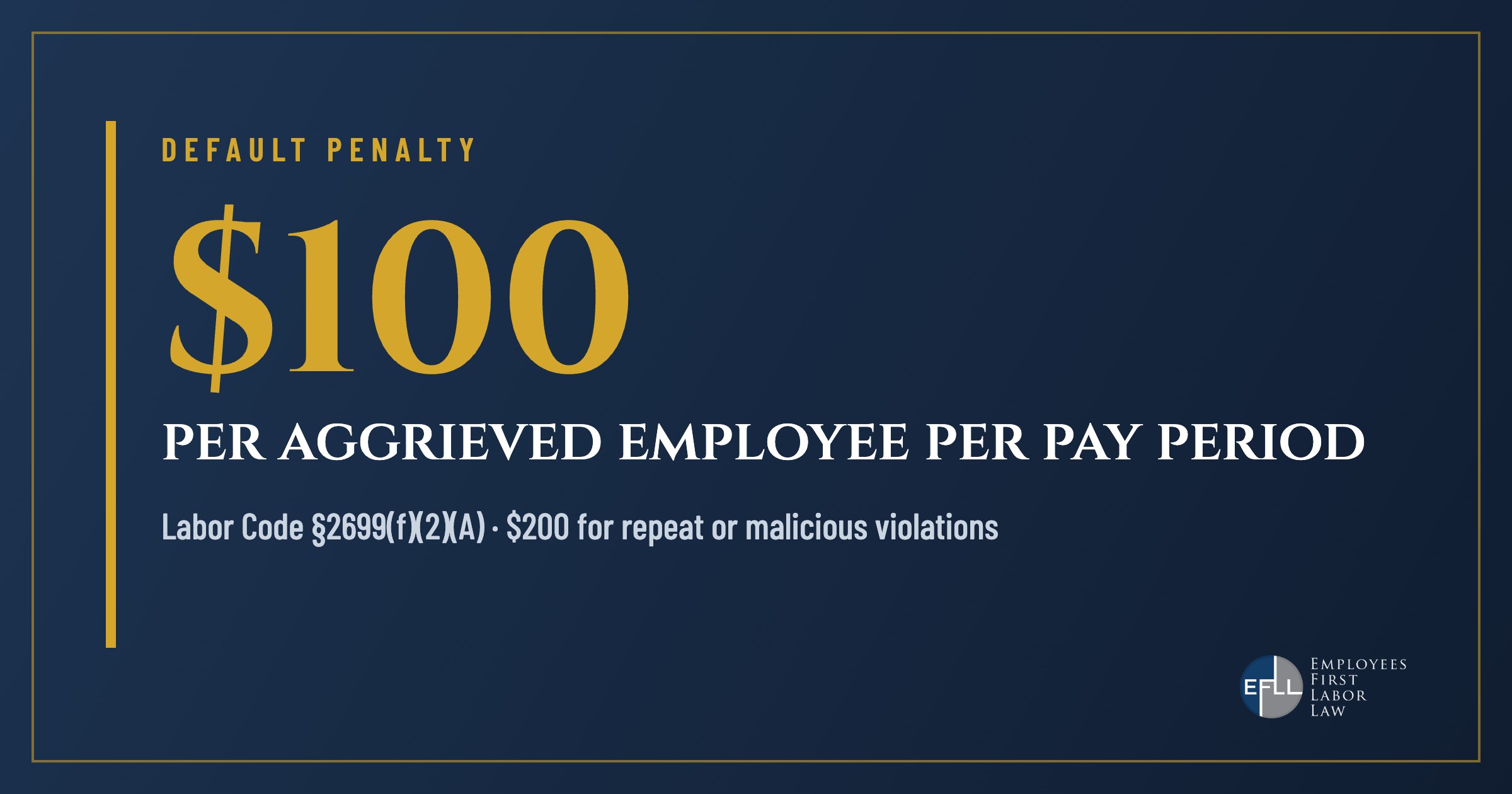
The numbers can be significant. The default penalty is $100 per aggrieved employee per pay period. For 40 workers paid every two weeks for a year, that is up to $104,000 before any reductions, and workers share 35% of what is recovered.
This guide breaks down the current text of §2699: standing, the notice requirement, the penalty amounts, the 15% and 30% caps, how money is split, deadlines and related sections. For a deeper look at one hot-button issue, see our guide on headless PAGA claims.
- Labor Code §2699 (PAGA) lets an aggrieved employee sue for civil penalties on behalf of the state and coworkers hit by the same violations.
- Since the 2024 reform, you must have personally suffered each violation you allege, within the one-year limitations period.
- The default penalty is $100 per aggrieved employee per pay period, or $200 for repeat or malicious conduct.
- Employers that took all reasonable steps to comply can cap penalties at 15% or 30%; recovered penalties are split 65% to the state and 35% to workers.
- Every PAGA case starts with an online notice to the LWDA and a 65-day review period before you can sue.
What Labor Code §2699 says
Many Labor Code provisions carry civil penalties that only the Labor and Workforce Development Agency (LWDA) and its divisions can normally collect. Section 2699(a) lets an “aggrieved employee” recover those penalties “as an alternative” through a civil action, on behalf of themself and other current or former employees against whom the same violation was committed.
For Labor Code provisions that do not set their own civil penalty, such as expense reimbursement under §2802, subdivision (f) creates a default penalty. The rest of the statute sets the amounts, the caps, the split of money, court oversight of settlements and the employee’s right to attorney’s fees.
The 2024 amendments apply to civil actions brought on or after June 19, 2024, unless the required PAGA notice was filed before that date (§2699(v)). The section was most recently amended by AB 1170, a nonsubstantive code-maintenance bill, effective January 1, 2026.
Who can bring a PAGA claim
Under §2699(c)(1), an “aggrieved employee” is someone who was employed by the alleged violator and “personally suffered each of the violations alleged” during the limitations period under Code of Civil Procedure §340. That is a key change from the pre-2024 law: you can no longer bring PAGA penalties for violation types you did not experience yourself.
A few other points about standing:
- Former employees count. You do not have to still work for the company.
- Coworkers are included. Once you have standing, the claim can seek penalties for other current and former employees hit by the same violations.
- Arbitration agreements. The California Supreme Court has held that a worker who is compelled to arbitrate the individual part of a PAGA claim does not lose standing to pursue the representative claims for other employees in court.
- Legal aid organizations. Certain nonprofit legal aid organizations with at least five years of PAGA experience before January 1, 2025 may serve as counsel of record (§2699(c)(2)).
What counts as a violation
PAGA covers violations of Labor Code provisions that carry civil penalties, plus the many provisions that fall under the default penalty in §2699(f). Common PAGA theories include unpaid overtime, missed meal and rest breaks, inaccurate wage statements, unreimbursed expenses, late final pay and off-the-clock work.
There are limits. No PAGA action may be brought for a violation of a posting, notice, agency reporting or filing requirement unless it involves mandatory payroll or workplace injury reporting (§2699(k)(2)). PAGA does not apply to penalties under the workers’ compensation laws (§2699(t)). And if the LWDA itself cites the employer on the same facts within the statutory timeframes, the employee’s PAGA action is barred (§2699(l)).
A PAGA claim can address violations affecting a whole workforce, but the deadline is short. Get a free, confidential case review.
Penalty amounts and caps
| Situation | Civil penalty | Subdivision |
|---|---|---|
| Default (no specific penalty in the statute violated) | $100 per aggrieved employee per pay period | §2699(f)(2)(A) |
| Prior finding of unlawful policy within 5 years, or conduct that is malicious, fraudulent or oppressive | $200 per aggrieved employee per pay period | §2699(f)(2)(B) |
| Isolated, nonrecurring event lasting no longer than the lesser of 30 consecutive days or 4 consecutive pay periods | $50 per employee per pay period | §2699(f)(2)(A)(ii) |
| Certain wage statement errors where the employee could still promptly and easily determine the correct information | $25 per employee per pay period | §2699(f)(2)(A)(i) |
| Employees paid weekly rather than biweekly or semimonthly | Penalty reduced by one-half | §2699(o) |
| Employer took all reasonable steps to comply before the PAGA notice or a records request | Capped at 15% of the penalty sought | §2699(g) |
| Employer took all reasonable steps within 60 days after the PAGA notice | Capped at 30% of the penalty sought | §2699(h) |
“All reasonable steps” can include payroll audits followed by corrective action, lawful written policies, supervisor training and corrective action with supervisors. The 15% and 30% caps do not apply when the $200 penalty applies. Courts can also reduce penalties that would be “unjust, arbitrary and oppressive, or confiscatory,” or exceed the caps when the facts warrant it (§2699(e)(2)).
Employers can avoid penalties for violations they properly “cure.” Under §2699(d), curing generally means correcting the violation and making each aggrieved employee whole: unpaid wages going back three years from the notice, 7% interest, any liquidated damages required by statute, and reasonable lodestar attorney’s fees and costs.
💡 Example: A hypothetical employer requires 40 workers to use their personal cell phones for work but never reimburses them under §2802, which has no penalty of its own. The workers are paid biweekly, and the violation runs for one year (26 pay periods). At the $100 default, the maximum is 40 × 26 × $100 = $104,000. Workers would share 35%, or $36,400, which is $910 each if split evenly. If the employer proves it had taken all reasonable steps before the notice, the 15% cap would limit penalties to $15,600.
How PAGA money is distributed
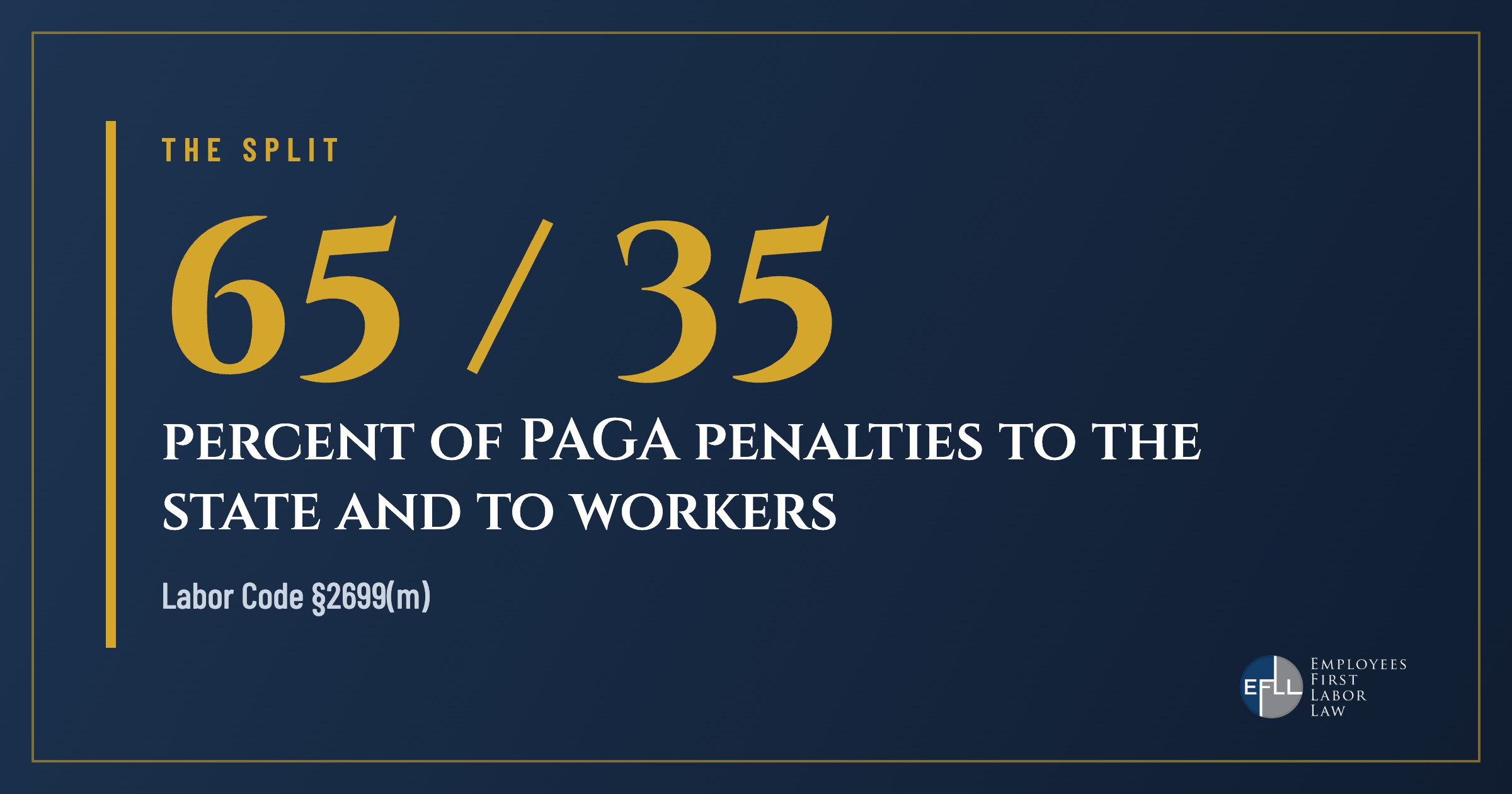
Under §2699(m), civil penalties recovered by employees are split 65% to the LWDA and 35% to the aggrieved employees. Penalties recovered under §2699(f)(1), which applies when the employer had no employees at the time of the violation, go to the LWDA.
PAGA penalties are separate from what you are owed personally. Unpaid wages, premiums and reimbursement are recovered through individual or class claims. Section 2699(i) prevents stacking certain derivative penalties on top of the PAGA penalty collected for the underlying unpaid-wage violation: penalties for violations of §§201–203, for late pay under §204 that was not willful or intentional, and for wage statement violations under §226 that were not knowing or intentional.
A prevailing employee is entitled to reasonable attorney’s fees and costs, including the PAGA filing fee (§2699(k)(1)). Any settlement must be reviewed and approved by the court, and the proposed settlement must be submitted to the LWDA at the same time it is submitted to the court (§2699(s)(2)).
Deadlines and where to file
A PAGA case starts with a notice to the state, not a lawsuit. Under Labor Code §2699.3, you (usually through an attorney) file a written notice online with the LWDA and send it by certified mail to the employer, describing the specific Labor Code provisions violated and the facts and theories supporting them. The notice carries a $75 filing fee, which can be waived for qualifying workers.
- Notice: filed online with the LWDA and sent by certified mail to the employer.
- Agency review: if the LWDA does not respond within 65 calendar days of the notice’s postmark, or says it will not investigate, you may file suit.
- Cure window for smaller employers: employers with fewer than 100 employees during the notice period can submit a confidential cure proposal within 33 days for violations of provisions not listed in §2699.5.
- Early evaluation for larger employers: employers with 100 or more employees can ask the court for an early evaluation conference and a stay after the complaint is served.
- After filing: within 10 days, a file-stamped copy of the complaint goes to the LWDA.
The limitations period is short: generally one year under Code of Civil Procedure §340. The time periods in §2699.3 are not counted against that year (§2699.3(e)). If you think you have a PAGA claim, talk to a lawyer well before the one-year mark.
Related Labor Code sections
- §2698: the short title, the Labor Code Private Attorneys General Act of 2004.
- §2699.3: the notice, cure and early evaluation procedures.
- §2699.5: the list of provisions that follow the standard notice track in §2699.3(a).
- §2802, §226, §226.7, §1198.5: common underlying claims, from expense reimbursement to pay stub violations.
Frequently asked questions
How much is a PAGA penalty per employee?
For violations without their own penalty amount, the default is $100 per aggrieved employee per pay period, or $200 if there was a prior finding of an unlawful policy within five years or the conduct was malicious, fraudulent or oppressive. Caps, cure rules and court discretion can reduce the final number.
Do I have to have suffered every violation in my PAGA notice?
Yes. Under the 2024 reforms, an aggrieved employee must have personally suffered each of the violations alleged, within the one-year limitations period.
Can I bring a PAGA claim if I signed an arbitration agreement?
Often, yes. Your individual PAGA claim may have to be arbitrated, but the California Supreme Court has held that you keep standing to pursue the representative claims for other workers. How that plays out depends on the agreement and the court.
How much of a PAGA recovery goes to workers?
Thirty-five percent of the civil penalties goes to the aggrieved employees and 65% goes to the LWDA. Unpaid wages and other individual remedies are recovered separately.
What is the deadline to file a PAGA claim?
Generally one year from the violation under Code of Civil Procedure §340. The notice and agency review periods in §2699.3 are not counted toward that year.
Can my employer fire me for filing a PAGA notice?
Retaliating against workers for reporting Labor Code violations is illegal under several California laws. If you were disciplined or fired after raising pay problems, see our guide on retaliation claims in California.
Related guides
 Workers only. Never employers.
At Employees First Labor Law, we represent California workers only, never employers. Our team has recovered more than $200 million for our clients, and we prepare every case as if it is going to trial. We have offices in Pasadena, Irvine, Long Beach, Pomona, Riverside, Bakersfield and Fresno, and we serve workers throughout California. Meet our team.







If you and your coworkers were shorted on wages, breaks or reimbursement, we can evaluate a PAGA claim alongside your individual claims and handle the LWDA notice process for you.
- ✅ Free, confidential consultation
- ✅ We represent workers only, never employers
- ✅ Se habla español: Empleados Primero
This article provides general information about California law and is not legal advice for any specific situation. Reading it does not create an attorney-client relationship. Past results do not guarantee a similar outcome.