
Updated October 2026 · 6 min read
Labor Code §5405 is California’s main workers’ comp statute of limitations. You generally have one year to start proceedings for medical or disability benefits. The year runs from the date of injury, the end of the last period covered by a disability payment, or the last date the employer provided medical treatment.
Miss this deadline and you can lose the right to have a judge award benefits, no matter how real the injury is. Say an adjuster stops paying for treatment after your last appointment in March. If nothing else happens and no claim form or case is pending, the one-year clock may run out the following March. Many workers assume that an “open claim” with the insurance company protects them indefinitely. It may not.
This explainer covers what §5405 says, the three dates that can start the clock, how filing a claim form pauses it, related deadlines that are shorter or longer, common disputes and what to do now.
- You generally have one year to start proceedings for medical or disability benefits (Labor Code §5405).
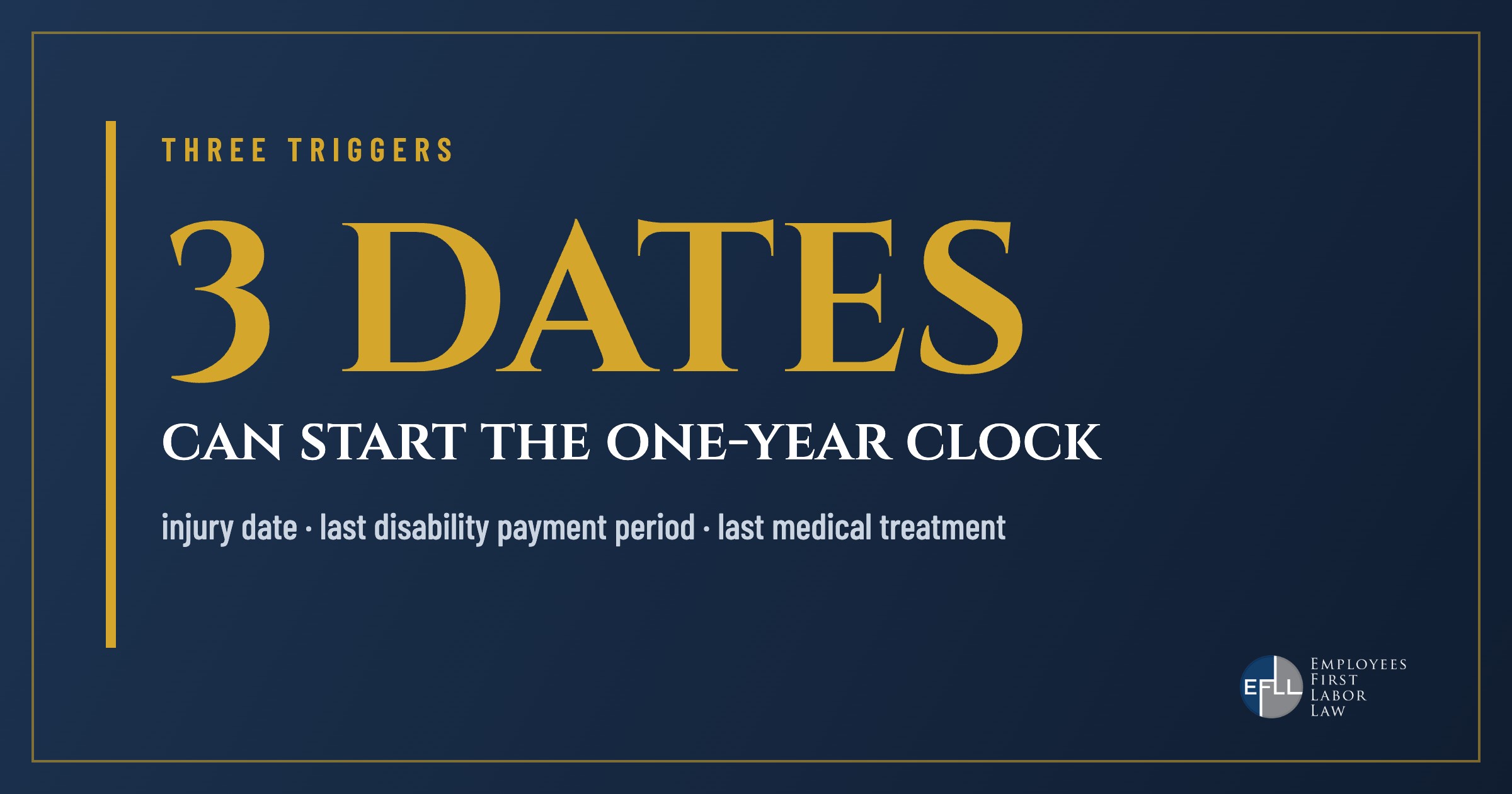
- The year runs from the latest of three dates: the date of injury, the end of the last period covered by a disability payment, or the last date medical treatment was provided.
- Filing a DWC-1 claim form tolls the deadline until the claim is denied or becomes presumed compensable (§5401(d)).
- Other deadlines differ: 12 months for serious and willful misconduct (§5407) and five years for new and further disability (§5410).
- For cumulative trauma, the clock starts on the §5412 date of injury, which can be years after symptoms began.
What Labor Code §5405 says
Section 5405 says the period to start proceedings “for the collection of the benefits” for medical treatment (Article 2, starting at Labor Code §4600) or disability payments (Article 3, starting at §4650) “is one year from any of the following”:
- (a) The date of injury.
- (b) The expiration of any period covered by payment of disability indemnity (temporary or permanent disability).
- (c) The last date on which any medical benefits were furnished.
In practice, the deadline is measured from whichever of these events happened last. Each time the employer pays disability for a period or provides treatment, a new one-year period can start.
“Commencing proceedings” generally means filing an Application for Adjudication of Claim with the Workers’ Compensation Appeals Board (WCAB). Once an application for any part of your compensation is timely filed, Labor Code §5404 says the limitations chapter no longer applies to further claims against those defendants for that injury. Later requests are governed by the board’s continuing-jurisdiction rules in §§5803–5805.

Who §5405 applies to
Section 5405 applies to injured workers seeking medical treatment or disability benefits. Other benefit types have their own deadlines:
| Claim | Deadline | Statute |
|---|---|---|
| Medical treatment and disability benefits | 1 year from the date of injury, the last disability payment period or the last medical treatment | LC §5405 |
| Written notice of injury to employer | 30 days, but late notice is excused unless the employer was misled or prejudiced | LC §§5400, 5403 |
| Serious and willful misconduct by the employer | 12 months from the date of injury, not extended by payments | LC §5407 |
| Death benefits | Generally 1 year from death, and never more than 240 weeks from the injury | LC §5406 |
| New and further disability | 5 years from the date of injury | LC §5410 |
The “date of injury” itself depends on the type of injury. For a specific incident, it is the date of the incident (Labor Code §5411). For cumulative trauma and occupational disease, it is the date set by Labor Code §5412: when you first suffered disability and knew, or should have known, it was work-related.
Watch: injured at work in California
Our attorneys explain what your employer must do after a work injury, and what to do in the first 24 hours to protect your claim.
How the one-year clock runs, and what pauses it
Two rules change the math for most workers.
Filing the claim form tolls the deadline. Under Labor Code §5401(d), for injuries on or after January 1, 1994, filing the claim form with your employer tolls (pauses) the §5405 and §5406 deadlines. The pause lasts until the employer denies the claim or the injury becomes presumed compensable under §5402. Read our Labor Code §5401 explainer for when a form counts as filed.
Benefits restart the clock. Because §5405 runs from the last disability payment period or the last treatment, an accepted claim with ongoing care keeps the clock from running. When benefits stop, it starts again.
💡 Example (hypothetical): Luis injures his knee at work on May 12, 2025. The claim is accepted. His last temporary disability payment covers a period ending January 31, 2026, and his last authorized physical therapy visit is March 20, 2026. He never files an Application for Adjudication. The latest of the three §5405 dates is March 20, 2026, so absent another event that extends or tolls the deadline, Luis should file before March 20, 2027.
Real cases are rarely this clean. Pending requests for treatment, late payments and missing notices can all affect the date, so don’t rely on a rough count when the deadline is close.
Don’t assume it’s too late. Tolling, ongoing benefits and the date-of-injury rules can change the answer. Ask us for a free review.
Common disputes over the §5405 deadline
Which date was really “last”?
Workers and adjusters often disagree about when the last disability period ended or when treatment was last “furnished.” Bills, pharmacy records and payment logs help settle this.
Was the deadline tolled?
If you filed a DWC-1 claim form, the clock was paused until a denial or until the claim became presumed compensable. The dates of the claim form and of any denial letter matter.
Did the employer give the required notices?
Employers and claims administrators must send injured workers benefit notices, including notice of rights. California courts have held in some cases that an employer’s failure to give required notices can prevent it from relying on the limitations period. Whether that applies depends on the facts.
When is the date of injury for a cumulative trauma claim?
Employers sometimes argue a CT claim is late because the worker had symptoms years earlier. Under §5412, the date of injury requires both disability and knowledge that work caused it, which can be much later.
Did the employer waive the defense?
Under Labor Code §5409, a missed deadline is an “affirmative defense” that bars the remedy but does not erase your underlying right. The employer can waive it, and failing to raise it before the case is submitted for decision is enough to waive it.
What to do if you’re worried about the deadline
- Find your three dates. Write down your date of injury, the last day covered by a disability payment and your last treatment date.
- Confirm you filed a claim form. If you never filed a DWC-1, file one now. Our DWC-1 form guide explains how.
- Gather your letters. Keep denial letters, delay letters, benefit notices and payment stubs.
- File an Application for Adjudication if time is short. Filing protects your right to have a judge decide disputes.
- Talk to an attorney early. Deadlines interact in ways that are easy to miss. See when to hire a workers’ comp attorney.
Once the claim is protected, our workers’ comp calculator can help you estimate disability benefits.
Related Labor Code sections
- §5400 and §5403: 30-day written notice of injury, and when failing to give it is excused.
- §5401: the claim form, which tolls the §5405 deadline.
- §5402: the 90-day presumption. See Labor Code §5402.
- §5404: once an application is filed, further claims are governed by §§5803–5805.
- §5409: the limitations period is an affirmative defense that the employer can waive.
- §5410: five years from the injury date to claim new and further disability.
- §5412: date of injury for cumulative trauma and occupational disease. See also our cumulative trauma guide.
Frequently asked questions
How long do I have to file a workers’ comp claim in California?
Generally one year under Labor Code §5405, measured from the latest of the date of injury, the last period covered by disability payments or the last medical treatment provided. You should also notify your employer within 30 days and file a claim form as soon as possible.
Does filing a DWC-1 claim form count as filing a case?
No. The claim form starts the claim with your employer and tolls the one-year deadline until a denial or until the claim becomes presumed compensable. A case before a judge starts with an Application for Adjudication of Claim.
My claim was denied. How long do I have?
After a denial, the tolling from your claim form ends and the one-year period runs again. Because the exact date depends on your injury date, the claim form date, the denial date and any benefits you received, get advice promptly.
What if I didn’t know my condition was work-related?
For cumulative trauma and occupational disease, the date of injury is when you first had disability and knew, or reasonably should have known, that work caused it. That can make a claim timely even if symptoms started years earlier.
Can my claim be reopened after the one-year deadline?
If benefits were paid or awarded, you may have up to five years from the date of injury to seek more benefits for new and further disability under Labor Code §5410.
Is there a shorter deadline for anything?
Yes. A claim that the employer’s serious and willful misconduct caused the injury must be filed within 12 months of the date of injury (Labor Code §5407), and that period is not extended by benefit payments.
Related guides
 Workers only. Never employers.
At Employees First Labor Law, we represent California workers only, never employers. Our team has recovered more than $200 million for our clients, and we prepare every case as if it is going to trial. We have offices in Pasadena, Irvine, Long Beach, Pomona, Riverside, Bakersfield and Fresno, and we serve workers throughout California. Meet our team.







If your claim was denied, your benefits stopped or you’re unsure whether time has run, we can check your dates and file what’s needed to protect your claim. We represent injured workers only.
- ✅ Free, confidential consultation
- ✅ We represent workers only, never employers
- ✅ Se habla español: Empleados Primero
This article provides general information about California law and is not legal advice for any specific situation. Reading it does not create an attorney-client relationship. Past results do not guarantee a similar outcome.