
Updated October 2026 · 8 min read
Labor Code §5402 gives your employer 90 days from the day you file your workers’ comp claim form to deny the claim. If it doesn’t reject the claim in that window, the law presumes your injury is covered. The same section requires the employer to authorize up to $10,000 in medical treatment within one working day after you file, while it investigates.
The 90-day rule shapes the first three months of most claims. Suppose you file your claim form on March 4 and hear nothing by early June. Your employer has probably lost the right to deny the claim unless it finds evidence it could not have found earlier. Many injured workers never learn that this deadline exists. Some wait for a decision that the law already made for them.
This explainer covers what §5402 says, who it applies to, how the 90-day and one-working-day clocks run, where claims adjusters and injured workers tend to disagree, and what to do if your claim is still “under investigation.”
- 90 days: if your employer doesn’t deny your claim within 90 days after you file the claim form, the injury is presumed compensable (Labor Code §5402(b)).
- The window is 75 days for injuries covered by the public-safety presumptions in §§3212–3212.85 and 3212.9–3213.2.
- After day 90, the employer can rebut the presumption only with evidence it discovered after the 90-day period.
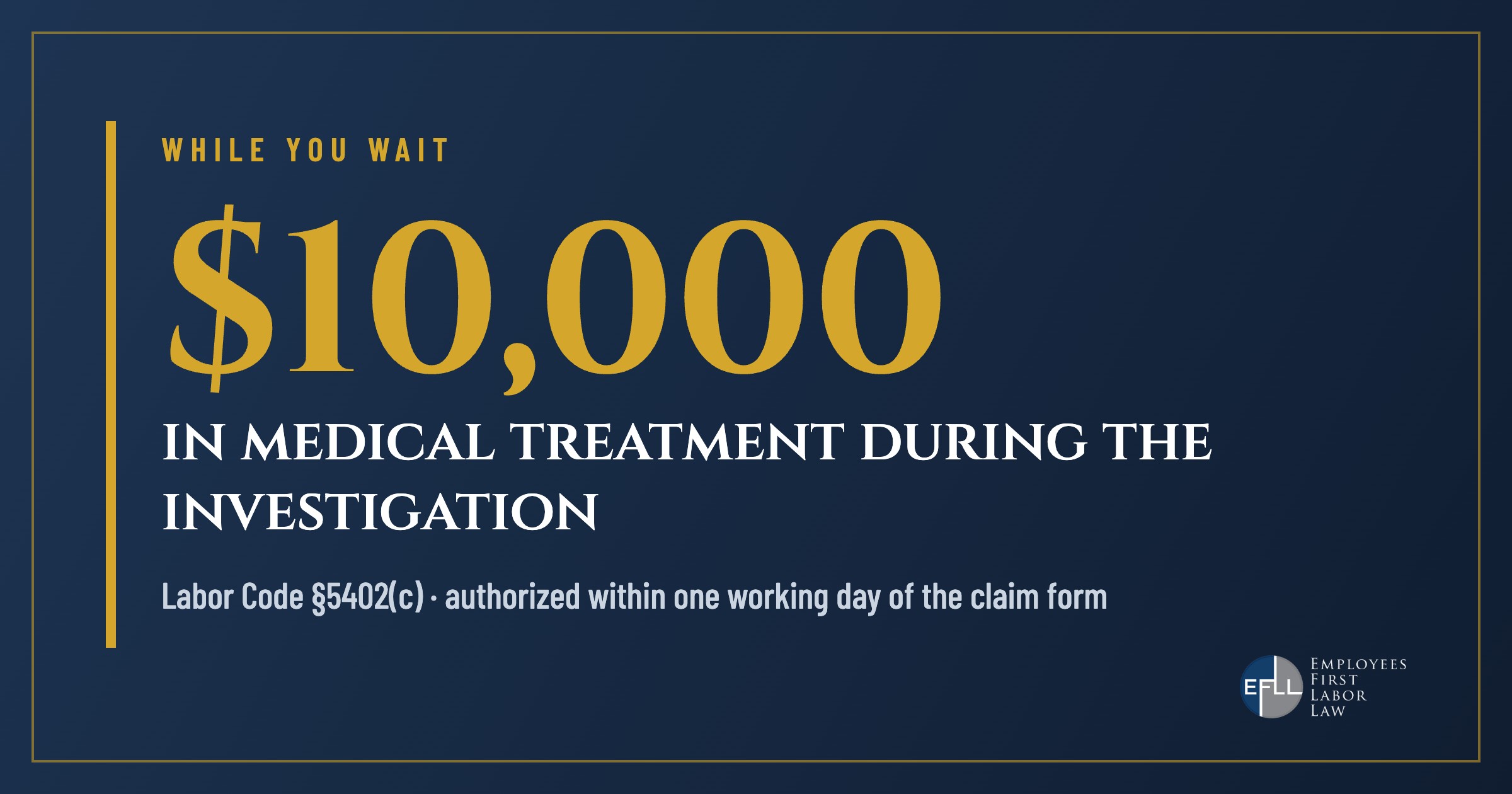
- Within one working day of your claim form, the employer must authorize treatment, up to $10,000, until it accepts or rejects the claim.
- A delay letter does not stop the clock. Keep a dated copy of your claim form; that date starts every deadline.
What Labor Code §5402 says
Section 5402 sits in the part of the Labor Code that sets limits on workers’ compensation proceedings. It has five subdivisions. Here is what each one does, in plain English:
- §5402(a), employer knowledge counts as notice. If your employer, a managing agent, a superintendent, a foreman or “other person in authority” learns of your injury from any source, that knowledge is treated the same as the written 30-day notice described in Labor Code §5400. The same goes for knowledge of a claim that is detailed enough to let the employer investigate.
- §5402(b)(1), the 90-day presumption. If the employer does not reject liability within 90 days after you file the claim form under §5401, the injury “shall be presumed compensable.” The employer can rebut that presumption only with evidence it discovered after the 90 days ended.
- §5402(b)(2), a 75-day window for some public-safety claims. For injuries and illnesses defined in Labor Code §§3212 to 3212.85 and 3212.9 to 3213.2, the window is 75 days. Most of those sections are the presumptions for firefighters, peace officers and other public-safety workers.
- §5402(c), treatment while the claim is pending. Within one working day after you file the claim form, the employer must authorize all treatment for the alleged injury that is consistent with the state’s medical treatment guidelines (Labor Code §5307.27). It must keep providing that treatment until it accepts or rejects the claim. Until then, its liability for treatment is capped at $10,000.
- §5402(d), treatment is not an admission. Paying for treatment during the investigation does not, by itself, make the employer liable for the claim.
Subdivision (e) concerns data the Division of Workers’ Compensation (DWC) collects on claim decisions, and it does not change your rights. The 75-day rule was added by SB 1127, effective January 1, 2023.

Who §5402 applies to
Section 5402 applies to most California employees who file a workers’ compensation claim form, whether the employer is insured, self-insured or a public agency. In practice the 90-day decision is made by the claims administrator (the insurance company or third-party administrator). The deadline still binds the employer.
Three groups should pay close attention:
- Workers whose claims are “delayed.” A delay letter does not stop the 90-day clock. Under the DWC’s regulations (Cal. Code Regs., tit. 8, §9812), a notice that the claims administrator is delaying its decision must explain that the claim is presumed compensable if it is not denied within 90 days of the filing of the claim form.
- Public-safety workers. Firefighters, peace officers and others whose claims fall under the listed presumption statutes get the shorter 75-day window.
- Workers with cumulative trauma or illness claims. The clock starts when the claim form is filed, not when symptoms began. See our explainer on Labor Code §5412 and the date of injury for cumulative trauma.
Watch: injured at work in California
Our attorneys explain what your employer must do after a work injury, and what to do in the first 24 hours to protect your claim.
The deadlines: 1 working day, 75 days and 90 days
Every deadline in §5402 runs from the date your claim form is “filed.” Under Labor Code §5401(c), a claim form is filed when it is personally delivered to the employer or received by the employer by first-class or certified mail. That is why the DWC recommends certified mail with a return receipt if you mail your form.
| Deadline | What must happen | Source |
|---|---|---|
| 1 working day after the claim form is filed | Employer authorizes treatment for the alleged injury, up to $10,000 until the claim is accepted or rejected | LC §5402(c) |
| 14 days after knowledge of injury and disability | First temporary disability payment, or a delay or denial notice | LC §4650(a); 8 CCR §9812 |
| 75 days after filing | Deadline to reject listed public-safety presumption claims | LC §5402(b)(2) |
| 90 days after filing | Deadline to reject all other claims, or the injury is presumed compensable | LC §5402(b)(1) |
💡 Example (hypothetical): Maria, a warehouse picker, hurts her shoulder and hand-delivers her completed DWC-1 claim form to her supervisor on Wednesday, March 4, 2026. Treatment should be authorized by Thursday, March 5. The adjuster sends a delay letter in April but never issues a denial. Day 90 falls on Tuesday, June 2, 2026. If no denial goes out by then, Maria’s shoulder injury is presumed compensable. The employer can overcome that presumption only with evidence it discovers after June 2.
Keep a dated copy of your claim form. The employer must give you one under §5401(c), and that date starts the clock.
If your claim was never denied, or was denied late, we can review the dates and your letters for free.
Common disputes under §5402
Most §5402 fights fall into a few patterns.
When was the claim form filed?
If the employer says it never received the form, or received it later than you say, the 90-day date moves. Proof of delivery, such as a signed copy, a certified-mail receipt or an email trail, often settles this.
Was the denial timely and properly sent?
A denial has to actually reject liability within the window. A letter that only says the claim is “under investigation” or “delayed” is not a denial.
What counts as evidence “discovered subsequent to” the 90 days?
After day 90, the employer can rebut the presumption only with evidence discovered later. California courts have generally read this to exclude evidence the employer could have found with a reasonable investigation during the 90 days. Claims administrators have a regulatory duty to investigate claims in good faith (8 CCR §10109). How this rule applies to a particular piece of evidence is a fact question for the workers’ compensation judge.
What does the presumption cover?
The presumption answers whether the injury is covered. It does not decide how much permanent disability you have or whether a particular treatment is reasonable. Those questions still go through your treating doctor, utilization review and, if needed, a QME or AME.
Was the $10,000 in treatment actually authorized?
Some workers are told to wait for a decision before seeing a doctor. The DWC’s own guidance says the claims administrator must authorize treatment within one working day of the claim form, even while the claim is investigated.
What to do if your claim is pending or denied
- File the claim form promptly and keep proof. Complete the employee section of the DWC-1, sign and date it, and deliver it in person or by certified mail. Our DWC-1 form guide walks through each box.
- Put day 90 (or day 75) on your calendar. Count from the filing date on your dated copy.
- Ask for treatment right away. If no doctor is authorized within one working day, ask the adjuster in writing to authorize care under §5402(c).
- Save every letter. Delay notices, denial letters and benefit notices are evidence of what the employer did and when.
- If the claim is denied, act quickly. A denial can be challenged by filing an Application for Adjudication of Claim with the Workers’ Compensation Appeals Board (WCAB). The fight over coverage usually turns on a medical-legal evaluation; see Labor Code §4060 and evaluations for denied claims.
- If day 90 passed without a denial, raise the presumption. An attorney can put the claims administrator on notice and, if necessary, ask a judge to find the injury compensable.
- Watch for late payments. Unreasonable delay in paying benefits can lead to penalties under Labor Code §5814.
Related Labor Code sections
- §5400: written notice of injury to the employer within 30 days. §5402(a) treats the employer’s actual knowledge as the same thing.
- §5401: the claim form (DWC-1) and when it is “filed.” See our explainer on Labor Code §5401 and the DWC-1 claim form.
- §5405: the one-year deadline to start proceedings. Filing the claim form tolls it until the claim is denied or becomes presumptively compensable.
- §4650: timing of temporary disability payments. See Labor Code §4650.
- §3600: the conditions for compensation (the injury must arise out of and in the course of employment).
To estimate what your temporary or permanent disability benefits might be worth once the claim is accepted, try our workers’ comp calculator.
Frequently asked questions
Does a delay letter stop the 90-day clock?
No. A delay notice explains why a decision hasn’t been made yet. It does not extend the 90 days. The DWC’s regulations require a delay notice to tell you that the claim is presumed compensable if it isn’t denied within 90 days of filing.
What if my employer never gave me a claim form?
The 90-day clock starts only when a claim form is filed, so get one and file it. Employers must provide the form within one working day of learning of an injury that needs more than first aid or causes lost time beyond the work shift. You can also download the DWC-1 from the DWC’s website.
Can my employer deny my claim after 90 days?
It can try, but only with evidence discovered after the 90-day period. Evidence that a reasonable investigation would have turned up earlier generally cannot be used to overcome the presumption.
Do I have to pay for treatment while my claim is investigated?
Generally, no. The employer must authorize treatment within one working day of your claim form and remains liable for up to $10,000 of it until the claim is accepted or rejected. That treatment must be consistent with the state’s treatment guidelines.
Is the deadline shorter for firefighters and police officers?
For injuries and illnesses defined in Labor Code §§3212 to 3212.85 and 3212.9 to 3213.2, which include many public-safety presumptions, the employer has 75 days instead of 90.
Does the presumption mean I automatically get permanent disability?
No. The presumption establishes that the injury is covered. The amount of temporary and permanent disability still depends on the medical evidence and the rating process.
Related guides
 Workers only. Never employers.
At Employees First Labor Law, we represent California workers only, never employers. Our team has recovered more than $200 million for our clients, and we prepare every case as if it is going to trial. We have offices in Pasadena, Irvine, Long Beach, Pomona, Riverside, Bakersfield and Fresno, and we serve workers throughout California. Meet our team.







If your workers’ comp claim is delayed, denied or stuck past the 90-day mark, we can help you enforce the presumption, get treatment authorized and protect your benefits. We represent injured workers only.
- ✅ Free, confidential consultation
- ✅ We represent workers only, never employers
- ✅ Se habla español: Empleados Primero
This article provides general information about California law and is not legal advice for any specific situation. Reading it does not create an attorney-client relationship. Past results do not guarantee a similar outcome.