

Updated October 2026 · 6 min read
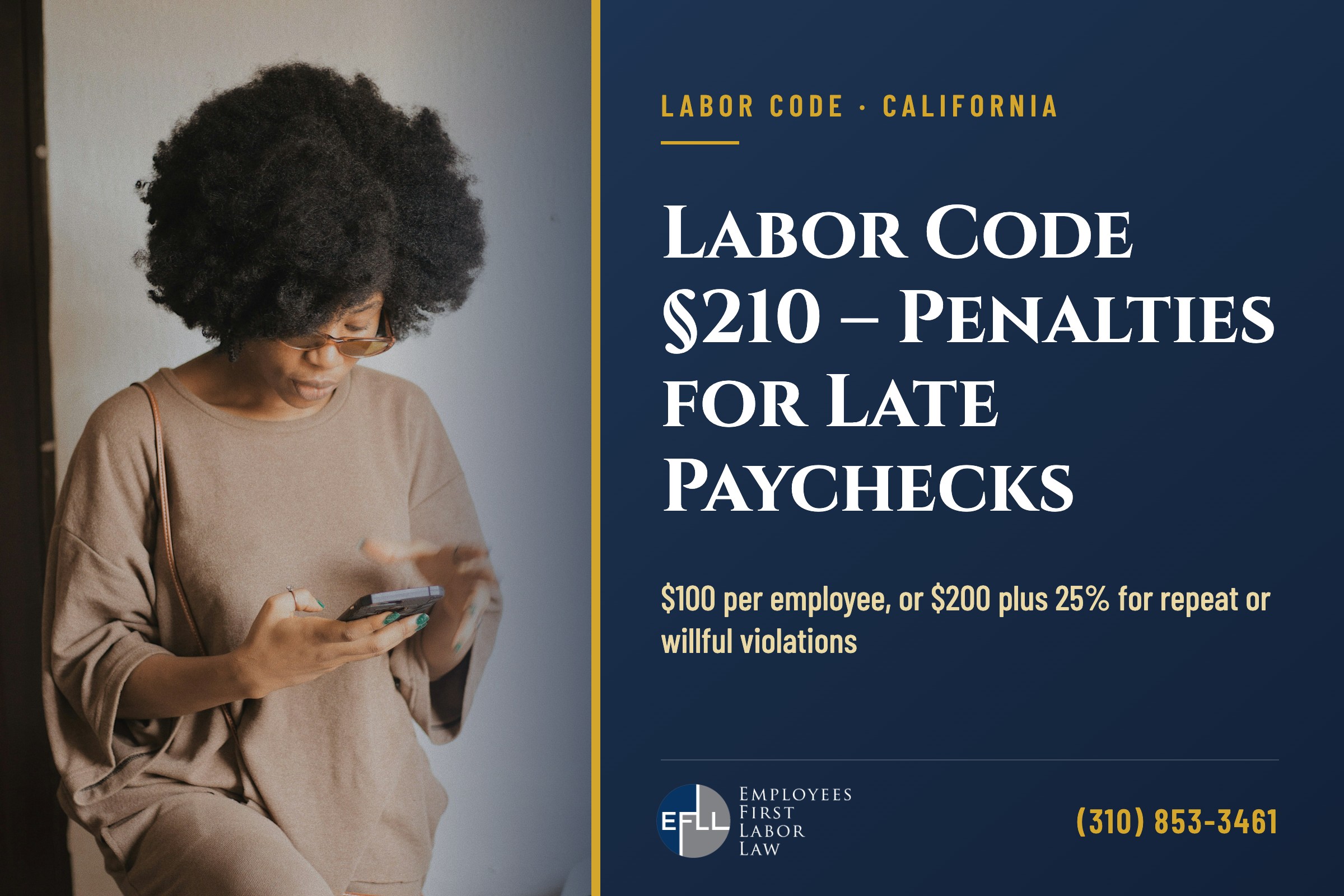
California Labor Code §210 sets the penalty for paying wages late during employment: $100 per employee for each initial failure to pay on time, and $200 per employee for each subsequent or willful failure, plus 25% of the amount unlawfully withheld. It is the enforcement tool behind the payday rules in Labor Code §204 and several related sections.
For years only the Labor Commissioner could collect this penalty. Since an amendment that took effect January 1, 2020, §210 also lets the employee recover it as a statutory penalty through the Labor Commissioner’s wage claim process. For a worker whose paycheck is repeatedly late, the 25% add-on can make the penalty significant.
This explainer covers the text of §210, which late payments it applies to, how the penalty is calculated, who can recover it and how, the deadline, and related sections. For practical steps when your paycheck is late, see our guide to late paychecks and California payday rules.
- Labor Code §210 imposes $100 per employee for each initial failure to pay wages on time under §204 and related sections.
- Repeat, willful or intentional violations cost $200 per employee plus 25% of the amount unlawfully withheld.
- Since 2020, the employee can recover the penalty through a Labor Commissioner claim; the Labor Commissioner can also cite the employer.
- You can recover the §210 penalty or a PAGA civil penalty for the same violation, not both.
- Penalty claims may have a one-year deadline, so act quickly.
What Labor Code §210 says
Section 210 has three subdivisions.
Subdivision (a): the penalty. “In addition to, and entirely independent and apart from, any other penalty” in the same article, every person who fails to pay employees’ wages as required by Labor Code §§201.3, 204, 204b, 204.1, 204.2, 204.11, 205, 205.5 and 1197.5 is subject to:
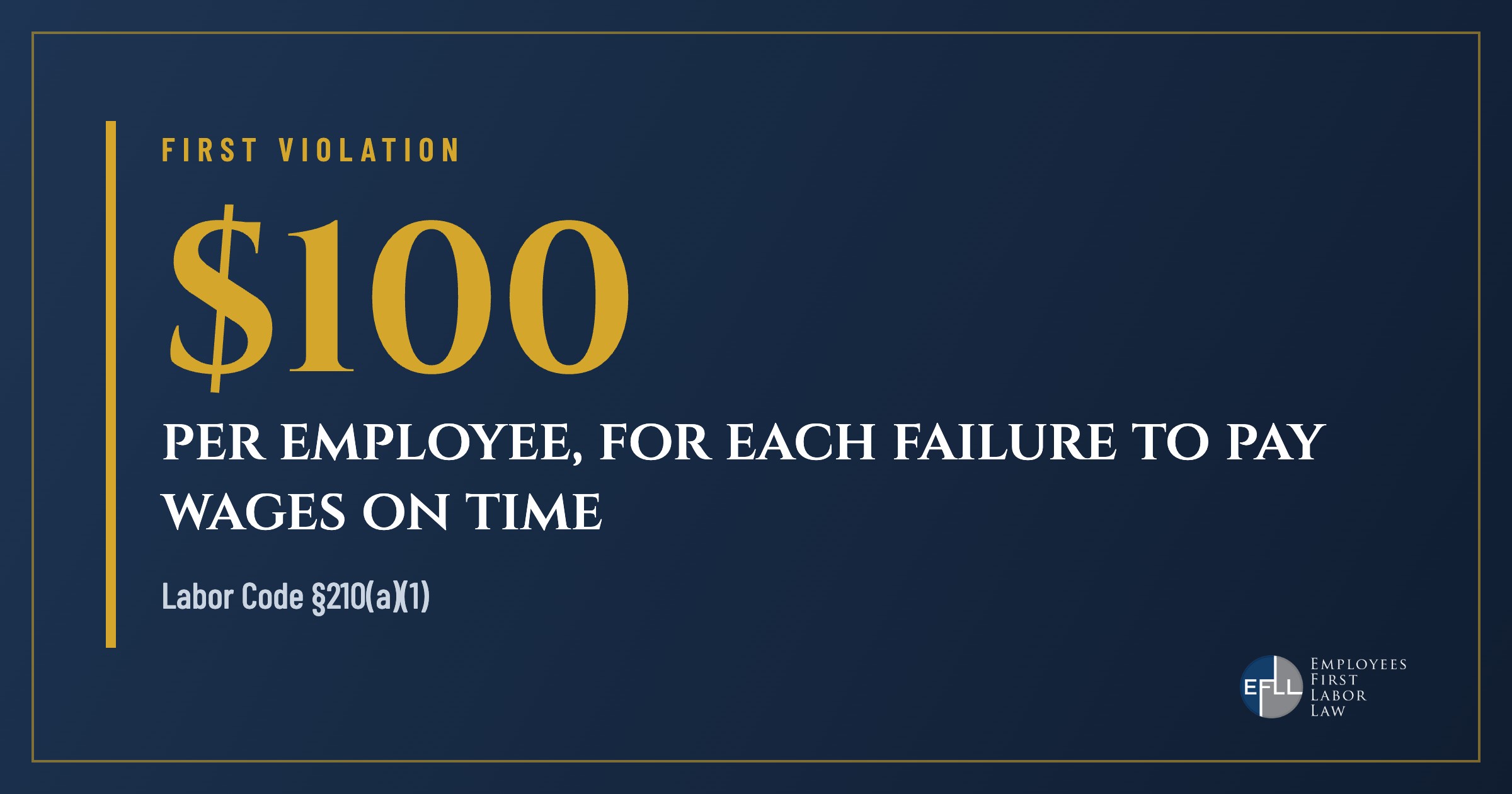
- For any initial violation: $100 “for each failure to pay each employee.”
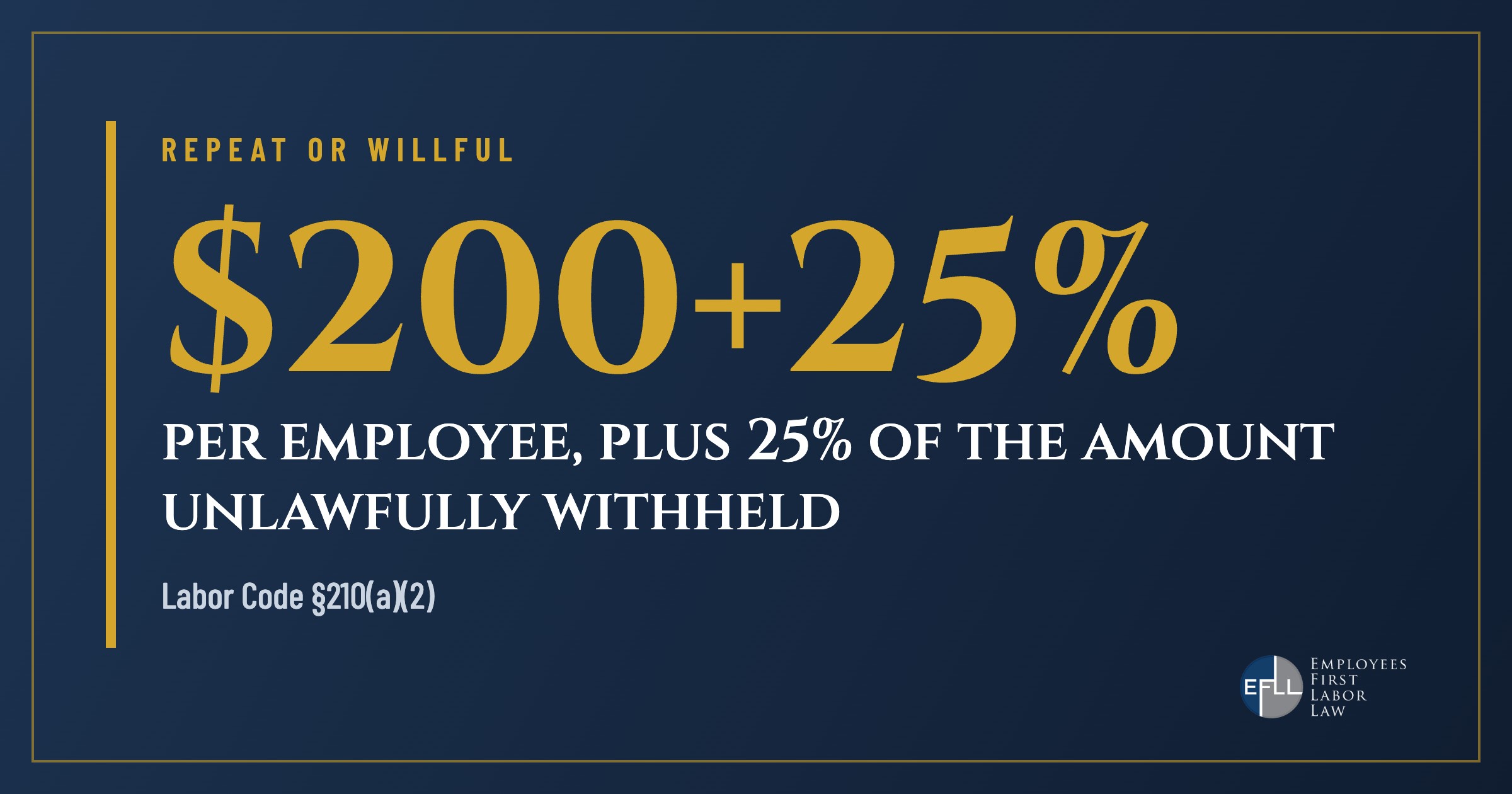
- For each subsequent violation, or any willful or intentional violation: $200 “for each failure to pay each employee, plus 25 percent of the amount unlawfully withheld.”
Subdivision (b): who recovers it. The penalty is recovered either “by the employee as a statutory penalty pursuant to Section 98,” which is the Labor Commissioner’s wage claim and hearing process, or “by the Labor Commissioner as a civil penalty” through a citation or a Labor Commissioner lawsuit under §98.3. Citations follow the procedures in Labor Code §1197.1.
Subdivision (c): no double recovery. For the same violation, an employee can recover either the §210 statutory penalty or a civil penalty under the Private Attorneys General Act (PAGA), “but not both.”
Which late payments §210 covers
Section 210 applies to late payment under the sections it lists. For most workers, the important one is Labor Code §204, which requires wages to be paid at least twice a month on designated paydays, and generally within seven calendar days after a weekly, biweekly or semimonthly pay period closes. Our explainer on California payday rules covers those deadlines.
The list also includes §201.3 (temporary services employees, who are generally paid weekly) and §1197.5 (California’s Equal Pay Act), among others.
Section 210 does not cover everything:
- Final paychecks. Late final wages after you quit or are fired fall under Labor Code §§201, 202 and the waiting time penalty in §203, which can be up to 30 days of wages. See our guide to final paycheck penalties.
- Bounced paychecks. Labor Code §203.1 provides its own penalty when a paycheck is refused for lack of funds.
- Local government employees. Under Labor Code §220(b), §§200 to 211 do not apply to employees directly employed by a county, city, town or other municipal corporation.
How the §210 penalty is calculated
The penalty is counted per employee, per failure to pay. Each late paycheck to each worker is a separate failure. The amount depends on whether it is a first violation or a repeat or willful one:
| Type of violation | Penalty per employee, per failure | Law |
|---|---|---|
| Initial violation | $100 | Labor Code §210(a)(1) |
| Subsequent violation | $200 plus 25% of the amount unlawfully withheld | Labor Code §210(a)(2) |
| Willful or intentional violation (even if first) | $200 plus 25% of the amount unlawfully withheld | Labor Code §210(a)(2) |
💡 Example (hypothetical): Kim’s employer pays a biweekly crew of 12 workers four days late. As an initial violation, the penalty is $100 per employee, or 12 × $100 = $1,200 across the crew. Two weeks later the employer pays late again, and Kim’s paycheck of $1,800 is held back. For that subsequent violation, Kim’s penalty is $200 + (25% × $1,800) = $200 + $450 = $650.
Interest on late wages is a separate item. Labor Code §218.6 provides for interest on unpaid wages in an action for nonpayment of wages, running from the date the wages were due.
Late pay can add up to penalties for you and your coworkers. Get a free, confidential case review.
Who can recover the penalty, and how
Section 210(b) gives three paths:
- The employee, through a Labor Commissioner claim. You can include the §210 penalty in a wage claim with the Labor Commissioner’s Office, which can hold a hearing under Labor Code §98.
- The Labor Commissioner, by citation or lawsuit. The Labor Commissioner can cite the employer for a civil penalty, or sue under §98.3. Citations can be contested through the procedures in §1197.1.
- PAGA, as an alternative. Section 204 is one of the provisions listed in Labor Code §2699.5, and late pay can support a PAGA claim for civil penalties on behalf of yourself and other affected employees. Under §210(c), you cannot collect both the statutory penalty and a PAGA civil penalty for the same violation.
Which path makes sense depends on how many paychecks were late, how many coworkers were affected, and what other claims you have. Our article comparing a Labor Commissioner wage claim with hiring a lawyer explains the trade-offs, and our article on PAGA claims covers one current PAGA issue.
Deadline to claim §210 penalties
Section 210 does not state its own deadline. Under Code of Civil Procedure §340(a), “an action upon a statute for a penalty or forfeiture, if the action is given to an individual” must be brought within one year, unless the statute imposing it sets a different limit. That suggests a one-year window may apply to an employee’s claim for the §210 penalty, which is much shorter than the three-year period that generally applies to unpaid wages under Code of Civil Procedure §338(a).
PAGA claims also have strict notice and timing rules. Because the penalty deadline may be short, talk to the Labor Commissioner’s Office or a lawyer soon after late payments start.
Protecting yourself when paychecks are late
- Write down each payday and the date you actually received your pay.
- Keep every pay stub. Your wage statement shows the pay period dates (Labor Code §226). Our pay stub guide explains what it must include.
- Check the posted payday notice. Labor Code §207 requires employers to post the regular paydays and the time and place of payment.
- Raise the issue in writing if you feel safe doing so. Labor Code §98.6 prohibits retaliation for complaining about unpaid wages. See our guide to retaliation claims.
- File a claim or get advice before the deadline.
Related Labor Code sections
- §204: paydays and pay period deadlines.
- §203: waiting time penalty for late final wages.
- §203.1: penalty for a paycheck that bounces.
- §218.6: interest on unpaid wages.
- §2699 (PAGA): civil penalties for Labor Code violations, recovered by an aggrieved employee on behalf of the state.
Frequently asked questions
Can I personally collect the Labor Code 210 penalty?
Yes. Since January 1, 2020, §210(b) allows the employee to recover the penalty as a statutory penalty through the Labor Commissioner’s wage claim process under Labor Code §98. The Labor Commissioner can also collect it as a civil penalty.
Is the penalty $100 per paycheck or $100 total?
It is $100 for each failure to pay each employee for an initial violation. A late payroll affecting 10 workers is 10 separate failures.
What makes it a $200 penalty instead of $100?
A subsequent violation, or any willful or intentional violation, carries $200 per failure per employee, plus 25% of the amount unlawfully withheld.
Can I get both the §210 penalty and PAGA penalties?
Not for the same violation. Section 210(c) says an employee can recover either the statutory penalty or a PAGA civil penalty, but not both.
Does §210 apply to my final paycheck?
No. Late final pay is governed by Labor Code §§201 to 203, including the waiting time penalty of up to 30 days of wages.
Related guides
 Workers only. Never employers.
At Employees First Labor Law, we represent California workers only, never employers. Our team has recovered more than $200 million for our clients, and we prepare every case as if it is going to trial. We have offices in Pasadena, Irvine, Long Beach, Pomona, Riverside, Bakersfield and Fresno, and we serve workers throughout California. Meet our team.







If your employer keeps paying late, we can review your paydays and pay stubs, calculate the penalties available under Labor Code §210 or PAGA, and pursue them along with any unpaid wages and interest.
- ✅ Free, confidential consultation
- ✅ We represent workers only, never employers
- ✅ Se habla español: Empleados Primero
This article provides general information about California law and is not legal advice for any specific situation. Reading it does not create an attorney-client relationship. Past results do not guarantee a similar outcome.