

Updated October 2026 · 7 min read
California Labor Code §204 requires most employers to pay wages at least twice a month on regular paydays set in advance, and sets hard deadlines for each pay period: generally no more than seven calendar days after a weekly, biweekly or semimonthly period closes. It is the basic “when must I be paid” rule for current employees in California.
The deadlines are short on purpose. A worker paid every two weeks whose pay period ends on a Friday is generally owed that paycheck by the following Friday. If the employer pays late, Labor Code §210 adds a penalty of $100 per employee for an initial violation, and more for repeat or willful violations.
This explainer walks through the text of §204: the twice-a-month rule, the semimonthly dates, the seven-day rule, overtime timing, the exceptions, a worked example, and what you can do when your paycheck is late. For practical tips, see our guide to late paychecks and California payday rules.
- Most California employees must be paid at least twice a month on regular paydays set in advance (Labor Code §204(a)).
- For weekly, biweekly and semimonthly payrolls, pay is generally due within 7 calendar days after the pay period closes (§204(d)).
- Overtime can be paid by the next regular payday after the period in which it was worked (§204(b)).
- Some FLSA-exempt salaried employees may be paid monthly; union contracts and public employers follow different rules.
- Late pay can trigger a $100 penalty per employee, or $200 plus 25% of the amount withheld for repeat or willful violations (§210).
What Labor Code §204 says
Section 204 has five subdivisions. The ones that matter to most workers are (a), (b) and (d).
Subdivision (a): twice a month, on designated paydays. All wages, other than final wages and a few special categories, “are due and payable twice during each calendar month, on days designated in advance by the employer as the regular paydays.” It then sets the semimonthly dates:
- Work performed from the 1st through the 15th must be paid between the 16th and the 26th of the same month.
- Work performed from the 16th through the last day of the month must be paid between the 1st and the 10th of the following month.
Subdivision (a) also lets employers pay certain salaried executive, administrative and professional employees who are exempt under the federal Fair Labor Standards Act once a month, on or before the 26th, but only if the entire month’s salary, including the part not yet earned, is paid at that time.
Subdivision (b): overtime. Wages for work beyond the normal work period must be paid “no later than the payday for the next regular payroll period.” The overtime hours can appear as corrections on the next pay stub, which must state the dates of the period being corrected.
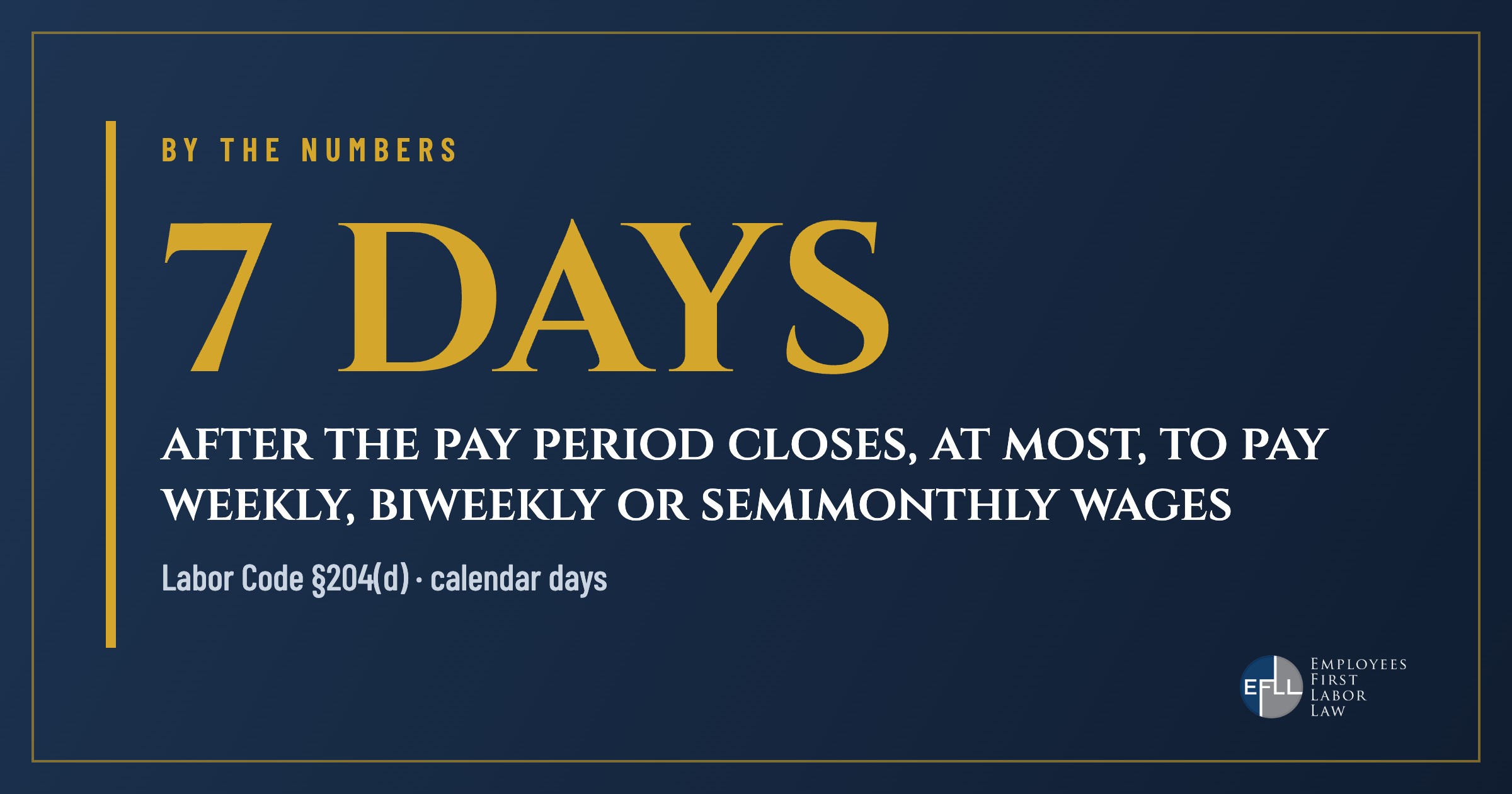
Subdivision (d): the seven-day rule. The requirements are satisfied for weekly, biweekly or semimonthly payrolls “if the wages are paid not more than seven calendar days following the close of the payroll period.”
The remaining subdivisions provide that a collective bargaining agreement with different pay arrangements controls for covered employees (subdivision (c)), and set special payday rules for employees of the University of California Regents (subdivision (e)).
Payday deadlines at a glance
| Pay schedule or wage type | Deadline | Law |
|---|---|---|
| Semimonthly, work from the 1st to the 15th | Between the 16th and the 26th of the same month | Labor Code §204(a) |
| Semimonthly, work from the 16th to month-end | Between the 1st and the 10th of the next month | Labor Code §204(a) |
| Weekly, biweekly or semimonthly payroll periods | No more than 7 calendar days after the period closes | Labor Code §204(d) |
| Overtime beyond the normal work period | By the payday for the next regular payroll period | Labor Code §204(b) |
| Certain FLSA-exempt salaried executives, administrators and professionals | Once a month, on or before the 26th, for the whole month | Labor Code §204(a) |
| Final wages when you quit or are fired | Different, stricter deadlines | Labor Code §§201, 202 |
Who §204 covers, and the exceptions
Section 204 applies to most private-sector employees in California, whether paid hourly, by salary, by commission or by piece rate. Its exceptions and limits include:
- Final wages. Wages due at the end of employment follow Labor Code §§201 and 202 (and related sections), not §204. See our explainer on final paycheck deadlines.
- Other special sections. Section 204(a) itself carves out wages covered by §§201.3 (temporary services employees), 204.1 and 204.2, which have their own rules.
- Union contracts. Under §204(c), a collective bargaining agreement that provides different pay arrangements applies to the covered employees.
- Public employees. Under Labor Code §220, §204 does not apply to employees directly employed by the State of California, or by a county, city, town or other municipal corporation.
Section 204 works together with Labor Code §207, which requires employers to post a notice at the workplace showing the regular paydays and the time and place of payment.
Repeated late paychecks can add up to penalties, and they are often a sign of other wage violations. Get a free, confidential case review.
Common payday questions the Labor Commissioner has answered
The Labor Commissioner’s Office has published guidance on how §204 applies in everyday situations:
- Missing timecard. An employer cannot hold your pay until you turn in a timecard. It must pay on the regular payday at least the wages it reasonably knows are due for your scheduled work.
- Payday on a holiday. If the regular payday falls on a holiday and the business closes for it, the employer may pay on the next business day.
- Changing pay schedules. An employer can change, for example, from biweekly to semimonthly pay, as long as it gives prior notice and the new schedule meets the payday requirements.
- Criminal exposure. According to the Labor Commissioner’s Office, failing to post the payday notice or to pay wages on the regular payday as required can be a misdemeanor under Labor Code §215.
Worked example: is this paycheck late?
💡 Example (hypothetical): Maya is paid every two weeks. Her pay period closes on Friday, June 12. Under §204(d), her paycheck for that period is due no later than seven calendar days later, Friday, June 19. Her employer instead pays her on Tuesday, June 23. That paycheck was 4 days late.
During the same period, Maya worked 6 overtime hours that came in after payroll was processed. Under §204(b), those overtime wages can be paid by the payday for the next regular payroll period, as long as the next pay stub shows them as a correction with the dates of the earlier period.
💡 Example (hypothetical): Omar is paid semimonthly. For work from March 1 to March 15, his employer must pay between March 16 and March 26. A paycheck dated March 31 for that work would violate §204(a), even though it arrives within the same month.
Remedies for late paychecks
Section 204 sets the deadlines. The main remedy for missing them is Labor Code §210, which applies to late payment under §204 and several related sections:
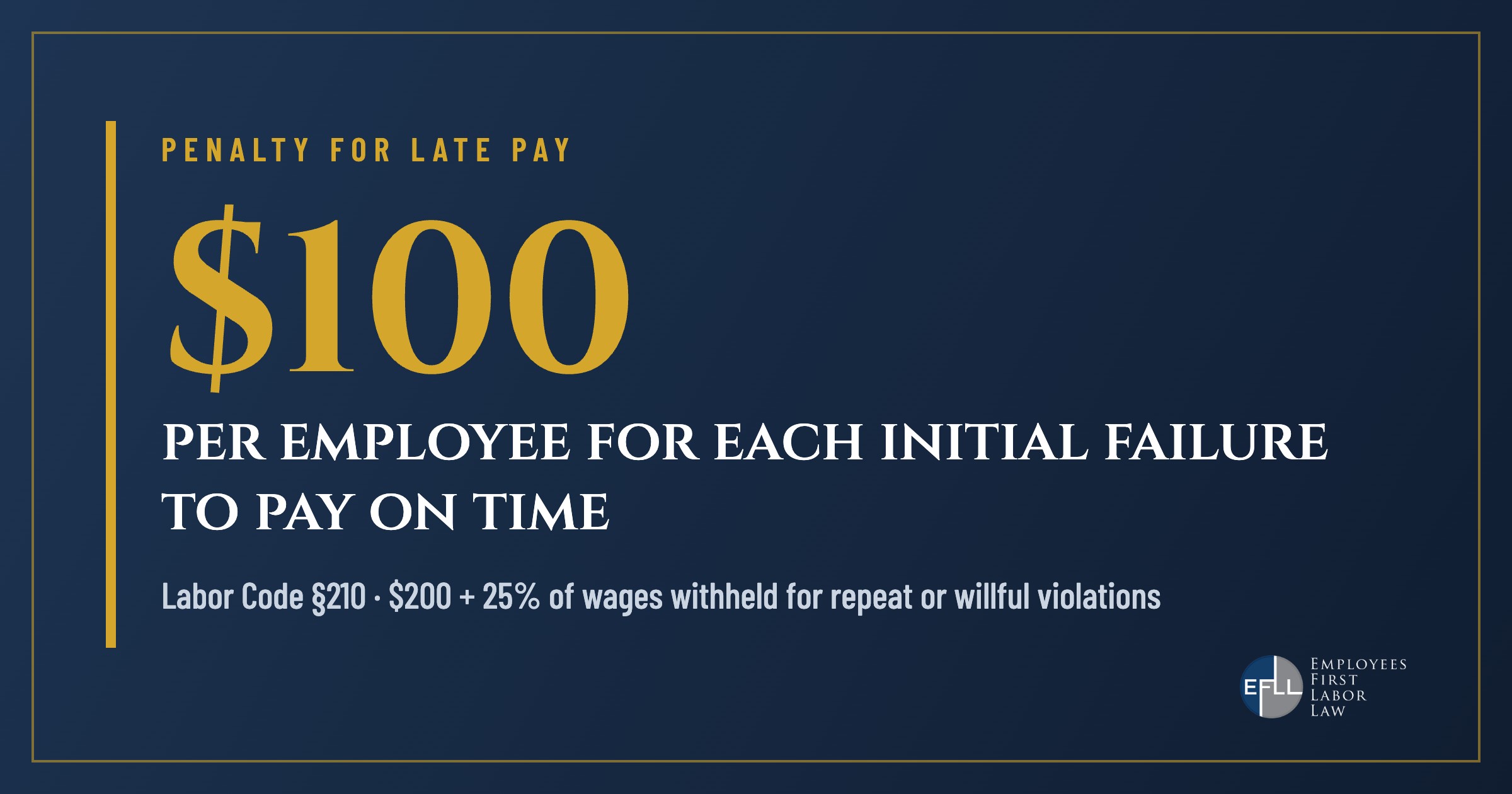
- Initial violation: $100 for each failure to pay each employee.
- Subsequent or willful violation: $200 for each failure to pay each employee, plus 25% of the amount unlawfully withheld.
Under §210(b), the penalty can be recovered by the employee as a statutory penalty through a Labor Commissioner claim under Labor Code §98, or by the Labor Commissioner as a civil penalty through a citation. Under §210(c), an employee can recover either the §210 statutory penalty or a civil penalty under the Private Attorneys General Act (PAGA) for the same violation, but not both. Section 204 is also one of the provisions listed in Labor Code §2699.5 for PAGA claims.
You may also be owed interest on late wages (Labor Code §218.6). If a paycheck bounces, Labor Code §203.1 provides a separate penalty. Our explainer on the late paycheck penalty rules covers these in more detail.
Deadlines and where to file
The deadline depends on what you are claiming. Claims for unpaid wages under the Labor Code are generally subject to a three-year statute of limitations under Code of Civil Procedure §338(a). Claims for statutory penalties can have a shorter deadline: Code of Civil Procedure §340(a) sets a one-year period for an action on a statute for a penalty given to an individual, unless the statute sets a different limit. Because the deadline for a late-pay penalty may be as short as one year, act promptly.
Your main options are:
- Keep records of each payday, the date you were actually paid, and your pay stubs.
- Contact or file a claim with the Labor Commissioner’s Office, which can explain the law to your employer, hear a claim for the §210 penalty, or issue a citation.
- Talk to a lawyer about a lawsuit or PAGA claim, especially if late pay is repeated or affects many workers. See Labor Commissioner wage claim vs. hiring a lawyer.
It is illegal for an employer to retaliate against you for complaining about late pay. Our guide to retaliation claims in California explains your protections.
Related Labor Code sections
- §§201 and 202: final pay deadlines when you are fired or quit.
- §207: employers must post regular paydays and the time and place of payment.
- §210: penalties for late payment of wages under §204 and related sections.
- §226: itemized wage statements. See our pay stub guide.
- §2810.5: the hiring notice must state your regular payday.
Frequently asked questions
How often must I be paid in California?
Generally at least twice a month, on regular paydays your employer designates in advance (Labor Code §204(a)). Some FLSA-exempt salaried executive, administrative and professional employees may be paid once a month.
How long can my employer wait after the pay period ends?
For weekly, biweekly and semimonthly payrolls, generally no more than seven calendar days after the pay period closes (Labor Code §204(d)).
When must overtime be paid?
Overtime for work beyond the normal work period must be paid no later than the payday for the next regular payroll period (Labor Code §204(b)).
Can my employer hold my check because I forgot to turn in my timecard?
No. The Labor Commissioner’s Office says the employer must still pay on the regular payday, at least for the wages it reasonably knows are due.
What is the penalty for a late paycheck?
Under Labor Code §210, $100 per employee for each initial failure to pay on time, and $200 per employee for each subsequent or willful failure plus 25% of the amount withheld.
Related guides
 Workers only. Never employers.
At Employees First Labor Law, we represent California workers only, never employers. Our team has recovered more than $200 million for our clients, and we prepare every case as if it is going to trial. We have offices in Pasadena, Irvine, Long Beach, Pomona, Riverside, Bakersfield and Fresno, and we serve workers throughout California. Meet our team.






If your employer pays you late, skips paydays, or holds your check, we can review your pay records and pursue the wages, penalties and interest you are owed, including through PAGA when the problem affects your coworkers too.
- ✅ Free, confidential consultation
- ✅ We represent workers only, never employers
- ✅ Se habla español: Empleados Primero
This article provides general information about California law and is not legal advice for any specific situation. Reading it does not create an attorney-client relationship. Past results do not guarantee a similar outcome.