

Updated October 2026 · 6 min read
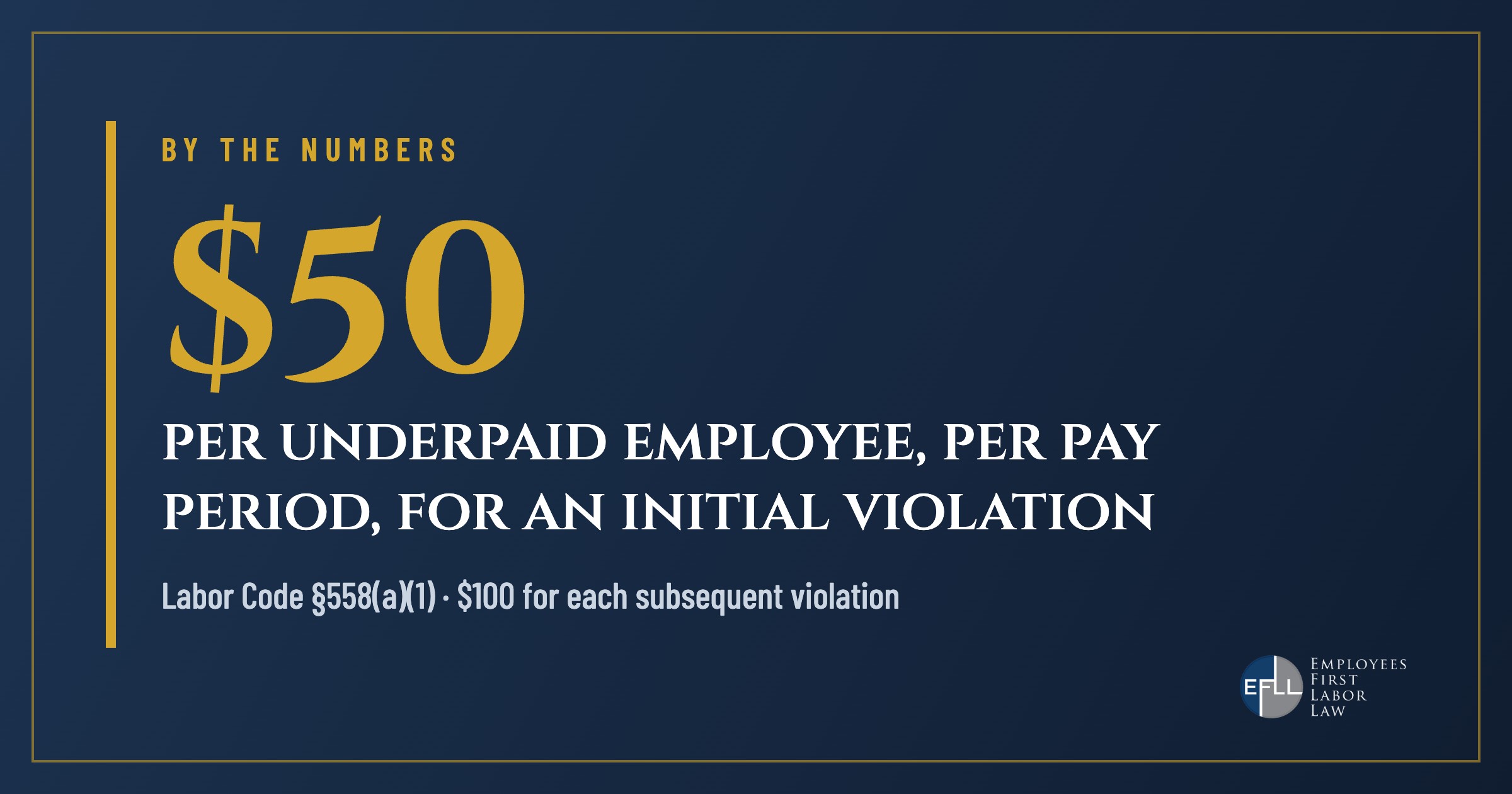
California Labor Code §558 makes an employer, or a person acting on its behalf, who violates California’s working-hours rules subject to a civil penalty of $50 per underpaid employee for each pay period of an initial violation and $100 per underpaid employee for each pay period of each subsequent violation, plus an amount sufficient to recover the underpaid wages. It covers overtime, meal-period and other hours rules in the Labor Code and in the Industrial Welfare Commission (IWC) Wage Orders.
The per-employee, per-pay-period structure is what makes §558 matter. A company that denies daily overtime to 20 workers for six biweekly pay periods faces $6,000 in initial-violation penalties (20 × 6 × $50), or $12,000 if every pay period is treated as a subsequent violation, before any back wages.
This page explains what §558 says, which violations it reaches, who can collect the penalty and how it connects to the Private Attorneys General Act (PAGA), with a worked example, deadlines and where to report a violation. If you are owed overtime yourself, start with our guide on claiming unpaid overtime in California.
- Labor Code §558 imposes $50 per underpaid employee per pay period for an initial violation and $100 for each subsequent violation, plus the underpaid wages.
- It covers the Labor Code’s working-hours chapter (§§500–558.1, including overtime and meal periods) and the hours provisions of the Wage Orders.
- The Labor Commissioner can cite employers, and workers can recover the penalties through PAGA, split 65% to the state and 35% to employees.
- Under ZB, N.A. v. Superior Court, the underpaid wages are not recoverable as a PAGA penalty; you pursue them through your own wage claim.
- PAGA penalty claims generally have a one-year deadline and require notice to the LWDA first.
What Labor Code §558 says
Subdivision (a) applies to “any employer or other person acting on behalf of an employer who violates, or causes to be violated,” either a section of the Labor Code chapter on working hours or “any provision regulating hours and days of work in any order of the Industrial Welfare Commission.” The penalty is:
- Initial violation: $50 for each underpaid employee for each pay period the employee was underpaid, “in addition to an amount sufficient to recover underpaid wages.”
- Each subsequent violation: $100 for each underpaid employee for each pay period, plus the underpaid wages.
- Wages to workers: wages recovered under the section “shall be paid to the affected employee.”
Subdivision (b) lets the Labor Commissioner issue a citation after an inspection or investigation finds overtime was paid in violation of the chapter, a Wage Order or an applicable local overtime law, using the citation procedures in Labor Code §1197.1. Subdivision (c) lets the Labor Commissioner cite for local overtime law violations at a local agency’s request. Subdivision (d) says these penalties are in addition to any other civil or criminal penalty, and subdivision (e) leaves local overtime laws in place.
Which violations §558 covers
“This chapter” means Chapter 1 of Part 2 of Division 2 of the Labor Code, Labor Code §§500 through 558.1. The most common violations it reaches are:
| Violation | Rule | Where it lives |
|---|---|---|
| Unpaid daily, weekly or seventh-day overtime | 1.5× or 2× the regular rate | Labor Code §510; Wage Order section 3 |
| Invalid alternative workweek schedule | Election and disclosure requirements | Labor Code §511; Wage Order section 3 |
| Missing or late meal periods | 30 minutes for workdays over 5 hours; second over 10 hours | Labor Code §512; Wage Order section 11 |
| Other hours and days-of-work rules | Industry-specific limits in the Wage Orders | IWC Wage Orders |
Whether a particular Wage Order rule “regulates hours and days of work,” such as rest periods, can be disputed, so ask a lawyer before counting on §558 for a specific violation.
Who pays: employers and individuals
Section 558 applies not only to the employer but to any “other person acting on behalf of an employer” who violates or causes a violation. A separate statute, Labor Code §558.1, goes further: an owner, director, officer or managing agent who violates or causes violations of the minimum wage or hours provisions of the Wage Orders, or of Labor Code §§203, 226, 226.7, 1193.6, 1194 or 2802, “may be held liable as the employer.” In a closely held business, that can put the people who made the decisions on the hook personally.
When overtime or meal period violations affect many workers, penalties under §558 and PAGA can add up quickly. Our attorneys offer a free, confidential case review.
Who collects the penalty, and how it relates to PAGA
There are two paths:
- The Labor Commissioner can investigate and issue a citation under §558(b).
- Workers, through PAGA. Labor Code §2699(a) lets an aggrieved employee recover, in a civil action, any Labor Code civil penalty that the Labor and Workforce Development Agency (LWDA) or its departments could assess. Because §558 sets its own penalty amounts, a PAGA claim based on §558 uses those amounts rather than PAGA’s default penalty, which applies only where no specific civil penalty is provided (§2699(f)).
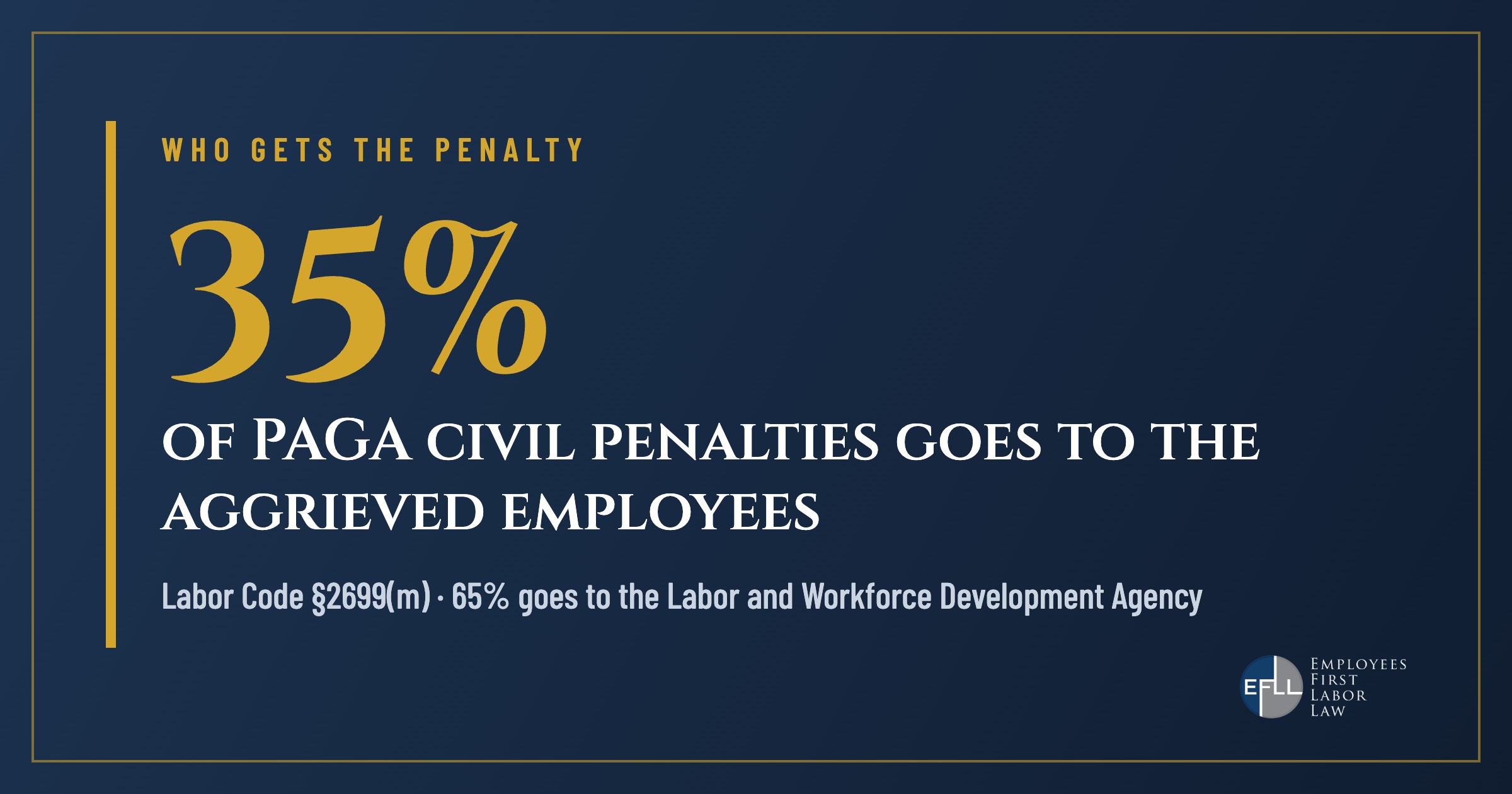
Under §2699(m), civil penalties recovered by aggrieved employees are split 65% to the LWDA and 35% to the aggrieved employees. The 2024 PAGA reforms also let courts reduce penalties for employers that took certain compliance steps.
One important limit: in ZB, N.A. v. Superior Court (2019), the California Supreme Court held that the civil penalties a plaintiff may seek under §558 through PAGA do not include the “amount sufficient to recover underpaid wages.” The wages themselves must be pursued as your own wage claim, and that individual claim may be subject to an arbitration agreement. Our article on headless PAGA claims covers related strategy.
Worked example
💡 Example (hypothetical): A warehouse pays 20 hourly workers every two weeks and does not pay daily overtime for 10-hour shifts. Over 6 pay periods, each worker is underpaid every period. If all 120 employee pay periods (20 workers × 6 pay periods) are treated as an initial violation, the §558 penalty is 120 × $50 = $6,000. If they are treated as subsequent violations, it is 120 × $100 = $12,000. Recovered through PAGA, the $6,000 figure would be split $3,900 (65%) to the LWDA and $2,100 (35%) to the 20 workers, about $105 each. Each worker’s unpaid overtime wages are recovered separately through his or her own wage claim.
The statute does not define when a violation becomes “subsequent,” and whether the $100 rate applies is often contested. You can estimate the underlying unpaid overtime with our wage and hour calculator.
Deadlines
- PAGA penalty claims are generally subject to the one-year statute of limitations in Code of Civil Procedure §340(a), which covers actions on a statute “for a penalty or forfeiture” given to an individual, or to an individual and the state. Before filing a PAGA lawsuit you must first give written notice to the LWDA and the employer under Labor Code §2699.3 and wait for the agency’s response period.
- Your own unpaid wages (overtime, meal premiums) are generally subject to the three-year deadline in Code of Civil Procedure §338(a), and in some court cases up to four years under Business and Professions Code §17208.
Where to report or file
| Goal | Where | Law |
|---|---|---|
| Recover your own unpaid wages | Labor Commissioner wage claim, superior court or arbitration | Labor Code §§98, 1194 |
| Ask the state to investigate and cite | Report the violation to the Labor Commissioner’s Office | Labor Code §558(b) |
| Recover §558 penalties for you and co-workers | PAGA notice to the LWDA, then a civil action | Labor Code §§2699, 2699.3 |
Not sure which route fits? Our article on filing with the Labor Commissioner versus hiring a lawyer compares them.
What to do if you suspect hours violations
- Keep your own record of start times, end times and meal periods.
- Save pay stubs showing hours and rates; compare them with your record.
- Note which co-workers are affected and how (same schedule, same pay practice).
- Request your payroll records under Labor Code §226(b).
- Talk to an employment lawyer quickly. The one-year PAGA clock is short, and the LWDA notice must be filed first.
Related Labor Code sections
- §510, §511, §512: overtime, alternative workweeks and meal periods.
- §558.1: personal liability for owners, directors, officers and managing agents.
- §1197.1: minimum wage citations; its procedures also govern §558 citations.
- §2699 and §2699.3: PAGA civil actions and notice requirements.
- §226.7: premium pay for missed meal, rest and recovery periods.
Frequently asked questions
How much is the Labor Code §558 penalty?
$50 per underpaid employee for each pay period of an initial violation and $100 per underpaid employee for each pay period of each subsequent violation, plus an amount sufficient to recover the underpaid wages.
Does the §558 penalty go to me?
Not directly. If the Labor Commissioner cites the employer, the civil penalty is assessed by the state, while §558(a)(3) requires recovered wages to be paid to the affected employees. If you recover the penalty through PAGA, 35% goes to the aggrieved employees and 65% to the LWDA.
Can I recover my unpaid wages through a §558 PAGA claim?
No. The California Supreme Court held in ZB, N.A. v. Superior Court that the underpaid-wages portion of §558 is not a civil penalty recoverable through PAGA. You recover your wages through your own wage claim.
Can a manager or owner be personally liable?
Yes, in some cases. Section 558 reaches any “person acting on behalf of an employer,” and §558.1 lets courts hold an owner, director, officer or managing agent liable as the employer for certain wage violations they cause.
What is the deadline for a §558 claim?
Through PAGA, generally one year (Code of Civil Procedure §340), with LWDA notice required first. Claims for your own underlying wages generally have three years.
Related guides
 Workers only. Never employers.
At Employees First Labor Law, we represent California workers only, never employers. Our team has recovered more than $200 million for our clients, and we prepare every case as if it is going to trial. We have offices in Pasadena, Irvine, Long Beach, Pomona, Riverside, Bakersfield and Fresno, and we serve workers throughout California. Meet our team.





We help California workers recover unpaid overtime and meal period wages and pursue the civil penalties the Labor Code and PAGA allow, for themselves and their co-workers. Tell us what is happening at your workplace and we will explain your options.
- ✅ Free, confidential consultation
- ✅ We represent workers only, never employers
- ✅ Se habla español: Empleados Primero
This article provides general information about California law and is not legal advice for any specific situation. Reading it does not create an attorney-client relationship. Past results do not guarantee a similar outcome.