

Updated October 2026 · 9 min read
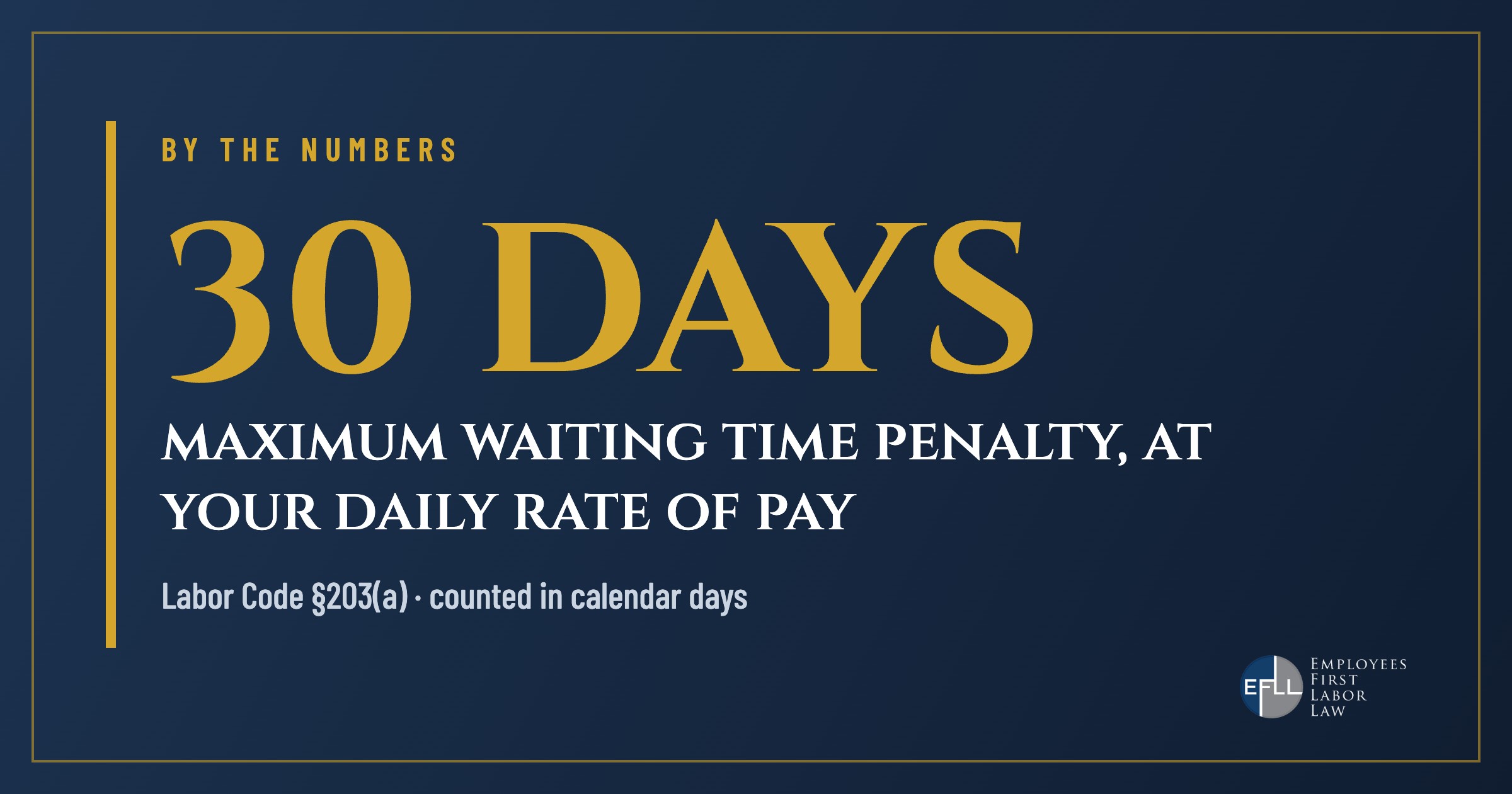
California Labor Code §203 says that when an employer willfully fails to pay all final wages on time to an employee who quits or is fired, the employee’s daily wages keep running as a penalty, for up to 30 days. It is the enforcement teeth behind the final-pay deadlines in Labor Code §§201 and 202, and it is commonly called the “waiting time penalty.”
The numbers add up quickly. A worker who earns $200 a day and never receives a final paycheck can be owed a penalty of up to $6,000 (30 days × $200), on top of the unpaid wages themselves. The penalty does not depend on how much was left unpaid. A small shortfall can trigger the same daily penalty as a large one.
This page walks through the text of §203 line by line: what it requires, who it covers, how the penalty is calculated, how long you have to claim it, and where to file. For a broader, step-by-step guide to final paychecks, see our article on California final paycheck rules and waiting time penalties.
- Labor Code §203 adds a penalty of one day’s wages for each day final pay is willfully late, up to 30 days.
- It enforces the final-pay deadlines in §§201 and 202: immediately if you are fired or laid off, and within 72 hours (or on your last day with notice) if you quit.
- The penalty counts calendar days and includes regularly scheduled overtime in your daily rate.
- A good-faith dispute over whether wages are owed is the main defense; inability to pay is not.
- You can generally claim the penalty within three years, through the Labor Commissioner or in court.
What Labor Code §203 says
Section 203 has two parts. Subdivision (a) creates the penalty. In plain English, it provides that if an employer “willfully fails to pay, without abatement or reduction,” the wages of an employee who is discharged or who quits, as required by the final-pay sections of the Labor Code, then “the wages of the employee shall continue as a penalty from the due date thereof at the same rate until paid or until an action therefor is commenced.” The penalty cannot run for more than 30 days.
Subdivision (a) also contains one limit that protects employers: an employee who hides or stays away to avoid being paid, or who refuses a payment that is fully offered, cannot collect the penalty for the time he or she avoided payment.
Subdivision (b) deals with timing. It says a lawsuit for these penalties may be filed any time before the statute of limitations expires on a claim for the wages that the penalty is based on.
The final-pay sections that §203 enforces are listed in the statute itself: §§201, 201.3, 201.5, 201.6, 201.8, 201.9, 202 and 205.5. The two that apply to most workers are §201 (fired or laid off: wages are due immediately) and §202 (quit: wages due within 72 hours, or at the time of quitting if you gave at least 72 hours’ notice). We explain those deadlines in detail in our article on when your final paycheck is due.
Who §203 covers, and the exceptions
Section 203 protects employees whose employment has ended, whether they were fired, laid off or quit. The Labor Commissioner’s Office treats a layoff as a discharge for this purpose. The penalty applies to “any wages,” which includes hourly pay, overtime, commissions that have been earned, and earned but unused vacation or PTO that must be paid out under Labor Code §227.3.
Some things fall outside §203:
- Current employees. A late paycheck while you are still working is governed by Labor Code §204 and the penalty in §210, not §203. See our guide to late paychecks and payday rules.
- Business expenses. The Labor Commissioner’s Office takes the position that reimbursable expenses are not “wages,” so late reimbursement alone does not trigger a §203 penalty. (It can still be recovered under Labor Code §2802.)
- Accrued paid sick leave. Under Labor Code §246(g), employers generally do not have to pay out accrued, unused paid sick days at separation. (A combined PTO bank that can be used for any purpose is different: the Labor Commissioner treats it like vacation.)
- Local government employees. Under Labor Code §220(b), §203 and the other wage-payment sections from §200 to §211 do not apply to employees directly employed by a county, city, town or other municipal corporation.
- Employees who avoid or refuse payment. As noted above, the penalty stops for any period you hid from, or turned down, a full payment.
What “willful” means, and the good-faith dispute defense
The penalty only applies to a “willful” failure to pay. That word is narrower than it sounds. California’s Labor Commissioner regulation, Cal. Code Regs., tit. 8, §13520, defines a willful failure to pay as one where the employer “intentionally fails to pay wages to an employee when those wages are due.” The employer does not need to act out of malice. The Labor Commissioner’s Office explains that it is enough that the employer knows what it is doing, the failure is within its control, and it does not do what the law requires.
The main defense is a “good faith dispute.” Under the same regulation, a good faith dispute exists when the employer presents a defense, based in law or fact, that would defeat the employee’s claim entirely if it succeeded. A defense that ultimately loses can still count. But a defense that is unsupported by any evidence, unreasonable, or raised in bad faith does not qualify.
Some common excuses do not work. The Labor Commissioner’s Office states that an employer’s inability to pay is not a defense to failing to pay final wages on time. Nor is “we always pay final checks on the next regular payday.”
You may be owed up to 30 days of wages on top of what you were already owed. Get a free, confidential case review.
How the waiting time penalty is calculated
The formula is simple: daily rate of pay × number of days the wages were late, capped at 30 days. A few rules from the Labor Commissioner’s guidance matter:
- Calendar days count. Weekends, days off and holidays all count toward the 30 days, not just days you would have worked.
- Regularly scheduled overtime counts. If overtime was part of your normal schedule, it is included in your daily rate. Occasional or irregular overtime is not.
- Salaried workers use a daily rate, not a monthly salary. The Labor Commissioner’s method converts salary to an annual figure, divides by 52 weeks, then divides by the number of workdays per week.
- The amount owed does not matter. The penalty is based on your daily wage, not on the size of the unpaid balance.
💡 Example (hypothetical): Luis earns $25 an hour and works a regular 8-hour day, so his daily rate is $200 (8 × $25). He is fired on March 6 but does not receive his final check until March 16. His final wages were 10 days late, so the waiting time penalty is 10 × $200 = $2,000. If Luis had also regularly worked two hours of overtime a day at $37.50 an hour (1.5 × $25), his daily rate would be $275 ($200 + $75), and the 10-day penalty would be $2,750. If he were never paid, the penalty would stop growing at 30 days: 30 × $275 = $8,250.
💡 Example (hypothetical): Dana is salaried at $5,000 a month and works five days a week. Her daily rate is $5,000 × 12 = $60,000 a year; $60,000 ÷ 52 = about $1,153.85 a week; $1,153.85 ÷ 5 = about $230.77 a day. A full 30-day penalty would be about $6,923.08, which is more than one month’s salary.
You can run your own numbers with our wage and hour calculator.
When the penalty stops running
Under §203(a), the penalty runs from the date the wages were due until the earliest of three events:
- The employer pays (or fully offers) all final wages owed.
- The employee files a lawsuit for the wages (“until an action therefor is commenced”).
- Thirty days pass.
One point surprises many workers. According to the Labor Commissioner’s Office, filing a wage claim with the Labor Commissioner is not “an action” for this purpose, so it does not stop the penalty from accruing. Filing a lawsuit in court does.
Partial payment does not stop the clock either. Section 203 refers to payment “without abatement or reduction,” and the Labor Commissioner’s examples measure the penalty up to the date all of the wages due are paid, subject to the good-faith dispute defense. Under Labor Code §206, an employer must pay any wages it concedes are owed, without conditions, even while it disputes the rest.
Deadline to claim §203 penalties
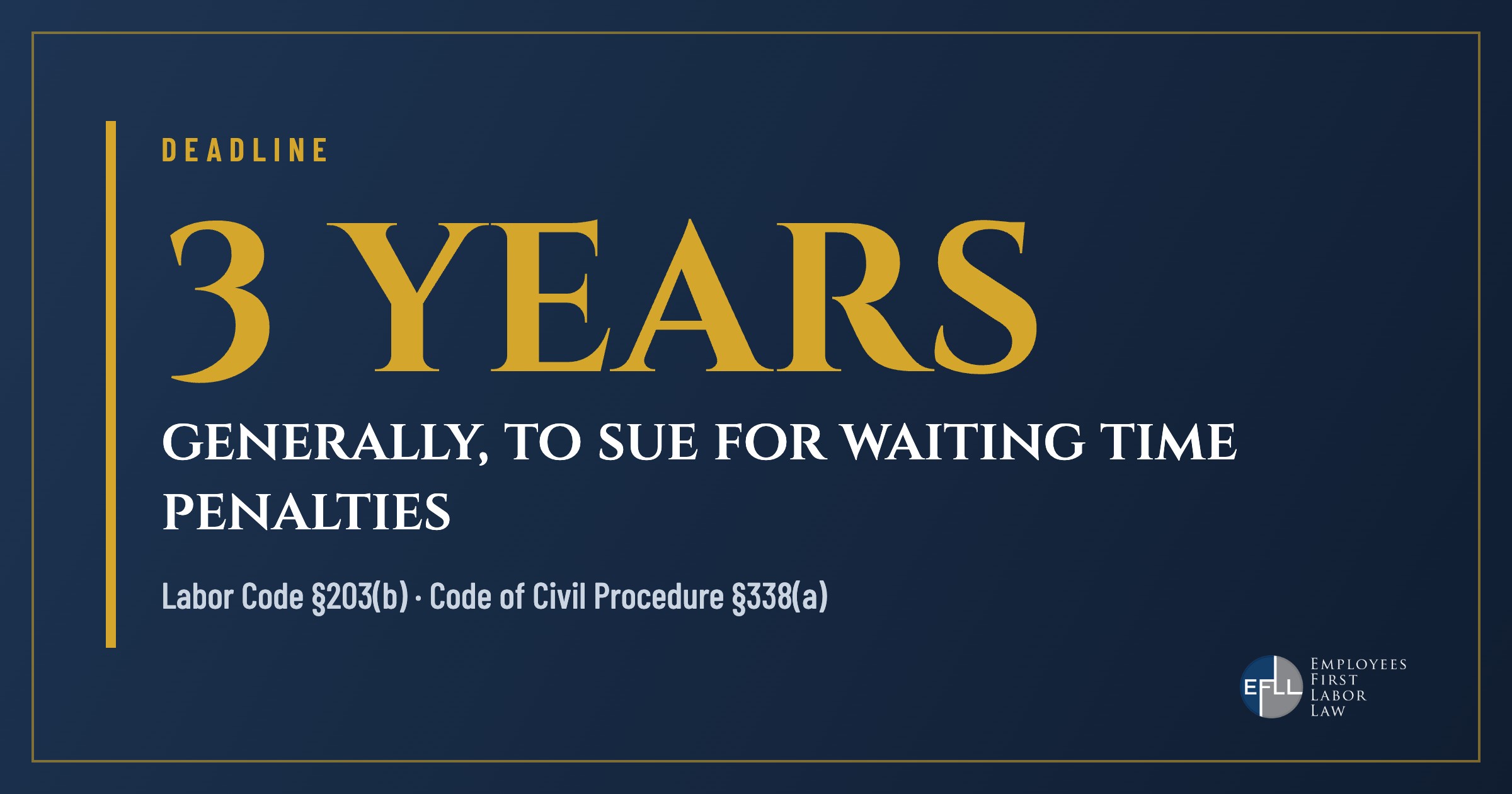
Section 203(b) ties the deadline for waiting time penalties to the deadline for the underlying wages. For most unpaid-wage claims based on the Labor Code, that deadline is three years under Code of Civil Procedure §338(a), which covers actions “upon a liability created by statute.” In practice, that generally gives you three years from the date your final wages were due to pursue a §203 penalty.
Other deadlines can apply depending on the claim, so it is safest to act well before the three-year mark.
Where to file a §203 claim
| Option | How it works | Law |
|---|---|---|
| Labor Commissioner wage claim | File a claim with the Labor Commissioner’s Office (DLSE) for unpaid final wages and waiting time penalties. There is a conference and, if needed, a hearing. | Labor Code §98 |
| Lawsuit in superior court | Sue for the wages, the §203 penalty, interest and, in many cases, attorney’s fees and costs. Filing the suit stops further penalty accrual. | Labor Code §§203, 218.5, 218.6 |
| PAGA representative action | Late final pay can also support civil penalties under the Private Attorneys General Act, after notice to the Labor and Workforce Development Agency. | Labor Code §§2699, 2699.3, 2699.5 |
Each route has trade-offs in speed, cost and what you can recover. Our article comparing a Labor Commissioner wage claim with hiring a lawyer explains the differences.
Related Labor Code sections
- §201: wages of a discharged employee are due immediately.
- §202: an employee who quits must be paid within 72 hours, or at the time of quitting with 72 hours’ notice.
- §203.1: a separate penalty of up to 30 days’ wages when a paycheck bounces for lack of funds.
- §206: undisputed wages must be paid even when other amounts are disputed.
- §208: where final pay must be delivered (place of discharge, or the employer’s office in the county where you worked).
- §227.3: vested vacation must be paid at the final rate when employment ends. See our guide to vacation payout.
- §§218.5 and 218.6: attorney’s fees and interest in actions for nonpayment of wages.
Late final pay is often a sign of other problems, such as unpaid overtime, missed meal breaks or inaccurate pay stubs. If your final pay was late, it is worth reviewing your pay stubs as well. Our wage and hour attorneys can review the whole picture.
Frequently asked questions
Is Labor Code 203 the same as the “waiting time penalty”?
Yes. “Waiting time penalty” is the common name for the penalty created by Labor Code §203. It is up to 30 days of your daily wages when an employer willfully fails to pay final wages on time.
Does the 30-day penalty count weekends?
Yes. According to the Labor Commissioner’s Office, the penalty is counted in calendar days, including weekends, days off and holidays.
My employer says it couldn’t afford to pay me. Is that a defense?
No. The Labor Commissioner’s Office states that inability to pay is not a defense to failing to pay final wages on time. The recognized defense is a good-faith dispute over whether wages are owed at all.
Does filing a wage claim stop the penalty from growing?
No. The Labor Commissioner’s Office says that a wage claim filed with its office is not an “action” under §203, so the penalty keeps accruing until payment or 30 days. Filing a lawsuit in court does stop it.
How long do I have to claim waiting time penalties?
Section 203(b) lets you sue for the penalty any time before the limitations period on the underlying wages expires. For most Labor Code wage claims that is three years (Code of Civil Procedure §338(a)).
Can I get the penalty if only a small amount was missing from my final check?
Often, yes. The penalty is based on your daily wage, not the size of the shortfall. If the missing amount was owed and there was no good-faith dispute, the full daily penalty can apply.
Related guides
 Workers only. Never employers.
At Employees First Labor Law, we represent California workers only, never employers. Our team has recovered more than $200 million for our clients, and we prepare every case as if it is going to trial. We have offices in Pasadena, Irvine, Long Beach, Pomona, Riverside, Bakersfield and Fresno, and we serve workers throughout California. Meet our team.







If your employer paid your final wages late, short, or not at all, we can calculate what you are owed under Labor Code §203 and pursue it. We also review your records for unpaid overtime, missed breaks and pay stub violations that often come with late final pay.
- ✅ Free, confidential consultation
- ✅ We represent workers only, never employers
- ✅ Se habla español: Empleados Primero
This article provides general information about California law and is not legal advice for any specific situation. Reading it does not create an attorney-client relationship. Past results do not guarantee a similar outcome.