

Updated October 2026 · 6 min read
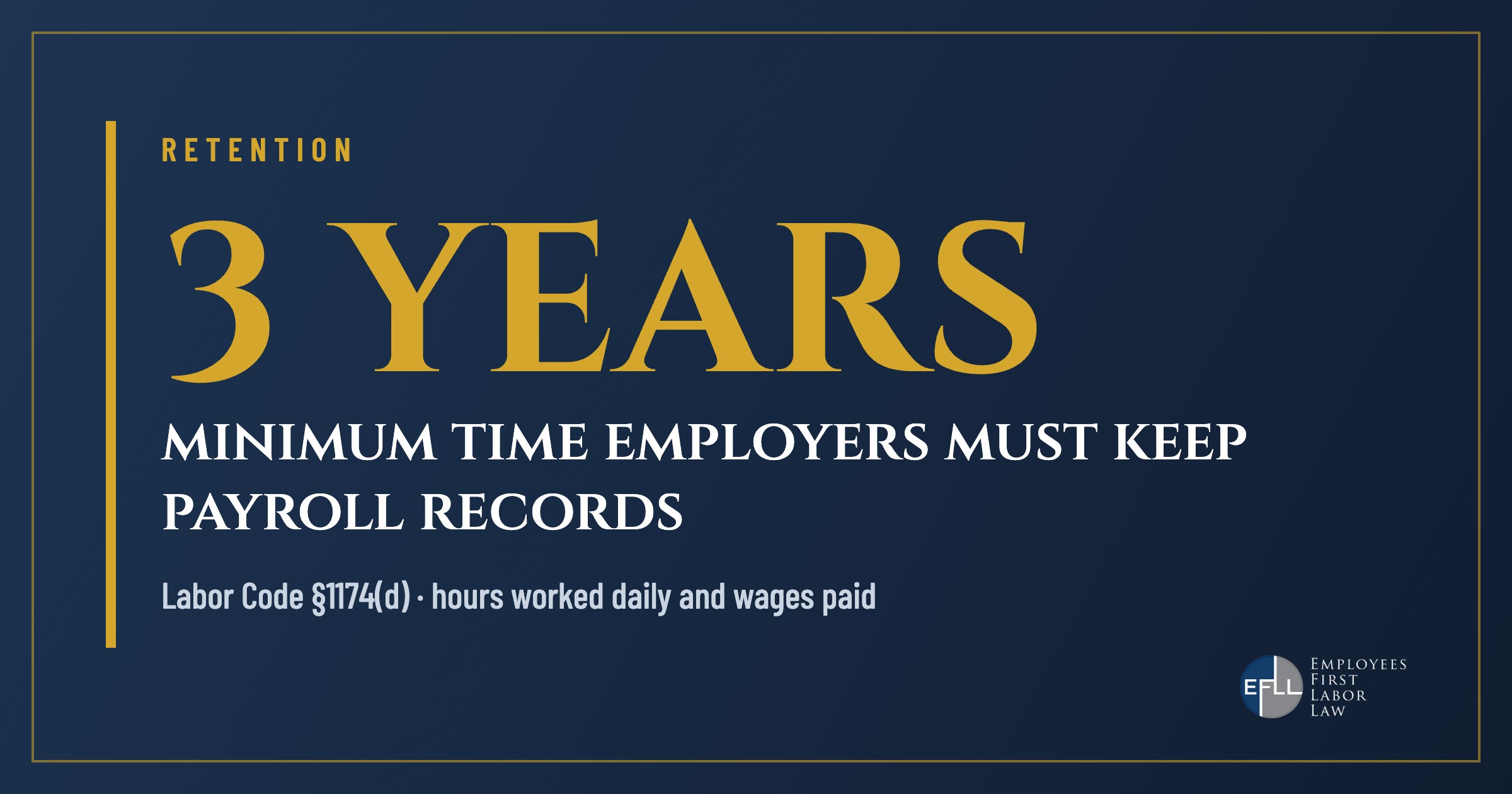
California Labor Code §1174 requires every employer to keep payroll records showing the hours each employee worked daily and the wages paid, keep them for at least three years, and let the Labor Commissioner inspect them. An employer cannot stop you from keeping your own record of your hours.
Recordkeeping sounds technical, but it often decides wage cases. When an employer’s time records are missing or unreliable, it becomes much harder for the employer to dispute a worker’s account of unpaid overtime, missed breaks or off-the-clock work.
This guide covers what §1174 says, who it applies to, what counts as a violation, the penalties, how to get your own records and the deadlines. If you need the records now, see our step-by-step guide on requesting your personnel file and payroll records.
- Labor Code §1174 requires employers to keep payroll records showing hours worked daily and wages paid to each employee.
- Records must be kept for at least three years, along with piece-rate units and rates where they apply.
- Your employer cannot prohibit you from keeping your own record of hours or piece-rate units.
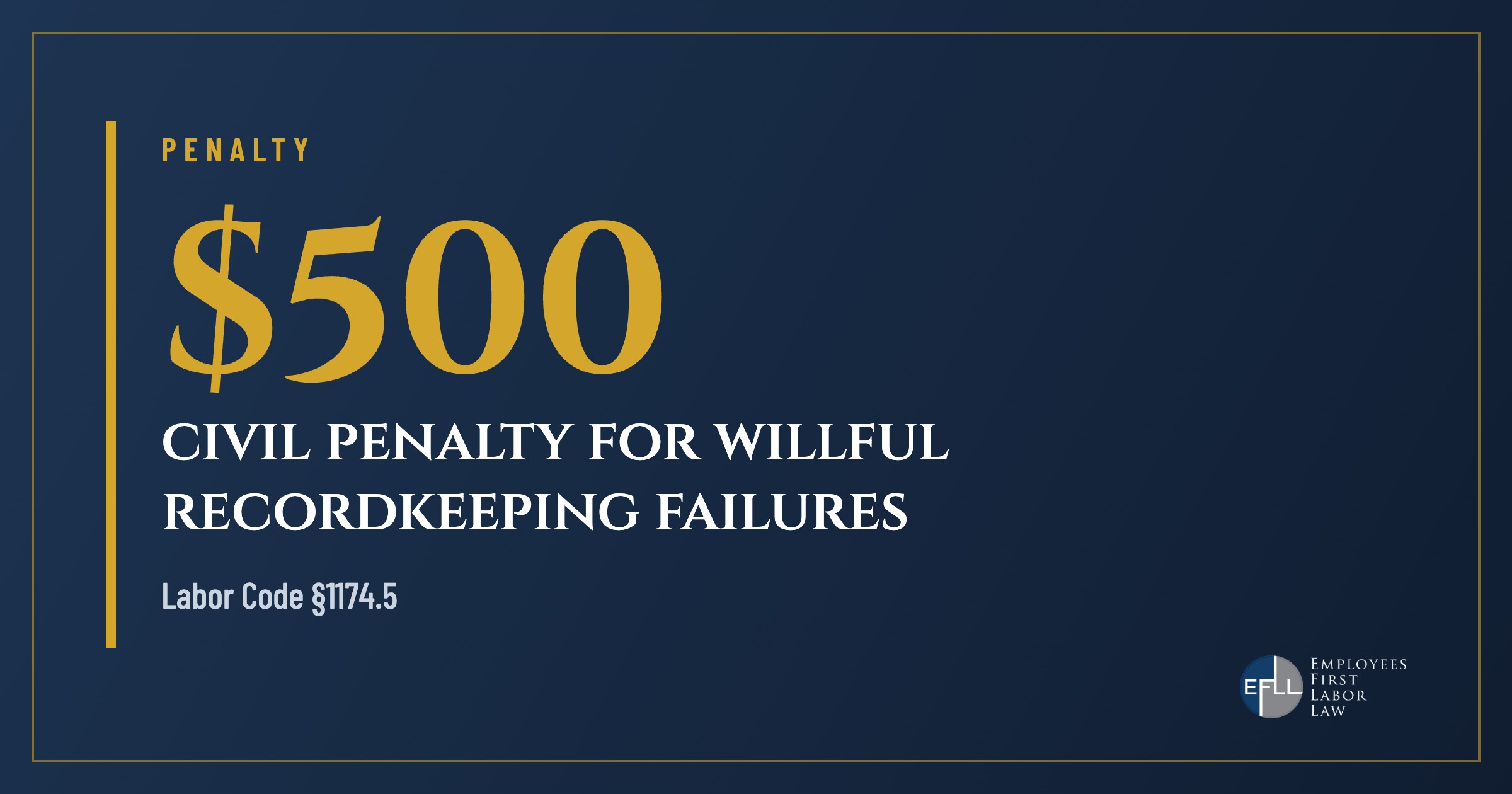
- A willful failure to keep records carries a $500 civil penalty under §1174.5, and PAGA penalties may apply.
- You can get your own records under §226(b) (21 days) and §1198.5 (30 days).
What Labor Code §1174 says
Section 1174 says that “every person employing labor in this state” shall do four things:
- (a) Report to the state. Furnish reports or information the Industrial Welfare Commission requires, verified if required.
- (b) Allow inspection. Give the commission and Division of Labor Standards Enforcement (the Labor Commissioner’s office) free access to the workplace to investigate, and let them inspect or copy books, reports, contracts, payrolls, documents or papers relating to employment.
- (c) Keep a roster. Keep a record of the names and addresses of all employees, and the ages of all minors.
- (d) Keep payroll records. Keep, at a central location in California or at the plants or establishments where employees work, payroll records “showing the hours worked daily by and the wages paid to” each employee, plus the number of piece-rate units earned and any applicable piece rate.
Subdivision (d) also sets the retention rule: the records must be kept “on file for not less than three years.” And it adds a worker protection: “An employer shall not prohibit an employee from maintaining a personal record of hours worked, or, if paid on a piece-rate basis, piece-rate units earned.”
The section was last amended effective January 1, 2012.
Who §1174 covers
The duty applies to “every person employing labor in this state,” which covers private employers of every size. It protects all employees: hourly, salaried, piece-rate and commissioned.
The industry wage orders issued by the Industrial Welfare Commission add their own, more detailed recordkeeping requirements. Wage Order 4, which covers professional, technical, clerical and similar occupations, is a typical example: it requires “time records showing when the employee begins and ends each work period,” and says meal periods, split shift intervals and total daily hours worked must also be recorded. It also requires records of total hours worked in each payroll period and the applicable rates of pay, made readily available to the employee on reasonable request. Section 1174 works alongside those rules, not in place of them.
What counts as a violation
An employer can violate §1174 by failing to keep required records, keeping incomplete or inaccurate records, destroying them before three years have passed, refusing the Labor Commissioner access, or forbidding employees from tracking their own time.
In practice, recordkeeping problems usually show up alongside pay problems:
- Edited or rounded punches that consistently shave minutes. See our guide on time rounding and automatic meal deductions.
- Automatic meal deductions recorded whether or not a break was taken.
- Work done before clock-in or after clock-out, such as security screenings, boot-ups or closing tasks. See off-the-clock work in California.
- Missing piece-rate counts, which make it impossible to check whether piece-rate workers were paid correctly.
💡 Example: Luis, a hypothetical warehouse worker, is told not to clock in until his shift starts, but he must arrive 15 minutes early for a safety briefing five days a week. His employer’s records show only scheduled hours. Luis keeps a simple notebook of his arrival times, which §1174(d) says his employer cannot forbid. At 15 minutes a day, that is 75 minutes a week of unrecorded work that may be owed as wages, and as overtime if it pushes him past 8 hours in a day or 40 in a week.
When the employer’s records are missing
California courts generally do not let an employer benefit from its own failure to keep records. When records are inadequate, a worker can typically prove unpaid hours with reasonable estimates based on memory, texts, schedules or other evidence, and the burden shifts to the employer to produce precise records or show the estimate is unreasonable.
Missing or edited records often hide unpaid wages and overtime. Get a free, confidential case review.
Remedies and penalties
| Provision | What it does |
|---|---|
| Labor Code §1174.5 | Civil penalty of $500 for an employer that willfully fails to keep the roster in §1174(c) or accurate and complete records under §1174(d), or that fails to allow inspection under §1174(b) |
| Labor Code §1199 | Makes it a misdemeanor to violate, refuse or neglect to comply with this chapter, punishable by a fine of at least $100, imprisonment of at least 30 days, or both |
| PAGA (Labor Code §2699) | Lets employees seek civil penalties for recordkeeping violations on behalf of the state and coworkers; §1174(c) and (d) are on the §2699.5 list that follows the standard notice track |
| Labor Code §226 | Separate penalties for inaccurate wage statements and for refusing payroll record requests |
The bigger recovery is usually the wages themselves: unpaid minimum wage, overtime and break premiums that the missing or false records were hiding.
How to get your records, deadlines and where to file
Section 1174 does not itself give employees a right to see their records. Two related sections do:
- Labor Code §226(b): current and former employees can inspect or receive a copy of the payroll records behind their wage statements. The request can be written or oral, the employer must comply within 21 calendar days, and a $750 penalty applies if it does not (§226(c), (f)).
- Labor Code §1198.5: current and former employees can inspect and copy their personnel records within 30 calendar days of a written request, with a $750 penalty for noncompliance.
For the underlying wage claims, the general deadline is three years (Code Civ. Proc. §338(a)), or four years under the Unfair Competition Law (Bus. & Prof. Code §17208). PAGA claims have a one-year limitations period (Code Civ. Proc. §340) and require notice to the Labor and Workforce Development Agency first. You can file a wage claim with the Labor Commissioner or bring a lawsuit; our guide on the Labor Commissioner vs. hiring a lawyer explains the tradeoffs.
What to do now
- Start your own log of start, end and break times today. Your employer cannot prohibit it.
- Request your payroll records under §226(b) and your personnel file under §1198.5 in one written letter.
- Compare the records to your pay stubs and your own notes, and look for rounding, auto-deductions or missing days.
- Estimate the gap with our wage and hour calculator, then talk to a lawyer before the deadlines run.
Related Labor Code sections
- §1174.5: the $500 civil penalty for willful recordkeeping failures.
- §1199: misdemeanor liability for violating the chapter or a wage order.
- §226: wage statements and employee access to payroll records. See our guide to California pay stub requirements.
- §1198.5: employee access to personnel records.
- §2699 and §2699.5: PAGA penalties and the notice track for §1174 violations.
Frequently asked questions
How long must California employers keep payroll records?
At least three years under Labor Code §1174(d). The records must show the hours worked daily and the wages paid to each employee, and piece-rate units and rates where applicable.
Can my employer stop me from tracking my own hours?
No. Section 1174(d) says an employer shall not prohibit an employee from maintaining a personal record of hours worked or piece-rate units earned.
What if my employer did not keep time records?
You can generally prove your hours with reasonable estimates and supporting evidence, and the employer then has to rebut them. Missing records can also lead to civil penalties.
How do I get a copy of my payroll records?
Make a request under Labor Code §226(b). The employer has 21 calendar days to comply, and a $750 penalty applies if it fails to.
What is the penalty for not keeping payroll records in California?
A willful failure carries a $500 civil penalty under §1174.5, violations of the chapter are misdemeanors under §1199, and employees can seek PAGA penalties on behalf of the state.
Related guides
 Workers only. Never employers.
At Employees First Labor Law, we represent California workers only, never employers. Our team has recovered more than $200 million for our clients, and we prepare every case as if it is going to trial. We have offices in Pasadena, Irvine, Long Beach, Pomona, Riverside, Bakersfield and Fresno, and we serve workers throughout California. Meet our team.







If your employer’s records leave out hours you worked, or it refuses to hand them over, we can help you get the records, reconstruct your time and pursue the wages and penalties you are owed.
- ✅ Free, confidential consultation
- ✅ We represent workers only, never employers
- ✅ Se habla español: Empleados Primero
This article provides general information about California law and is not legal advice for any specific situation. Reading it does not create an attorney-client relationship. Past results do not guarantee a similar outcome.