

Updated October 2026 · 8 min read
California Wage Order 11 sets the wage, hour and working-condition rules for the broadcasting industry: businesses that broadcast, or tape and broadcast, programs by radio or television. It covers non-exempt workers at radio and TV stations, from camera operators, editors, board operators and production assistants to traffic coordinators, sales assistants, engineers and office staff.
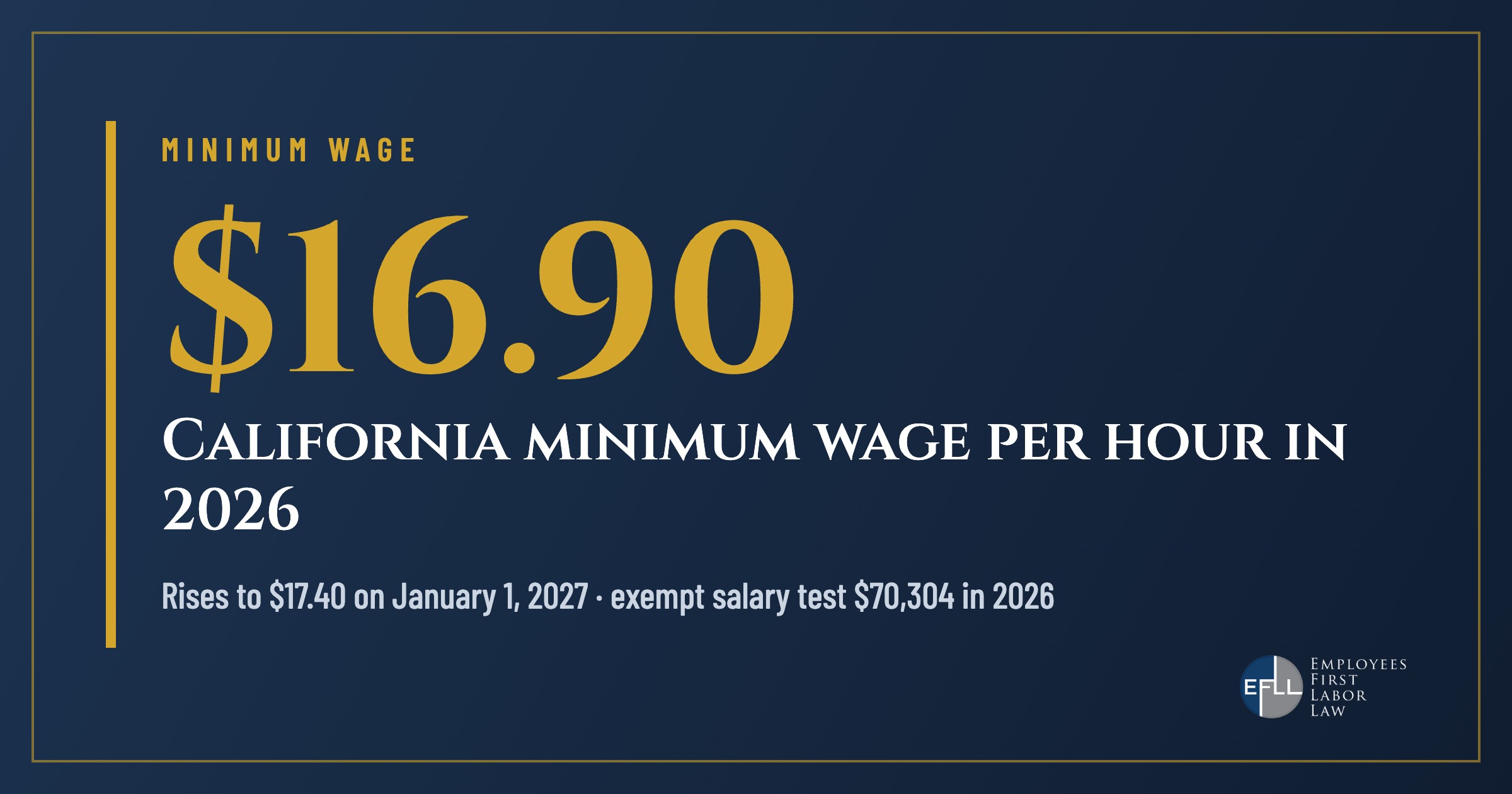
Order 11 follows the standard California overtime and break structure, but it has two broadcasting-specific features: a small-market overtime exemption for announcers, news editors and chief engineers, and a Labor Code rule that lets qualifying union contracts replace the meal period requirements. DIR republished Order 11 for 2026 with the current $16.90 state minimum wage, which rises to $17.40 on January 1, 2027.
This guide explains who Order 11 covers, its exemptions, overtime, meal and rest breaks, reporting time and on-call work, uniforms and equipment, records, and what to do if you were underpaid.
- Wage Order 11 covers radio and TV businesses that broadcast, or tape and broadcast, programs, and generally every non-exempt employee they hire.
- Announcers, news editors and chief engineers at stations in towns of 25,000 or fewer people are outside the order’s overtime section; other jobs are not.
- A union contract that provides meal periods and a monetary remedy replaces the standard meal rules under Labor Code §512(d); rest break rules still apply.
- A creative or producer title doesn’t make you exempt; you must meet the duties test and earn at least $70,304 in 2026.
- The 2026 Order 11 shows the $16.90 minimum wage, which rises to $17.40 on January 1, 2027.
Who Wage Order 11 covers
Order 11 defines the broadcasting industry as any business “operated for the purpose of broadcasting or taping and broadcasting programs through the medium of radio or television” (Order 11, §2(B); Cal. Code Regs., tit. 8, §11110). It also defines a “location” as any place other than the studio where the employer broadcasts or tapes all or part of a program (§2(I)), which matters for field crews.
Broadcasting, motion picture or something else?
Coverage follows your employer’s main business, not your job. The Labor Commissioner’s “Which IWC Order?” guide draws these lines:
- If a company both tapes and broadcasts, as with a TV news show, the taping is under Order 11.
- If a broadcaster contracts with another firm to produce a videotape, the production company’s work is under Wage Order 12 (motion picture).
- Producing video for purposes other than broadcasting usually falls under Order 12.
- Most cable TV companies are primarily in the communications service business and fall under Wage Order 4.
Because the order follows the employer, a receptionist or IT technician at a TV station is generally under Order 11 just like the news crew.
Exemptions from Order 11
Executive, administrative and professional employees. The hours, overtime and break sections (§§3–12) don’t apply to employees who mainly perform exempt duties, regularly exercise discretion and independent judgment, and earn at least twice the state minimum wage for full-time work: $70,304 a year in 2026 and $72,384 in 2027. The professional exemption includes work that is “original and creative in character in a recognized field of artistic endeavor,” but only when the result depends primarily on the employee’s invention, imagination or talent. Producers, writers and on-air staff with “creative” titles are not automatically exempt; see misclassified exempt employees.
Computer professionals. Certain highly skilled software employees paid by the hour can be exempt if paid at least $58.85 an hour (the rate in the 2026 Order 11), but not trainees, employees who operate computers or repair hardware, or employees who aren’t working independently.
Other exclusions. Professional actors are covered only by §§1, 2, 4, 10 and 20 (minimum wage, meals and lodging, and penalties) (§1(C)). Government employees get the same limited coverage. Outside salespersons and the employer’s parent, spouse or child are excluded.
Overtime, including the small-market exemption
Order 11’s overtime rule tracks Labor Code §510: time and a half after 8 hours in a workday or 40 in a workweek and for the first 8 hours on the seventh consecutive day; double time after 12 hours in a day and after 8 hours on the seventh day. A salaried non-exempt employee’s regular rate is one-fortieth of the weekly salary.
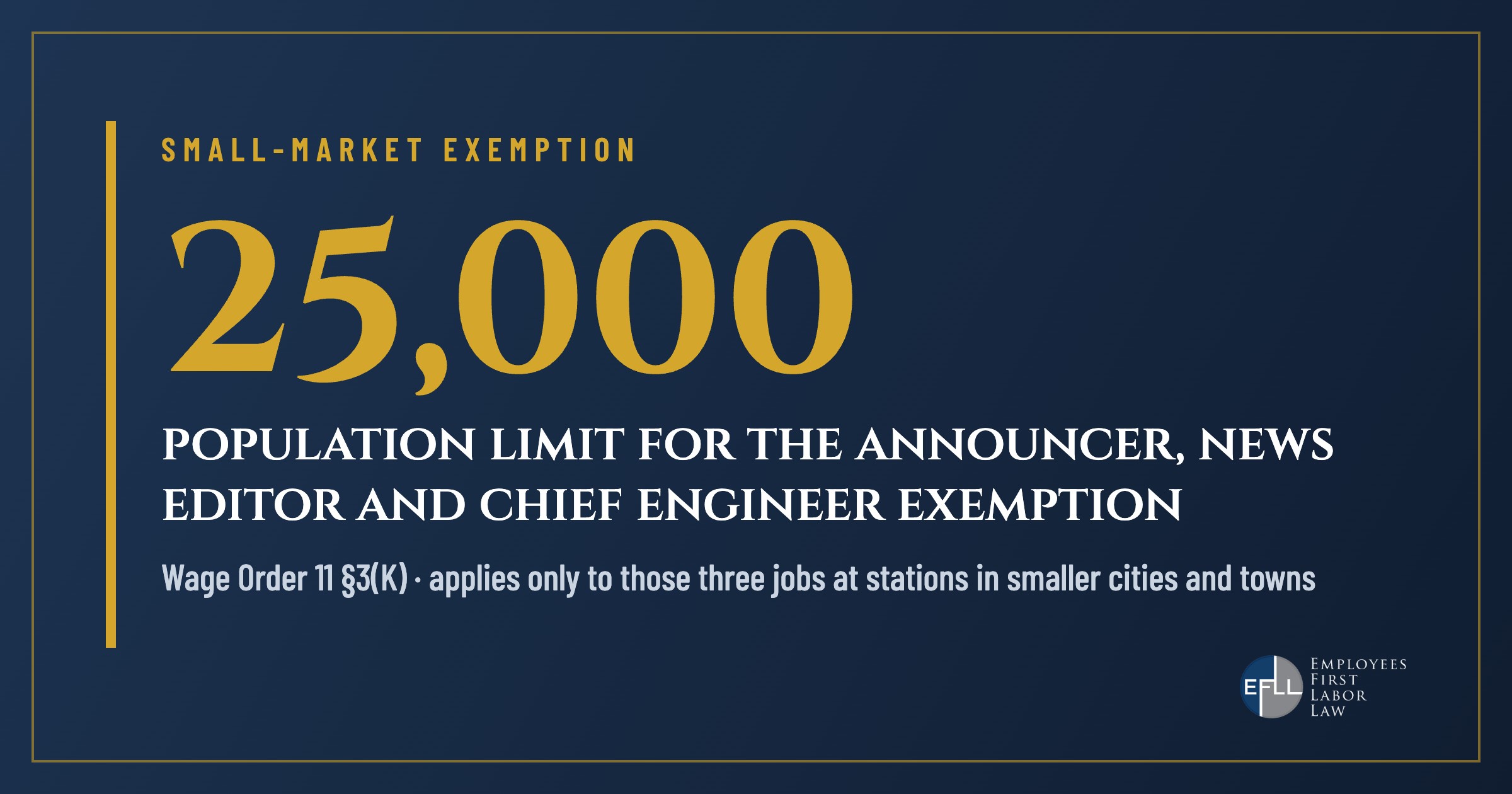
- Small-market exemption (§3(K)). The hours and overtime section does not apply to anyone employed as an announcer, news editor or chief engineer by a radio or TV station in a city or town with a population of 25,000 or less. It doesn’t cover other jobs at those stations, or those jobs at stations in larger cities.
- Alternative workweeks (§3(B)). A schedule of up to 10 hours a day in a 40-hour week requires a two-thirds secret-ballot election and must give at least two consecutive days off each week. See alternative workweeks and 12-hour shifts.
- Union contracts (§3(H); Labor Code §514). The hours section doesn’t apply to employees under a collective bargaining agreement that provides premium overtime pay and a regular rate at least 30% above the state minimum wage (one day’s rest in seven still applies unless the contract says otherwise).
- Make-up time (§3(J)). With a signed written request, you can make up time lost to a personal obligation in the same workweek without daily overtime, up to 11 hours a day and 40 a week. Your employer can’t encourage or solicit these requests.
💡 Example: Jordan, a non-union production assistant at a Los Angeles TV station, earns $25 an hour. On election night he works 10 hours, gets his rest breaks, but is never relieved for a meal. He is owed 8 hours × $25 = $200, plus 2 overtime hours × $37.50 = $75, plus a one-hour meal premium of $25, for $300 that day. (Hypothetical.)
We can review your hours, pay stubs and any union contract and tell you what Wage Order 11 requires. Free, confidential consultation.
Meal and rest breaks in broadcasting
- Meal periods (§11; Labor Code §512): 30 minutes when you work more than 5 hours, and a second 30 minutes when you work more than 10, with the usual limited mutual-consent waivers. An on-duty meal is allowed only when the work prevents relief from all duty and you’ve agreed in writing, with a written right to revoke.
- Rest periods (§12): 10 minutes of paid rest per 4 hours worked or major fraction thereof, not required if total daily work time is under 3½ hours.
- Premiums: one hour of pay at your regular rate for each workday a required meal period isn’t provided, and one for each workday a rest period isn’t provided (Labor Code §226.7). See meal and rest break premiums.
The union-contract meal rule. Labor Code §512(d) provides that if an employee in the broadcasting or motion picture industry is covered by a valid collective bargaining agreement that provides for meal periods and includes a monetary remedy for missed meal periods, the agreement’s meal period terms and remedies apply instead of §512(a), §226.7 and the meal provisions of Orders 11 and 12. Non-union employees, and union employees whose contract lacks those features, keep the standard rules. Rest periods are not affected by §512(d).
If a meal period falls on a shift that begins or ends between 10 p.m. and 6 a.m., the employer must make hot food and drink (or a way to heat food) available, plus a sheltered place to eat (§3(F)), a rule that matters for overnight and morning-show crews.
Reporting time, standby and split shifts
If you’re required to report and are given no work or less than half your usual or scheduled day, Order 11 requires pay for half the scheduled day, at least 2 and no more than 4 hours, at your regular rate. A second call-in the same day with less than 2 hours of work earns 2 hours’ pay (§5). The rule doesn’t apply to an employee on paid standby who is called in outside their scheduled reporting time (§5(D)). Exceptions also exist for threats to people or property, utility failures and causes outside the employer’s control.
Whether on-call time itself is compensable depends on how restricted you are while waiting; under the order’s definition, time during which you are “subject to the control of an employer” counts as hours worked. A split shift earns one extra hour’s pay at the minimum wage (§4(C)). Our guide to split-shift and reporting time pay has more.
Uniforms, equipment, meals and lodging
Uniforms and tools (§9). Required uniforms, meaning apparel and accessories of distinctive design or color, must be provided and maintained by the employer. Required tools and equipment must be provided too, except that employees earning at least twice the minimum wage can be required to supply hand tools customarily required by their trade. No deductions for normal wear and tear. Personal phones, vehicles and other equipment you’re required to use may be reimbursable under Labor Code §2802; see expense reimbursement.
Meals and lodging (§10). These can count toward minimum wage only under a voluntary written agreement, up to the 2026 maximums printed in the republished order:
| Credit (2026, all employers) | Maximum |
|---|---|
| Room occupied alone / shared | $79.46 / $65.59 per week |
| Apartment | Two-thirds of ordinary rental value, up to $954.43 per month |
| Apartment, couple both employed | Two-thirds of ordinary rental value, up to $1,411.85 per month |
| Breakfast / Lunch / Dinner | $6.10 / $8.42 / $11.28 |
Seats, records and the bigger picture
Employees must have suitable seats when the nature of the work reasonably permits (§14). Employers must record each work period’s start and end, meal periods, split-shift intervals and daily totals, keep records at least three years, and provide clocks in major work areas (§7). Deductions for cash shortages, breakage or lost equipment are barred unless caused by dishonesty, a willful act or gross negligence (§8).
The Industrial Welfare Commission was defunded in 2004, but its orders remain in effect, and DIR updates the minimum wage and credits each year (Labor Code §1182.13). The 2026 Order 11 shows $16.90; from January 1, 2027, use $17.40 (and $72,384 for the exempt salary test), or a higher local rate (see minimum wage by city). Where the Labor Code gives workers more, such as paid sick leave or final pay deadlines, the Labor Code controls.
What to do if your employer isn’t following Order 11
- Check whether you’re truly exempt. A creative or “producer” title isn’t enough.
- Find out whether a union contract covers you and whether it provides meal periods with a monetary remedy.
- Track your hours, including standby, call-ins and live-event days, and missed meal and rest breaks.
- Estimate what you’re owed with our wage and hour calculator.
- Act within three years for most wage claims (Code of Civil Procedure §338), and compare a Labor Commissioner claim vs. a lawsuit.
Frequently asked questions
What is California Wage Order 11?
It’s the Industrial Welfare Commission order that governs wages, hours and working conditions in the broadcasting industry: radio and television businesses that broadcast, or tape and broadcast, programs.
Are TV news producers exempt from overtime?
Not automatically. They must meet the duties test for an exemption and earn at least $70,304 a year in 2026. Many producers who mainly gather, write or package routine content may not qualify.
Does the small-market exemption apply to everyone at a small station?
No. It covers only announcers, news editors and chief engineers at stations in cities or towns of 25,000 or fewer people.
My union contract has its own meal rules. Do I still get meal premiums?
If the contract provides meal periods and a monetary remedy for missed ones, Labor Code §512(d) says its terms apply instead of the standard meal rules and premium. Rest break rules still apply.
Related guides
 Workers only. Never employers.
At Employees First Labor Law, we represent California workers only, never employers. Our team has recovered more than $200 million for our clients, and we prepare every case as if it is going to trial. We have offices in Pasadena, Irvine, Long Beach, Pomona, Riverside, Bakersfield and Fresno, and we serve workers throughout California. Meet our team.







We represent radio and television workers across California, from production assistants to engineers, in unpaid overtime, missed-break and misclassification claims. Call for a free case review.
- ✅ Free, confidential consultation
- ✅ We represent workers only, never employers
- ✅ Se habla español: Empleados Primero
This article provides general information about California law and is not legal advice for any specific situation. Reading it does not create an attorney-client relationship. Past results do not guarantee a similar outcome.