
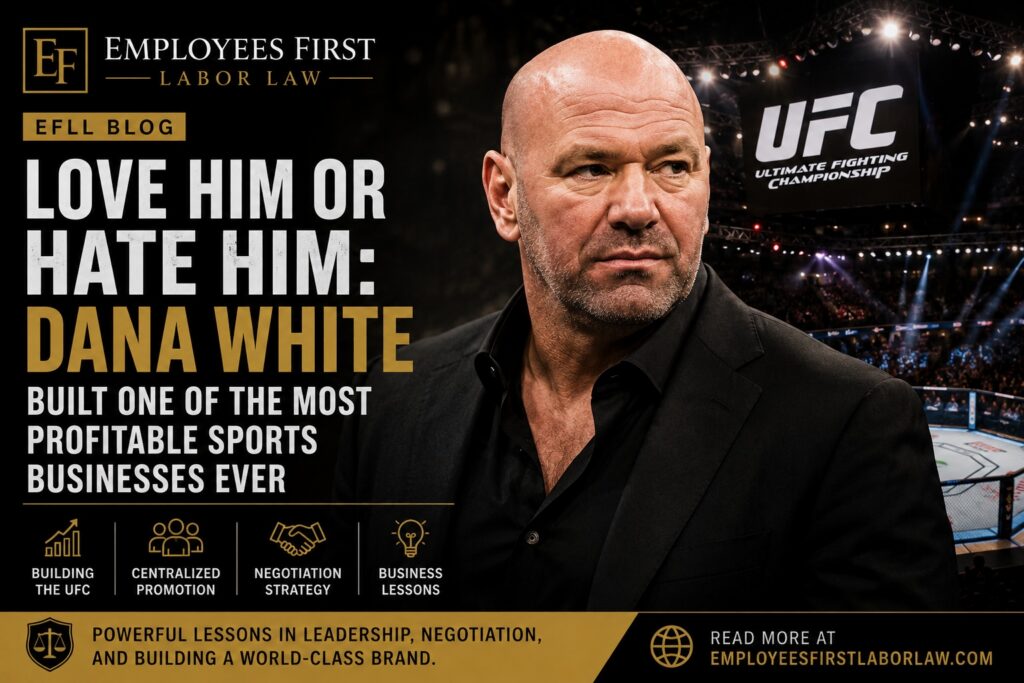
There are few executives in sports more polarizing than Dana White.
To some, he is the driving force behind the UFC’s transformation from a struggling promotion into a global sports powerhouse. To others, he is a tough negotiator who has consistently resisted calls for higher fighter compensation.
Regardless of where you stand, one fact is difficult to dispute:
Dana White helped build one of the most successful sports businesses in the world.
At Employees First Labor Law, we spend our days advocating for workers and employees. While we may not always agree with every business decision made by employers, we also recognize that there are valuable lessons entrepreneurs and business leaders can learn from extraordinary success stories. Dana White’s leadership of the UFC is one of them.
Taking a Company Few Believed In
When Dana White partnered with Lorenzo and Frank Fertitta to acquire the UFC in 2001, the organization was far from the global phenomenon it is today.
The UFC faced significant regulatory challenges, limited television exposure, and financial losses. Many believed mixed martial arts would never become a mainstream sport.
Instead of accepting that narrative, White focused relentlessly on growing the brand.
Through strategic partnerships, relentless promotion, and a willingness to take calculated risks, the UFC evolved into one of the premier sports organizations in the world, hosting events across multiple continents and producing some of the biggest pay-per-view events in combat sports history.
The Power of a Centralized Brand
One of the UFC’s greatest business strengths has been its ability to make the promotion itself the attraction.
Unlike boxing, where multiple promoters often compete for talent and events, the UFC built a centralized platform where fans follow the organization as much as they follow individual fighters.
That creates consistency.
Fans know what to expect, broadcasters know what they’re buying, and sponsors know where their audience is.
From a business perspective, that’s an incredibly valuable model.
Negotiation Is a Competitive Advantage
Dana White has developed a reputation as one of the toughest negotiators in professional sports.
Whether negotiating television rights, sponsorship agreements, venue contracts, or fighter compensation, the UFC has historically maintained significant leverage because of the strength of its brand and its position as the sport’s premier promotion.
Every business owner can learn an important lesson from this:
Negotiating leverage is created long before you ever sit down at the table.
Companies build leverage by creating products or services that customers cannot easily replace. Professionals build leverage by becoming indispensable in their industries.
The strongest negotiators usually have the strongest alternatives.
Consistency Builds Trust
For more than two decades, the UFC has consistently delivered major events.
Fans know there will be championship fights.
Broadcasters know there will be content.
Sponsors know millions of viewers will tune in.
That consistency creates confidence, and confidence creates enterprise value.
Businesses of every size can benefit from the same principle.
A great reputation isn’t built through one successful project. It’s built through years of delivering quality work.
The Importance of Strong Leadership
Running a global sports organization requires making difficult decisions every day.
Whether those decisions involve scheduling, media rights, athlete relations, or responding to criticism, leadership requires the willingness to make decisions that won’t satisfy everyone.
Successful leaders are rarely universally popular.
What matters is whether the organization continues to execute its long-term vision.
The UFC’s sustained growth suggests that White has remained focused on that objective.
A Different Perspective on Fighter Pay
None of this means the debate over fighter compensation isn’t legitimate.
Many athletes and observers believe UFC fighters should receive a larger share of the organization’s revenues, and that conversation continues today.
Recognizing Dana White’s business accomplishments does not require agreeing with every aspect of the UFC’s compensation structure.
Both ideas can be true:
- Dana White helped build an extraordinary business.
- Fighter pay will likely remain one of the sport’s biggest issues.
Lessons Every Entrepreneur Can Take Away
Whether you run a law firm, a startup, or a Fortune 500 company, several lessons stand out from the UFC’s success:
- Build a brand people trust.
- Be consistent over decades, not months.
- Create negotiating leverage before negotiations begin.
- Invest in long-term relationships with customers.
- Don’t be afraid to make difficult decisions.
- Focus relentlessly on delivering value.
Final Thoughts
At Employees First Labor Law, we fight every day to ensure employees receive fair treatment and fair compensation.
At the same time, we also appreciate exceptional entrepreneurship and leadership.
Dana White’s story demonstrates what relentless execution, disciplined branding, and long-term vision can accomplish.
Whether you admire his leadership style or disagree with some of his business decisions, the results speak for themselves.
The UFC didn’t become one of the world’s most valuable sports properties by accident—it was built through years of strategic decisions, calculated risks, and unwavering commitment to growing the brand.
For entrepreneurs, executives, and business owners, there is a great deal to learn from that journey.
Related Posts:
Get Help From EMPLOYEES FIRST LABOR LAW